Land Stack Portal and Revenue Glossary: Digital Land Governance Explained
The launch of Land Stack and a Glossary of Revenue Terms in January 2026 placed land-record modernisation back in the news. The initiative aims to standardise land-governance vocabulary and improve access to digital land information.
For UPSC, land records are not a dry administrative topic. They shape credit access, property disputes, urbanisation, welfare targeting, women’s property rights, infrastructure acquisition and rural economic security.
This article explains Land Stack as a digital-governance issue and links it with DILRMP, ULPIN, SVAMITVA and the unfinished agenda of land reform.
Quick Facts
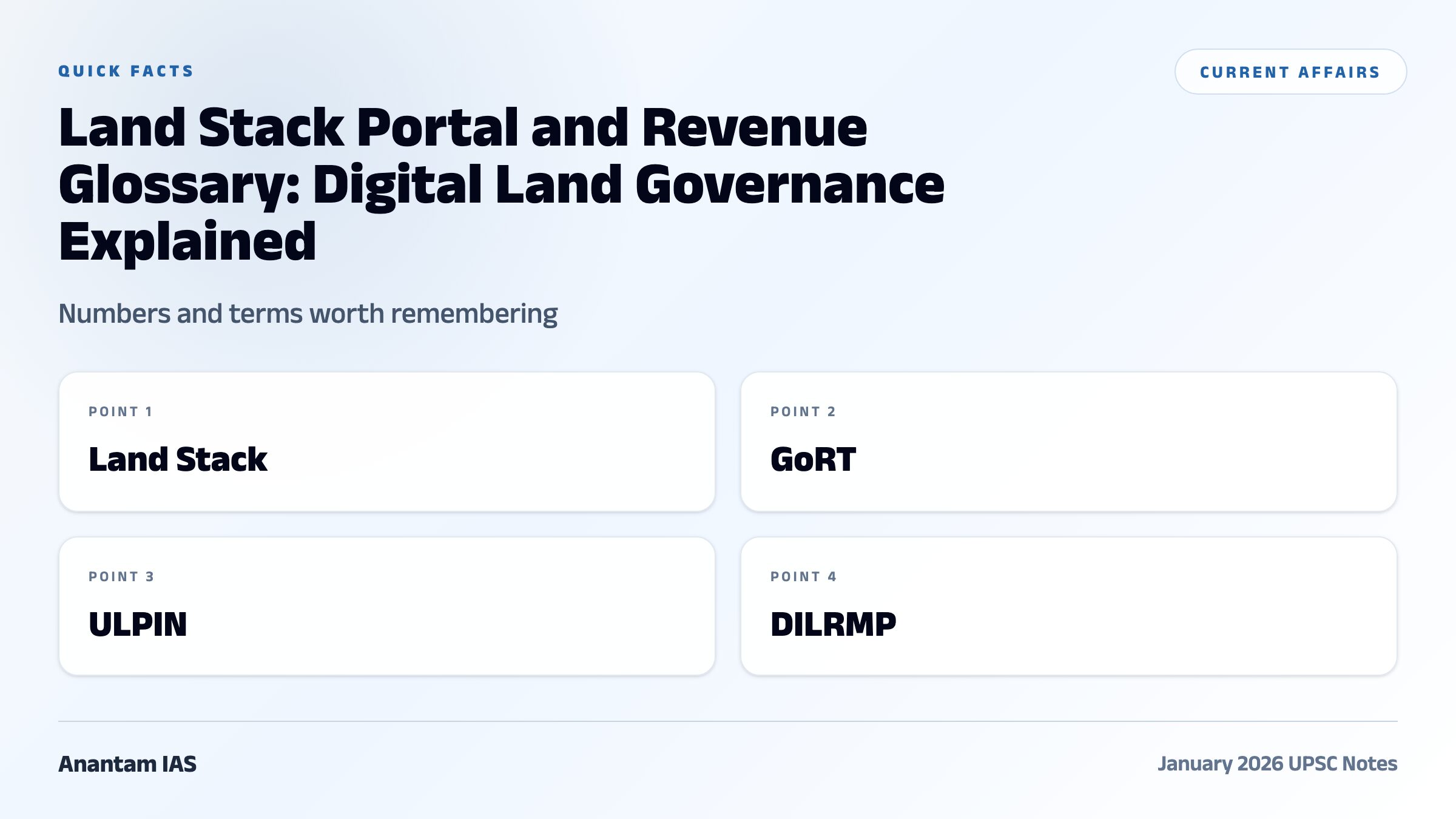
- Land Stack was launched with a Glossary of Revenue Terms.
- The initiative is linked to the Department of Land Resources.
- It supports standardisation in a field where state-level terminology varies widely.
- It connects with DILRMP, ULPIN, cadastral maps and land-record digitisation.
- Land is a State List subject, which makes harmonisation a federal challenge.
- Official source: PIB Press Note dated 2 January 2026.
- Official source: PIB, Ministry of Rural Development.
What Just Happened
The government launched Land Stack and the Glossary of Revenue Terms to improve standardisation and accessibility in land governance.
The move responds to a long-standing problem: land records in India are fragmented across departments, languages, formats, maps and legal histories.
For aspirants, the topic is a strong example of how Digital India reforms are limited by federalism, legacy records and local administrative capacity.
Background and Historical Context
India’s land-record system has colonial roots. Records of rights, cadastral maps, mutation registers and registration databases often evolved separately.
The Digital India Land Records Modernization Programme seeks to digitise records, maps, registration and mutation processes. ULPIN aims to create a unique land parcel identifier.
SVAMITVA uses drone mapping to provide property cards in rural inhabited areas. Together, these programs try to convert land from a disputed social asset into a clearer economic asset.
Key Features of Land Governance
The core policy architecture can be read through these features.
- Terminology standardisation: a common glossary can reduce confusion across states and departments.
- Digital access: Land Stack can improve discoverability of land-governance resources.
- Federal coordination: states remain central because land administration is state-led.
- ULPIN link: unique parcel identification can improve transactions and service delivery.
- Dispute reduction: better records can lower litigation and fraud.
- Credit link: clear titles can improve mortgage and institutional credit access.
Why It Matters
This is a high-yield UPSC topic because it joins current news with durable syllabus themes.
- It connects a January 2026 event with durable UPSC syllabus themes.
- It gives usable facts for Prelims and analytical hooks for Mains.
- It helps students move from news recall to policy reasoning.
- It can be linked with static concepts in polity, economy, governance, science, environment or society.
Detailed Analysis: Land Governance Lens
Land is data plus law plus local power. Digitising a wrong record can make injustice more efficient. Verification and grievance redress are as important as portals.
Standardisation is a quiet reform. A glossary may look small, but inconsistent terminology often blocks interoperability across states and departments.
Gender and tenancy cannot be ignored. Digital records can improve women’s property claims only if inheritance, mutation and social barriers are addressed.
Comparative Perspective
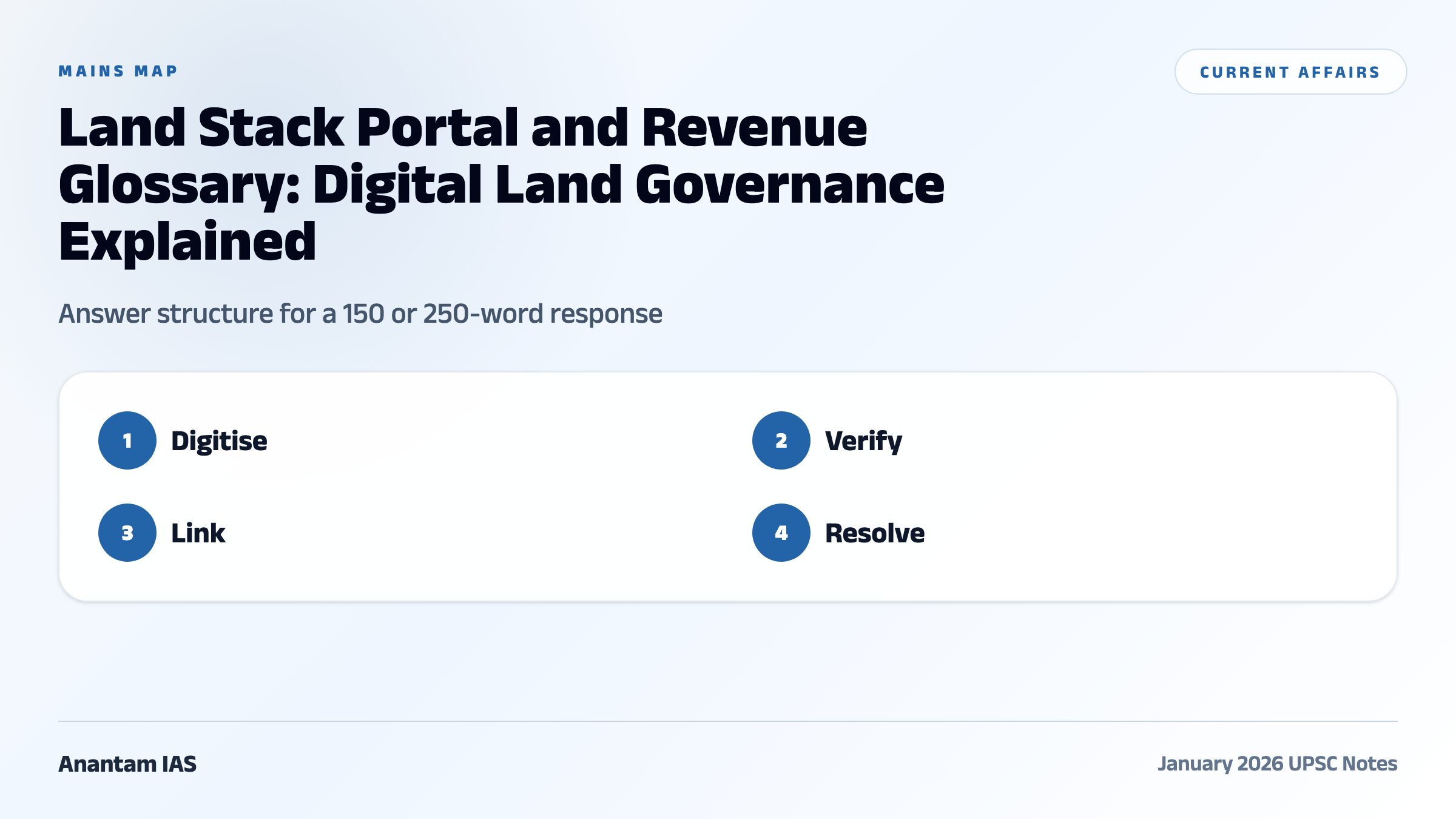
A comparison helps prevent the answer from becoming a one-dimensional news summary.
- DILRMP: digitises and modernises land records and registration systems.
- SVAMITVA: maps rural inhabited property and issues property cards.
- ULPIN: creates a unique land parcel identifier.
- Land Stack: works as a knowledge and interoperability layer for land governance.
Challenges
The policy or institutional promise runs into recurring constraints.
- Legacy records may be inaccurate or contested.
- Mutation delays can make records outdated.
- Land is a state subject, so implementation varies widely.
- Digital exclusion can hurt vulnerable landholders.
- Clear records do not automatically solve tenancy and women’s ownership gaps.
Prelims Pointers
- Land is largely a State List subject.
- DILRMP stands for Digital India Land Records Modernization Programme.
- ULPIN means Unique Land Parcel Identification Number.
- SVAMITVA uses drone surveying for rural property cards.
- Records of Rights are important land-record documents.
- Cadastral maps show land parcel boundaries.
Mains Questions
- Land-record digitisation can reduce disputes only when legal verification and grievance redress accompany technology. Discuss. (GS Paper II, 250 words)
- Explain the significance of ULPIN and SVAMITVA in rural economic development. (GS Paper III, 150 words)
- Why is land governance a federal challenge in India? (GS Paper II, 250 words)
- Digital land records can improve credit access but may also reproduce old exclusions. Analyse. (GS Paper III, 250 words)
Way Forward
Land Stack should be linked with state-level record correction drives, legal-aid support, gender-sensitive mutation processes and public grievance systems.
Interoperability must not be confused with centralisation. States need flexibility, but core definitions, parcel IDs and metadata standards should converge.
A strong UPSC answer should mention that technology clarifies records; it does not by itself settle ownership justice.
The examiner is unlikely to reward a bare fact dump here. The better answer connects the January 2026 event to institutional design, implementation capacity and India’s long-term development priorities.
Frequently Asked Questions
What is Land Stack?
It is a digital land-governance initiative linked to better access, standardisation and interoperability of land-record information.
What is ULPIN?
ULPIN is a Unique Land Parcel Identification Number for land parcels.
Why is land governance difficult in India?
Records are fragmented, land is state-administered, ownership is often contested and local power relations matter.
What is DILRMP?
It is the Digital India Land Records Modernization Programme.
How does SVAMITVA relate to land records?
It uses drone mapping to provide property cards in rural inhabited areas.
What is the UPSC relevance?
Federalism, e-governance, land reforms, rural credit, property rights and dispute reduction.