Logistics Ease Across Different States (LEADS) 2024 report unveiled
Why in News?
The Government released the sixth edition of LEADS, introducing Sustainable Logistics as a fourth pillar and expanding objective indicators to measure state logistics performance. It also launched complementary initiatives including LEAPS awards, a PM GatiShakti course, and a Logistics Cost Framework report.
- LEADS 2024 launch by the Union Commerce Minister signals renewed focus on state-level logistics reforms and competitive federalism in logistics.
- New pillar: Sustainable Logistics added to the assessment, aligning logistics policy with climate and green transition objectives.
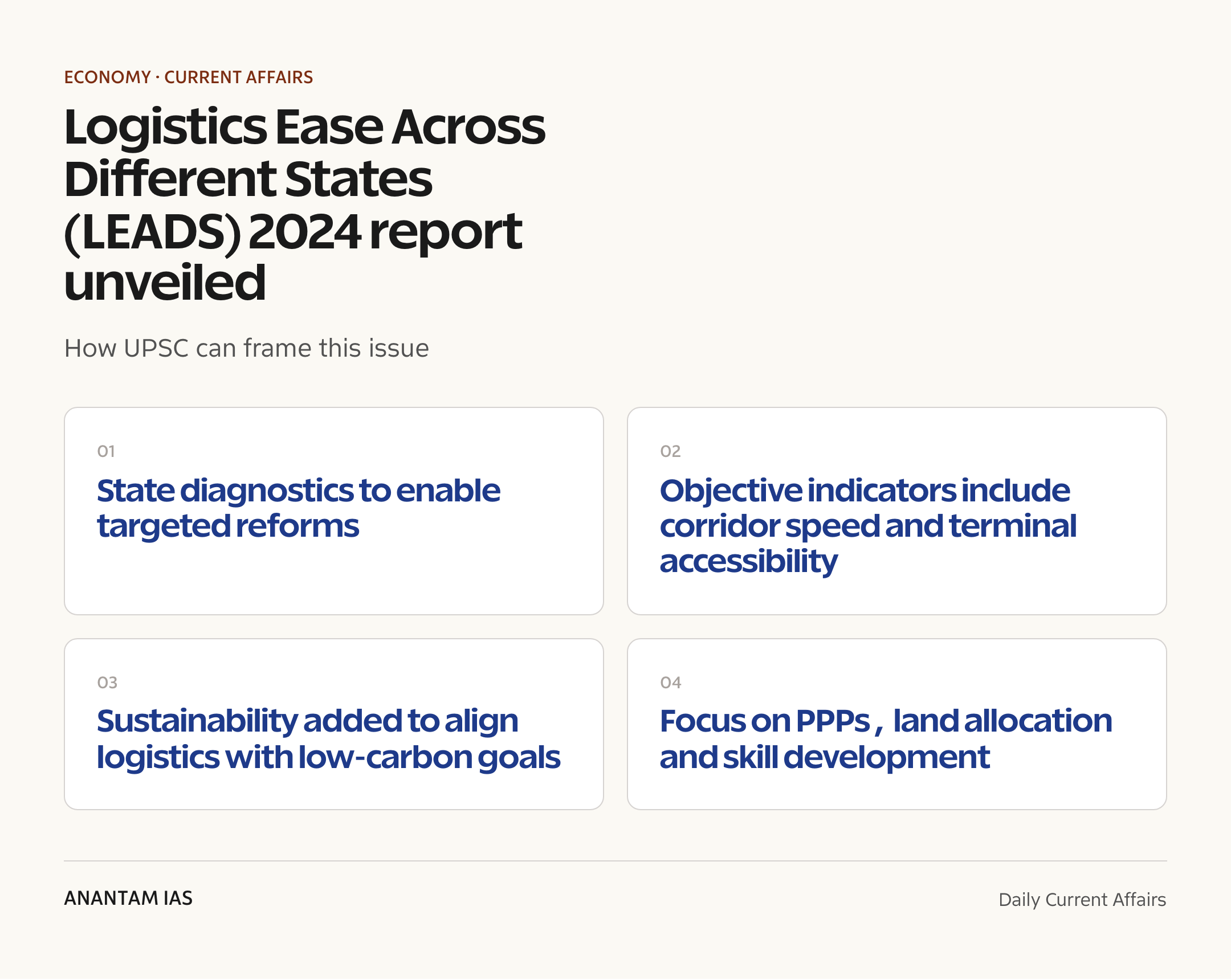
- Objective indicators expanded to include terminal accessibility and corridor speeds, improving measurement accuracy for policy action.
- Complementary initiatives launched: LEAPS awards, PM GatiShakti course for administrators, and an NCAER Logistics Cost Framework.
The development matters in the context of:
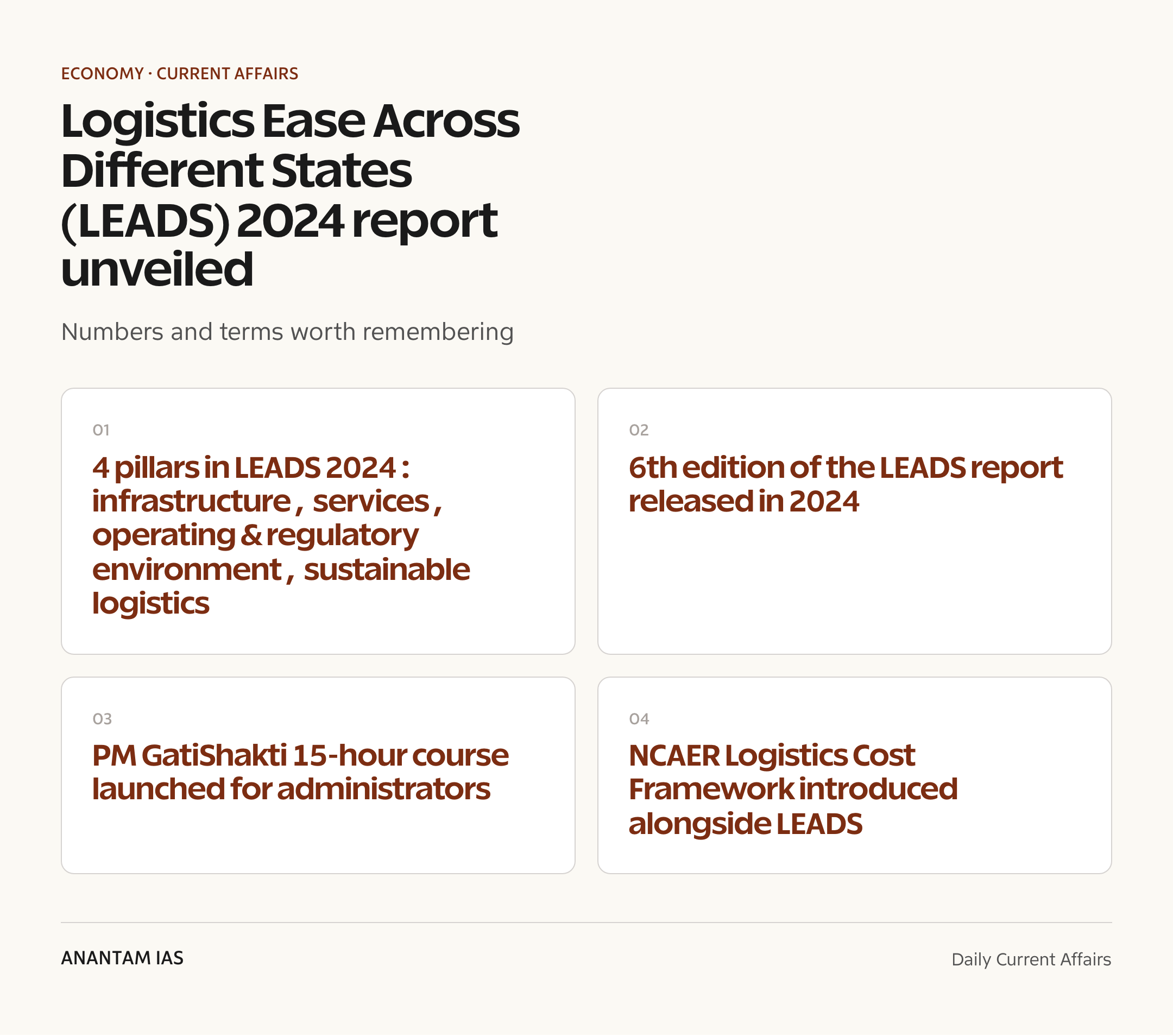
- What is LEADS: A periodic state/UT ranking and diagnostic tool prepared by DPIIT to evaluate logistics ecosystem across states and suggest reforms.
- Scope: State-level assessment covering infrastructure, services, operating/regulatory environment and now sustainability.
- Why state focus: Logistics is multi-jurisdictional; state policies on land, terminals, last-mile connectivity and services shape costs and efficiency.
- Link to PM GatiShakti: LEADS supports GatiShakti goals by providing data-driven inputs for integrated planning of infrastructure and multimodal connectivity.
- Private sector role: Report emphasizes public-private partnerships and land allocation for multimodal hubs through transparent bidding.
- National objective: Lower logistics cost and faster movement are essential for export competitiveness, inflation control and achieving a $32 trillion economy by 2047.
UPSC Relevance
Prelims Relevance
- Tests factual recall on what LEADS measures, the four pillars (including new Sustainable Logistics), and institutional initiatives launched alongside the report such as PM GatiShakti course and Logistics Cost Framework.
Mains Relevance
GS3 Economy
- Useful for answers on supply-chain infrastructure, state role in economic reforms, transport and logistics policy, sustainable logistics transition, and federal-state coordination for economic competitiveness.
Essay
- Material for essays on ‘Infrastructure and Economic Growth’, ‘India and the Global Supply Chain’, ‘Sustainable Development and Industrial Policy’, and ‘Cooperative Federalism for Economic Reform’.
Background and Context
Evolution and purpose of LEADS
How LEADS started and what it seeks to achieve at state level.
- Origin: LEADS is a DPIIT initiative to rank and diagnose logistics performance of States/UTs, launched to promote reforms and competitive federalism.
- Periodic editions: Sixth edition in 2024; each cycle refines methodology to increase objectivity and policy relevance.
- Policy objective: Encourage states to adopt reforms that reduce logistics cost, boost efficiency and attract investments.
- Stakeholder reach: Targets state governments, transport agencies, private logistics firms and investors for coordinated action.
- Outcome orientation: Goes beyond ranking to propose state-specific opportunities and action points for reform.
Four pillars of assessment
LEADS 2024 evaluates performance across four structured domains for comparability.
- Logistics Infrastructure: Road, rail, ports, airports, ICDs/ICDs and terminal density used to assess physical readiness.
- Logistics Services: Availability, quality and competitiveness of freight forwarders, warehousing and transport services.
- Operating and Regulatory Environment: Ease of permits, enforcement, land access, inter-agency coordination and policy clarity at state level.
- Sustainable Logistics (new): Emissions, green transport uptake, modal shift potential and policies to support low-carbon logistics.
- Composite scoring: Combines objective indicators and perception metrics to produce state-level rankings and gap analysis.
Why add Sustainable Logistics
Rationale for integrating sustainability into logistics assessment.
- Climate alignment: Logistics accounts for a growing share of emissions; sustainability pillar aligns logistics with national climate commitments.
- Risk resilience: Green logistics includes energy efficiency and modal shift which reduce vulnerability to fuel price shocks.
- Market demand: Buyers and exporters increasingly prefer low-carbon supply chains; states that act early gain competitiveness.
- Policy leverage: Encourages states to pilot electric vehicle infrastructure, biofuels, modal integration and energy-efficient terminals.
Methodology refinements in 2024
What changed in the sixth edition to improve measurement and comparability.
- More objective indicators: Added measures such as terminal accessibility and corridor speed to reduce subjective bias.
- Data sources: Combination of administrative data, satellite-based corridor speed measures and survey inputs for service quality.
- State-specific diagnostics: The report identifies targeted opportunities rather than uniform prescriptions.
- Integration with cost framework: Links findings to the NCAER Logistics Cost Framework for a monetary view of inefficiencies.
Complementary initiatives launched
Other measures announced alongside LEADS 2024 to build capacity and recognise excellence.
- LEAPS awards: Recognise exemplary performance by states, MSMEs, startups and institutions in logistics innovation and operations.
- PM GatiShakti course: A 15-hour course on integrated infrastructure planning to be hosted on iGOT Karmayogi and UGC SWAYAM to train administrators.
- Logistics Cost Framework report: NCAER-led hybrid methodology to estimate logistics costs across EXIM and domestic cargo.
- PPP and land allocation guidance: Encouragement for states to use transparent bidding to allocate land for multimodal hubs.
Key messages from Minister and DPIIT
What policymakers emphasised at the launch event.
- State action plans: States and private sector urged to prepare regional and city-level logistics plans for last-mile connectivity.
- Technology adoption: Push for AI, machine learning and data analytics to improve efficiency and planning.
- Skill and gender focus: Emphasis on workforce upskilling and greater participation of women in logistics.
- Transparency and efficiency: Use of bidding for land allocation and PPPs to lower costs and attract investment.
Way Forward
State-level action planning
- Create regional logistics masterplans that prioritise last-mile connectivity, multimodal hubs and warehousing near demand centres.
- Set measurable targets for corridor speeds, terminal accessibility and modal share shifts with timelines and monitoring.
- Use LEADS diagnostics to prioritise high-impact reforms based on state-specific bottlenecks rather than uniform templates.
Financing and PPP models
- Design transparent land allotment for logistics parks using competitive bidding and clear service-level agreements.
- Promote viability gap funding and blended finance for multimodal terminals and green infrastructure where commercial returns are slow.
- Encourage service contracts that align operator incentives with performance metrics such as dwell time reduction.
Technology and data
- Invest in digital corridor monitoring using GPS and traffic analytics to measure speeds and congestion in near real time.
- Adopt interoperable platforms for permitting, e-way bills and terminal access to reduce paperwork and dwell time.
- Leverage analytics for demand forecasting, route optimisation and greener modal choices.
Sustainability and workforce
- Pilot electric and low-emission fleets for last-mile delivery in urban clusters and link incentives to state LEADS performance.
- Upskill logistics workforce through the PM GatiShakti course and state training institutes with emphasis on digital and green skills.
- Promote gender-inclusive hiring and workplace safety measures to increase female participation in logistics.
Conclusion
LEADS 2024 deepens the policy toolkit for state-level logistics reform by adding sustainability metrics and more objective indicators. Actionable diagnostics, training initiatives and a logistics cost framework together provide a pathway to reduce logistics cost, accelerate multimodal integration and align the sector with low-carbon goals. Successful outcomes will depend on state implementation, PPP design, data-driven monitoring and upskilling of the logistics workforce.
UPSC Practice Questions
Prelims MCQ 1
Which of the following is a newly introduced pillar in the LEADS 2024 report?
(a) Logistics Technology (b) Sustainable Logistics (c) Cross-border Logistics (d) E-commerce Logistics
Answer: (b) Sustainable Logistics
Explanation:
LEADS 2024 added Sustainable Logistics as the fourth pillar alongside Logistics Infrastructure, Logistics Services, and Operating and Regulatory Environment.
Prelims MCQ 2
Which institution prepared the Logistics Cost Framework launched alongside LEADS 2024?
(a) NITI Aayog (b) NCAER (c) RITES (d) World Bank
Answer: (b) NCAER
Explanation:
The NCAER prepared the Logistics Cost Framework, using a hybrid methodology to estimate logistics costs across EXIM and domestic cargo.
UPSC Mains Questions
- {‘question’: ‘Examine how state-level reforms in logistics, guided by tools like LEADS, can contribute to reducing inflationary pressures in India. Discuss with examples.’, ‘model_answer’: ‘State-level logistics reforms reduce transactional costs, improve speed of movement and lower inventory holding costs, which can ease supply-side constraints and reduce price pressures. Improving corridor speeds and terminal accessibility cuts transit time and freight rates, lowering distribution costs that feed into consumer prices. For example, faster delivery of perishables through cold chain terminals can reduce food wastage and price volatility. Shifting freight from road to rail on key corridors can lower transport cost per tonne-kilometre, reducing input costs for industry. State reforms such as streamlined permits, better last-mile connectivity and investment in warehousing reduce lead times and buffer stock requirements. When combined with national measures like PM GatiShakti for integrated planning, these state actions can help stabilise supply chains and moderate inflation.’}
- {‘question’: ‘Critically analyse the inclusion of a Sustainable Logistics pillar in LEADS 2024. What challenges and opportunities does it create for states?’, ‘model_answer’: ‘Inclusion of Sustainable Logistics aligns logistics planning with climate objectives and market demand for low-carbon supply chains. Opportunities include access to green finance, competitive advantage for exporters, and long-term resilience to fuel shocks. States can pilot EV charging for freight, promote modal shift to rail and waterways, and incentivise energy-efficient terminals. Challenges include upfront capital costs, coordination across agencies, limited technical capacity and uneven readiness among states. Measuring emissions accurately and attributing reductions to policy actions are complex. To be effective, the pillar must be tied to financing mechanisms, capacity building and realistic transition pathways that account for regional industrial structure and modal mixes.’}
Source: PIB, Ministry of Commerce & Industry.
Frequently Asked Questions
q
a
q
a
q
a
q
a
q
a
q
a