Left-Wing Extremism on the Retreat: India’s Push for a Naxal-Free Nation
Why in News?
The Ministry of Home Affairs, through the Press Information Bureau, has released fresh 2026 data showing a sharp retreat of Left-Wing Extremism (LWE) — also called Naxalism — and reiterated the government’s target of a Naxal-free India. The figures span fortified police stations, road connectivity, mobile towers and a surge in surrenders, framed around a three-pillar strategy of security, infrastructure and welfare.
Union Home Minister Amit Shah told the Lok Sabha on 30 March 2026 that the count of LWE-affected districts had fallen from 126 in 2014 to just two, and the ‘most affected’ category from 35 to zero, marking the symbolic end of the Red Corridor that once ran across central and eastern India. The data underline a security-development model that other internal-security theatres are now being benchmarked against.
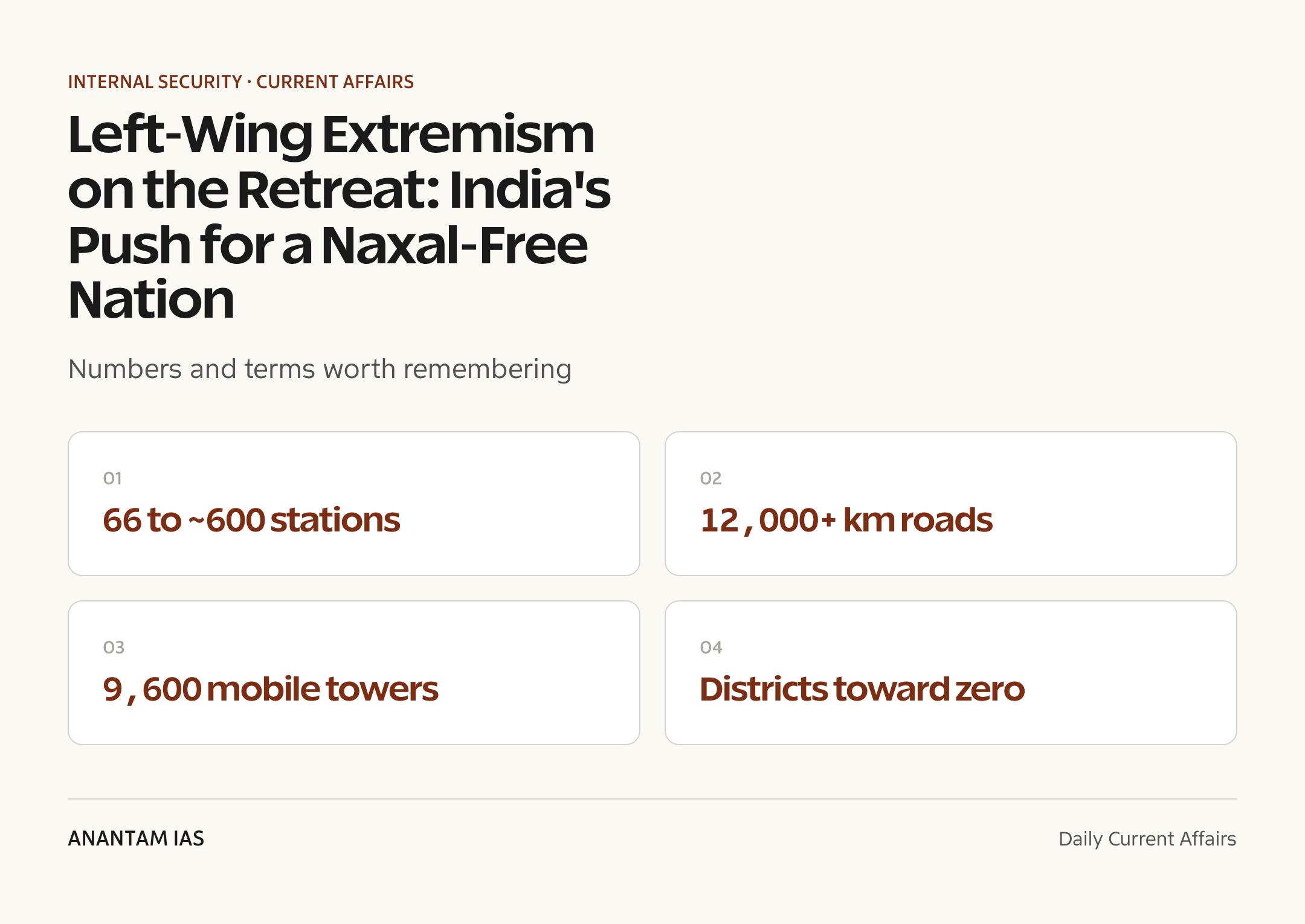
- Fortified police stations rose from 66 (pre-2014) to nearly 600 in LWE areas, per MHA data.
- Over 12,000 km of roads have been built in affected districts since 2014 to break geographic isolation.
- Around 9,600 mobile towers were added, extending 4G into forested interiors.
- Surrenders climbed steeply, with thousands of cadres surrendering between 2024 and March 2026.
- The number of LWE-affected districts declined from 126 in 2014 to two by March 2026, per the Home Minister’s Lok Sabha reply.
The development matters in the context of:
- Naxalism traces to the 1967 Naxalbari (West Bengal) peasant uprising; the dominant outfit today is the CPI (Maoist), banned under the UAPA.
- The MHA classifies LWE as the country’s gravest internal-security challenge in affected pockets, blending armed insurgency with ideological mobilisation in tribal, forested districts.
UPSC Relevance
Prelims Relevance
- SAMADHAN doctrine — the MHA’s umbrella anti-LWE strategy (Smart leadership, Aggressive strategy, Motivation and training, Actionable intelligence, Dashboard-based KPIs, Harnessing technology, Action plan for each theatre, No access to financing).
- National Policy and Action Plan, 2015 — the integrated security-and-development approach against LWE.
- Security Related Expenditure (SRE) Scheme — reimburses states for security operations, rehabilitation of surrendered cadres and community policing.
- Special Central Assistance (SCA) — funds public infrastructure and services in the most affected districts.
- Road Requirement Plan (RRP-I and RCPLWEA) — road connectivity schemes in LWE-affected districts.
- LWE Mobile Tower Project — phased installation of towers to plug telecom gaps.
- Aspirational Districts Programme overlaps heavily with LWE geographies for development indicators.
- CPI (Maoist) is a banned terrorist organisation under the Unlawful Activities (Prevention) Act.
Mains Relevance
GS Paper 3
- Linkages between development and the spread of extremism — the security-development nexus in LWE-affected tribal districts.
- Assessment of the MHA’s whole-of-government anti-LWE strategy: what worked, residual risks, and whether a ‘declared end’ is durable.
Essay
- Security without development is fragile; development without security is impossible.
- The state’s monopoly on legitimate force versus winning hearts and minds in marginalised regions.
Background and Context
What Left-Wing Extremism Is
A four-decade armed-ideological insurgency, not a law-and-order footnote.
- LWE / Naxalism seeks to overthrow the state through ‘protracted armed struggle’, drawing on Maoist doctrine.
- Roots lie in the 1967 Naxalbari uprising; the movement consolidated into the CPI (Maoist) in 2004.
- It concentrated in a contiguous Red Corridor across Chhattisgarh, Jharkhand, Odisha, Bihar, Telangana and neighbours.
- Grievances exploited include land alienation, forest-rights denial, displacement and thin state presence in tribal belts.
The Three-Pillar Strategy
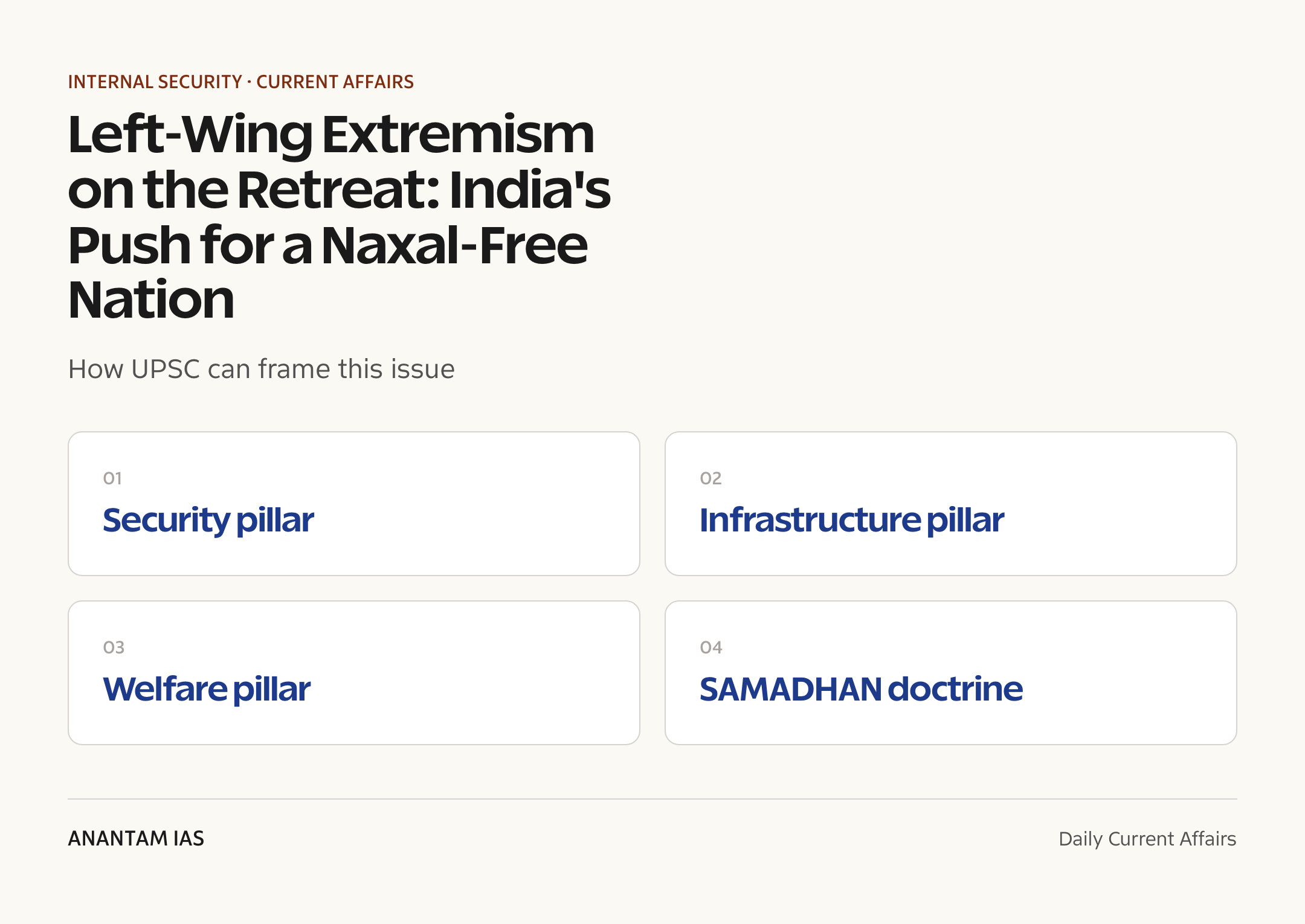
The MHA frames its approach as security, infrastructure and welfare working together.
- Security: clearing and holding territory through CAPF camps, fortified police stations and joint operations with state police.
- Infrastructure: roads, mobile towers, banks and post offices to end the physical isolation insurgents relied on.
- Welfare: rehabilitation of surrendered cadres, skilling and delivery of welfare schemes to rebuild trust in the state.
- The doctrine binding these is SAMADHAN, with dashboard-tracked targets for each affected theatre.
The Security Footprint
Hardened presence and dismantled leadership define the security gains.
- Fortified police stations grew from 66 before 2014 to roughly 600, per MHA figures.
- Hundreds of new CAPF camps were established to occupy formerly insurgent-held ground.
- Security forces report neutralising, arresting or accepting the surrender of thousands of cadres between 2024 and March 2026.
- MHA accounts note that the CPI (Maoist) top leadership — its Central Committee and Politburo — has been largely neutralised or has surrendered.
Development as a Weapon
Connectivity and services are treated as instruments of pacification.
- Over 12,000 km of roads built in LWE districts since 2014 opened previously sealed terrain.
- Around 9,600 mobile towers extended 4G coverage into forest interiors.
- Financial inclusion expanded through new bank branches, ATMs and post offices in affected blocks.
- SCA and the Aspirational Districts Programme targeted health, education and livelihoods where the state had been thinnest.
Surrender and Rehabilitation
An exit ramp paired with the military squeeze drove a surge in surrenders.
- State surrender-and-rehabilitation policies offer cash grants, monthly stipends and skilling to cadres who lay down arms.
- Surrenders rose sharply, with thousands recorded between 2024 and early 2026 according to MHA data.
- The SRE Scheme reimburses states for rehabilitation costs alongside security expenditure.
- Sustained surrenders erode an outfit’s recruitment base and local intelligence shield.
The Declining District Map
The shrinking list of affected districts is the headline metric of progress.
- The count of LWE-affected districts fell from 126 in 2014 to two by March 2026, with none left in the ‘most affected’ category.
- Categories such as ‘districts of concern’ and ‘most affected’ were progressively pruned as violence dropped.
- Annual violent incidents fell to a fraction of their 2010 peak, per government figures.
- Late-March 2026 saw the Home Minister declare the effective end of the affected-district list.
Way Forward
Consolidate, do not declare victory
- Treat the milestone as a transition, retaining intelligence grids and CAPF presence to prevent regrouping.
- Watch for displacement of cadres into urban fronts or neighbouring states rather than genuine collapse.
Lock in development gains
- Ensure roads, towers and welfare delivery are maintained and expanded so the state’s footprint endures.
- Implement the Forest Rights Act and PESA fully to resolve the grievances that fed the insurgency.
Make rehabilitation durable
- Provide sustained livelihoods and reintegration for surrendered cadres to prevent relapse.
- Protect tribal land and mineral-region communities from fresh alienation that could rekindle conflict.
Conclusion
The 2026 data mark one of independent India’s most striking internal-security turnarounds: a four-decade armed movement reduced from a Red Corridor spanning 126 districts in 2014 to just two on the MHA’s affected list by March 2026. The combination of a hardened security footprint, deliberate development of isolated terrain and a credible surrender pathway shows that the security-development nexus, when funded and tracked, can work.
The harder test is permanence. Insurgencies recede before they vanish, and the underlying grievances — land, forest rights and tribal marginalisation — outlast any single outfit. A durable Naxal-free India depends less on the declaration and more on whether the roads, schools and trust now reaching these districts are sustained long after the headlines fade.
UPSC Practice Questions
Prelims MCQ 1
With reference to government initiatives against Left-Wing Extremism, consider the following statements:
- The Security Related Expenditure (SRE) Scheme reimburses State governments for expenditure on anti-LWE operations and rehabilitation of surrendered cadres.
- The CPI (Maoist) is a banned terrorist organisation under the Unlawful Activities (Prevention) Act.
- SAMADHAN is the umbrella anti-LWE strategy articulated by the Ministry of Home Affairs.
How many of the above statements are correct?
(a) Only one (b) Only two (c) All three (d) None
Answer: (c) All three
Explanation:
All three are correct: the SRE Scheme funds security and rehabilitation costs, the CPI (Maoist) is proscribed under UAPA, and SAMADHAN is the MHA’s overarching anti-LWE doctrine.
Prelims MCQ 2
In the context of the Ministry of Home Affairs’ anti-LWE doctrine, the letters in ‘SAMADHAN’ best correspond to which of the following?
(a) A welfare scheme for tribal districts only (b) A strategic framework covering smart leadership, aggressive strategy, actionable intelligence, technology and cutting off financing (c) A road-connectivity programme for affected districts (d) A surrender-and-rehabilitation cash-grant policy
Answer: (b) A strategic framework covering smart leadership, aggressive strategy, actionable intelligence, technology and cutting off financing
Explanation:
SAMADHAN is an acronym for the MHA’s eight-element strategy — smart leadership, aggressive strategy, motivation/training, actionable intelligence, dashboard-based KPIs, harnessing technology, action plans per theatre, and no access to financing.
UPSC Mains Questions
- Examine the security-development nexus in India’s fight against Left-Wing Extremism. To what extent has the Ministry of Home Affairs’ three-pillar strategy of security, infrastructure and welfare driven the decline of the Red Corridor? (250 words)
- “Insurgencies recede before they vanish.” Critically assess whether India’s declared milestone toward a Naxal-free nation is durable, identifying the residual risks the state must guard against. (250 words)
Sources: PIB, Ministry of Home Affairs and Ministry of Home Affairs.
Frequently Asked Questions
What is Left-Wing Extremism (LWE)?
LWE, popularly called Naxalism, is an armed-ideological insurgency that seeks to overthrow the Indian state through protracted armed struggle, drawing on Maoist doctrine. It is led mainly by the banned CPI (Maoist) and historically concentrated in tribal, forested districts of central and eastern India known as the Red Corridor.
What is the SAMADHAN doctrine?
SAMADHAN is the Ministry of Home Affairs’ umbrella anti-LWE strategy. The acronym covers smart leadership, aggressive strategy, motivation and training, actionable intelligence, dashboard-based key indicators, harnessing technology, an action plan for each theatre, and no access to financing for extremist groups.
What does a ‘Naxal-free India’ mean here?
It refers to the Ministry of Home Affairs effectively reducing the list of LWE-affected districts to zero. Union Home Minister Amit Shah declared the milestone in Parliament in late March 2026. It signals that no district remains on the official affected list, though analysts caution that residual cells may persist.
What is the SRE Scheme?
The Security Related Expenditure (SRE) Scheme is a central scheme under which the Union government reimburses LWE-affected states for spending on security operations, training, community policing and the rehabilitation of surrendered cadres. It works alongside Special Central Assistance, which funds development in the worst-hit districts.
How did development help defeat LWE?
The MHA paired security operations with roads, mobile towers, banks and post offices to end the physical isolation that insurgents exploited. Over 12,000 km of roads and around 9,600 mobile towers, according to MHA data, brought connectivity and welfare into interior districts, weakening the conditions that sustained the movement.
Is the Naxal threat fully over?
Not necessarily. Independent analysts note that insurgencies recede before they disappear and that underlying grievances — land alienation, forest-rights denial and tribal marginalisation — outlast any single outfit. Sustained security presence, durable rehabilitation and continued development are needed to make the gains permanent.