Regional Languages in Legal Education: A Ten-Year Action Plan
Why in News?
The Department of Legal Affairs, Ministry of Law & Justice, in collaboration with the Bar Council of India (BCI), held a National Conference on Strengthening Legal Education through Integration of Regional Languages at the BCI premises in New Delhi. As PIB confirmed on 11 July 2026, the two bodies deliberated on a structured roadmap to teach law in Hindi and other Indian languages.
The headline outcome was agreement to formulate a Ten-Year Perspective Action Plan for multilingual legal education, backed by a National Declaration on Indian Languages in Legal Education and a jointly-anchored National Steering Committee to monitor implementation.
The conference matters because it moves a long-standing idea — that justice should be delivered in a language the litigant understands — from rhetoric into an institutional plan with owners, phases and review machinery. It also ties professional-education reform directly to constitutional goals under Articles 39A and 348, and to the government’s larger Viksit Bharat @2047 and Bharatiya Bhasha push.
- Conference co-organised by the Department of Legal Affairs and the Bar Council of India on 11 July 2026, New Delhi.
- Aim: a phased, measurable, quality-assured framework for a bilingual and progressively multilingual legal-education model.
- English retained as an important national and international link language; Indian languages added in a calibrated manner.
- Attended by Justice Rajendra Menon (Chairperson, Armed Forces Tribunal), Manan Kumar Mishra (Chairman, BCI and Rajya Sabha MP) and Dr. Rajiv Mani (Secretary, Legal Affairs).
- Three deliverables: a National Declaration, the Ten-Year Action Plan, and a National Steering Committee.
- Emphasis on AI-enabled translation, digital legal repositories and standardised glossaries, all to be validated by legal and linguistic experts before classroom use.
- Framed as a contribution to the vision of Viksit Bharat @2047 and the promotion of Bharatiya Bhasha in higher education.
The development matters in the context of:
- Touches the constitutional debate over the language of courts (Article 348) and the promotion of Hindi and Indian languages.
- Directly links a professional-education reform to the fundamental goal of equal access to justice under Article 39A.
- Signals a governance shift toward localisation of law for district and subordinate courts, where most litigants operate in regional languages.
UPSC Relevance
Prelims Relevance
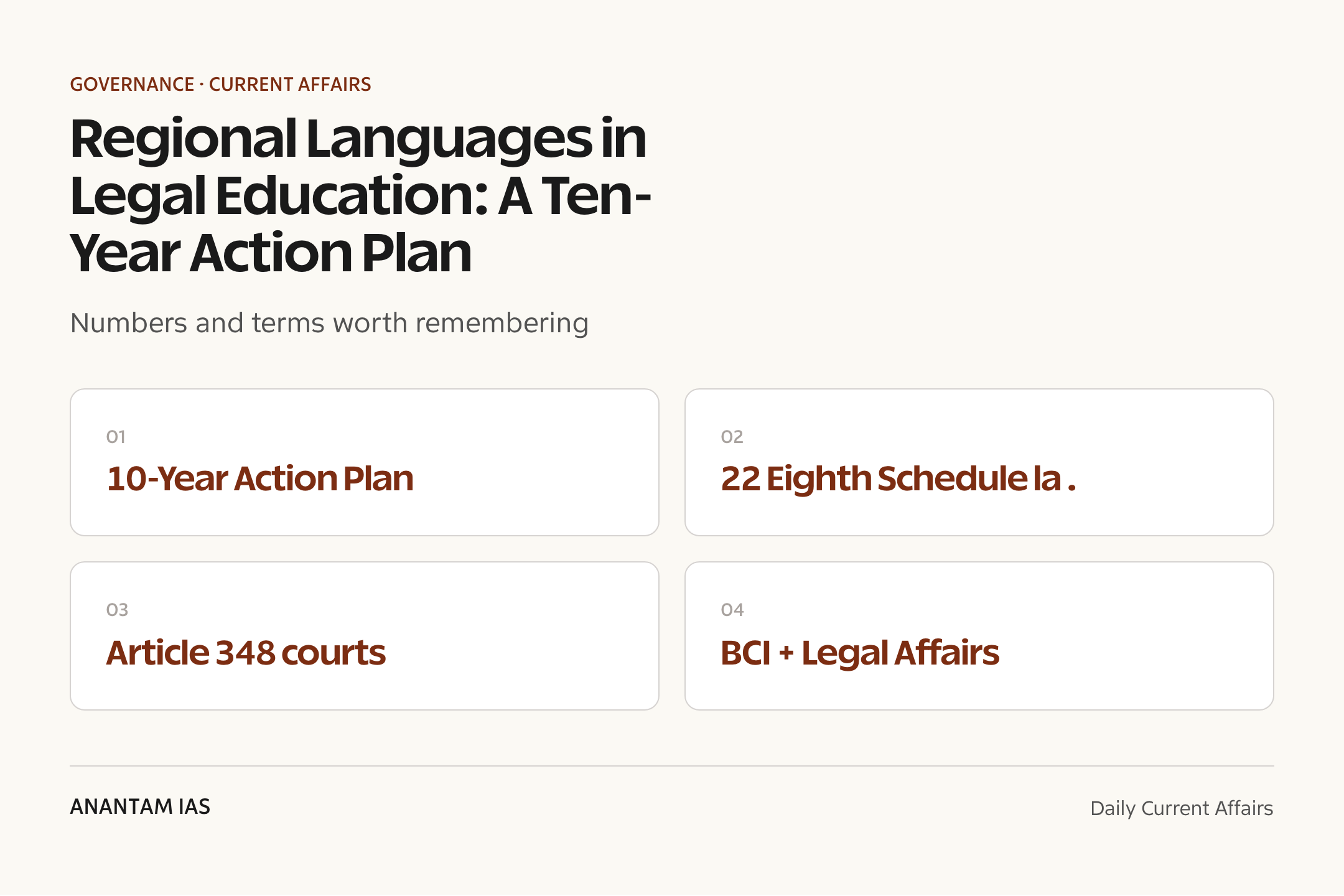
- Bar Council of India — statutory body under the Advocates Act, 1961; regulates legal education and the legal profession.
- Article 348 — language to be used in the Supreme Court and High Courts and for authoritative texts of Acts/Bills (English).
- Article 348(2) — Governor, with the President’s prior consent, may authorise Hindi or a State language in High Court proceedings.
- Article 39A — Directive Principle on equal justice and free legal aid (inserted by the 42nd Amendment, 1976).
- Article 343 — Hindi in Devanagari as the official language of the Union; Article 351 — directive to promote Hindi.
- Eighth Schedule — lists 22 scheduled languages of India.
- SUVAS (Supreme Court Vidhik Anuvaad Software) — AI translation tool launched in 2019 for judgments.
- Department of Legal Affairs is under the Ministry of Law & Justice (along with the Legislative Department and Department of Justice).
Mains Relevance
GS Paper 2
- Government policies and interventions for development in the education and justice sectors, and issues in their design and implementation.
- Mechanisms and institutions for the protection and betterment of access to justice for vulnerable and rural populations.
- Role of statutory and regulatory bodies (Bar Council of India) in reforming professional education.
GS Paper 1
- Salient features of Indian society and the role of language and linguistic diversity in social inclusion.
Essay
- Justice in one’s own language: is legal reform incomplete without linguistic access?
- Bridging the gap between the letter of the law and the language of the litigant.
Background and Context
What the Conference decided
The meeting set a concrete institutional agenda rather than a general endorsement.
- Agreed to draft a Ten-Year Perspective Action Plan for phased, measurable integration of Indian languages into legal education.
- Resolved to adopt a National Declaration on Indian Languages in Legal Education to anchor the reform politically and institutionally.
- Decided to set up a National Steering Committee, jointly anchored by the Department of Legal Affairs and the Bar Council of India, to oversee and monitor rollout.
- Chose a bilingual-to-multilingual model — adding Indian languages while retaining English as a link language, not replacing it.
- Stressed that the shift must be phased, measurable and quality-assured, so that comprehension improves without any drop in professional standards.
- Positioned the reform as a joint government-and-profession effort rather than a top-down mandate, giving the regulator, the bar and law schools shared ownership.
Why access to justice is the core rationale
The reform is pitched less as a language project and more as a justice-delivery project.
- Most litigation happens in district and subordinate courts, where proceedings and litigants overwhelmingly use regional languages.
- Article 39A makes equal justice and free legal aid a State obligation — comprehension in one’s own language is central to that promise.
- A lawyer trained only in English can struggle to serve first-generation and rural litigants; the plan explicitly targets legal aid and clinical legal education.
- Better legal comprehension is meant to reduce dependence on intermediaries and lower the cost of seeking justice.
- A pipeline of lawyers fluent in the local language can strengthen district judiciary, legal aid clinics and para-legal services where the demand is greatest.
- The move complements judicial steps such as translating Supreme Court and High Court judgments into Indian languages, so both the practice and the teaching of law become more accessible.
The constitutional language backdrop
The initiative sits inside a long-running Rajbhasha and language-of-courts debate.
- Under Article 348, proceedings in the Supreme Court and High Courts, and authoritative texts of laws, are in English.
- Article 348(2) lets a Governor, with the President’s prior consent, authorise Hindi or a State language in High Court proceedings — but judgments still issue in English.
- Some High Courts (for example in Uttar Pradesh, Bihar, Madhya Pradesh and Rajasthan) already permit Hindi in proceedings under this route.
- Articles 343 and 351 and the Eighth Schedule (22 languages) frame the constitutional push to promote Indian languages.
Bar Council of India and the regulation of legal education
The BCI is the statutory gatekeeper any such reform must run through.
- The Bar Council of India is a statutory body under the Advocates Act, 1961, and prescribes standards of legal education and recognition of law degrees.
- It approves law colleges, sets curriculum norms and conducts the All India Bar Examination (AIBE) for enrolment.
- Its co-ownership of the plan gives the reform regulatory teeth — curriculum and accreditation changes flow through the BCI.
- Legal education is also shaped by the UGC and by the National Education Policy 2020, which promotes teaching in the mother tongue and Indian languages up to higher and professional levels.
- The BCI’s own Legal Education Rules govern the three-year and five-year LLB, clinical courses and moot-court training — the very components that would carry bilingual material.
- Because enrolment as an advocate runs through the BCI and state bar councils, only the regulator can make a regional-language stream count toward a recognised law degree.
The technology lever
Delegates saw language technology as an accelerator, not a substitute for expert validation.
- Emphasis on AI-enabled translation tools, digital legal repositories, and standardised legal glossaries and terminology databases.
- All tools to be subject to rigorous validation by legal and linguistic experts before use in teaching.
- Builds on existing efforts such as SUVAS (Supreme Court Vidhik Anuvaad Software) for translating judgments into Indian languages.
- A shared, standardised legal vocabulary across languages is essential to avoid inconsistent or misleading translations of legal terms.
Challenges and criticisms
The gap between intent and delivery is where earlier language reforms have stalled.
- Acute shortage of quality legal textbooks, commentaries and case material in Indian languages.
- Risk of a two-tier profession if regional-language graduates are seen as less employable in higher courts and corporate practice.
- Standardising legal terminology across many languages is technically hard; a mistranslated term can change legal meaning.
- Faculty capacity, examination standards and cross-State mobility of students need safeguards so quality is not diluted.
- Balancing promotion of Indian languages with English as the link language for appeals and inter-State practice remains politically sensitive.
Way Forward
Build the knowledge base
- Fund translation of core statutes, leading judgments and standard textbooks into Indian languages with expert review.
- Create validated, open legal glossaries and terminology databases so terms stay consistent across States.
Phase it and measure it
- Roll out the Ten-Year Action Plan in clear phases with measurable targets and a public dashboard via the National Steering Committee.
- Pilot bilingual streams in select law schools before scaling, and evaluate outcomes on comprehension and bar-exam performance.
Protect quality and mobility
- Keep English proficiency mandatory as a link-language skill so graduates can practise across States and before higher courts.
- Align the reform with the National Education Policy 2020 and UGC norms to avoid a two-tier degree.
Conclusion
The push to teach law in Hindi and Indian languages reframes a language question as a justice question. For a litigant in a district court, the plan’s success will be measured by whether the law finally speaks in a language they understand.
The design choices matter more than the declaration. A phased, quality-assured framework that keeps English as a link language and invests in translated material and expert-validated terminology can widen access without diluting standards — the test now is delivery over the next decade.
For UPSC, the story is a clean intersection of governance, the Constitution and access to justice: it links Articles 348, 39A, 343 and 351 with the role of a statutory regulator, the NEP 2020 mother-tongue push and the wider debate on Indianising legal and administrative processes — a ready case study for GS2 answers on justice-delivery reform.
UPSC Practice Questions
Prelims MCQ 1
With reference to the Bar Council of India (BCI), consider the following statements:
- It is a statutory body established under the Advocates Act, 1961.
- It lays down standards of legal education in India.
- It conducts the All India Bar Examination for enrolment as an advocate.
How many of the above statements are correct?
(a) Only one (b) Only two (c) All three (d) None
Answer: (c) All three
Explanation:
The BCI is a statutory body under the Advocates Act, 1961; it prescribes standards of legal education (with universities) and conducts the All India Bar Examination (AIBE). All three statements are correct.
Prelims MCQ 2
Which one of the following constitutional provisions deals with the language to be used in the Supreme Court and the High Courts?
(a) Article 343 (b) Article 348 (c) Article 351 (d) Article 39A
Answer: (b) Article 348
Explanation:
Article 348 provides that proceedings in the Supreme Court and High Courts, and authoritative texts of laws, shall be in English, until Parliament provides otherwise. Article 343 concerns the official language of the Union, 351 the promotion of Hindi, and 39A equal justice and free legal aid.
UPSC Mains Questions
- Access to justice remains hollow if the litigant cannot understand the language of the law. In light of the proposed Ten-Year Action Plan on regional languages in legal education, examine how linguistic access advances the goal of equal justice under Article 39A.
- Integrating Indian languages into legal education promises inclusion but risks a two-tier profession. Discuss the design safeguards needed to promote multilingual legal education without diluting standards or restricting the mobility of law graduates.
Sources: PIB, Ministry of Law & Justice and Bar Council of India.
Frequently Asked Questions
What was the July 2026 conference about?
The Department of Legal Affairs and the Bar Council of India jointly held a National Conference on strengthening legal education through regional languages in New Delhi. They agreed to draft a Ten-Year Perspective Action Plan to teach law in Hindi and other Indian languages, alongside a National Declaration and a National Steering Committee to guide the reform.
Will English be removed from legal education?
No. The framework keeps English as an important national and international link language. The model is bilingual and progressively multilingual — Indian languages are added in a calibrated way, not as a replacement, so graduates can still practise across States and before higher courts.
Why does the language of law matter for access to justice?
Most cases are heard in district and subordinate courts, where litigants use regional languages. If law is taught and practised only in English, first-generation and rural litigants struggle to understand proceedings. Teaching law in Indian languages supports the Article 39A goal of equal justice and effective legal aid.
What does Article 348 say about court language?
Article 348 provides that proceedings in the Supreme Court and every High Court, and the authoritative texts of Bills and Acts, shall be in English. Under Article 348(2), a Governor may, with the President’s prior consent, authorise Hindi or a State language in High Court proceedings, though judgments still issue in English.
What role does the Bar Council of India play?
The Bar Council of India is a statutory body under the Advocates Act, 1961. It sets standards of legal education, recognises law degrees, approves law colleges and conducts the All India Bar Examination. Its co-ownership of the plan means curriculum and accreditation changes can be implemented through it.
How will technology help?
Delegates highlighted AI-enabled translation tools, digital legal repositories and standardised legal glossaries and terminology databases. These can speed up producing study material in Indian languages, but the conference stressed that all tools must be rigorously validated by legal and linguistic experts before use.