Legal Metrology Reform: Improvement Notice Before Penalty
Why in News?
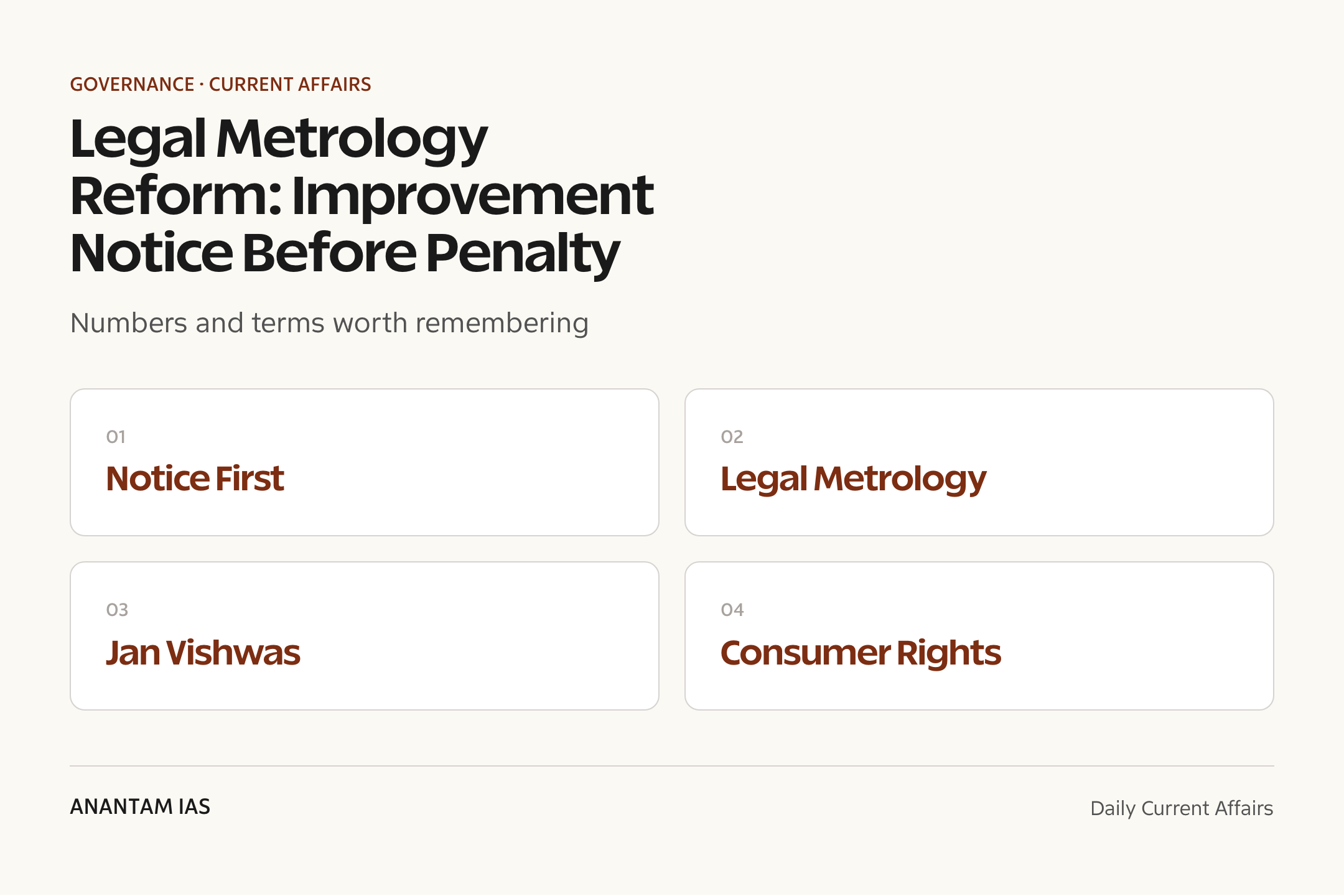
PIB reported that the Department of Consumer Affairs introduced an Improvement Notice mechanism under the Legal Metrology Act framework.
The reform allows specified first-time procedural or regulatory mistakes to be corrected before penalty proceedings, linking consumer protection with trust-based governance.
- The mechanism was brought through the Jan Vishwas amendment framework.
- It is presented as an ease-of-doing-business reform while retaining consumer protection.
- Legal metrology affects packaged commodities, measurements, weights, declarations, and market fairness.
- The governance issue is how to distinguish minor procedural lapses from deliberate consumer harm.
The development matters in the context of:
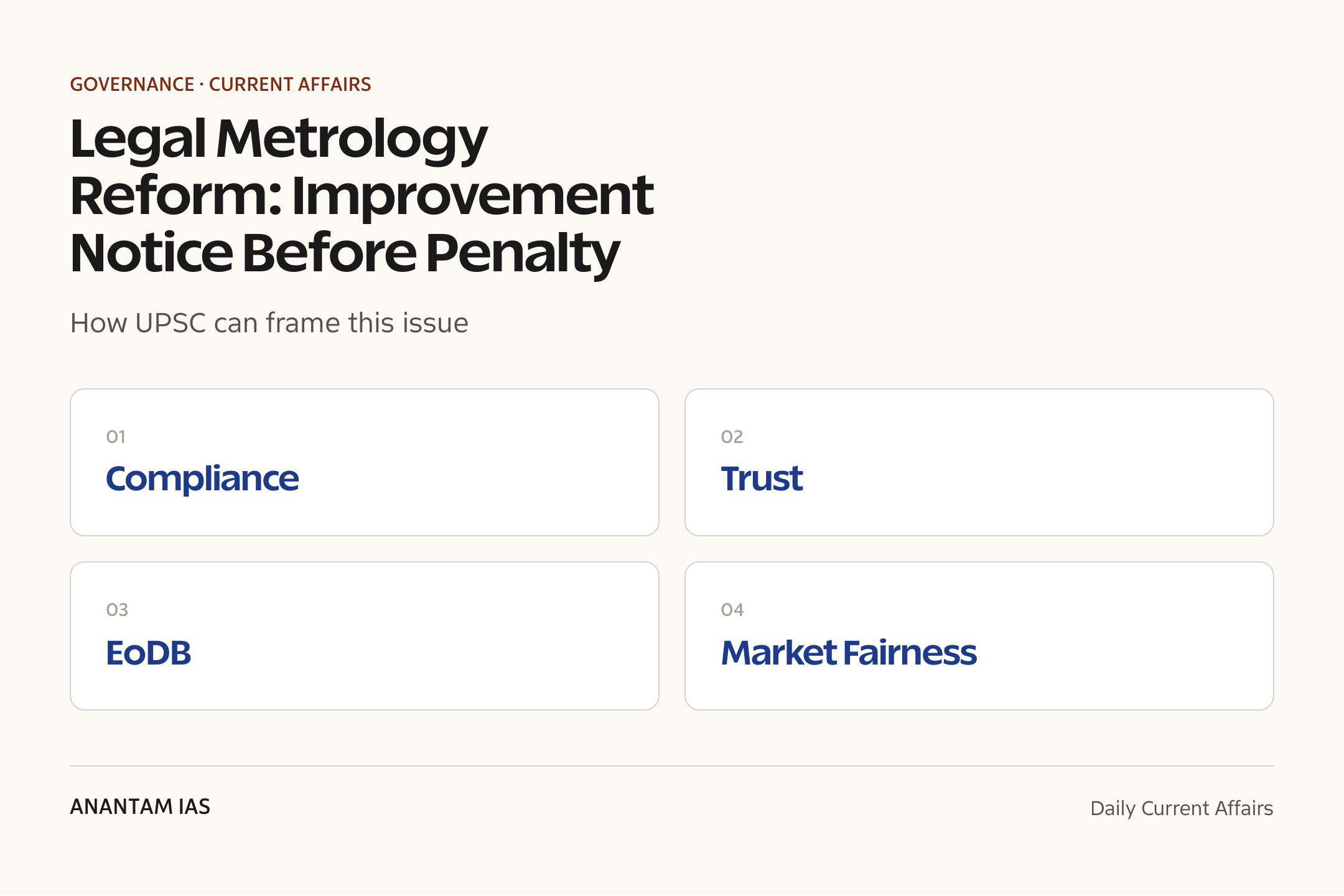
- Compliance reform is a recurring GS2 and GS3 theme because regulation affects both citizens and businesses.
- Trust-based governance tries to reduce fear of penalty for small first-time errors.
- Consumer protection must not be weakened because measurement fraud directly affects ordinary buyers.
UPSC Relevance
Prelims Relevance
- Legal Metrology Act, 2009 regulates weights, measures, and related declarations.
- Improvement notice gives a chance to correct specified first-time procedural non-compliance before penalty action.
- Jan Vishwas reforms aim to reduce unnecessary criminalisation and compliance burden.
- Packaged commodities require declarations such as quantity, price, manufacturer details, and other prescribed information.
- Consumer protection depends on accurate weights, measures, and truthful declarations.
- Ease of doing business includes simpler compliance, predictable enforcement, and lower fear of harassment.
- Trust-based governance means regulation relies more on correction and risk-based enforcement where appropriate.
Mains Relevance
GS Paper 2
- Regulatory governance and citizen-centric administration
- Consumer rights and accountability
- Decriminalisation of minor compliance lapses
GS Paper 3
- Ease of doing business
- Formalisation and compliance costs
- Market fairness
Essay
- Regulation should protect, not paralyse
- Trust and accountability in governance
- Consumer rights in a market economy
Background and Context
What The Improvement Notice Does
The reform creates a correction window before penalty action for specified first-time procedural mistakes.
- Improvement notice does not erase regulation; it changes the first response to certain minor lapses.
- First-time procedural errors may include correctable mistakes where there is no clear fraud or consumer injury.
- Penalty action remains available if the business fails to correct the deficiency or commits serious violations.
- Trust-based governance asks regulators to guide compliance rather than punish every small error immediately.
- Consumer protection remains the test: correction must not become an excuse for cheating buyers.
Why Legal Metrology Matters
Weights, measures, and declarations are small details with large consumer-rights consequences.
- Accurate measurement ensures that consumers receive the quantity they pay for.
- Packaged commodity declarations help buyers compare price, quantity, date, and manufacturer details.
- Market trust depends on common standards for weighing, measuring, and labelling.
- Small businesses often face compliance complexity, especially when rules are technical and inspections are frequent.
- Regulatory clarity helps honest businesses comply while allowing strict action against deception.
Jan Vishwas And Decriminalisation
The improvement-notice mechanism fits a wider move to reduce harsh treatment of minor compliance lapses.
- Jan Vishwas reforms aim to shift selected minor offences from criminal punishment toward civil or corrective approaches.
- Compliance burden can discourage entrepreneurship when minor technical errors trigger disproportionate penalties.
- Regulatory trust grows when businesses know that honest mistakes can be corrected transparently.
- Risk-based enforcement lets regulators focus stronger action on repeat offenders, fraud, and consumer harm.
- Administrative efficiency improves when inspectors and departments spend less time on low-risk cases.
Consumer Protection Safeguards
A correction-first approach must be paired with safeguards so consumer rights are not diluted.
- Fraudulent conduct should not receive leniency under the cover of procedural correction.
- Repeat violations need escalating penalties because repeated non-compliance shows disregard for law.
- Clear categories are needed so inspectors know which errors qualify for improvement notices.
- Time-bound correction protects consumers by ensuring that notices do not become indefinite delays.
- Public grievance systems should remain active for consumers affected by short weight, false declarations, or misleading labels.
Ease Of Doing Business Angle
The reform supports enterprise by making compliance more predictable and less punitive for honest errors.
- Micro and small enterprises can face high compliance anxiety when rules are complex and penalties are immediate.
- Predictable enforcement reduces discretion and lowers the risk of harassment.
- Correction pathway encourages businesses to fix errors quickly rather than fight every notice.
- Formalisation improves when smaller businesses see regulation as manageable.
- Economic governance improves when consumer protection and business confidence are treated together.
How To Use It In Answers
This is a compact example for regulatory reform questions.
- Governance point: move from penalty-first administration to compliance assistance for minor lapses.
- Economic point: reduce fear and cost for honest businesses, especially MSMEs.
- Consumer point: preserve strict action against fraud, repeat violations, and deceptive practices.
- Rule-of-law point: publish clear criteria, timelines, and appeal mechanisms.
- Balanced conclusion: trust-based governance needs both empathy and enforcement.
Design Safeguards
The improvement-notice model will work only if it is clear, trackable, and resistant to misuse.
- Clear classification is needed so inspectors can separate a correctable labelling omission from short weight, tampering, or deliberate deception.
- Digital notices can reduce discretion by recording the defect, correction deadline, evidence uploaded, and final compliance status.
- Appeal mechanism gives businesses a route to challenge wrongful notices while still protecting consumers from delay tactics.
- Consumer complaints should override leniency where buyers report real loss, false declarations, or repeat conduct by the same trader.
- Public dashboards can show categories of notices, correction rates, and repeat violations without exposing sensitive business data.
- Graded penalties should distinguish clerical errors, delayed correction, repeated non-compliance, and intentional fraud.
- MSME outreach is important because small traders often need plain-language compliance guides rather than only inspection notices.
- Third-party verification can be useful in higher-risk sectors where corrected labels, weights, or declarations must be checked before products continue in the market.
- Consumer awareness must run beside business reform because buyers should know how to read quantity declarations, maximum retail price, complaint details, and correction notices.
- Repeat-offender tracking can prevent misuse of leniency by firms that correct one notice but continue the same pattern elsewhere through related outlets, branches, or brands.
- Inspector training is needed because trust-based regulation fails if field officials apply old penalty habits or use notices as bargaining tools.
Way Forward
Define Eligible Lapses
- Clearly list which first-time procedural errors qualify for improvement notices.
- Exclude fraud, consumer injury, and repeat violations from leniency.
Make It Time-Bound
- Set clear correction deadlines and digital tracking.
- Escalate to penalty if compliance is not completed.
Protect Consumers
- Keep grievance systems active and accessible.
- Use risk-based inspections for sectors with higher consumer-harm potential.
Conclusion
Improvement notice is a useful regulatory reform because it treats honest first-time procedural mistakes differently from deliberate consumer harm.
The reform can reduce compliance fear and support ease of doing business if it is transparent, time-bound, and backed by strict action against fraud.
For UPSC, it is a neat example of trust-based governance where the State tries to balance business confidence with consumer rights.
UPSC Practice Questions
Prelims MCQ 1
With reference to the improvement notice mechanism under legal metrology reform, consider the following statements:
- It gives a correction opportunity for specified first-time procedural non-compliance.
- It is linked with reducing compliance burden.
- It removes all consumer-protection penalties permanently.
How many of the above statements are correct?
(a) Only one (b) Only two (c) All three (d) None
Answer: (b) Only two
Explanation:
Statements 1 and 2 are correct. Penalties are not permanently removed for all violations.
Prelims MCQ 2
Legal metrology primarily concerns which of the following?
(a) Weights, measures, and related declarations (b) Election scheduling (c) Wildlife census only (d) Inter-State river tribunals
Answer: (a) Weights, measures, and related declarations
Explanation:
Legal metrology regulates weights, measures, packaged commodity declarations, and related consumer-market standards.
UPSC Mains Questions
- Trust-based governance can reduce compliance burden, but it must not weaken consumer protection. Discuss with reference to legal metrology reform.
- How can India distinguish honest procedural mistakes from deliberate market deception in regulatory enforcement?
- Decriminalisation of minor business lapses can improve economic governance. Examine the safeguards needed.
Source: PIB, Department of Consumer Affairs.
Frequently Asked Questions
What is improvement notice?
It is a correction opportunity for specified first-time procedural non-compliance before penalty action begins.
Which law is involved?
The reform is linked with the Legal Metrology Act framework and the Jan Vishwas amendment approach.
Why does legal metrology matter?
It protects consumers by ensuring accurate weights, measures, and truthful declarations in markets.
Does this weaken consumer rights?
It should not. Serious fraud, repeat violations, and consumer harm still need strict enforcement.
How does it help businesses?
It reduces fear of immediate penalties for honest technical mistakes and supports predictable compliance.
What is the UPSC angle?
It links GS2 governance, GS3 economy, consumer protection, decriminalisation, and ease of doing business.