Lesson from China on tackling pollution

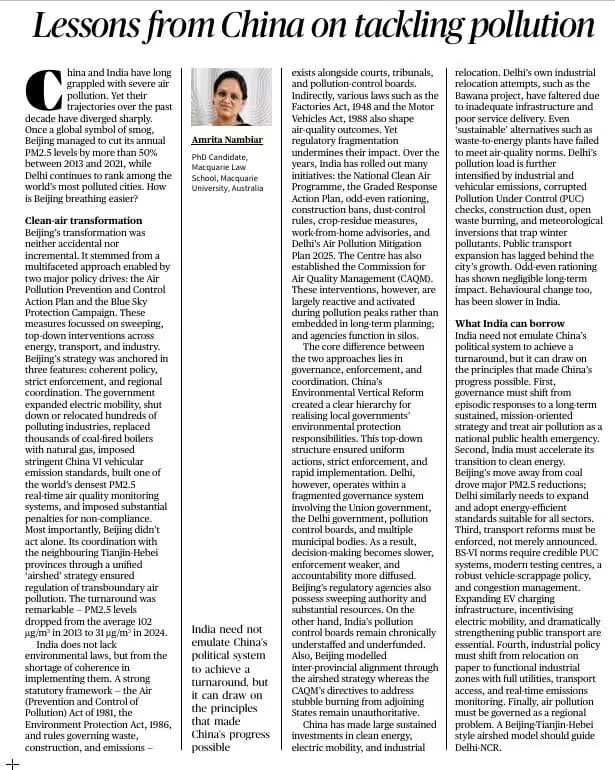
Context:
How China—especially Beijing—has sharply reduced air pollution over the past decade, drawing policy lessons for India, particularly Delhi-NCR, which continues to face severe air-quality crises.
Key Evidence Highlighted (China vs India)
China (Beijing)
- Achieved a ~50% reduction in annual PM2.5 levels between 2013 and 2021.
- Implemented:
- Clean Air Action Plan
- Blue Sky Protection Campaign
- Used:
- Strict industrial emission norms
- Closure/relocation of polluting industries
- Massive push for electric mobility
- Real-time air-quality monitoring
- Heavy penalties and strong enforcement
- Followed a regional approach: Beijing–Tianjin–Hebei “airshed” coordination to control transboundary pollution.
India (Delhi-NCR)
- Has laws like:
- Air (Prevention and Control of Pollution) Act, 1981
- Environment (Protection) Act, 1986
- But faces:
- Fragmented governance (Centre–State–Local overlap)
- Weak enforcement and regulatory capacity
- Over-reliance on short-term emergency measures (odd-even, construction bans)
- Bodies like CAQM exist but lack:
- Strong enforcement powers
- Adequate funding and accountability
What India Can Learn (Policy Lessons)
Shift from episodic response to mission-mode strategy
- Treat air pollution as a public health emergency, not a seasonal problem.
Strengthen institutional capacity
- Empower CAQM with:
- Enforcement authority
- Financial autonomy
- Accountability mechanisms
Regional (airshed-based) governance
- Adopt a Beijing–Tianjin–Hebei–style model for Delhi-NCR and neighbouring states.
Transport-sector reforms
- Stronger vehicle emission standards (beyond BS-VI)
- Expansion of public transport and EVs
- Congestion pricing and better traffic management
Data-driven regulation
- Public access to air-quality and emissions data
- Real-time emissions monitoring
- Source-apportionment-based policymaking