Youth Mental-Health Support: The Design and Safeguards of Let’s Talk Life
Why in News?
The Hindu reported on August 28 that NIMHANS and IIIT-B’s Let’s Talk Life platform offers young people anonymous, moderated peer support for mental-wellbeing concerns.
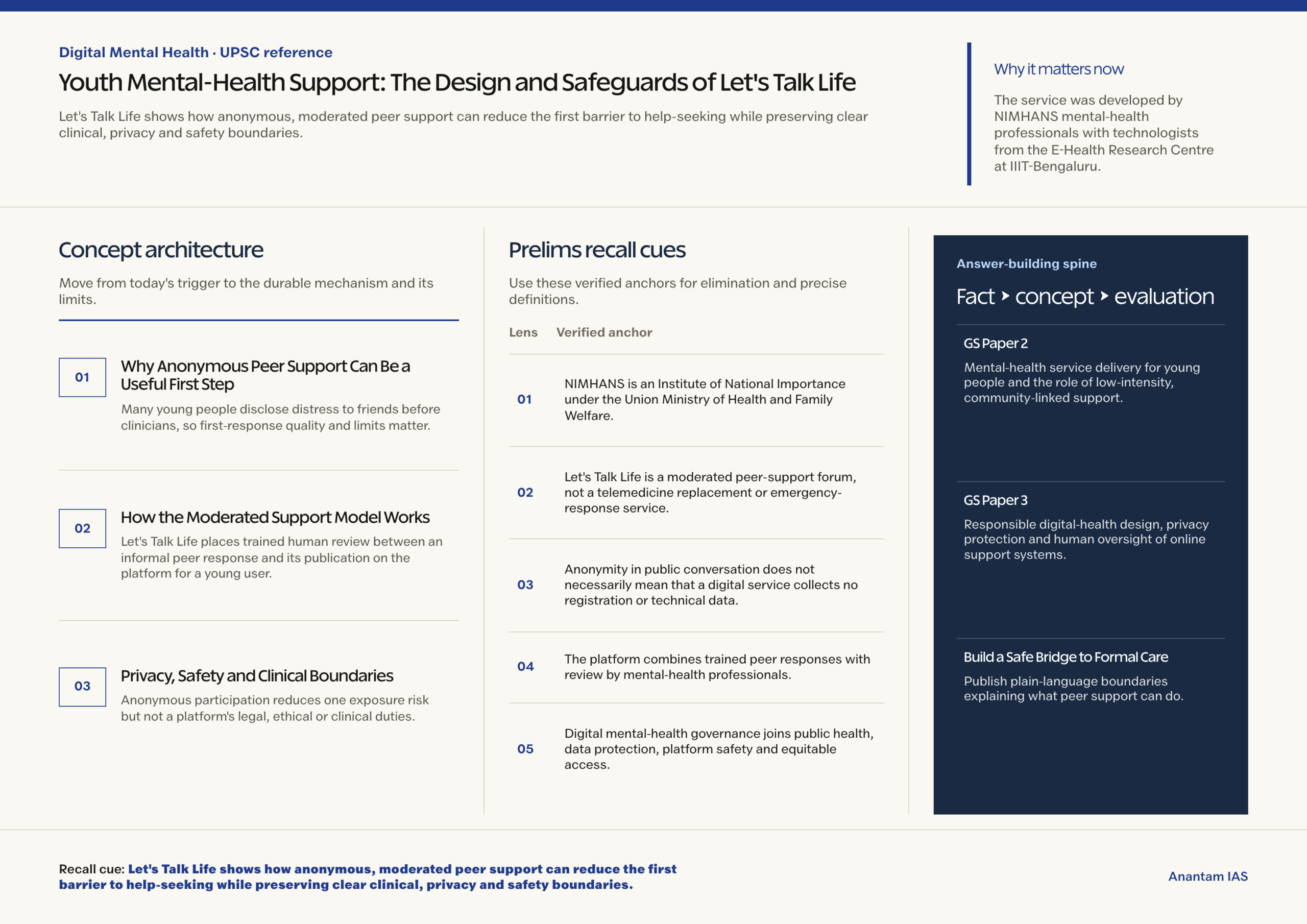
- The service was developed by NIMHANS mental-health professionals with technologists from the E-Health Research Centre at IIIT-Bengaluru.
- Users can post concerns anonymously and receive responses from trained young peer volunteers whose replies are reviewed by mental-health professionals.
- A reported study of 137 platform posts examined why users sought support; it did not establish clinical effectiveness or population-level outcomes.
- The service describes itself as low-intensity peer support, not crisis care, counselling or a substitute for professional treatment.
- Anonymous first contact can lower stigma and fear of judgement, helping a young person put distress into words before deciding whether to seek formal care.
- Public value depends on a safe bridge to care: moderation, escalation pathways, privacy safeguards and honest limits matter as much as digital access.
UPSC Relevance
Prelims Relevance
- NIMHANS is an Institute of National Importance under the Union Ministry of Health and Family Welfare.
- Let’s Talk Life is a moderated peer-support forum, not a telemedicine replacement or emergency-response service.
- Anonymity in public conversation does not necessarily mean that a digital service collects no registration or technical data.
- The platform combines trained peer responses with review by mental-health professionals.
- Digital mental-health governance joins public health, data protection, platform safety and equitable access.
Mains Relevance
GS Paper 2
- Mental-health service delivery for young people and the role of low-intensity, community-linked support.
- Stigma, access barriers, referral continuity and accountability in public-health innovation.
GS Paper 3
- Responsible digital-health design, privacy protection and human oversight of online support systems.
Essay
- Technology can open the first door to care, but trust is built through human judgement, privacy and dependable institutions.
Background and Context
Why Anonymous Peer Support Can Be a Useful First Step
Many young people disclose distress to friends before approaching a clinician, making the quality, safety and limits of that first response especially important.
- Stigma, fear of misunderstanding and doubt about whether a problem is serious enough can delay formal help-seeking until distress becomes harder to manage.
- Anonymous posting can reduce the social cost of disclosure and let users discuss stress, loneliness, relationships, family pressure or uncertainty without public identification or immediate face-to-face exposure.
- A trained peer can offer empathetic listening, validation and practical perspective in language that feels less institutional than a clinical intake, especially at first disclosure.
- This is best understood as early, low-intensity support: it may make distress speakable and encourage help-seeking, but it neither diagnoses illness nor proves improvement.
- Digital access can widen the entry point, yet language, disability access, connectivity and digital literacy still shape who can use it safely.
How the Moderated Support Model Works
Let’s Talk Life places trained human review between an informal peer response and its publication on the platform for a young user.
- Young peer volunteers receive structured training in empathetic, respectful and solution-oriented responses, with role boundaries that prevent them from acting as unqualified counsellors.
- Mental-health professionals review responses for safety and appropriateness, adding supervision and a second judgement layer that an open, unmoderated discussion board would lack.
- Responders are trained to notice signs of significant distress and encourage professional intervention when a user’s needs, risk or symptoms exceed the peer-support role.
- The model creates a referral bridge: listen without judgement, clarify the concern, support the next step, recognise limits and avoid promising treatment outcomes.
- Its public-health contribution should be assessed through safe referrals, user trust and access quality, not engagement time or the volume of posts.
Privacy, Safety and Clinical Boundaries
Anonymous participation reduces one exposure risk, but it does not remove a platform’s legal, ethical and clinical duties toward users in distress.
- The official privacy policy says posts and questions may be used for research in aggregated and anonymised form; meaningful consent and purpose limitation remain essential.
- Anonymous public posting is different from collecting no data: registration or service operation may involve personal or technical information requiring data minimisation, security and limited retention.
- A clear crisis disclaimer must be matched by visible helplines, risk-recognition protocols and a workable escalation pathway for serious, persistent or rapidly worsening concerns.
- Moderators need defined roles, supervision and protection from emotional overload; users need accessible reporting, deletion and grievance mechanisms that work predictably in practice.
- The study of platform posts describes user needs and behaviour. It cannot by itself prove reduced illness, prevented self-harm or improved clinical outcomes.
Way Forward
Build a Safe Bridge to Formal Care
- Publish plain-language boundaries explaining what peer support can do, what it cannot do and when a user should seek urgent or professional help.
- Create audited referral and crisis pathways linked to qualified services, with response protocols tested for high-risk disclosures.
- Collect only necessary data, explain research use clearly and provide practical access, correction, deletion and grievance options.
- Evaluate safety, referral completion, accessibility and user-reported trust through independent review, without turning vulnerable disclosures into engagement targets.
Conclusion
- Let’s Talk Life illustrates a useful stepped-care entry point: moderated peer support can reduce silence and help a young person recognise when more specialised care is needed.
- In a Mains answer, pair digital reach with four safeguards: professional oversight, clinical escalation, privacy by design and measurable accountability for safety and access.
UPSC Practice Questions
Prelims MCQ 1
With reference to the Let’s Talk Life platform, consider the following statements:
- It was developed through collaboration between NIMHANS mental-health professionals and IIIT-Bengaluru technologists.
- It is designed to replace professional counselling for young people with persistent mental-health concerns.
- Responses from trained peer volunteers are reviewed by mental-health professionals before publication.
How many of the above statements are correct?
(a) Only one (b) Only two (c) All three (d) None
Answer: (b) Only two
Explanation:
Statements 1 and 3 are correct. The platform is a low-intensity, moderated peer-support service and explicitly does not replace professional care.
Prelims MCQ 2
Which safeguard most directly distinguishes a moderated digital peer-support service from an unmoderated online discussion forum?
(a) Maximising the number of daily posts (b) Requiring public disclosure of users’ identities (c) Professional review and escalation protocols for significant distress (d) Replacing all referrals with automated replies
Answer: (c) Professional review and escalation protocols for significant distress
Explanation:
Professional oversight and escalation create safety boundaries around peer responses. Popularity or anonymity alone cannot provide clinical risk management.
UPSC Mains Questions
- Anonymous digital peer-support platforms can reduce barriers to mental-health help-seeking, but they cannot substitute for clinical care. Discuss with reference to service design and safeguards.
- Examine how privacy by design, human moderation and referral pathways can make digital mental-health services safer and more accountable for young users.
Sources: The Hindu and Let's Talk Life official privacy policy.
Frequently Asked Questions
What is Let’s Talk Life?
It is an anonymous online peer-support forum for young people, developed by NIMHANS mental-health professionals with IIIT-Bengaluru technologists and moderated by mental-health experts.
Does the platform provide counselling or crisis care?
No. It is designed as low-intensity peer support, not a substitute for counselling, treatment or emergency assistance. Serious or persistent concerns require qualified professional care.
How are responses kept safe?
Trained young peer volunteers draft empathetic responses, and mental-health professionals review them for safety and appropriateness before they are posted.
Does anonymous posting mean that no personal data is collected?
Not necessarily. Public anonymity and backend data collection are different. The service must still minimise data, explain its purposes, secure records and provide meaningful user rights.
What is the main governance lesson?
Digital access works best as a bridge to care when professional oversight, crisis escalation, privacy safeguards and independent evaluation are built into the service.