Rising Life Insurance Surrenders: What India’s Premature Exits Signal
Why in News?
Surrenders and withdrawals of life insurance policies before maturity have climbed steadily over five years, with The Indian Express reporting (citing IRDAI data) that they now nearly match payouts to policyholders who complete the full term.
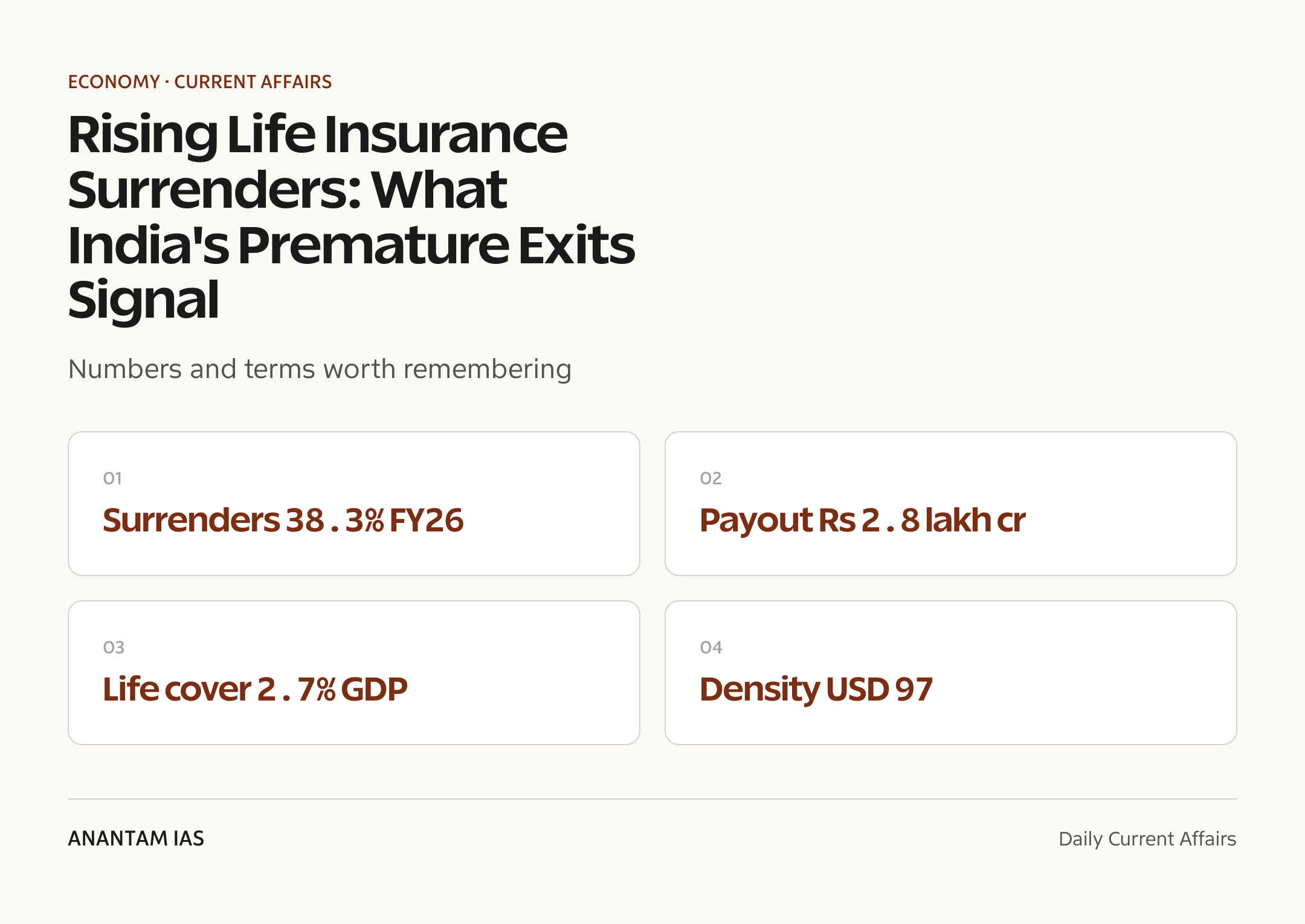
In 2025-26, life insurers paid Rs 7.3 lakh crore in total benefits; 38.3% of this – about Rs 2.8 lakh crore – was premature surrender or withdrawal, versus Rs 2.69 lakh crore paid as maturity benefit.
The trend matters because life insurance is meant to be a long-term protection and savings instrument, not a short-tenure parking of cash. When exits before maturity rival orderly completions, it signals a mix of household financial stress, weak product design and mis-selling – and it feeds directly into the GS3 debate on the financialisation of savings and the health of the insurance sector.
- Surrender/withdrawal share of total benefits rose from about 30% in FY2022 to 38.3% in FY2026, per IRDAI data.
- Share of policyholders completing the full term fell from roughly 48% in 2021-22 to 36.9% in 2025-26.
- The RBI Financial Stability Report flags this near-parity as a risk to insurers’ asset-liability management (ALM).
- Officials attribute exits to mis-selling and household financial stress – inflation, rising living costs and loan repayments.
- The surge persists despite IRDAI‘s revised surrender-value norms of October 2024, which were meant to make early exits less punitive and discourage impulsive quitting.
- It coincides with a third straight yearly fall in life-insurance penetration, underscoring that India’s protection gap is widening even as the economy formalises.
The development matters in the context of:
- Fits the GS3 theme of household savings, financialisation and financial-sector regulation.
- Surrenders penalise policyholders, who forgo full benefits and may book losses on early exit.
- Weak persistency undermines insurance penetration – a proxy for social-security depth.
UPSC Relevance
Prelims Relevance
- IRDAI – statutory regulator under the IRDA Act, 1999; regulates life and general insurance.
- Surrender value – amount paid to a policyholder who exits before maturity.
- Special Surrender Value (SSV) and Guaranteed Surrender Value (GSV).
- IRDAI’s 2024 surrender-value norms, effective 1 October 2024.
- Persistency ratio – measured at 13th, 25th, 37th, 49th and 61st month.
- Insurance penetration (premium as % of GDP) and insurance density (premium per capita).
- Asset-liability management (ALM) in life insurance.
- RBI Financial Stability Report (FSR) – half-yearly systemic-risk assessment.
- Net household financial savings as a share of GNDI.
- 10-Year G-Sec yield as a benchmark rate.
Mains Relevance
GS Paper 3
- Financialisation of household savings and its risks – shift from physical to financial assets, and premature exits.
- Insurance-sector regulation: mis-selling, consumer protection and the ALM stability angle in the RBI FSR.
GS Paper 2
- Insurance as social security: low penetration, protection gap, and the state’s role in universalising cover.
Essay
- “Financial inclusion without financial literacy is a half-built bridge.”
- Trust, protection and the promise of insurance in a stressed economy.
Background and Context
What the IRDAI data shows
The core signal is that premature exits are catching up with orderly maturities.
- Total benefits paid by life insurers in 2025-26 stood at Rs 7.3 lakh crore, per IRDAI.
- Premature surrender/withdrawal made up 38.3% (about Rs 2.8 lakh crore), up from roughly 30% in FY2022.
- By contrast, maturity benefits after the full term were Rs 2.69 lakh crore – so exits and completions now run near-parity.
- The share completing the full policy term slid from about 48% (2021-22) to 36.9% (2025-26).
- The five-year climb – from about 30% (FY2022) to 38.3% (FY2026) – shows a structural drift, not a one-off spike.
- Because a rupee paid out early is a rupee not compounding for the saver, the shift also quietly erodes the long-term wealth-building role that life insurance is supposed to play.
Why policyholders are exiting early
Insurance experts cited by The Indian Express point to a mix of stress, mis-selling and better alternatives.
- Households surrender traditional policies to meet urgent cash needs amid inflation, higher living costs and loan repayments.
- Many buyers expect short-term, FD-like returns and quit on learning of the long lock-in and surrender penalties.
- Rising returns on bank FDs, equities and mutual funds pull savers away from low-yield insurance products.
- Mis-selling by agents, banks and NBFCs – long flagged by RBI and IRDAI – inflates early lapses.
- Bancassurance channels, where policies are bundled with loans or pushed for commissions, often place products with buyers who neither need nor understand them.
- Low financial literacy means many first-time buyers cannot tell a pure-protection term plan from a bundled savings-cum-investment product, and abandon it once expectations are not met.
Why premature surrenders hurt
Early exits are a bad deal for the saver and a stability worry for the insurer.
- A policyholder who surrenders forgoes full benefits and may even book a loss on the amount paid in.
- The RBI FSR warns that elevated surrenders disrupt the long-duration assumptions behind insurers’ investment strategies.
- Early exits can force asset liquidation ahead of schedule, straining asset-liability management (ALM).
- Persistently high surrenders signal policyholder dissatisfaction, product mis-selling and competitive pressure from other instruments.
Persistency: the deeper weakness
Surrenders are the visible edge of a long-standing persistency problem.
- Persistency ratio tracks how many policies stay in force at the 13th, 25th, 37th, 49th and 61st month.
- Industry 13th-month persistency for private insurers sits around 65-70% – meaning up to a third lapse within a year.
- It falls further by the 61st month to roughly 45-55% for many insurers.
- LIC historically holds higher persistency on its traditional, agent-driven book.
The IRDAI 2024 surrender-value reform
The regulator has tried to make early exits less punitive.
- New surrender-value norms took effect on 1 October 2024.
- Special Surrender Value (SSV) can now be paid after just the first policy year, once one full year’s premium is received – earlier the first year paid nothing and two years were needed.
- SSV must at least equal the present value of the paid-up sum assured and vested benefits.
- The discount rate is capped at the 10-Year G-Sec yield plus 50 basis points, curbing deep deductions.
The savings and penetration backdrop
Surrender trends sit inside a wider story of financialisation and shallow insurance cover.
- Overall insurance penetration was flat at 3.7% of GDP, against a global average near 7.3%.
- Life-insurance penetration slipped to 2.7% in 2024-25 from 2.8% – a third straight yearly fall.
- Insurance density edged up to USD 97 (life at USD 72); India is the world’s 10th-largest insurance market at 1.8% global share.
- Net household financial savings rebounded to 5.1% of GNDI in 2023-24 after a multi-year low, even as savers rotate toward equities and deposits.
- A shallow, lapse-prone life book weakens insurers as long-term institutional investors in infrastructure and government debt – a channel the economy relies on.
- The government’s stated goal of Insurance for All by 2047 depends on both widening cover and keeping policies in force, making persistency a policy metric, not just a business one.
Way Forward
Curb mis-selling
- Tighten conduct rules for banks and NBFCs and enforce suitability checks at the point of sale.
- Act on IRDAI‘s move to rein in dark patterns and opaque product design.
Reward persistency
- Align agent commissions and incentives with renewals, not just first-year sales.
- Simplify traditional products and disclose surrender penalties up front.
Deepen penetration
- Push term cover and micro-insurance to close the protection gap.
- Build financial literacy so buyers match products to real goals and horizons.
Conclusion
The near-parity between premature surrenders and maturity payouts is a warning light. It tells us that many Indians treat life insurance as a stop-gap savings pot rather than long-term protection – and exit the moment cash is tight or returns look better elsewhere.
Fixing this needs work on both sides: cleaner selling and better-designed products from insurers, and stronger financial literacy among savers. Only then can insurance play its intended role as durable social security rather than a leaky store of value.
For UPSC, the theme threads through GS3 and GS2 alike – the financialisation of household savings, the conduct-regulation mandate of IRDAI, the systemic-stability lens of the RBI Financial Stability Report, and insurance as a pillar of social security. Rising surrenders are a compact case study on how consumer protection, product design and financial literacy together decide whether a savings instrument actually delivers.
UPSC Practice Questions
Prelims MCQ 1
With reference to life insurance in India, consider the following statements:
- The persistency ratio measures how many policies remain in force at set anniversaries such as the 13th and 61st month.
- The Insurance Regulatory and Development Authority of India (IRDAI) is a statutory body.
- Insurance penetration is defined as insurance premium expressed as a percentage of GDP.
How many of the above statements are correct?
(a) Only one (b) Only two (c) All three (d) None
Answer: (c) All three
Explanation:
All three are correct. Persistency tracks in-force policies at anniversaries; IRDAI is statutory under the IRDA Act, 1999; penetration is premium as a share of GDP (density is premium per capita).
Prelims MCQ 2
IRDAI’s revised surrender-value norms, effective 1 October 2024, primarily aimed to:
(a) Ban surrender of traditional policies before maturity (b) Allow a Special Surrender Value from the first policy year and reduce deductions (c) Make all life insurance premiums tax-free (d) Transfer surrender decisions to the RBI
Answer: (b) Allow a Special Surrender Value from the first policy year and reduce deductions
Explanation:
The 2024 norms let the Special Surrender Value be paid after the first policy year and cap the discount rate near the 10-Year G-Sec yield, giving policyholders higher, fairer refunds.
UPSC Mains Questions
- Premature surrenders of life insurance policies in India now nearly equal maturity payouts. Examine the causes of this trend and its implications for household savings and financial stability. (250 words)
- “Low insurance penetration reflects a deeper failure of financial literacy and product design, not just of income.” Critically analyse in the context of India’s life insurance sector. (250 words)
Sources: The Indian Express (Explained) and IRDAI / RBI Financial Stability Report.
Frequently Asked Questions
What is a surrender value in life insurance?
It is the amount an insurer pays a policyholder who exits a policy before it matures. Because charges and penalties are deducted, the surrender value is usually far lower than the premiums paid, so early exit often means the policyholder loses money.
Why are life insurance surrenders rising in India?
IRDAI data cited by The Indian Express show families surrendering traditional policies to meet urgent cash needs amid inflation and loan repayments. Mis-selling, long lock-ins, surrender penalties and more attractive returns on FDs, equities and mutual funds also drive early exits.
What did IRDAI change about surrender values in 2024?
From 1 October 2024, the Special Surrender Value can be paid after the first policy year once a full year’s premium is received, instead of nothing in year one. The discount rate is capped near the 10-Year G-Sec yield plus 50 basis points, giving savers higher, fairer refunds.
What is the persistency ratio?
It measures the share of policies still in force at set anniversaries – the 13th, 25th, 37th, 49th and 61st month. A high ratio means customers keep renewing. India’s persistency is weak, with a large share of private-insurer policies lapsing within the first year or two.
Why does the RBI worry about high surrenders?
The RBI Financial Stability Report notes that early exits disrupt the long-duration assumptions behind insurers’ investments and can force asset sales ahead of schedule. This strains asset-liability management and signals policyholder dissatisfaction, mis-selling and competitive pressure.
What is the difference between insurance penetration and density?
Penetration is insurance premium as a percentage of GDP, measuring how deep insurance is in the economy. Density is premium per person. India’s penetration is about 3.7% against a global average near 7.3%, showing a wide protection gap.