LokOS: A Digital Backbone for Rural Self-Help Groups and Livelihoods
Why in News?
The Ministry of Rural Development has been scaling LokOS (Lok Operating System) as the digital backbone for India’s Self-Help Group (SHG) ecosystem under the Deendayal Antyodaya Yojana – National Rural Livelihoods Mission (DAY-NRLM). Official Digital India Corporation material describes it as a profile-management and financial-operational system for rural Community-Based Organisations (CBOs), built on a federated microservices architecture that feeds the national NRLM management information system.
The platform now supports end-to-end digitisation of SHG savings, internal lending and repayments across the country, is designed to capture SHG financial transactions of the order of ₹2 lakh crore a year, and is being positioned as the data engine behind the government’s Lakhpati Didi drive to raise women’s household incomes.
- LokOS stands for Lok (People) Operating System, a national CBO platform under NRLM, Ministry of Rural Development.
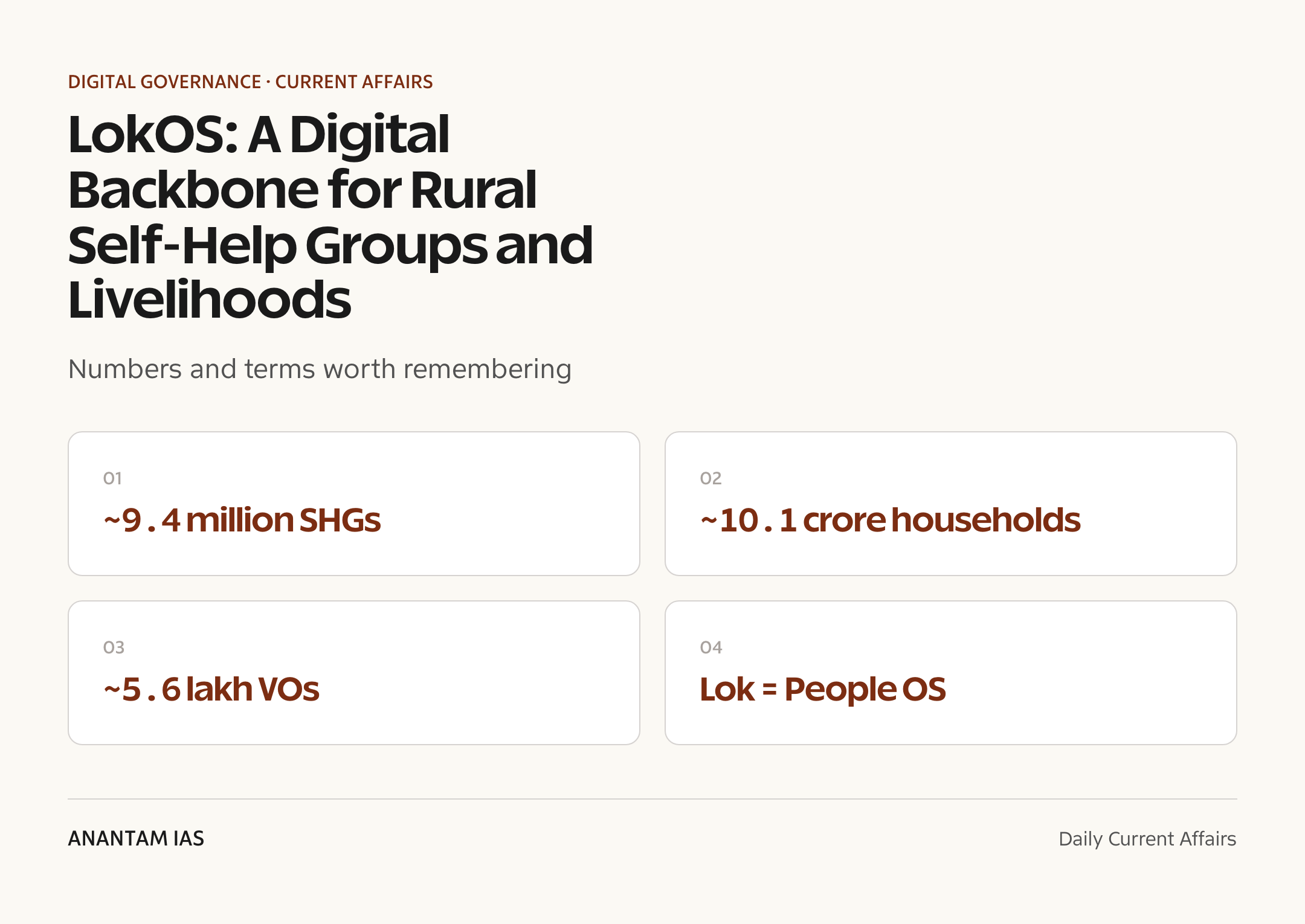
- Digital India Corporation figures put coverage at about 9.4 million SHGs and roughly 5.6 lakh Village Organisations.
- Around 10.1 crore households have been mobilised into the SHG network the platform serves.
- Built as paired web and mobile apps on a federated microservices design, it records field-level transactions and approvals in near real time and strengthens the NRLM MIS.
- It is built to handle SHG money flows worth about ₹2 lakh crore a year — member savings, DAY-NRLM assistance and bank loans.
- It feeds the Lakhpati Didi target of women SHG members earning over ₹1 lakh a year.
The development matters in the context of:
- SHG-led financial inclusion is a flagship of the JAM (Jan Dhan-Aadhaar-Mobile) and Digital Public Infrastructure agenda.
- Digitised books make SHG finances auditable, easing SHG-bank linkage and collateral-free credit.
- The platform sits at the intersection of governance, women’s economic empowerment and rural poverty reduction.
UPSC Relevance
Prelims Relevance
- LokOS full form: Lok (People) Operating System
- Parent scheme: DAY-NRLM under Ministry of Rural Development
- CBO hierarchy: SHG then Village Organisation (VO) then Cluster Level Federation (CLF)
- Implementing tech partner: Digital India Corporation
- Lakhpati Didi: SHG woman earning over ₹1 lakh/year
- DAY-NRLM finance tools: Revolving Fund, Community Investment Fund (CIF), collateral-free loans
- DAY-NRLM launched in 2011 (relaunched as DAY-NRLM in 2015)
- Scale markers: ~9.4 million SHGs, ~10.1 crore households mobilised
Mains Relevance
GS Paper 2
- Role of digital platforms and e-governance in delivery of welfare to the rural poor.
- SHG-based community institutions as instruments of participatory development and social capital.
GS Paper 3
- Financial inclusion, SHG-bank linkage and inclusive growth through microfinance.
- Women’s economic empowerment and rural livelihood diversification via DAY-NRLM.
Essay
- Empowering the last woman: technology, credit and dignity in rural India.
- Data as public infrastructure: can digitisation deepen grassroots democracy?
Background and Context
What LokOS is
LokOS is a purpose-built operating system for India’s community institutions, not a consumer app.
- It is a profile-management and financial-operational system for rural Community-Based Organisations (CBOs) — the SHGs and their federations that DAY-NRLM builds.
- Runs under the National Rural Livelihoods Mission (NRLM), Ministry of Rural Development, with Digital India Corporation handling development, operations and management.
- The name unpacks as Lok (people) plus OS (operating system) — a shared operating layer for the SHG movement rather than a single scheme portal.
- Pairs a web application for administrators, e-bookkeepers and transaction approvers with a mobile app used by field functionaries at the group level.
- The web side creates and approves SHGs, Village Organisations and Cluster Level Federations; the app records transactions and meetings on the ground.
- It is built on a federated microservices architecture so that States and UTs can plug in and scale independently while feeding one national data spine.
What it digitises
The core value is turning handwritten group ledgers into structured, auditable digital books.
- Captures member and group profiles, meeting attendance and the CBO’s organisational data in one place.
- Records the SHG money cycle end to end: savings, internal lending and repayments within the group.
- Tracks fund flows such as the Revolving Fund and Community Investment Fund routed from the mission to the groups.
- Consolidates SHG financial activity of the order of ₹2 lakh crore a year — savings, DAY-NRLM assistance and bank loans — into a single system.
- Introduces the e-bookkeeper role, replacing error-prone manual registers with validated entries and approval workflows.
- Because the books are structured and time-stamped, they can be audited and reconciled far more easily than paper registers.
The DAY-NRLM engine behind it
LokOS is a tool; DAY-NRLM is the mission it serves.
- DAY-NRLM (Deendayal Antyodaya Yojana – National Rural Livelihoods Mission) mobilises poor rural women into SHGs and their federations.
- The mission was launched as the National Rural Livelihoods Mission in 2011 and renamed DAY-NRLM in 2015, drawing on the earlier SHG-bank linkage tradition.
- It provides seed money through the Revolving Fund and the larger Community Investment Fund (CIF), plus interest-subvention that makes bank credit cheaper for SHGs.
- The three-tier design (SHG then VO then CLF) builds social capital and a delivery channel for credit, skills, entitlements and enterprise support.
- Federations also act as a bridge to banks, government schemes and markets, so a single woman is never negotiating the system alone.
- Sustained budgetary backing for the mission signals a political bet on the SHG model as a route out of rural poverty.
Scale and reach
The numbers explain why a single digital rail matters.
- Digital India Corporation figures cite about 9.4 million SHGs on the platform.
- Roughly 5.6 lakh Village Organisations sit above these groups as the second tier.
- Around 10.1 crore rural households have been mobilised into the wider SHG network.
- Because most SHG members are women, this makes it one of the largest women-centred financial networks anywhere.
- The system is designed to work across all States and Union Territories, each adopting it on its own timeline and to local needs.
- Managing a network this large by paper is impractical — the case for a common digital rail is scale itself.
SHG-bank linkage and financial inclusion
Digitisation is meant to deepen the decades-old SHG-bank linkage story.
- SHG-bank linkage lets groups with a good repayment track record access collateral-free institutional credit at concessional rates.
- Clean, auditable digital books make a group’s credit history legible to banks, lowering the cost and friction of lending.
- Anchoring SHG accounts in the JAM (Jan Dhan-Aadhaar-Mobile) trinity eases account-linked disbursals, subsidies and repayments.
- This pulls poor households out of the grip of informal moneylenders and into the formal financial system.
- Better data also supports evidence-based targeting and reduced leakage in a programme spread across the whole country.
Link to Lakhpati Didi
Digitised group data is the measurement layer for the income-lifting drive.
- Lakhpati Didi aims to make SHG women earn over ₹1 lakh a year through diversified, sustainable livelihoods.
- The original target of 3 crore Lakhpati Didis (set for 2027) was reported achieved by 2025, and the government has raised the goal to 6 crore by 2029-30.
- The next phase is harder: the early gains came from women already near the threshold, while lifting the lowest earners needs deeper support.
- Reliable group-level financial data helps identify who is close to the threshold and channel skills, credit and market links accordingly.
- It strengthens women’s economic standing by making their savings and credit history visible to banks and scheme designers.
- So LokOS is not just a bookkeeping tool but the measurement and targeting layer for a headline welfare promise.
A grassroots Digital Public Infrastructure
LokOS is a working example of Digital Public Infrastructure reaching the poorest institutions.
- Digital Public Infrastructure (DPI) means shared, interoperable digital rails — like Aadhaar, UPI and Jan Dhan — that many services can build on.
- LokOS extends the DPI idea from individuals to community institutions, giving SHGs and federations portable, structured digital records.
- Real-time data feeds the NRLM management information system, supporting monitoring, planning and course-correction from block to Centre.
- It shifts community institutions from paper dependence toward transparent, portable digital records that survive staff turnover.
- Layering welfare, credit and enterprise services on one data rail illustrates the governance logic of platform-based delivery.
Women's economic empowerment
The deeper stake is agency and dignity for rural women, not just software.
- Nearly all SHG members are women, so digitising the network directly advances women’s economic empowerment.
- Owning a visible savings and credit record gives women stronger standing within the household and with banks.
- SHG federations double as platforms for collective bargaining, awareness and access to entitlements and public services.
- Rising, recorded incomes under Lakhpati Didi convert group membership into measurable gains in household welfare.
- The model treats poor women as economic agents and producers, not merely as beneficiaries of transfers.
Concerns and limits
Digitisation at this scale carries familiar last-mile risks.
- Uneven digital literacy and patchy connectivity in remote blocks can slow real adoption on the ground.
- Dependence on trained e-bookkeepers creates a human-capacity bottleneck; a shortage can stall whole clusters.
- Data privacy and security of sensitive financial records of poor households need strong, enforceable safeguards.
- A push to hit targets can tempt data inflation or over-reporting unless entries are independently validated.
- Digital records help only if matched by real market access, skills and demand for SHG products — data alone does not raise incomes.
Way Forward
Capacity and literacy
- Invest in training e-bookkeepers and community cadres so the app is used, not bypassed at the group level.
- Pair rollout with sustained digital-literacy drives for SHG members in low-connectivity districts.
- Build offline-first and vernacular features so weak networks do not lock the poorest groups out.
Data trust and interoperability
- Codify data privacy, consent and grievance-redress norms for sensitive SHG financial data.
- Make LokOS interoperable with banking, UPI and wider DPI rails to deepen SHG-bank linkage and cut friction.
- Add independent validation and audit trails to guard against over-reporting and data inflation.
From data to incomes
- Use LokOS analytics to target the lowest-earning members who are furthest from the Lakhpati Didi threshold.
- Link groups to markets, credit and enterprise support so recorded data translates into real livelihood gains.
Ultimately the platform must be judged by outcomes on the ground — rising, resilient household incomes and stronger community institutions — not by the volume of transactions it records.
Conclusion
LokOS shows how Digital Public Infrastructure can reach the poorest community institutions, turning informal group ledgers into transparent, auditable records that banks and administrators can trust across nearly ten million SHGs.
By anchoring SHG finance in the JAM trinity and feeding the NRLM MIS, it can deepen financial inclusion, ease collateral-free credit and give rural women a visible economic identity.
Its promise still rests on the last mile: literacy, connectivity, data safeguards and real markets. Handled well, LokOS can make DAY-NRLM and Lakhpati Didi more accountable, more measurable and more genuinely empowering for rural women.
UPSC Practice Questions
Prelims MCQ 1
With reference to LokOS, consider the following statements:
- It is a digital platform for Community-Based Organisations under the National Rural Livelihoods Mission.
- It is implemented by the Reserve Bank of India as a microfinance regulator.
- It digitises savings, internal lending and repayments of Self-Help Groups.
How many of the above statements are correct?
(a) Only one (b) Only two (c) All three (d) None
Answer: (b) Only two
Explanation:
LokOS runs under NRLM (Ministry of Rural Development) with Digital India Corporation, not the RBI, so statement 2 is wrong. Statements 1 and 3 are correct.
Prelims MCQ 2
The ‘Lakhpati Didi’ initiative is most directly associated with which of the following?
(a) Free legal aid for rural women (b) SHG women members earning over one lakh rupees a year under DAY-NRLM (c) A crop insurance scheme for women farmers (d) A housing subsidy for below-poverty-line families
Answer: (b) SHG women members earning over one lakh rupees a year under DAY-NRLM
Explanation:
Lakhpati Didi targets women in DAY-NRLM Self-Help Groups earning above ₹1 lakh annually through diversified livelihoods; LokOS data supports its tracking.
UPSC Mains Questions
- Digital platforms like LokOS promise to transform grassroots financial institutions. Examine how digitisation of Self-Help Groups under DAY-NRLM can advance financial inclusion, and the risks that must be managed.
- Self-Help Groups have emerged as a key vehicle of women’s economic empowerment in rural India. Discuss the role of the DAY-NRLM architecture, including Community Investment Funds and initiatives like Lakhpati Didi, in this transformation.
Sources: Digital India Corporation, Ministry of Rural Development (LokOS) and LokOS portal, DoRD / NRLM.
Frequently Asked Questions
What is the full form of LokOS?
LokOS stands for Lok Operating System, where ‘Lok’ means people. It is a national digital platform for rural Community-Based Organisations under the National Rural Livelihoods Mission, run by the Ministry of Rural Development with Digital India Corporation as the technology partner.
Which ministry runs LokOS?
The Ministry of Rural Development runs LokOS through the Deendayal Antyodaya Yojana – National Rural Livelihoods Mission (DAY-NRLM). Digital India Corporation handles the platform’s development, operations and management, while community cadres and e-bookkeepers use it in the field.
What does LokOS actually digitise?
It digitises the profiles and finances of Self-Help Groups and their federations. This includes member data, meeting records, savings, internal lending, repayments and fund flows such as the Revolving Fund and Community Investment Fund, replacing handwritten ledgers with auditable digital books.
How is LokOS linked to Lakhpati Didi?
Lakhpati Didi aims to help SHG women earn over one lakh rupees a year. Reliable digital group data from LokOS helps identify members near this income threshold and channel skills, credit and market links to them, making the drive easier to monitor and target.
What is the CBO hierarchy under DAY-NRLM?
Poor rural women first form Self-Help Groups. Several SHGs federate into a Village Organisation, and Village Organisations combine into a Cluster Level Federation. This three-tier structure builds social capital and serves as a channel for credit, skills, and livelihood support under the mission.
Why does digitising SHGs matter for financial inclusion?
Auditable digital records make SHG finances transparent to banks, easing SHG-bank linkage and collateral-free lending. Combined with the JAM trinity, this deepens financial inclusion, reduces leakage, and gives poor women a visible savings and credit history that supports their access to formal finance.