Lumpy Skin Disease: Vaccination, Vectors and Movement Control
Why in News?
On 8 September 2026, DAHD reported strengthened vaccination, surveillance and containment measures against Lumpy Skin Disease following sporadic infections reported since July.
- DAHD’s 8 September assessment reported 3,461 active cases and described the national situation as under control, with reduced severity and mortality.
- Reported active cases were mainly among young and unvaccinated animals and animals with co-morbidities.
- DAHD reported more than 36.18 crore cattle vaccinated/re-vaccinated; this cumulative figure must not be read as a count of distinct animals immunised.
- States and Union Territories were advised to combine vaccination, vector control and movement precautions with isolation, sanitation, quarantine and timely reporting.
- Livestock protection requires both disease prevention and the ability to identify and contain infections when they occur.
- Layered containment addresses animal susceptibility, opportunities for spread and delays in detection; no single activity describes the entire response.
UPSC Relevance
Prelims Relevance
- Lumpy Skin Disease: a viral disease affecting cattle and buffaloes.
- Principal transmission: arthropod vectors, according to DAHD.
- Isolation: separation of affected animals; distinguish it from quarantine of newly introduced animals.
- Ring vaccination: targeted vaccination around an affected area to support containment.
- DAHD: coordinates technical guidance, vaccination and diagnostic support with States and Union Territories.
Mains Relevance
GS Paper 3
- Livestock disease control and protection of the animal-husbandry economy.
- Vaccination, vector management and disease surveillance as complementary measures.
GS Paper 2
- Centre-State coordination and timely reporting in veterinary service delivery.
Essay
- Preparedness depends on the connections between services, not merely the availability of individual tools.
Background and Context
Read the current situation without losing the risk
The official assessment describes a controlled situation while retaining a targeted response for animals and locations where infections continue.
- Lumpy Skin Disease affects cattle and buffaloes and is transmitted mainly through arthropod vectors. This makes management of the surrounding disease environment relevant alongside measures directed at the animals themselves.
- Young and unvaccinated animals feature prominently in DAHD’s current case assessment. The response specifically emphasises timely vaccination of heifers and young cattle, rather than assuming earlier campaigns have closed every protection gap.
- Under control is DAHD’s assessment as reported on 8 September, not a declaration that infections have disappeared. Continuing active cases explain why surveillance and preventive measures remain part of the response.
- Low reported severity should not be converted into a promise about every affected animal. The national assessment describes the reported situation; individual outcomes cannot be inferred from that broad administrative description alone.
- Vaccination and revaccination totals describe cumulative programme activity. Repeated vaccination means the headline total cannot independently establish the number of distinct protected animals or reveal gaps among young cattle in particular locations.
How the containment measures work together
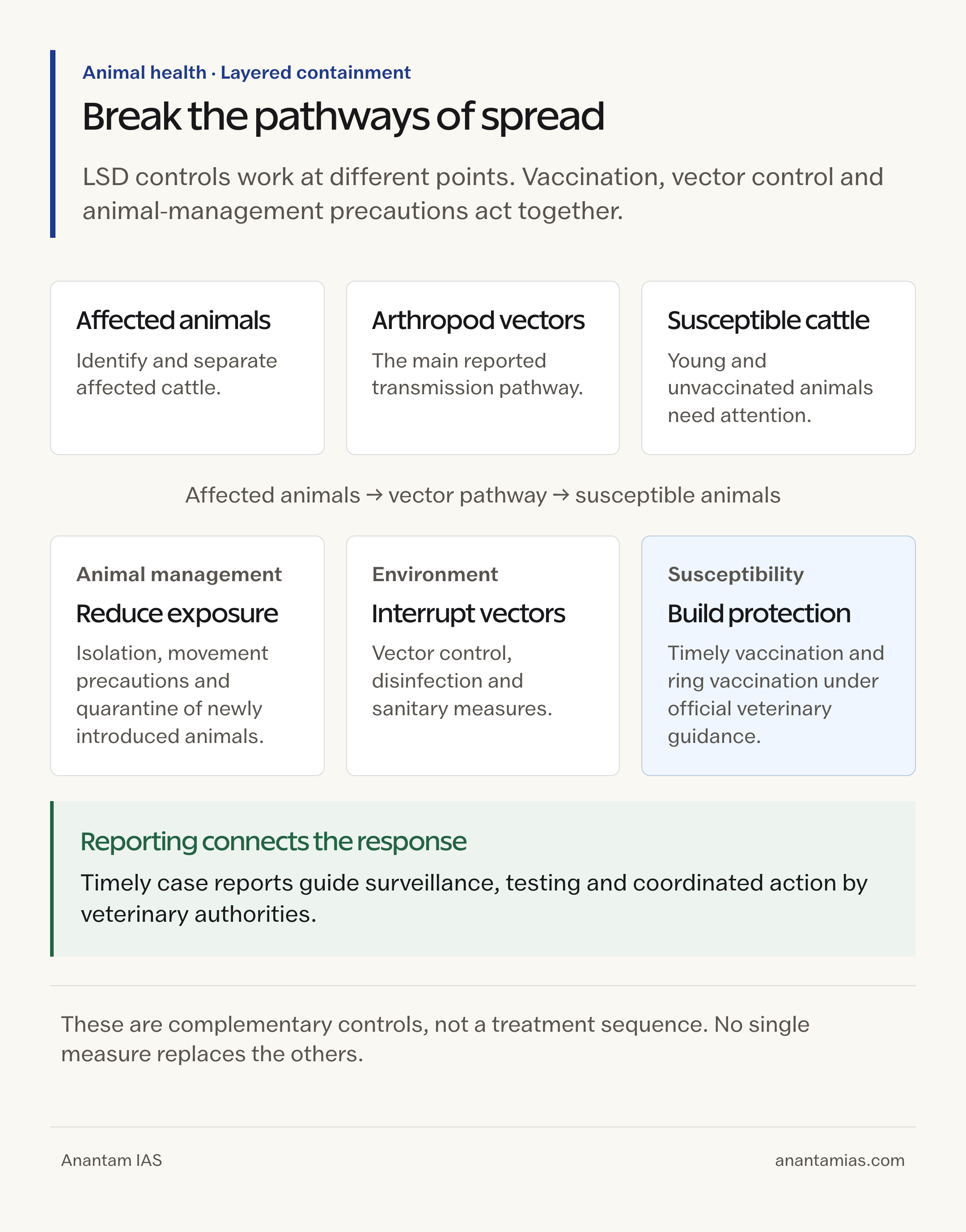
The measures address different parts of containment: susceptible animals, opportunities for spread, and the information needed to organise a response.
- Vaccination is the preventive component directed at animal susceptibility. Ring vaccination focuses protection around affected areas; the release does not prescribe a universal operational radius or announce a new vaccine approval.
- Vector control addresses the principal transmission mechanism identified by DAHD. It complements vaccination because disease management must consider opportunities for vector-mediated spread as well as the protection of animals at risk.
- Isolation and movement control address the management of affected animals and their movement between locations. These precautions belong within the wider containment plan and do not replace action against arthropod vectors.
- Quarantine of newly introduced animals addresses entry into an existing animal group. It differs from isolation of animals already affected, so the two terms should not be treated as interchangeable containment measures.
- Timely reporting gives authorities information to assess the situation and organise action. Vaccination, movement precautions and vector control become harder to target when local disease incidents remain absent from official reporting channels.
Turn surveillance into a coordinated response
Surveillance is useful when information leads to field assessment, diagnostic support and practical follow-up across administrative boundaries.
- Centre-State coordination links national technical guidance with implementation in States and Union Territories. DAHD describes ongoing review, vaccination support and assistance for veterinary capacity, rather than a response confined to one affected district.
- Diagnostic capacity supports the investigation of disease reports. DAHD identifies technical support from ICAR-NIHSAD, Bhopal, and a laboratory network; recording a report and establishing its diagnostic basis are related but distinct tasks.
- Field assessment can check whether reported conditions match the operational response. The central expert team’s deployment to Uttar Pradesh illustrates how technical oversight can connect national monitoring with conditions encountered by State authorities.
- Transparent reporting should support early action rather than be judged solely by low case totals. An apparent absence of cases is less informative if reporting and diagnostic access are weak in that location.
- Preparedness in unaffected areas remains part of DAHD’s approach. Preventive measures outside currently affected locations recognise that response planning must consider newly introduced animals and continuing susceptibility, not only the existing case list.
Way Forward
Close the gap between reporting and field action
- Review local vaccination gaps, especially among young animals, instead of relying only on the cumulative vaccination/revaccination total.
- Connect incident reports with diagnostic and field follow-up so authorities can target containment measures to the actual situation.
- Assess vaccination, vector control and movement precautions together; completion of one activity should not stand in for the full containment response.
Conclusion
- LSD containment combines protection of susceptible animals, precautions against spread and timely information. Its strength lies in coordinated implementation of complementary measures across veterinary and administrative services.
- In an answer, distinguish programme activity from protection gaps and the dated national assessment from local risk; use the response to explain why surveillance must lead to targeted action.
UPSC Practice Questions
Prelims MCQ 1
With reference to India’s Lumpy Skin Disease response, consider the following statements:
- DAHD identifies arthropod vectors as the principal means of transmission.
- A cumulative vaccination and revaccination total necessarily equals the number of distinct animals immunised.
- Quarantine of newly introduced animals differs from isolation of affected animals.
How many of the above statements are correct?
(a) Only one (b) Only two (c) All three (d) None
Answer: (b) Only two
Explanation:
Statements 1 and 3 are correct. A total that includes revaccination cannot be treated as a count of distinct animals immunised.
Prelims MCQ 2
Why are vaccination and vector control complementary in the LSD response?
(a) Both are only methods for reporting cases (b) Vector control establishes the number of animals vaccinated (c) They address animal susceptibility and opportunities for vector-mediated spread respectively (d) Vaccination eliminates the need for surveillance
Answer: (c) They address animal susceptibility and opportunities for vector-mediated spread respectively
Explanation:
The response combines prevention in animals with action against the vectors involved in transmission. Reporting and surveillance remain necessary to guide containment.
UPSC Mains Questions
- Explain why livestock disease containment requires vaccination, vector control, movement precautions and surveillance to work together.
- A large cumulative vaccination total does not establish the absence of local protection gaps. Discuss with reference to India’s Lumpy Skin Disease response.
Source: PIB, Department of Animal Husbandry and Dairying.
Frequently Asked Questions
What did DAHD report on 8 September 2026?
DAHD reported 3,461 active LSD cases and described the situation as under control, while continuing vaccination, surveillance and containment measures. This is a dated official assessment, not a declaration of elimination.
Does the vaccination figure count distinct cattle?
DAHD’s figure includes vaccination and revaccination. It should not be presented as a count of distinct cattle immunised, nor used alone to establish that local protection gaps have disappeared.
Why is vector control part of the response?
DAHD identifies arthropod vectors as the principal transmission mechanism. Vector control addresses opportunities for spread and complements measures directed at animals, including vaccination, isolation and movement precautions within the containment response.
How does reporting support containment?
Timely and transparent reporting helps authorities assess where disease incidents occur and organise follow-up. Its value lies in connecting information with diagnostic support, field assessment and appropriately targeted containment measures.