LVM3 Semi-Cryogenic Upgrade: Full-Thrust Power-Head Test
Why in News?
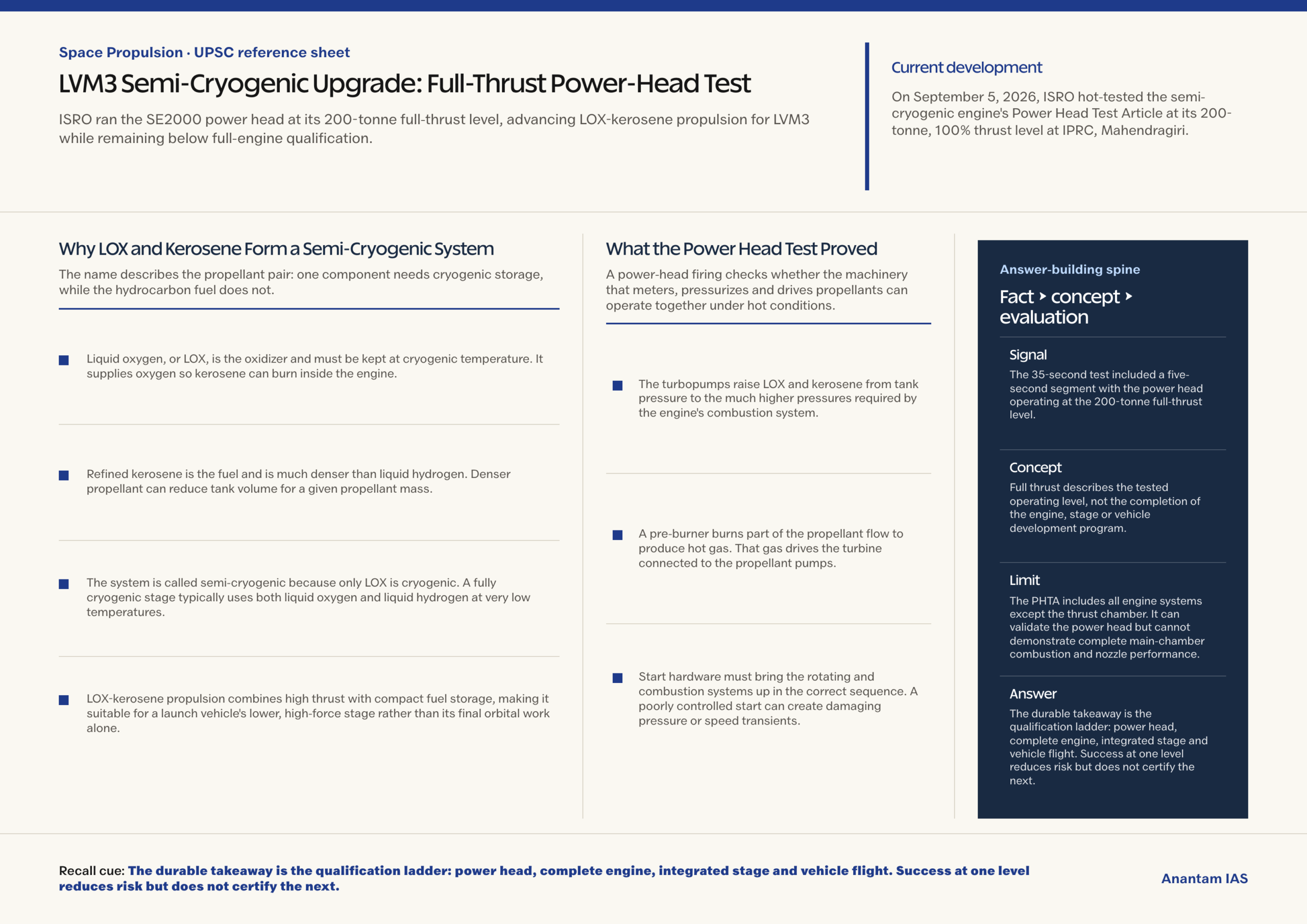
On September 5, 2026, ISRO hot-tested the semi-cryogenic engine’s Power Head Test Article at its 200-tonne, 100% thrust level at IPRC, Mahendragiri.
- The 35-second test included a five-second segment with the power head operating at the 200-tonne full-thrust level.
- ISRO described it as the ninth PHTA hot test and the first operation of this article at 100% thrust.
- The test also validated switching propellant supply from a low-pressure start tank to a medium-pressure run tank for later long-duration testing.
- The PHTA excludes the thrust chamber, so the result is not qualification of the complete SE2000 engine, SC120 stage or a flight system.
- The power head is the engine’s propellant-feeding and turbine-driving core. Stable operation must come before the complete engine can sustain controlled combustion in its main chamber.
- The development matters because the planned SC120 stage would replace LVM3’s current L110 core stage and contribute to higher payload capability.
UPSC Relevance
Prelims Relevance
- A semi-cryogenic engine pairs cryogenic liquid oxygen with a hydrocarbon fuel such as refined kerosene.
- The SE2000 is a 2,000 kN-class engine planned to power the SC120 semi-cryogenic stage.
- The PHTA contains engine systems including turbopumps, pre-burner, start system and controls, but excludes the thrust chamber.
- The SC120 stage is being developed to replace the L110 liquid core stage of LVM3.
- ISRO’s SE2000 uses an oxidizer-rich staged-combustion cycle, in which pre-burner gas drives turbomachinery before the main combustion process.
Mains Relevance
GS Paper 3
- Achievements of Indians in science and technology: indigenous development of high-thrust liquid propulsion and associated test infrastructure.
- Awareness in the fields of space: how propulsion efficiency and stage architecture influence launch-vehicle payload capability.
Essay
- Complex technologies mature through staged testing, where each verified subsystem closes one risk without pretending that the whole system is ready.
Background and Context
Why LOX and Kerosene Form a Semi-Cryogenic System
The name describes the propellant pair: one component needs cryogenic storage, while the hydrocarbon fuel does not.
- Liquid oxygen, or LOX, is the oxidizer and must be kept at cryogenic temperature. It supplies oxygen so kerosene can burn inside the engine.
- Refined kerosene is the fuel and is much denser than liquid hydrogen. Denser propellant can reduce tank volume for a given propellant mass.
- The system is called semi-cryogenic because only LOX is cryogenic. A fully cryogenic stage typically uses both liquid oxygen and liquid hydrogen at very low temperatures.
- LOX-kerosene propulsion combines high thrust with compact fuel storage, making it suitable for a launch vehicle’s lower, high-force stage rather than its final orbital work alone.
- The trade-off is demanding combustion hardware. Pumps, seals, valves and materials must handle large flows, high pressures and hot oxygen-rich gas without unstable operation.
What the Power Head Test Proved
A power-head firing checks whether the machinery that meters, pressurizes and drives propellants can operate together under hot conditions.
- The turbopumps raise LOX and kerosene from tank pressure to the much higher pressures required by the engine’s combustion system.
- A pre-burner burns part of the propellant flow to produce hot gas. That gas drives the turbine connected to the propellant pumps.
- Start hardware must bring the rotating and combustion systems up in the correct sequence. A poorly controlled start can create damaging pressure or speed transients.
- Control components regulate valves, flows and operating transitions. The September test showed expected parameters while the PHTA reached its rated 200-tonne operating level for five seconds.
- The tank switchover matters because a brief start supply cannot support a long firing. Moving to the run tank is a prerequisite for extended power-head tests.
Where the Test Sits in Qualification
Full thrust describes the tested operating level, not the completion of the engine, stage or vehicle development program.
- The PHTA includes all engine systems except the thrust chamber. It can validate the power head but cannot demonstrate complete main-chamber combustion and nozzle performance.
- A complete-engine test must integrate the power head with the thrust chamber and show that their pressures, flows, cooling and combustion remain compatible across the required operating envelope.
- Longer firings then build evidence on steady operation and durability. A five-second full-thrust segment is a milestone, but it does not establish mission-duration performance.
- Stage qualification adds tanks, feed lines, structures, controls and integrated operations around the engine. Vehicle-level work must later show that the stage functions within LVM3.
- The planned SC120, paired with an uprated C32 cryogenic upper stage, is intended to raise LVM3 payload capability. This test advances that path without completing it.
Way Forward
Move From Rated Power to Integrated Endurance
The next evidence must connect short power-head performance to longer, complete-engine and stage-level operation.
- ISRO should extend PHTA firing duration after validating the start-to-run tank transition and examine whether key pressures, temperatures and turbopump speeds remain stable.
- Complete-engine tests should integrate the thrust chamber and verify combustion stability, cooling and control across start-up, rated operation and shutdown.
- Stage testing should validate propellant tanks, feed systems, structures and controls under conditions representing the planned SC120 operating envelope.
- Payload gains should be treated as a vehicle-level outcome only after engine, stage and LVM3 integration are demonstrated through the required qualification sequence.
Conclusion
- The 200-tonne PHTA test shows that SE2000’s power-head systems can reach their rated design operating level, including a controlled transition to the run-tank supply.
- The durable takeaway is the qualification ladder: power head, complete engine, integrated stage and vehicle flight. Success at one level reduces risk but does not certify the next.
UPSC Practice Questions
Prelims MCQ 1
With reference to ISRO’s semi-cryogenic propulsion program, consider the following statements:
- The SE2000 uses liquid oxygen and refined kerosene as propellants.
- The Power Head Test Article includes the thrust chamber and nozzle.
- The SC120 stage is planned to replace LVM3’s L110 core stage.
How many of the above statements are correct?
(a) Only one (b) Only two (c) All three (d) None
Answer: (b) Only two
Explanation:
Statements 1 and 3 are correct. ISRO states that the PHTA encompasses the engine systems except the thrust chamber.
Prelims MCQ 2
What did ISRO’s September 5, 2026 SE2000 test directly demonstrate?
(a) A completed SC120 flight demonstration (b) Full qualification of the complete SE2000 engine (c) PHTA operation at the 200-tonne level for five seconds within a 35-second test (d) Replacement of the L110 stage on an operational LVM3 mission
Answer: (c) PHTA operation at the 200-tonne level for five seconds within a 35-second test
Explanation:
The test reached 100% power-head thrust level, but the article excluded the thrust chamber and was not a complete-engine, stage or flight qualification.
UPSC Mains Questions
- Explain why power-head testing is a distinct stage in the qualification of a high-thrust liquid rocket engine. What additional evidence is required before flight use?
- Discuss how LOX-kerosene semi-cryogenic propulsion can influence LVM3 payload capability, while distinguishing a subsystem milestone from engine, stage and vehicle qualification.
Sources: Indian Space Research Organisation and Indian Space Research Organisation, SE2000 development update.
Frequently Asked Questions
What is a Power Head Test Article?
It is an intermediate engine configuration used to test the propellant-feed and turbine-driving systems together. ISRO’s PHTA includes the engine systems except the thrust chamber.
Why is the engine called semi-cryogenic?
Its liquid-oxygen oxidizer requires cryogenic storage, while refined kerosene is a hydrocarbon fuel stored without the extreme cooling needed for liquid hydrogen.
Did the test qualify the complete SE2000 engine?
No. It operated the PHTA at the full-thrust level, but the article excluded the thrust chamber. Complete-engine integration, longer tests and later qualification stages remain separate steps.
What was achieved during the 35-second test?
The PHTA operated at the 200-tonne, 100% level for five seconds, and ISRO also validated switching propellant supply from the start tank to the run tank.
How could the SC120 stage affect LVM3?
ISRO plans SC120 as a replacement for the L110 core stage. Combined with an uprated C32 upper stage, it is intended to enhance LVM3’s payload capability.