Uniform Civil Code: Madhya Pradesh Fast-Tracks a UCC Bill Amid Tribal Concerns
Why in News?
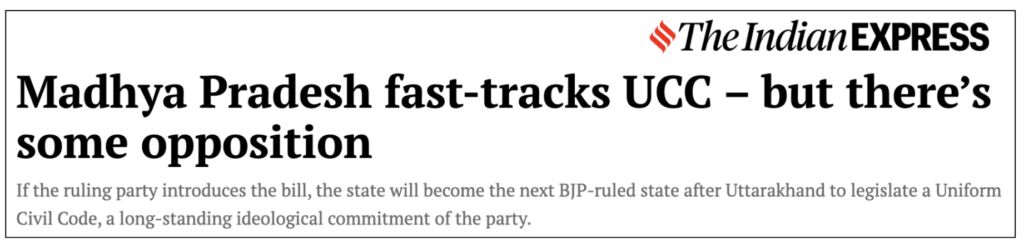
Madhya Pradesh Chief Minister Mohan Yadav announced that a Uniform Civil Code (UCC) Bill will be introduced and passed in the state Assembly’s monsoon session. If enacted, Madhya Pradesh would become the next BJP-ruled state after Uttarakhand to legislate a UCC, reviving the long-pending Article 44 Directive Principle.
The move has triggered opposition from tribal organisations and the Congress, who want the Scheduled Tribe communities exempted as their customary laws on marriage, succession and inheritance are protected under the Constitution.
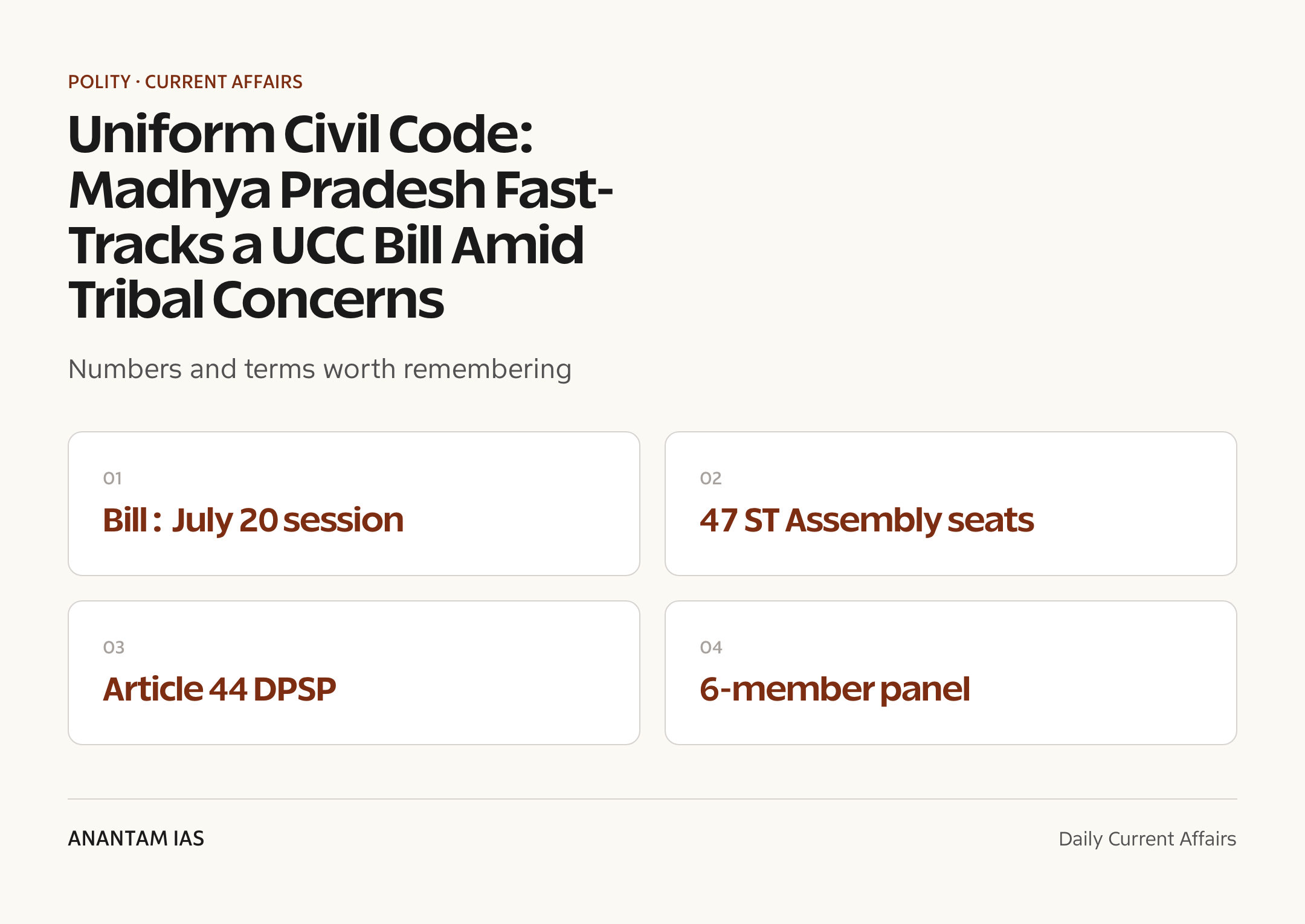
- A six-member committee headed by a former Supreme Court judge was constituted to study existing personal laws and prepare a draft framework.
- The proposed law would cover marriage, divorce, maintenance, inheritance, adoption and the regulation of live-in relationships.
- Tribal communities make up over a fifth of MP’s population; the state has 47 Assembly seats reserved for STs.
- Congress leaders demanded clarity on whether the Scheduled Tribes will be exempted, as was done in Uttarakhand.
- Adivasi groups invoked the Fifth Schedule and the PESA Act to argue that customary laws form an integral part of tribal identity.
The development matters in the context of:
- The UCC sits at the intersection of Article 44 (DPSP), Articles 25-26 (religious freedom) and constitutional protections for tribal autonomy.
- After Uttarakhand (2024), MP would extend the state-level UCC trend, raising federalism and uniformity questions absent a central law.
UPSC Relevance
Prelims Relevance
- Article 44 — UCC is a Directive Principle of State Policy (non-justiciable).
- DPSPs lie in Part IV of the Constitution; not enforceable by courts (Article 37).
- Article 25-26 — freedom of religion and management of religious affairs.
- Article 366(25) defines ‘Scheduled Tribes’.
- Fifth Schedule — administration of Scheduled Areas and STs (excludes the North-East).
- Sixth Schedule — tribal areas in Assam, Meghalaya, Tripura and Mizoram with Autonomous District Councils.
- PESA Act, 1996 — extends Panchayati Raj (Part IX) to Scheduled Areas, protecting customary law.
- Concurrent List — marriage, divorce, succession and adoption fall under Entry 5, letting states legislate.
- Uttarakhand became the first state to enact a UCC in 2024; STs were exempted.
- Shah Bano (1985) and Sarla Mudgal (1995) — courts urged enacting a UCC.
Mains Relevance
GS Paper 2
- Significance of Article 44 and the constitutionality of state-level UCCs in a federal polity.
- Reconciling a UCC with Articles 25-26 and the autonomy of tribal customary law under the Fifth Schedule and PESA.
GS Paper 1
- Diversity of personal laws and tribal customs in Indian society; identity and social reform.
Essay
- Uniformity versus diversity: can one civil code serve a plural society?
- Reform without erasure — balancing gender justice and cultural autonomy.
Background and Context
Article 44 and the UCC idea
The Constitution aspires to a common civil code but leaves it to the state’s discretion.
- Article 44 directs the State to ‘endeavour to secure for the citizens a uniform civil code throughout the territory of India’.
- It is a Directive Principle (Part IV) — non-justiciable under Article 37, so no citizen can compel its enactment.
- A UCC would replace community-specific personal laws on marriage, divorce, succession, maintenance, adoption and guardianship with one common set of rules.
- The framers in the Constituent Assembly deferred a mandatory UCC, treating it as a goal to be approached gradually as society readied for it.
- The aim is legal uniformity, equality and gender justice across communities, the MP government has argued.

Judicial nudges over the decades
Courts have repeatedly flagged the absence of a UCC without striking down personal laws.
- In Shah Bano (1985), the Supreme Court granted maintenance to a divorced Muslim woman and lamented that Article 44 ‘remained a dead letter’.
- In Sarla Mudgal (1995) and John Vallamattom (2003), the Court again urged the government to consider a UCC.
- The judiciary has stressed it is for Parliament and legislatures, not courts, to frame such a code.
- The 21st Law Commission (2018) held that a UCC was ‘neither necessary nor desirable at this stage’, favouring reform within each personal law instead.
- The 22nd Law Commission (2023) sought fresh public and religious-body views on the issue.
The Uttarakhand precedent (2024)
Uttarakhand set the template MP is now expected to follow, including a tribal carve-out.
- The Uniform Civil Code of Uttarakhand Act, 2024, made it the first Indian state to enact a UCC; rules were notified in January 2025.
- It standardised marriage, divorce, inheritance and live-in relationship registration across communities.
- Crucially, it exempted Scheduled Tribes defined under Article 366(25), plus persons whose customary rights are protected under Part XXI of the Constitution.
- Much of the code drew on the Hindu Marriage Act, 1955 and the Hindu Succession Act, 1956, which themselves do not apply to ST communities.
- Critics noted the ST exemption exposes a tension at the heart of the ‘uniform’ label.
Tribal autonomy: Fifth Schedule, PESA and custom
Adivasi groups in MP argue that their customary laws enjoy distinct constitutional protection.
- The Fifth Schedule empowers the Governor to direct that any law shall not apply, or apply with modifications, to a Scheduled Area.
- The PESA Act, 1996, mandates that Gram Sabhas in Scheduled Areas safeguard community resources and the ‘customs, religious beliefs and traditional management practices’ of tribes.
- Tribal customary laws on marriage, succession and social relations often differ sharply from Hindu, Muslim or general civil law.
- Several Adivasi bodies and the Congress’s Umang Singhar warned a blanket UCC could dilute these safeguards and ‘erase’ tribal identity.
- Groups practising distinct faiths, such as Sarna, have raised similar concerns about losing customary inheritance systems.
Sixth Schedule and the federalism question
The North-East has a separate protective regime, and state-by-state UCCs raise uniformity puzzles.
- The Sixth Schedule grants Autonomous District Councils in Assam, Meghalaya, Tripura and Mizoram power to make laws on marriage, inheritance and social custom.
- Articles 371A (Nagaland) and 371G (Mizoram) protect Naga and Mizo customary law and procedure from parliamentary override without consent.
- Marriage, divorce, succession and adoption sit in the Concurrent List (Entry 5), letting states legislate but inviting central conflict if a national UCC ever follows.
- A patchwork of state UCCs with varying exemptions risks a ‘uniform’ code that differs across India, undercutting the very rationale of Article 44.
- Article 254 would let a central law override conflicting state UCCs, leaving the present state-led drive provisional.
Religious freedom and the equality balance
The debate weighs Articles 25-26 against equality and gender-justice goals.
- Articles 25-26 guarantee freedom of conscience and the right of religious denominations to manage their own affairs, subject to public order, morality and health.
- Supporters argue that a UCC advances Article 14 equality and women’s rights in maintenance, inheritance and divorce.
- Opponents counter that personal laws are tied to religious and cultural identity, protected by the freedom-of-religion guarantees.
- The MP committee has been asked to examine provisions on women’s rights, children’s welfare and live-in relationships.
- How the bill draws the line between essential religious practice and reformable civil matter will shape any legal challenge.
Way Forward
Consultation and consent
- Hold genuine consultation with tribal Gram Sabhas under PESA and with religious bodies before tabling the bill.
- Spell out clearly whether and how Scheduled Tribes will be exempted, avoiding ambiguity over the ‘uniform’ claim.
Reform within, not erasure
- Target gender-just outcomes — equal inheritance, maintenance and consent in marriage — that most communities can accept.
- Preserve protected customary law under the Fifth Schedule, Sixth Schedule and Articles 371A/371G where it operates.
A durable solution may require a national conversation, possibly a fresh Law Commission consensus and parliamentary debate, rather than a fragmented set of state codes with differing carve-outs.
Conclusion
Madhya Pradesh’s UCC push turns a constitutional aspiration in Article 44 into live legislative politics, following the path Uttarakhand opened in 2024.
Its success will be judged less by speed than by how it reconciles equality and gender justice with religious freedom under Articles 25-26 and the protected customary autonomy of India’s tribal communities.
UPSC Practice Questions
Prelims MCQ 1
With reference to the Uniform Civil Code in the Indian constitutional scheme, consider the following statements:
- Article 44 places the Uniform Civil Code among the Fundamental Rights.
- Directive Principles of State Policy are not enforceable by any court.
- Marriage, divorce and succession fall under the Concurrent List.
How many of the above statements are correct?
(a) Only one (b) Only two (c) All three (d) None
Answer: (b) Only two
Explanation:
Article 44 is a Directive Principle (Part IV), not a Fundamental Right, so statement 1 is wrong. DPSPs are non-justiciable under Article 37 (statement 2 correct). Marriage, divorce, succession and adoption are in the Concurrent List, Entry 5 (statement 3 correct).
Prelims MCQ 2
Which constitutional provision was used to define and exempt Scheduled Tribes under the Uttarakhand UCC, 2024?
(a) Article 244(1)
(b) Article 366(25)
(c) Article 342
(d) Article 164
Answer: (b) Article 366(25)
Explanation:
Article 366(25) supplies the constitutional definition of ‘Scheduled Tribes’. The Uttarakhand UCC exempted STs within that meaning, read with protections under Part XXI, leaving their customary law untouched.
UPSC Mains Questions
- The Uniform Civil Code remains an unfulfilled Directive Principle. Examine the constitutional, federal and social challenges in legislating a UCC at the state level, with reference to recent moves in Uttarakhand and Madhya Pradesh. (250 words)
- Tribal customary law enjoys distinct constitutional protection in India. Discuss how a Uniform Civil Code can be reconciled with the safeguards available under the Fifth Schedule, the Sixth Schedule and the PESA Act. (250 words)
Sources: The Indian Express and Outlook India.
Frequently Asked Questions
What is the Uniform Civil Code (UCC)?
A Uniform Civil Code is a single set of laws governing personal matters such as marriage, divorce, maintenance, inheritance and adoption for all citizens, replacing community-specific personal laws. Article 44 of the Constitution directs the State to endeavour to secure such a code, but it is a non-justiciable Directive Principle, so no one can force its enactment through the courts.
Why is Madhya Pradesh in the news over the UCC?
Chief Minister Mohan Yadav announced that a UCC Bill will be introduced and passed in the state Assembly’s monsoon session beginning July 20, 2026. A six-member committee headed by a former Supreme Court judge is preparing a draft. If enacted, Madhya Pradesh would become the next BJP-ruled state after Uttarakhand to legislate a UCC.
Why do tribal groups oppose the UCC?
Adivasi organisations argue their customary laws on marriage, succession and social relations are integral to tribal identity and are protected by the Constitution. They point to the Fifth Schedule and the PESA Act, 1996, which safeguard the traditions and management practices of communities in Scheduled Areas, and demand that Scheduled Tribes be exempted from the proposed law.
How did Uttarakhand handle tribal communities in its UCC?
The Uniform Civil Code of Uttarakhand Act, 2024, the first state UCC, exempted Scheduled Tribes defined under Article 366(25), along with persons whose customary rights are protected under Part XXI of the Constitution. Much of the code drew on Hindu personal laws, which themselves do not apply to ST communities, making the exemption both practical and constitutionally necessary.
Can states make their own UCC?
Yes. Marriage, divorce, succession and adoption fall under the Concurrent List (Entry 5), so state legislatures can enact civil-code laws with the President’s assent. Uttarakhand did so in 2024. However, under Article 254, a future central UCC could override conflicting state codes, making the present state-led drive provisional rather than final.
What constitutional articles are central to the UCC debate?
Article 44 (the Directive Principle on a UCC) and Article 37 (non-justiciability of DPSPs) frame the goal. Articles 25-26 protect religious freedom and community affairs. Article 366(25) defines Scheduled Tribes, while the Fifth Schedule, Sixth Schedule, Articles 371A and 371G and the PESA Act protect tribal customary autonomy.