Maharashtra Earthquake Swarm: What Repeated Small Tremors Reveal
Why in News?
Maharashtra recorded a concentrated sequence of small, mostly shallow earthquakes through late July and the first half of August 2026, with the activity centred mainly around northern Nashik and additional events recorded in Palghar and Nagpur.
- Reporting based on the official earthquake catalogue counted 29 Maharashtra events between 30 July and 14 August: 24 around Nashik, four in Palghar and one near Nagpur.
- The reported magnitudes ranged from 2.0 to 4.3. National Center for Seismology records show the magnitude 4.3 event near Nashik on 8 August at a reviewed depth of 5 km.
- The official catalogue also shows multiple reviewed Nashik events on 13 and 14 August, many at depths of about 3-6 km, supporting the description of a continuing shallow, localised cluster.
- Repeated light shaking can alarm residents even without major damage. The policy need is to communicate what is known, inspect vulnerable structures and improve the local seismic record without claiming that a larger event can be.
- The Maharashtra sequence is an intraplate problem within the Indian peninsula. It is different from the 15 August Indonesia topic, which concerned a plate-boundary subduction setting and associated tsunami-generating mechanisms.
- A swarm is defined by the pattern of the sequence, not merely by the number of earthquakes. Several nearby events of comparable scale occur without an obvious mainshock-aftershock hierarchy.
- Small magnitude does not equal zero risk. Shallow tremors may be felt strongly near their source, while weak masonry, falling objects, panic and unsafe evacuation can create secondary harm.
- Earthquake catalogues are revised as analysts improve event locations, depths and magnitudes. Public communication should distinguish preliminary detections from reviewed events.
UPSC Relevance
Prelims Relevance
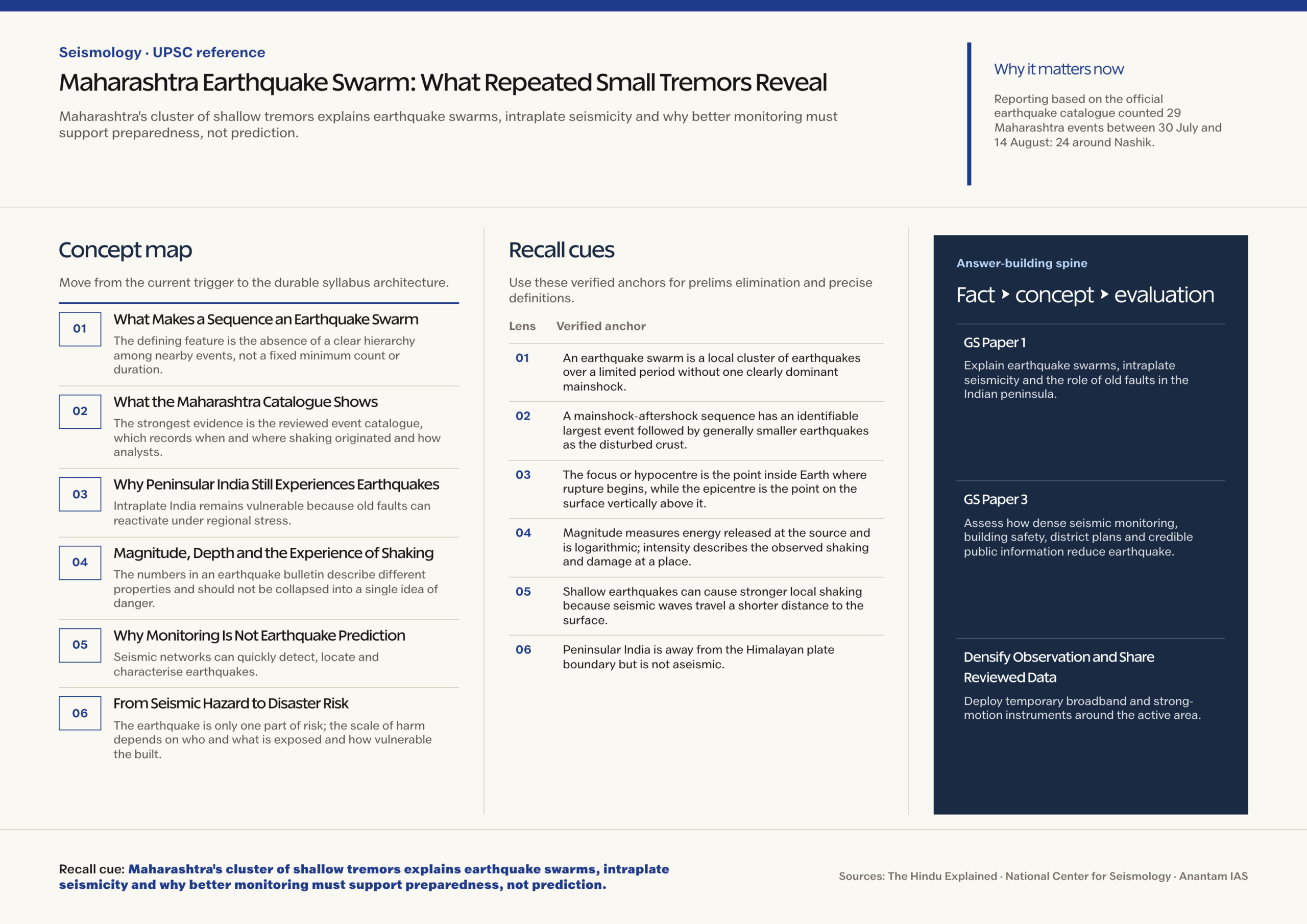
- An earthquake swarm is a local cluster of earthquakes over a limited period without one clearly dominant mainshock.
- A mainshock-aftershock sequence has an identifiable largest event followed by generally smaller earthquakes as the disturbed crust readjusts; the largest event may be recognised only after the sequence evolves.
- The focus or hypocentre is the point inside Earth where rupture begins, while the epicentre is the point on the surface vertically above it.
- Magnitude measures energy released at the source and is logarithmic; intensity describes the observed shaking and damage at a place, so one earthquake can produce different intensities at different locations.
- Shallow earthquakes often cause stronger local shaking than equally sized deeper events because seismic waves travel a shorter distance to the surface.
- Peninsular India is away from the Himalayan plate boundary but is not aseismic. Old faults within the continental crust can be reactivated by the regional stress field, producing intraplate earthquakes.
Mains Relevance
GS Paper 1
- Explain earthquake swarms, intraplate seismicity and the role of old faults in the Indian peninsula.
- Distinguish magnitude, intensity, depth, epicentre and hypocentre when interpreting earthquake reports.
GS Paper 3
- Assess how dense seismic monitoring, building safety, district plans and credible public information reduce earthquake risk.
- Examine the limits of prediction and the need for uncertainty-aware communication during an evolving sequence.
Essay
- Preparedness begins by respecting uncertainty: science can narrow risk and guide action even when it cannot predict an event.
Background and Context
What Makes a Sequence an Earthquake Swarm
The defining feature is the absence of a clear hierarchy among nearby events, not a fixed minimum count or duration.
- In a conventional sequence, a relatively large mainshock releases substantial stress and is followed by aftershocks around the ruptured zone. Their rate commonly declines with time, although individual aftershocks can still be damaging.
- In a swarm, many earthquakes occur within a restricted area over days, weeks or longer, and several events may have comparable magnitudes. No one event initially explains the rest as its aftershocks.
- The label can remain provisional while data accumulate. If a later, larger earthquake occurs, seismologists may reinterpret earlier events as foreshocks; a foreshock is identified retrospectively, not predicted in advance from its size alone.
- A swarm also differs from unrelated earthquakes spread across a wide region. Spatial clustering, timing, depths, waveform evidence and the local fault structure are examined together before a scientific interpretation is made.
- For public policy, the safe message is neither panic nor reassurance without evidence: an ongoing swarm warrants observation and preparedness, but it does not prove that a destructive earthquake is imminent.
What the Maharashtra Catalogue Shows
The strongest evidence is the reviewed event catalogue, which records when and where shaking originated and how analysts classified each event.
- Between 30 July and 14 August, the reported Maharashtra set comprised 29 earthquakes: 24 around Nashik, four in Palghar and one near Nagpur. Most of the tightly clustered activity lay north or north-northwest of Nashik.
- The National Center for Seismology listed a reviewed magnitude 4.3 earthquake at 22:00:59 IST on 8 August, about 48 km north-northwest of Nashik, at a depth of 5 km. It was the largest event in the.
- The catalogue recorded repeated reviewed events around Nashik on 13-14 August, including several magnitudes in the high-2 to mid-3 range at shallow depths. This persistence, rather than any single tremor, is the newsworthy pattern.
- A Palghar pair on 10 August and an isolated Nagpur event on the same day appear in the wider state count, but they should not automatically be assumed to arise from one continuous fault rupture. Fine.
- No coordinates are needed to understand the lesson. The official region labels and relative descriptions are sufficient; an invented map or guessed fault trace would add false precision.
Why Peninsular India Still Experiences Earthquakes
Distance from an active plate margin reduces some forms of hazard, but it does not make the continental interior free of seismic stress.
- The Indian plate continues to interact with surrounding plates. Stress transmitted through the plate can accumulate along ancient faults, fractures and weak zones within the peninsular crust.
- When frictional resistance is overcome, a fault segment can slip and release elastic strain as seismic waves. This mechanism can produce intraplate earthquakes far from the Himalayan collision zone or the Sunda subduction system.
- Maharashtra’s history includes destructive intraplate events, notably the 1967 Koyna and 1993 Killari earthquakes, as well as earlier swarm activity in places such as Palghar. These examples show why a stable continental region still needs seismic.
- Researchers have examined whether reservoir loading, groundwater movement or rainfall-related pore-pressure change can help trigger particular shallow sequences. Such mechanisms can alter effective stress on a fault, but they must be tested with local hydrological and.
- Calling the present activity rain-triggered on timing alone would confuse a hypothesis with a finding. Tectonic stress, local geology, fluids and observational limits must be evaluated together.
Magnitude, Depth and the Experience of Shaking
The numbers in an earthquake bulletin describe different properties and should not be collapsed into a single idea of danger.
- Magnitude expresses earthquake size at the source on a logarithmic scale. A one-unit increase represents ten times the measured wave amplitude and roughly 32 times the energy release, so small numerical differences are physically important.
- Intensity is place-specific. The same earthquake may be strongly felt near the epicentre and barely noticed farther away, depending on distance, depth, local soil, topography and building response.
- Many Maharashtra events were listed at shallow depths. Shallow sources can produce noticeable local shaking even at modest magnitudes because less energy is lost before waves reach the surface.
- Damage cannot be inferred from magnitude alone. Unreinforced masonry, heavy unsecured objects, soft-storey buildings and structures on amplifying soils may perform worse than code-compliant construction.
- Event depth and location also carry uncertainty, especially when nearby stations are sparse. Temporary local instruments can improve detection of microearthquakes and reduce uncertainty in the geometry of a swarm.
Way Forward
Densify Observation and Share Reviewed Data
- Deploy temporary broadband and strong-motion instruments around the active area, integrate them with national and state stations, and retain the network long enough to capture how the sequence evolves.
- Publish reviewed event parameters, uncertainty notes and plain-language sequence updates through one coordinated channel linking NCS, district authorities and Maharashtra SDMA.
- Combine seismology with geological field mapping and, where scientifically justified, hydrological observations to test triggering hypotheses rather than announcing them prematurely.
Conclusion
- Maharashtra’s repeated tremors matter less as a countdown to an assumed large earthquake than as evidence that peninsular seismic risk is real, local and scientifically complex.
- The sound response is disciplined observation joined with vulnerability reduction: improve the local catalogue, test hypotheses, inspect weak structures, enforce safer construction and communicate uncertainty honestly.
UPSC Practice Questions
Prelims MCQ 1
With reference to earthquake swarms, consider the following statements:
- An earthquake swarm necessarily begins with one clearly dominant mainshock.
- A foreshock can be identified with certainty before a larger earthquake occurs.
- An earthquake swarm may comprise many local events of comparable magnitude over days or weeks.
How many of the above statements are correct?
(a) Only one (b) Only two (c) All three (d) None
Answer: (a) Only one
Explanation:
Only statement 3 is correct. A swarm lacks one clearly dominant mainshock. An event is called a foreshock only retrospectively after a larger event follows; it cannot be identified with certainty beforehand.
Prelims MCQ 2
Which one of the following best explains why a modest shallow earthquake may be strongly felt near its source?
(a) Magnitude and intensity are identical at every location (b) Seismic waves travel a shorter distance before reaching the surface (c) All shallow earthquakes occur at plate boundaries (d) Shallow depth guarantees severe structural damage
Answer: (b) Seismic waves travel a shorter distance before reaching the surface
Explanation:
A shallow source allows seismic energy to reach nearby ground with less travel and attenuation. Felt intensity still varies with distance, local geology and buildings, and shallow depth alone does not guarantee damage.
UPSC Mains Questions
- Earthquake swarms challenge both scientific interpretation and public communication. Explain how a swarm differs from a mainshock-aftershock sequence and suggest a risk-management strategy for the recent Maharashtra cluster. (250 words)
- Peninsular India is relatively stable but not aseismic. Discuss the origin of intraplate earthquakes and the measures needed to reduce their disaster risk. (250 words)
Sources: The Hindu Explained and National Center for Seismology.
Frequently Asked Questions
What is an earthquake swarm?
An earthquake swarm is a cluster of earthquakes in a limited area over a relatively short period without one clearly dominant mainshock. Several events may have comparable magnitudes. The classification depends on the evolving spatial and temporal pattern, so scientists.
How is a swarm different from aftershocks?
Aftershocks follow an identifiable mainshock and occur as the surrounding crust readjusts. A swarm has no obvious mainshock controlling the sequence. A small event cannot be labelled a foreshock with certainty when it occurs; that label is applied only if.
Does Maharashtra’s swarm predict a larger earthquake?
No. The cluster shows ongoing local seismic activity, but it does not provide a reliable prediction of the date, place or magnitude of a future earthquake. Monitoring can refine locations, depths and fault interpretation. Authorities should pair that evidence with.
Why can earthquakes occur inside peninsular India?
Peninsular India lies away from the Himalayan plate boundary, but stresses are transmitted through the Indian plate. Ancient faults and weak zones in the continental crust can be reactivated, producing intraplate earthquakes. Maharashtra’s Koyna, Killari and Palghar experiences show that.
Can heavy rainfall trigger an earthquake swarm?
Rainwater infiltration can change pore-fluid pressure and effective stress on faults, so researchers study it as a possible trigger for some shallow swarms. A seasonal coincidence is not proof. Local seismic, geological and hydrological evidence is needed before attributing the.