Milk Traceability: Maharashtra Plans Farm-to-Market Adulteration Control
Why in News?
The Maharashtra Food and Drug Administration plans an end-to-end traceability system for milk, linking its movement from procurement and collection to processing, transport, distribution and sale.
- The plan follows a statewide compliance push covering milk collection centres, dairy plants, transporters, distributors, wholesalers and retailers.
- Operators are expected to maintain records that connect milk suppliers, collection lots, test results, processing batches, transport movements and points of sale.
- The wider compliance framework stresses cold-chain control, food-grade handling equipment, food-safety management systems and sealed, labelled, tamper-evident packaging for pasteurised milk.
- Raw milk sold to consumers is to carry a boil-before-use warning, while food handlers are expected to meet hygiene and medical-fitness requirements.
- The immediate policy concern is adulteration and synthetic milk, but traceability can also help investigate contamination, antibiotic residues, hygiene failures and breaks in temperature control.
- Milk passes through many small farms, village collection points, bulk coolers, tankers, processors and retailers. Each transfer creates an information gap that can hide dilution, substitution or unsafe handling.
- Traceability makes a lot or batch the unit of accountability. Regulators can identify where a failure entered the chain, which other lots may be affected and what stock should be isolated or recalled.
- A credible system also protects compliant farmers and dairies from unfair competition by operators who reduce costs through adulteration, mislabelling or neglect of the cold chain.
UPSC Relevance
Prelims Relevance
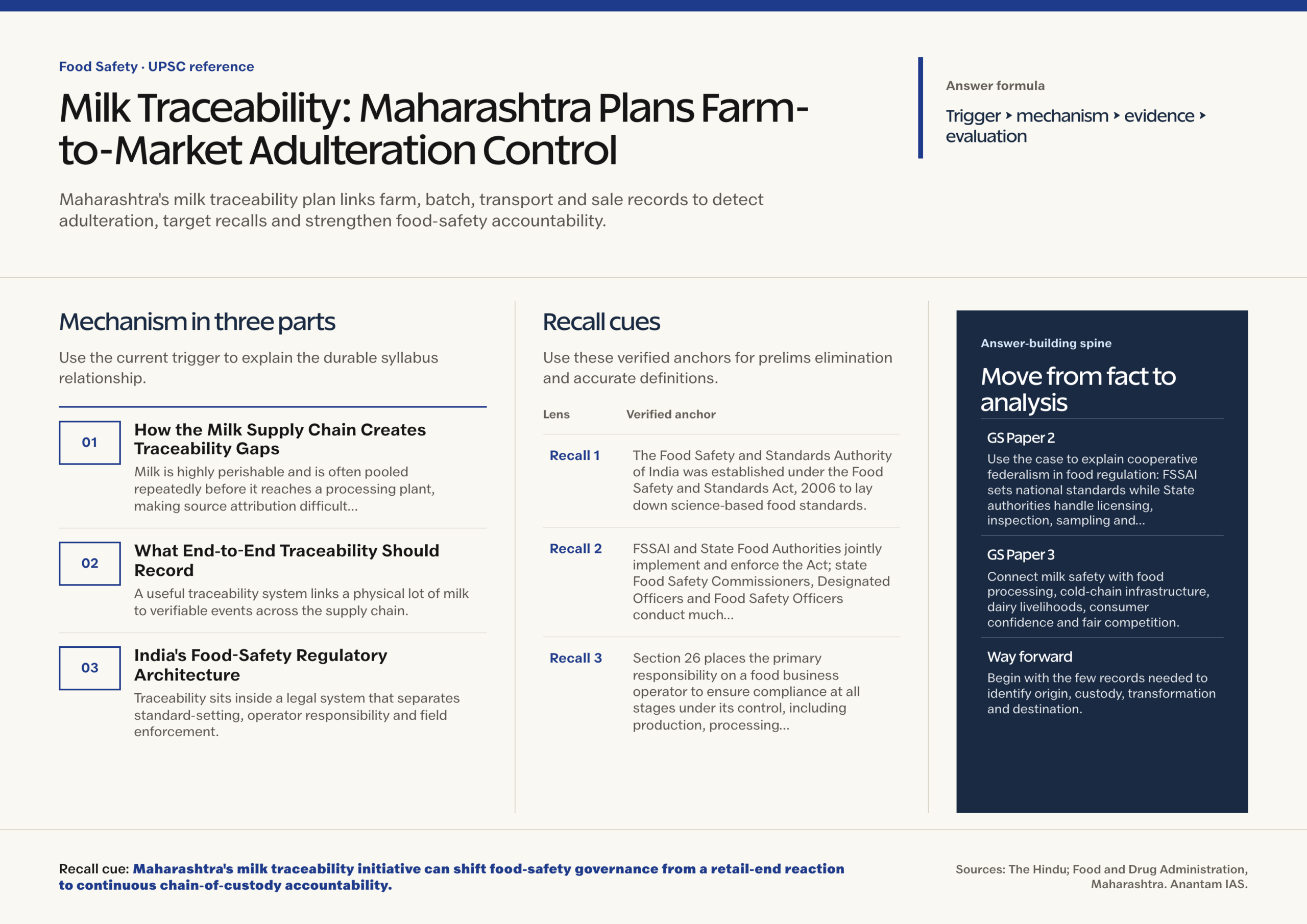
- The Food Safety and Standards Authority of India was established under the Food Safety and Standards Act, 2006 to lay down science-based food standards.
- FSSAI and State Food Authorities jointly implement and enforce the Act; state Food Safety Commissioners, Designated Officers and Food Safety Officers conduct much of the field enforcement.
- Section 26 places the primary responsibility on a food business operator to ensure compliance at all stages under its control, including production, processing, distribution and sale.
- Section 28 concerns withdrawal of non-compliant food from the market, while the Food Safety and Standards (Food Recall Procedure) Regulations, 2017 define traceability as the ability to follow a food article through specified stages.
- Section 31 requires food businesses to be licensed or registered, subject to the categories and conditions in the licensing framework.
- Maharashtra’s licensing requirements for milk-processing units include the source of milk or procurement plan and locations of milk collection centres.
Mains Relevance
GS Paper 2
- Use the case to explain cooperative federalism in food regulation: FSSAI sets national standards while State authorities handle licensing, inspection, sampling and enforcement on the ground.
- Assess traceability as a governance reform that joins records, laboratories, grievance redressal and risk-based inspection instead of relying only on periodic raids.
GS Paper 3
- Connect milk safety with food processing, cold-chain infrastructure, dairy livelihoods, consumer confidence and fair competition.
- Explain how batch-level provenance can reduce the time and scope of recalls, identify repeated high-risk nodes and protect genuine producers from market distortion.
Essay
- Trust in a food system depends not only on abundance but also on the ability to prove origin, safety and responsibility.
Background and Context
How the Milk Supply Chain Creates Traceability Gaps
Milk is highly perishable and is often pooled repeatedly before it reaches a processing plant, making source attribution difficult without disciplined lot records.
- A typical chain may include a farmer, village collector or cooperative, chilling centre, tanker, dairy processor, distributor and retailer. Milk from many animals and farms can be combined at an early stage.
- Dilution or substitution at one node may be hidden after pooling. A failed retail sample cannot automatically reveal whether the problem arose at the farm, collection point, tanker, plant or shop.
- Temperature abuse can raise microbial risk even when no chemical adulterant is added. A complete record must connect custody, time, temperature and test status, not only ownership.
- Informal procurement and handwritten ledgers can create missing, inconsistent or easily altered data. Small operators also face real costs in devices, connectivity, training and record retention.
- The policy challenge is to preserve last-mile participation while creating a reliable chain of custody. Excluding small suppliers can shift trade into less visible channels.
What End-to-End Traceability Should Record
A useful traceability system links a physical lot of milk to verifiable events across the supply chain.
- At procurement, the record should identify the supplier or collection unit, date and time, quantity, lot number and basic quality-test results such as fat and solids-not-fat.
- At chilling and processing, it should preserve reception tests, pooling or transformation events, cleaning records, processing batch numbers and release decisions.
- During transport, it should connect the source and destination, vehicle or tanker identity, seal status, dispatch and receipt times and relevant temperature records.
- At packaging and sale, the batch should link to production details, labelled identity, distribution destinations and stock movement. A code may improve retrieval, but the code is only an access key to the underlying record.
- The system must support both backward tracing to find the likely source of a failure and forward tracing to locate every destination that received the affected batch.
India's Food-Safety Regulatory Architecture
Traceability sits inside a legal system that separates standard-setting, operator responsibility and field enforcement.
- The Food Safety and Standards Act, 2006 created FSSAI and consolidated the regulation of manufacture, storage, distribution, sale and import of food.
- FSSAI sets science-based standards and regulations. State Food Authorities undertake surveillance, inspections, sampling and enforcement through the Commissioner of Food Safety, Designated Officers and Food Safety Officers.
- The food business operator bears primary responsibility for food under its control. Manufacturers, distributors and sellers may have distinct liabilities when a product does not conform to the law.
- Food Safety Officers can inspect premises, draw samples and seize food or adulterants subject to the Act and procedure. Laboratory results and the statutory process determine the nature of enforcement action.
- The licensing system creates an entry point for compliance. Maharashtra already asks milk-processing applicants for a source or procurement plan and locations of collection centres, which can form the base layer for stronger traceability.
Adulteration, Contamination and Substandard Milk
UPSC answers should distinguish deliberate fraud from accidental contamination and compositional non-compliance.
- Adulteration commonly implies deliberate addition, substitution, abstraction or concealment that changes the nature, substance or quality of food. Dilution with water can reduce nutritional quality and may introduce microbial risk if the water is unsafe.
- Contamination may arise from poor hygiene, equipment, animal feed, residues or failures in storage and transport. It can occur without an intent to defraud.
- Substandard milk may fail a prescribed compositional parameter such as fat or solids-not-fat while not necessarily being unsafe. Enforcement must classify the violation on evidence rather than treating every failure alike.
- FSSAI’s National Milk Safety and Quality Survey 2018 found 12 of 6,432 samples adulterated in a manner that made them unsafe. It also found aflatoxin M1 above permissible limits in 368 samples and antibiotic residues above.
- The same survey found 5,976 samples, above 93%, absolutely safe for human consumption, while roughly 41% fell short on one or more quality parameters. The findings support targeted surveillance instead of unsupported blanket claims.
Way Forward
Define a Minimum Traceability Dataset
- Standardise supplier, lot, batch, test, seal, time, temperature and dispatch fields across collection centres, tankers, plants and sellers.
- Assign persistent lot identifiers and record every pooling or split event so that physical milk and digital history remain linked.
- Publish clear data standards and allow interoperable tools instead of locking every operator into one vendor.
Conclusion
- Maharashtra’s milk traceability initiative can shift food-safety governance from a retail-end reaction to continuous chain-of-custody accountability .
- The reform will succeed only if accurate records, physical inspections, accredited testing, due process and support for small suppliers advance together.
UPSC Practice Questions
Prelims MCQ 1
With reference to food-safety regulation in India, consider the following statements:
- FSSAI and State Food Authorities are jointly responsible for implementing and enforcing the Food Safety and Standards Act, 2006.
- The primary responsibility for ensuring compliance at stages under its control rests with the food business operator.
- Traceability by itself is a laboratory method for establishing whether a milk sample meets compositional standards.
How many of the above statements are correct?
(a) Only one (b) Only two (c) All three (d) None
Answer: (b) Only two
Explanation:
Statements 1 and 2 are correct. FSSAI and State authorities share enforcement responsibility, and Section 26 places primary responsibility on food business operators for food under their control. Statement 3 is incorrect: traceability links movement and custody; testing establishes conformity with safety or quality standards.
Prelims MCQ 2
Which one of the following best describes the main regulatory value of end-to-end milk traceability?
(a) It replaces all physical sampling with digital declarations (b) It guarantees that every recorded batch is free from contamination (c) It links origin, custody and destination so a suspect batch can be investigated and recalled (d) It transfers food-standard-setting from FSSAI to dairy cooperatives
Answer: (c) It links origin, custody and destination so a suspect batch can be investigated and recalled
Explanation:
Traceability makes backward investigation and forward recall faster by linking events and actors associated with a lot or batch. It complements sampling and laboratory analysis; it does not establish purity by itself or transfer FSSAI’s standard-setting role.
UPSC Mains Questions
- Milk traceability is as much an institutional reform as a technology project. Discuss with reference to India’s food-safety architecture and Maharashtra’s proposed farm-to-market system. (150 words)
- Explain how end-to-end traceability can curb milk adulteration and improve recall efficiency. What safeguards are needed to prevent exclusion of small dairy producers? (250 words)
Sources: The Hindu and Food and Drug Administration, Maharashtra.
Frequently Asked Questions
What is end-to-end milk traceability?
It is the ability to follow a milk lot through procurement, collection, chilling, transport, processing, packaging, distribution and sale. A working system links supplier identity, test results, custody changes, batch transformations and destinations, allowing regulators to trace a failed batch.
Does traceability prove that milk is pure?
No. Traceability records where a batch came from, how it moved and where it went. Purity, safety and compositional conformity require representative sampling and accredited laboratory analysis. Strong enforcement uses both: records locate responsibility and exposure, while testing establishes the.
Who enforces milk-safety rules in India?
FSSAI lays down national science-based food standards, while FSSAI and State Food Authorities jointly implement and enforce the Food Safety and Standards Act. State Food Safety Commissioners, Designated Officers and Food Safety Officers carry out licensing, surveillance, inspection, sampling and.
How can traceability help during a food recall?
Backward records can identify the supplier, collection centre, tanker or processing event associated with a suspect batch. Forward records show which distributors and retailers received it. This can make withdrawal faster, improve recall completeness and reduce unnecessary destruction of unaffected.
What is the difference between adulterated and substandard milk?
Adulteration usually involves deliberate addition, substitution, abstraction or concealment that changes a food’s nature or quality. Substandard milk may fail a prescribed parameter, such as fat or solids-not-fat, without necessarily being unsafe. Contamination may arise without fraud through hygiene, feed.