Maharashtra Makes Snakebite a Notifiable Disease
Why in News?
Maharashtra made suspected, probable and confirmed snakebite cases and related deaths mandatorily reportable to health authorities under a new State notification.
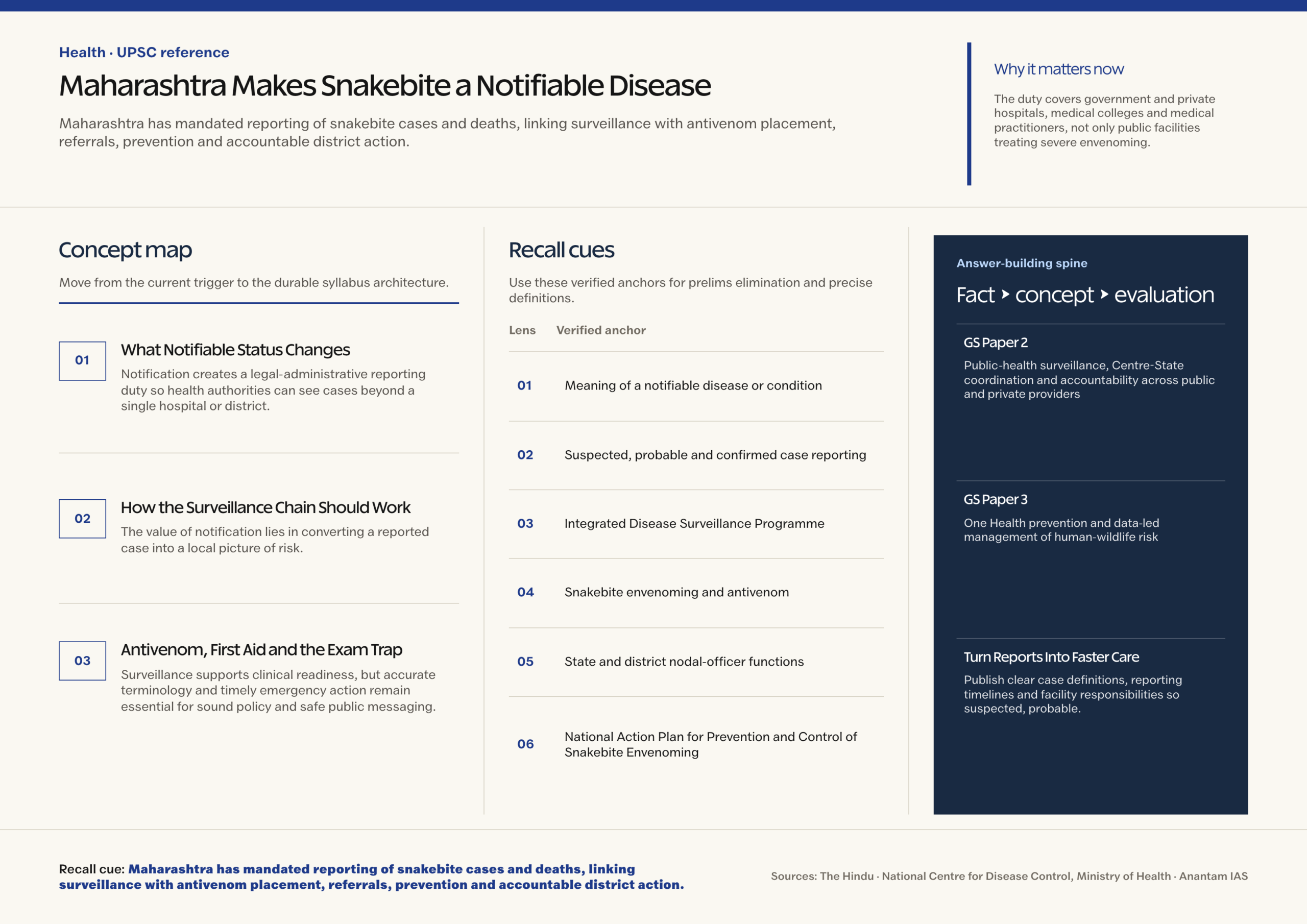
- The duty covers government and private hospitals, medical colleges and medical practitioners, not only public facilities treating severe envenoming.
- Each covered case must reach the concerned District Health Officer or District Surgeon through the prescribed reporting system.
- State, district and municipal Snakebite Nodal Officers will coordinate reporting, monitoring and the use of data for local action.
- The notification supports antivenom placement, referral planning and prevention; anti-snake venom is an antivenom treatment, not a vaccine.
- Mandatory reporting converts scattered clinical encounters into a surveillance dataset that can reveal where, when and under what circumstances severe bites occur.
- For governance answers, connect notification with a complete response chain: timely reporting, reliable analysis, stocked facilities, rapid referral, trained staff and community prevention.
- The durable development is the State-wide surveillance duty, distinct from the earlier Gadchiroli school incident that prompted administrative action.
UPSC Relevance
Prelims Relevance
- Meaning of a notifiable disease or condition
- Suspected, probable and confirmed case reporting
- Integrated Disease Surveillance Programme
- Snakebite envenoming and antivenom
- State and district nodal-officer functions
- National Action Plan for Prevention and Control of Snakebite Envenoming
Mains Relevance
GS Paper 2
- Public-health surveillance, Centre-State coordination and accountability across public and private providers
- Last-mile emergency care, referral systems and health equity in rural and tribal areas
GS Paper 3
- One Health prevention and data-led management of human-wildlife risk
Essay
- Public data becomes valuable only when institutions convert it into timely care for vulnerable citizens.
Background and Context
What Notifiable Status Changes
Notification creates a legal-administrative reporting duty so health authorities can see cases beyond a single hospital or district.
- A notifiable condition must be reported to designated public authorities in the form and time prescribed by the competent government; reporting is not left to voluntary publication.
- Maharashtra’s duty covers every suspected, probable or confirmed snakebite under observation or treatment, plus deaths attributed to snakebite.
- The broad case spectrum matters because waiting for laboratory certainty or a fatal outcome would hide early demand, delayed referrals and clinically managed cases from surveillance.
- Government and private hospitals, medical colleges and individual practitioners form one reporting network, reducing the blind spots created when surveillance relies only on public-facility records.
- Notification does not itself prevent a bite or guarantee treatment; it supplies a compulsory information layer on which prevention, readiness and accountability can be built.
How the Surveillance Chain Should Work
The value of notification lies in converting a reported case into a local picture of risk, treatment demand and referral performance.
- Institutions report to the concerned District Health Officer or District Surgeon, while designated officers at State, district and municipal levels act as Snakebite Nodal Officers.
- Records can capture place and date of bite, symptoms of envenoming, treatment, antivenom use, referral, outcome and circumstances associated with the event.
- Aggregation by location and season can identify high-incidence areas, allowing authorities to place antivenom and trained teams nearer to predictable demand rather than distribute stocks uniformly.
- Referral data can show where patients lose time between first contact and definitive care, guiding ambulance links, facility protocols and escalation pathways for airway, bleeding or kidney complications.
- The national snakebite programme similarly prioritises stronger surveillance, emergency care, treatment access, facility mapping, professional training and community outreach.
Antivenom, First Aid and the Exam Trap
Surveillance supports clinical readiness, but accurate terminology and timely emergency action remain essential for sound policy and safe public messaging.
- Snakebite describes the exposure, while envenoming occurs when injected venom produces toxic effects; not every bite produces the same clinical syndrome or needs identical management.
- Anti-snake venom is an antivenom containing antibodies that neutralise relevant venom effects. It treats indicated envenoming after exposure; it is not a preventive vaccine.
- The World Health Organization identifies high-quality antivenom as the specific treatment that can prevent or reverse most venomous effects when appropriately administered.
- A bitten person should be kept still, immobilised and transported promptly for medical care; tight tourniquets, wound cutting, suction and traditional remedies can cause harm or waste critical time.
- Stock counts alone are an incomplete readiness measure. Safe outcomes also require trained diagnosis, management of reactions, airway and bleeding support, transport and a functional referral destination.
Way Forward
Turn Reports Into Faster Care
- Publish clear case definitions, reporting timelines and facility responsibilities so suspected, probable, confirmed and fatal cases are recorded consistently across sectors.
- Use district dashboards to connect incidence and referral delays with antivenom stocks, trained staff, ambulance routes and facilities capable of respiratory and renal support.
- Audit missing fields, late reports and outcomes instead of treating submission volume as proof that the surveillance system is working.
- Pair risk-season alerts with practical prevention and correct first-aid guidance for farmers, forest-edge communities, schools and other locally exposed groups.
Conclusion
- Making snakebite notifiable is a governance intervention: it links compulsory reporting with a State-to-district chain for risk mapping, antivenom readiness, referrals and prevention.
- In a Mains answer, distinguish data collection from health outcomes and explain the conversion pathway: complete reports, local analysis, stocked and trained facilities, rapid transport, appropriate antivenom and outcome audit.
UPSC Practice Questions
Prelims MCQ 1
With reference to Maharashtra’s snakebite notification, consider the following statements:
- Only laboratory-confirmed snakebite cases are required to be reported.
- The reporting duty covers government and private health-care providers.
- Anti-snake venom is an antivenom treatment rather than a preventive vaccine.
How many of the above statements are correct?
(a) Only one (b) Only two (c) All three (d) None
Answer: (b) Only two
Explanation:
Statements 2 and 3 are correct. The notification covers suspected, probable and confirmed cases, as well as snakebite deaths; it is not restricted to laboratory-confirmed cases.
Prelims MCQ 2
What is the most direct public-health purpose of making snakebite a notifiable condition?
(a) Replacing clinical diagnosis with a central database (b) Vaccinating every resident of a high-incidence district (c) Creating systematic surveillance for treatment, referral and prevention planning (d) Transferring all treatment from private hospitals to district hospitals
Answer: (c) Creating systematic surveillance for treatment, referral and prevention planning
Explanation:
Mandatory case reporting produces a fuller risk and service-use picture. Authorities can use it to plan antivenom availability, referrals, prevention and monitoring; it neither replaces diagnosis nor creates a vaccine programme.
UPSC Mains Questions
- Making a health condition notifiable improves visibility but does not automatically improve outcomes. Discuss with reference to snakebite surveillance and emergency-care readiness.
- Explain how district-level snakebite data can be converted into an equitable public-health response for rural and tribal communities.
Sources: The Hindu and National Centre for Disease Control, Ministry of Health and Family Welfare.
Frequently Asked Questions
What does making snakebite notifiable mean?
It means designated health providers must report covered snakebite cases and deaths to public-health authorities under the prescribed system, enabling systematic surveillance rather than voluntary or fragmented reporting.
Which snakebite cases must be reported in Maharashtra?
The notification covers suspected, probable and confirmed snakebite cases under observation or treatment, along with snakebite deaths, across government and private providers, medical colleges and practitioners.
Is anti-snake venom a vaccine?
No. Anti-snake venom is an antivenom treatment containing antibodies used after a bite when clinically indicated to neutralise venom effects. It is not preventive vaccination against future snakebites.
How can surveillance reduce snakebite deaths?
Reliable local data can reveal risk locations, seasons, treatment demand and referral delays, helping authorities position antivenom, train facilities, improve transport and target practical prevention measures.
Who are the nodal officers under the Maharashtra system?
The system designates a State-level hospital director, district surgeons and district health officers, plus municipal medical health officers, to coordinate snakebite reporting, monitoring and response.