Women Farmers: Maharashtra Bill and the Identity Gap
Why in News?
Women farmers entered the governance spotlight after The Hindu reported that the Maharashtra government introduced the Women Farmers’ Empowerment Bill in the State Assembly on July 1, 2026.
The Bill proposes a Woman Farmer Certificate as an official identity document for women engaged in agriculture and allied activities, even when they do not own land.
- Women Farmers’ Empowerment Bill was tabled during the ongoing Monsoon session of the Maharashtra Assembly.
- Woman Farmer Certificate is meant to help women access government schemes, subsidies, institutional finance, services and market support.
- Land ownership will not be the sole gateway; the Bill recognises women who cultivate family or community land without formal title.
- Allied activities such as fisheries, livestock rearing, poultry farming and forest-produce collection are part of the recognition frame.
- Gram Sabhas and urban local bodies are proposed as certificate-issuing authorities, with an appeal route for rejected applications.
- Women Farmer Support Officers are to be appointed at district and taluka levels from existing officials.
The development matters in the context of:
- Identity gap is the core policy issue: women may work as cultivators but remain invisible in land records, credit systems and scheme databases.
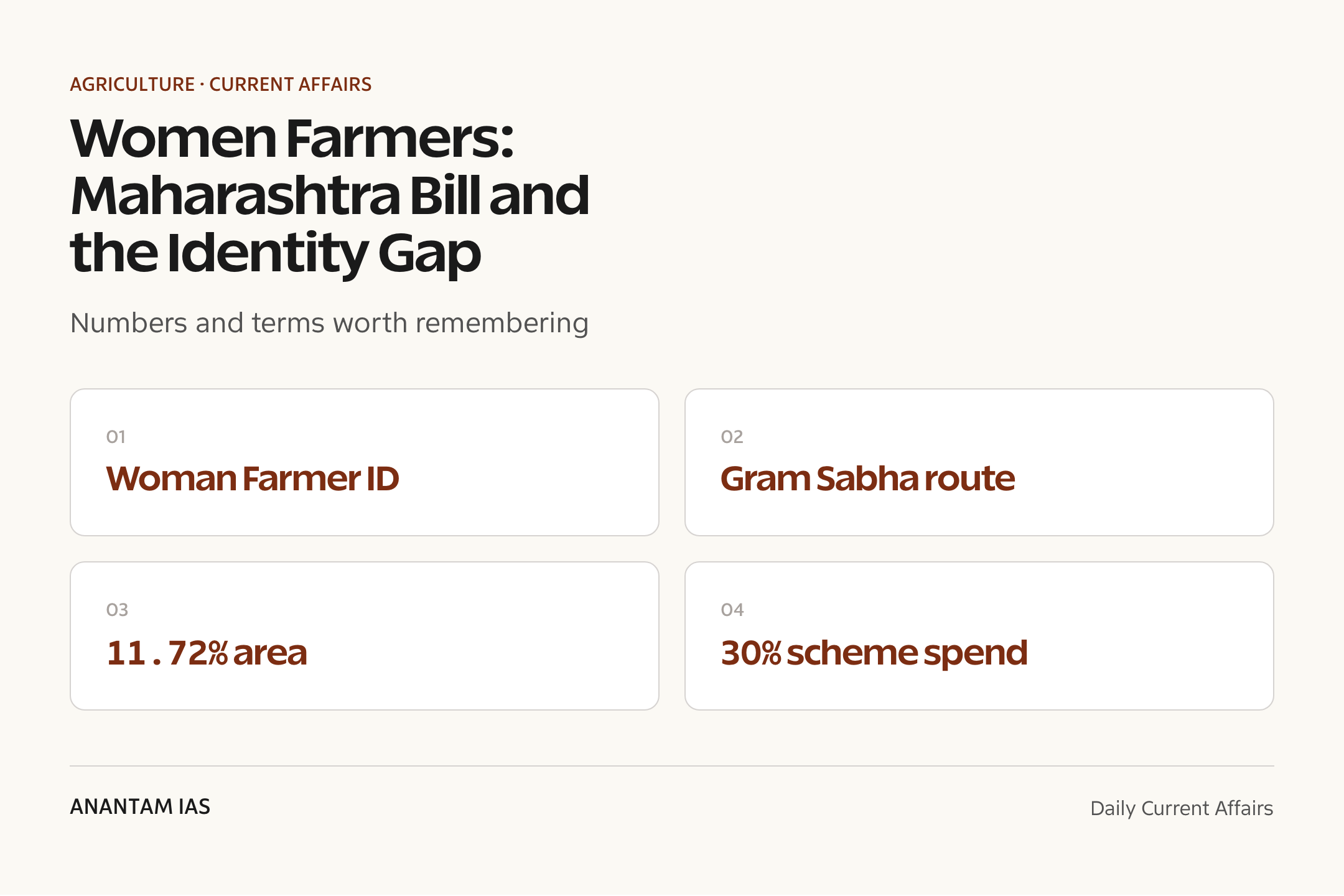
- PIB data from Agriculture Census 2015-16 records that female operational holders operated only 11.72% of total operated area in India.
- Gender-neutral schemes can still exclude women when eligibility depends on land title, bankable collateral or recorded farmer status.
- Decentralised certification links the Bill to local governance, social justice and last-mile delivery through Gram Sabhas and urban local bodies.
UPSC Relevance
Prelims Relevance
- Women Farmers’ Empowerment Bill: Maharashtra Bill to recognise women engaged in agriculture and allied activities as farmers.
- Woman Farmer Certificate: proposed official identity document for access to schemes, subsidies, institutional finance and market support.
- Gram Sabha: village-level body proposed as one issuing authority for the certificate in rural areas.
- Urban local bodies: proposed issuing authorities for eligible women in urban or peri-urban contexts.
- Women Farmers’ Fund: proposed Maharashtra State Women Farmers’ Fund for supporting women farmers.
- Three-tier framework: Women Farmers’ Empowerment Council, State Monitoring Committees and Women Farmers’ Empowerment Cell.
- MKSP: Mahila Kisan Sashaktikaran Pariyojana under DAY-NRLM, aimed at enhancing women’s participation and livelihoods in agriculture.
- Agriculture Census 2015-16: official source showing female operational holders operated 11.72% of total operated area in India.
Mains Relevance
GS Paper 2
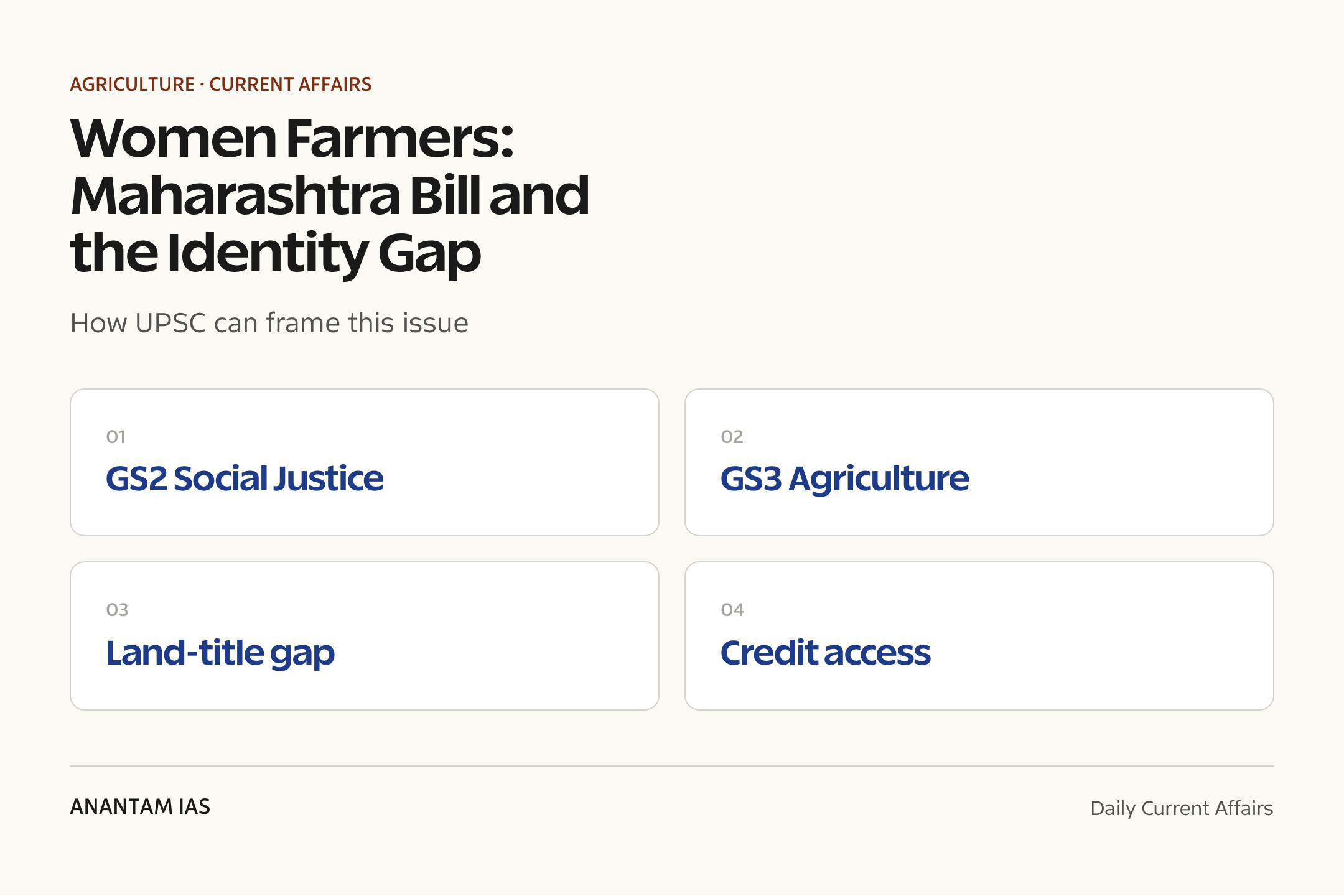
- Social justice: gendered exclusion from welfare schemes, credit and public services despite women’s agricultural work.
- Governance: local-body certification, database creation, appeal mechanisms and convergence across departments.
- Rights-based delivery: moving from informal recognition in households to formal identity in State systems.
GS Paper 3
- Agriculture: feminisation of farm work, access to extension services, credit and market support.
- Rural economy: land title, collateral, institutional finance and productivity constraints for women cultivators.
- Allied sectors: livestock, poultry, fisheries and forest-produce livelihoods as part of farm policy.
Essay
- Recognition is often the first step toward redistribution.
- Land records can decide who receives the benefits of development.
- Gender equality in agriculture needs identity, assets and bargaining power.
Background and Context
What the Maharashtra Bill Proposes
Maharashtra is trying to convert women’s farm work into a formal administrative identity.
- Core purpose: recognise women engaged in agriculture and allied activities as women farmers.
- Certificate route: issue a Woman Farmer Certificate that works as an official identity document for farm-linked benefits.
- Access promise: connect recognised women to entitlements, subsidies, services, credit and market support.
- Land-neutral design: avoid making land ownership the only condition for recognition where women cultivate without title.
- Allied activities: include women working in fisheries, livestock rearing, poultry farming and forest-produce collection.
- Policy significance: the Bill treats farm identity as a governance problem, not only as a land-record problem.
Why Land Title Creates Exclusion
Land title is a gatekeeping document in Indian agriculture, but women often work outside formal ownership records.
- Scheme eligibility frequently depends on land records, tenancy proof, collateral or recorded cultivator status.
- Family land may be cultivated by women, but the title often remains with male household members.
- Community land or informal cultivation can make women visible in the field but invisible in files.
- Agricultural labourer label can undercount women who actually make cultivation decisions without formal ownership.
- Credit access weakens when banks cannot easily verify farmer identity or collateral through land records.
- Land reforms are the broader historical context; see Land Reforms in India for the structural background.
Institutional Design in the Bill
Institutional design decides whether a recognition law becomes a working delivery system.
- Women Farmers’ Empowerment Council is proposed as part of the top-level framework and includes the Chief Minister, Deputy Chief Ministers and Agriculture Minister as ex-officio members.
- State Monitoring Committees are meant to track implementation instead of leaving certificates as a one-time paper exercise.
- Women Farmers’ Empowerment Cell adds an administrative unit for coordination, data and follow-up support.
- Women Farmers’ Fund is proposed as a dedicated Maharashtra State fund for women farmers.
- Women-farmer database can improve targeting, but it must protect privacy and avoid excluding women with weak documents.
- Appeal mechanism matters because rejected applications can reproduce the same exclusion the Bill is trying to fix.
Role of Gram Sabhas and Local Bodies
Local verification is useful because village institutions often know who actually cultivates the land.
- Gram Sabhas are proposed as certificate-issuing authorities in rural areas, making local knowledge part of recognition.
- Urban local bodies are included for eligible women in urban, peri-urban or administratively urban areas.
- Panchayati Raj institutions can reduce paperwork distance between women farmers and the State; revise the governance base through Panchayati Raj.
- Local capture risk remains: caste, household pressure, political influence or local disputes can affect certification.
- Due process needs clear criteria, written reasons for rejection, time limits and easy appeal access.
- Digital records should support, not replace, local verification where women’s work is informal but real.
National Policy Context
Women farmers are already recognised in national schemes, but access often depends on documents and implementation capacity.
- PIB has stated that beneficiary-oriented schemes of the Department of Agriculture and Farmers Welfare require States and implementing agencies to incur at least 30% expenditure on women farmers.
- MKSP under DAY-NRLM has been implemented since 2011 to enhance women’s participation and create sustainable rural livelihoods.
- Agriculture Census 2015-16 shows the mismatch between women’s farm participation and female-operated area, which stood at 11.72% of total operated area.
- Gender-neutral policy is not enough when the access route is built around documents that women are less likely to possess.
- Women empowerment in this case is economic, legal and administrative; connect it with Women Empowerment in India.
- Convergence with credit, insurance, extension, FPOs and market-linkage schemes will decide the Bill’s field impact.
Agriculture Governance Lens
Agriculture governance increasingly depends on databases, certificates and delivery channels as much as on subsidies.
- Farmer identity is becoming the entry point for public support, from credit and insurance to input subsidy and market access.
- Extension services often reach the recorded landholder, so women without formal farmer status may miss training and advisory support.
- Institutional finance can improve if banks treat the certificate as credible proof of farming activity, subject to clear guidelines.
- Market support should include procurement access, FPO membership, storage, transport, value addition and digital-market onboarding.
- Allied livelihoods need equal weight because livestock, poultry, fisheries and forest produce are major income streams for rural women.
- Indian agriculture is not only a production sector; it is also a rights, identity and welfare-delivery system. See Indian Agriculture for the wider policy frame.
Way Forward
Make recognition verifiable and inclusive
- Eligibility criteria should recognise cultivation, allied work and contribution to farm decisions, not only ownership papers.
- Evidence options should include Gram Sabha verification, SHG records, FPO membership, tenancy evidence, livestock records and local-body certification.
- Appeal timelines should be simple and time-bound so rejected women are not pushed into repeated office visits.
Connect certificates to real benefits
- Credit linkage should be clarified with banks, cooperative institutions and NABARD-linked channels so the certificate has operational value.
- Scheme convergence should map certificates to PM-KISAN-like databases where applicable, crop insurance, KCC, extension services and market-support channels.
- Support officers should be trained on gender-sensitive delivery, documentation help and grievance handling.
Guard against new exclusion
- Database design should prevent duplicate, fake or coerced claims without making documentation impossible for landless women.
- Social audit through Gram Sabhas, women’s SHGs and civil-society partners can check local bias and elite capture.
- Outcome tracking should measure credit received, schemes accessed, extension visits, FPO membership and income gains, not only certificates issued.
Conclusion
Maharashtra’s Bill is important because it recognises a simple but persistent reality: a woman can be central to farming and still be missing from the official farmer category.
The real test will come after certification. If the Woman Farmer Certificate opens doors to credit, schemes, extension and markets, it can narrow the identity gap in agriculture. If it remains a paper document, the old exclusion will survive with a new name.
UPSC Practice Questions
Prelims MCQ 1
With reference to Maharashtra’s proposed Women Farmers’ Empowerment Bill, consider the following statements:
- It proposes a Woman Farmer Certificate for women engaged in agriculture and allied activities.
- The certificate is proposed only for women who individually own agricultural land.
- Gram Sabhas or urban local bodies are proposed as certificate-issuing authorities.
How many of the above statements are correct?
(a) Only one (b) Only two (c) All three (d) None
Answer: (b) Only two
Explanation:
Statements 1 and 3 are correct. Statement 2 is incorrect because the Bill aims to recognise women farmers irrespective of whether they own land.
Prelims MCQ 2
Which one of the following best explains the governance problem behind the women-farmer identity gap?
(a) Women are legally barred from all allied agricultural activities. (b) Agriculture schemes never use land records for eligibility. (c) Women may perform farm work but remain outside formal land, credit and scheme records. (d) Gram Sabhas cannot verify any rural livelihood activity.
Answer: (c) Women may perform farm work but remain outside formal land, credit and scheme records.
Explanation:
The identity gap arises when women’s actual agricultural work is not reflected in land titles, farmer databases, credit channels or scheme records.
UPSC Mains Questions
- Women’s work in agriculture is often visible in the field but invisible in official records. Discuss how farmer identity, land title and welfare delivery interact in the context of Maharashtra’s proposed Women Farmers’ Empowerment Bill.
- A certificate-based recognition system can improve access to credit and schemes, but it can also create new administrative barriers. Examine the safeguards needed for inclusive implementation.
- Discuss the role of Gram Sabhas and local bodies in identifying beneficiaries for welfare schemes, with reference to women farmers, local verification and risks of exclusion.
Sources: The Hindu and PIB, Ministry of Agriculture and Farmers Welfare.
Frequently Asked Questions
What is the Bill about?
Maharashtra’s Women Farmers’ Empowerment Bill seeks to recognise women engaged in agriculture and allied activities as farmers. Its central proposal is a Woman Farmer Certificate that can support access to schemes, subsidies, credit, services and market support.
Why is land ownership important?
Land ownership often decides who is treated as a farmer in scheme records, bank documents and subsidy systems. Many women cultivate family or community land without title, so they may work as farmers but remain outside formal benefits.
Who will issue certificates?
The Hindu reported that Gram Sabhas or urban local bodies are proposed as issuing authorities. This local route matters because village and local institutions can verify actual farm work, but the process also needs safeguards against bias.
What allied activities are covered?
The Bill’s recognition frame includes fisheries, livestock rearing, poultry farming and collection of forest produce. This is important because many rural women earn through allied activities that are not always captured in narrow landholder-based definitions.
How does MKSP connect here?
Mahila Kisan Sashaktikaran Pariyojana under DAY-NRLM is a national programme for women’s agricultural livelihoods. The Maharashtra Bill works at the State-recognition layer, while MKSP shows the broader policy aim of enhancing women’s participation and productivity.
What is the main risk?
The main risk is that certification becomes another paperwork layer. The Bill will matter only if the certificate actually unlocks credit, insurance, subsidies, extension services, FPO access and market support for women farmers.