Intelligence Bureau: Mahesh Dixit Appointed Director and the Agency’s Place in India’s Security Architecture
Why in News?
The Appointments Committee of the Cabinet (ACC), headed by the Prime Minister, has approved the appointment of senior IPS officer Mahesh Dixit as the new Director of the Intelligence Bureau (DIB), India’s premier domestic intelligence agency under the Ministry of Home Affairs (MHA). Dixit succeeds Tapan Deka, who headed the IB since 2022.
The Hindu and ANI reported that Dixit, a 1993-batch IPS officer who was serving as a Special Director in the IB, has been given a fixed tenure of two years. The change at the top of the country’s oldest intelligence organisation is a natural prompt to revise the IB’s role, history, and the long-running debate on intelligence accountability.
- ACC cleared Mahesh Dixit as the next Director, Intelligence Bureau (DIB).
- Reported by The Hindu and ANI to be a 1993-batch IPS officer, earlier a Special Director in the IB.
- He succeeds Tapan Deka, IB chief since 2022.
- Tenure fixed at two years from the date he assumes charge.
- The IB operates under the MHA and handles internal/domestic intelligence.
The development matters in the context of:
- The Intelligence Bureau (IB) is India’s lead agency for internal security intelligence, counter-intelligence and counter-terrorism on home soil.
- Its head, the DIB, is conventionally an IPS officer and reports to the Home Minister and Prime Minister.
- The IB is distinct from R&AW, which handles external intelligence under the Cabinet Secretariat.
- Neither agency has a specific statutory charter or direct parliamentary oversight, fuelling an accountability debate.
UPSC Relevance
Prelims Relevance
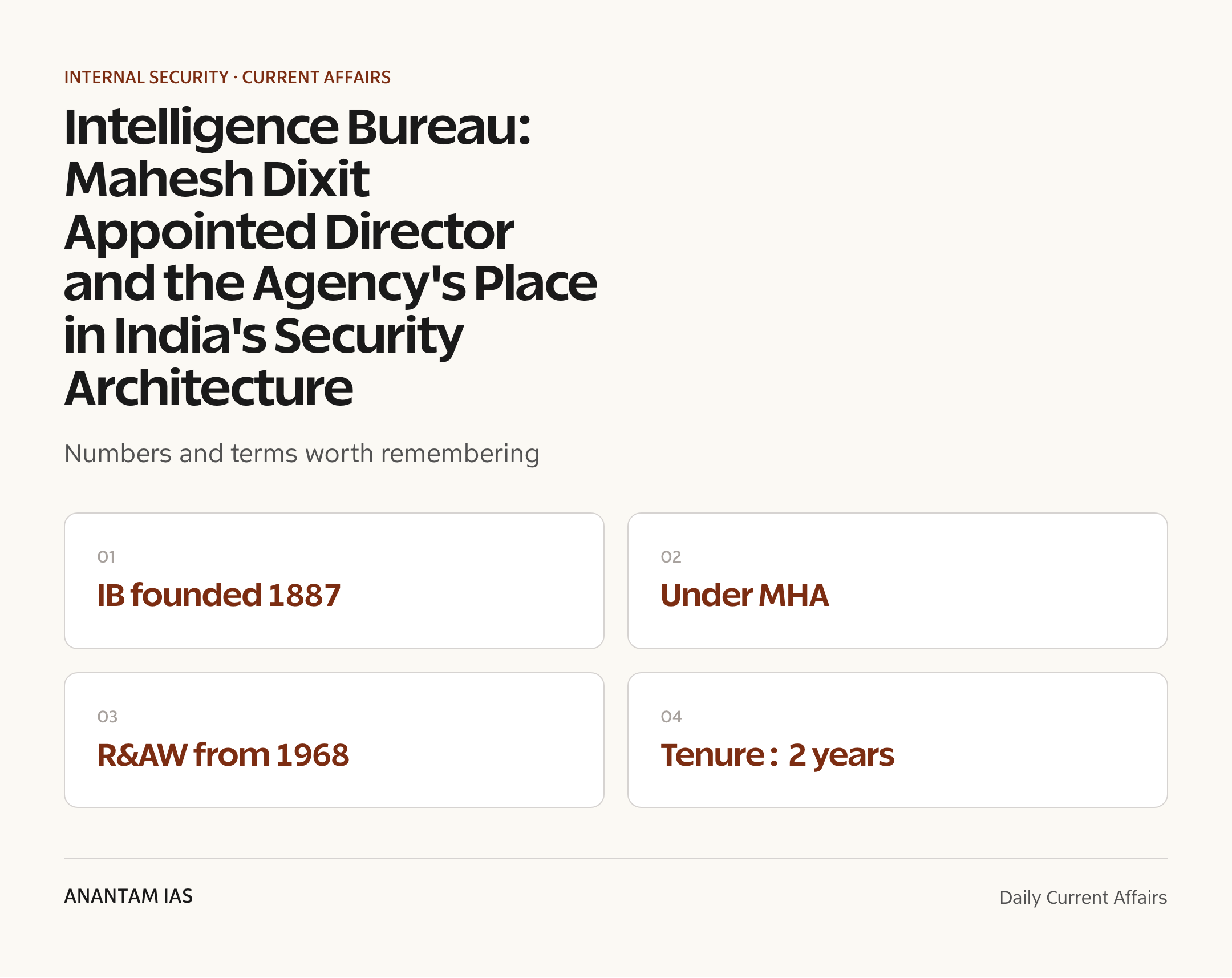
- Intelligence Bureau (IB) traces its origin to the Central Special Branch (1887); reorganised in 1947 and often described as among the world’s oldest intelligence agencies.
- The IB functions under the Ministry of Home Affairs (MHA) and deals with internal/domestic intelligence.
- The IB is headed by the Director, Intelligence Bureau (DIB), usually an IPS officer.
- Appointments to the post are made by the Appointments Committee of the Cabinet (ACC), chaired by the Prime Minister.
- R&AW (Research and Analysis Wing) handles external intelligence, works under the Cabinet Secretariat, and was created in 1968 after the 1962 and 1965 wars.
- The Multi Agency Centre (MAC), a shared intelligence-coordination grid run by the IB, was strengthened after the 26/11 (2008) Mumbai attacks.
- NATGRID (National Intelligence Grid) is a networked database platform linking security and intelligence agencies to multiple databases.
- Neither the IB nor R&AW was created by a specific Act of Parliament; both lack a dedicated statutory charter.
- The IB is the designated lead agency for counter-intelligence and internal counter-terrorism assessments.
Mains Relevance
GS Paper 3
- Map India’s internal-security intelligence architecture – IB, MAC, NATGRID, NIA – and evaluate post-26/11 coordination reforms.
- Assess the case for a statutory charter and oversight mechanism for intelligence agencies without compromising operational secrecy.
GS Paper 2
- Examine the role of the Appointments Committee of the Cabinet (ACC) and fixed tenures in insulating sensitive security appointments from arbitrariness.
Essay
- Security and liberty: can a democracy run powerful intelligence agencies without statutory accountability?
- The unseen state: intelligence, secrecy, and the limits of public scrutiny.
Background and Context
What the Intelligence Bureau Is
The IB is India’s domestic intelligence backbone, working quietly under the Home Ministry.
- Lead agency for internal intelligence, counter-intelligence and on-soil counter-terrorism assessment.
- Operates under the Ministry of Home Affairs (MHA); the DIB reports to the Home Minister and Prime Minister.
- Staffed largely by IPS officers on deputation alongside a dedicated cadre of intelligence personnel.
- Functions include VIP security inputs, monitoring of extremist and subversive activity, and border-area human intelligence.
Origin and Evolution
The IB carries one of the longest institutional pedigrees among the world’s intelligence services.
- Traces back to the Central Special Branch (1887) set up in British India.
- Reorganised as the Intelligence Bureau in 1947 after Independence.
- Until 1968, the IB handled both internal and external intelligence; external work was then carved out to create R&AW.
- Continues as a purely civilian, non-statutory body without a founding Act of Parliament.
IB vs R&AW – the Internal-External Divide
India’s two flagship agencies split the intelligence task by geography of threat.
- IB – internal/domestic intelligence, under the MHA; head is the DIB.
- R&AW – external/foreign intelligence, under the Cabinet Secretariat; head is the Secretary (R).
- R&AW was created in 1968 after intelligence gaps exposed by the 1962 and 1965 wars.
- Both feed assessments into national decision-making but neither is directly answerable to Parliament.
Coordination Architecture After 26/11
The 2008 Mumbai attacks triggered a redesign of how intelligence is shared.
- Multi Agency Centre (MAC), run by the IB, was upgraded into a round-the-clock intelligence-sharing grid linking central and state agencies.
- NATGRID was conceived to give authorised agencies networked access to multiple databases (travel, banking, telecom).
- National Investigation Agency (NIA) was created in 2008 as the federal counter-terror investigating body.
- State Special/Subsidiary MACs extend the grid to the district level.
The Accountability Debate
Powerful agencies without a statutory charter raise persistent governance questions.
- No specific Act defines the IB’s powers, limits, or oversight – it rests on executive authority.
- Unlike several democracies, India has no dedicated parliamentary intelligence committee to scrutinise budgets and operations.
- Private members’ bills and commentators have urged a statutory framework with secure, in-camera oversight.
- The balance sought is between operational secrecy and constitutional accountability in a rights-based democracy.
Significance of This Appointment
Leadership and tenure stability at the IB matter for continuity in security planning.
- The Hindu and ANI report Mahesh Dixit as a 1993-batch IPS officer, earlier a Special Director in the IB.
- He takes over from Tapan Deka, IB chief since 2022.
- A two-year fixed tenure aims to give continuity across counter-terror and internal-security priorities.
- The ACC, chaired by the Prime Minister, retains the final say on such sensitive appointments.
Way Forward
Statutory and Oversight Reform
- Consider a calibrated statutory charter for intelligence agencies that protects secrecy while defining mandate and limits.
- Explore a secure, in-camera parliamentary oversight mechanism on the lines of mature democracies.
Coordination and Technology
- Deepen integration of MAC and NATGRID with state police and central agencies for seamless intelligence flow.
- Invest in cyber, financial and AI-driven analytics capability to track evolving threats.
Capacity and Professionalism
- Strengthen specialised recruitment, training and analyst cadres beyond IPS deputation.
- Institutionalise fixed tenures and merit-based succession to insulate leadership from arbitrariness.
Conclusion
The change of guard at the Intelligence Bureau is more than a routine personnel move – it is a reminder of how central domestic intelligence is to India’s internal-security architecture, from counter-terrorism to monitoring extremism. The agency’s quiet, non-statutory character has given it operational flexibility but has also kept it outside the framework of formal accountability that defines most state institutions.
As threats grow more networked and technology-driven, the long-term challenge is institutional, not personal: building coordinated, professional and technologically capable intelligence services while answering the democratic question of who watches the watchers. A fixed-tenure, experienced leadership at the top is one step; a thoughtful debate on a statutory charter and credible oversight is the larger task ahead.
UPSC Practice Questions
Prelims MCQ 1
With reference to India’s intelligence agencies, consider the following statements:
- The Intelligence Bureau functions under the Ministry of Home Affairs and handles internal intelligence.
- The Research and Analysis Wing (R&AW) was created in 1968 and works under the Ministry of Defence.
- Appointments to the post of Director, Intelligence Bureau are approved by the Appointments Committee of the Cabinet.
How many of the above statements are correct?
(a) Only one (b) Only two (c) All three (d) None
Answer: (b) Only two
Explanation:
Statements 1 and 3 are correct. R&AW was created in 1968 but functions under the Cabinet Secretariat, not the Ministry of Defence, so statement 2 is wrong.
Prelims MCQ 2
The Multi Agency Centre (MAC), associated with intelligence coordination in India, is operated under which of the following organisations?
(a) Research and Analysis Wing (b) National Investigation Agency (c) Intelligence Bureau (d) Central Bureau of Investigation
Answer: (c) Intelligence Bureau
Explanation:
The Multi Agency Centre, an intelligence-sharing grid strengthened after the 26/11 attacks, is run under the Intelligence Bureau to pool inputs from central and state agencies.
UPSC Mains Questions
- India’s principal intelligence agencies operate without a specific statutory charter or parliamentary oversight. Critically examine the case for a statutory framework for intelligence agencies while safeguarding operational secrecy. (250 words)
- Evaluate the reforms in India’s internal-security and intelligence-coordination architecture undertaken after the 2008 Mumbai attacks. To what extent have they addressed earlier gaps? (250 words)
Sources: The Hindu and ANI.
Frequently Asked Questions
What is the Intelligence Bureau (IB)?
The Intelligence Bureau is India’s lead domestic intelligence agency, working under the Ministry of Home Affairs. It handles internal intelligence, counter-intelligence and counter-terrorism assessment within the country, and is headed by the Director, Intelligence Bureau (DIB), conventionally a senior IPS officer.
Who is the new Director of the Intelligence Bureau?
The Appointments Committee of the Cabinet has appointed senior IPS officer Mahesh Dixit as the new Director of the Intelligence Bureau. As reported by The Hindu and ANI, he is a 1993-batch officer who earlier served as a Special Director in the IB, and he succeeds Tapan Deka.
How is the IB different from R&AW?
The IB handles internal or domestic intelligence and works under the Ministry of Home Affairs. The Research and Analysis Wing (R&AW) handles external or foreign intelligence and functions under the Cabinet Secretariat. R&AW was carved out of the IB in 1968 after intelligence gaps in the 1962 and 1965 wars.
Who appoints the Director of the Intelligence Bureau?
The Director of the Intelligence Bureau is appointed by the Appointments Committee of the Cabinet (ACC), which is chaired by the Prime Minister. The post is usually filled by a senior IPS officer and, in recent practice, carries a fixed tenure to ensure continuity.
Why is there an accountability debate around the IB?
Neither the IB nor R&AW was created by a specific Act of Parliament, so they lack a statutory charter and direct parliamentary oversight. Critics argue this leaves powerful agencies outside formal accountability, and have urged a statutory framework with secure, in-camera oversight that still protects operational secrecy.
What are MAC and NATGRID?
The Multi Agency Centre (MAC) is an intelligence-sharing grid run by the IB that pools inputs from central and state agencies; it was strengthened after the 2008 Mumbai attacks. NATGRID, the National Intelligence Grid, is a networked platform giving authorised agencies access to multiple databases to track security threats.