Majority of India’s Gig Workers remain beyond the Welfare Net
Context: Despite a sharp rise in registrations on the e-Shram portal, only a small proportion of India’s rapidly growing gig and platform workforce has entered the government’s social-security database.
| UPSC Relevance: GS-2 Social Justice: Human Resources (Labour Welfare) Prelims: e-Shram portal, gig and platform workers, Code on Social Security, 2020. Mains: Informal employment, social security, digital economy and labour reforms. |
Who are Gig and Platform Workers?
The Code on Social Security, 2020 defines:
- Gig worker: A person earning through work arrangements outside the traditional employer-employee relationship. The above definition separates gig workers from both formal and informal categories.
- Platform worker: A person accessing work through an online platform, such as a food-delivery, ride-hailing, e-commerce or home-services application.
Thus, platform workers form the digitally mediated segment of the wider gig economy.
A Rapidly Growing Workforce:
NITI Aayog’s 2022 report, India’s Booming Gig and Platform Economy, estimated that:
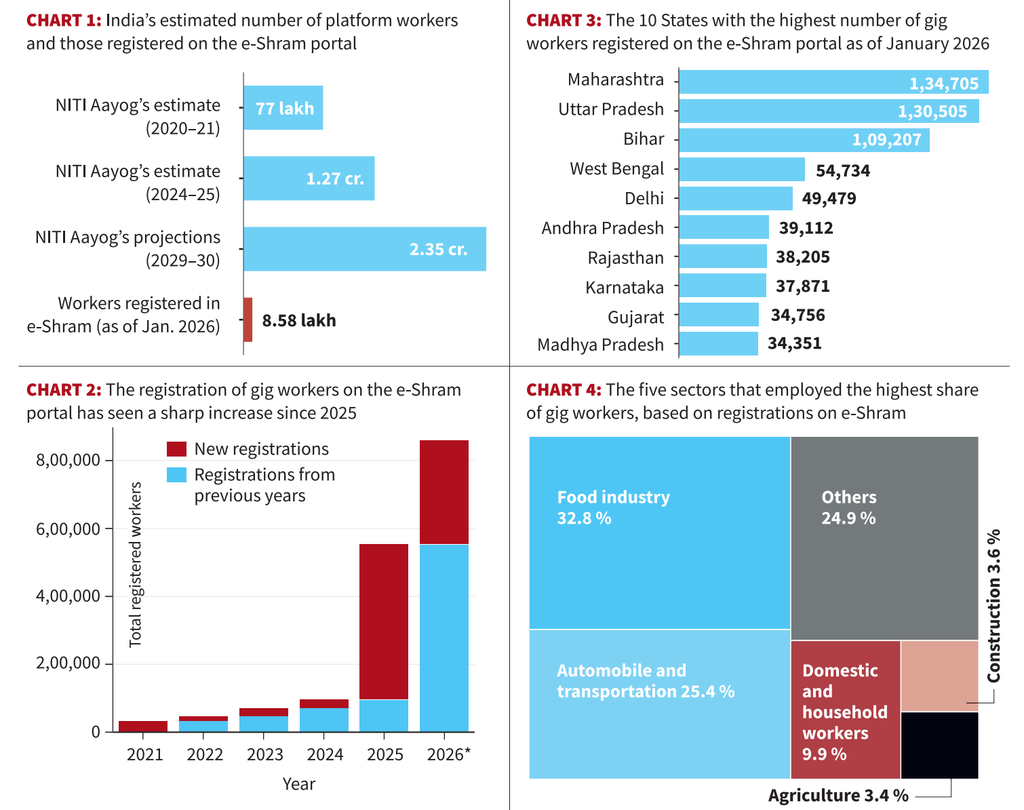
- India had 77 lakh gig workers in 2020-21.
- Their number was projected to reach 1.43 crore in 2025-26 and 2.35 crore by 2029-30.
- By 2029-30, they could constitute 4.1% of India’s total workforce and 6.7% of its non-agricultural workforce.
However, these are indirect projections rather than results of a dedicated official survey.
The Registration Gap:
- The e-Shram portal, launched in 2021, is an Aadhaar-seeded National Database of Unorganised Workers. A separate aggregator module was introduced in 2024 to facilitate the onboarding of platforms and their workers.
- Registrations have accelerated, especially after the announcement of healthcare benefits. Around 10.8 lakh platform workers are registered by July 2026.
Nevertheless, this represents only about 7% of NITI Aayog’s projected gig workforce for 2026-27. The comparison is indicative because e-Shram primarily counts registered platform workers, while NITI Aayog’s estimate covers the broader gig economy.
Uneven State-wise Registration:
- As of January 2026, Maharashtra, Uttar Pradesh and Bihar recorded the highest registrations. In contrast, highly urbanised States such as Tamil Nadu, Telangana and Kerala recorded relatively low numbers. This suggests that e-Shram registrations may reflect awareness, administrative mobilisation and aggregator cooperation, rather than the actual geographical distribution of gig work.
- Registrations were concentrated in:
- food-related services: 32.8%
- automobile and transportation: 25.4%
- domestic and household work
Existing Social-Security Framework:
- The Union Budget 2025-26 announced:
- identity cards and e-Shram registration for online platform workers
- healthcare coverage under Ayushman Bharat-PM Jan Arogya Yojana, providing up to ₹5 lakh per family annually for secondary and tertiary hospitalisation
- An expected coverage of nearly one crore workers.
- The Code on Social Security, 2020, which came into force in 2025, provides for life and disability cover, accident insurance, health and maternity benefits, old-age protection and a dedicated Social Security Fund. Aggregators may be required to contribute 1-2% of their annual turnover, subject to a ceiling of 5% of the amount paid or payable to gig and platform workers.
However, many benefits depend upon the formulation and effective implementation of individual schemes.
Why do Gig Workers Remain Outside the System?
- Voluntary registration: Workers must register themselves or depend on aggregators to upload their information.
- High workforce churn: Workers frequently enter or exit platforms and may work simultaneously for several applications.
- Digital barriers: Aadhaar-linked mobile numbers, bank details and inaccurate occupational classification can impede registration.
- Weak incentive: Workers may not register when the benefits promised through e-Shram remain uncertain or are still being operationalised.
- Narrow platform focus: Freelancers and non-platform gig workers may remain outside aggregator-based registration.
- Data limitations: Multiple accounts can create duplication, while inactive, part-time and seasonal workers are difficult to classify.
The Periodic Labour Force Survey does not yet identify gig workers as a separate category. Most official estimates continue to rely on NITI Aayog’s 2022 report.
Challenges Beyond Registration:
Registration alone cannot address deeper problems such as:
- Employment ambiguity: Independent-contractor status excludes workers from many wage, working-hour and labour protections.
- Income insecurity: Piece-rate earnings are low, unstable and lack minimum earning guarantees.
- Cost shifting: Workers bear vehicle, fuel, maintenance, smartphone, data and insurance expenses.
- Health and safety risks: Long hours, fatigue and delivery deadlines increase accidents and occupational stress.
- Algorithmic control: Opaque algorithms determine work allocation, incentives, ratings and penalties.
- Arbitrary deactivation: Accounts may be suspended without explanation, human review or effective appeal.
- Weak collective voice: Workers lack collective bargaining rights and effective grievance-redressal mechanisms.
- Limited social security: Accident cover, maternity benefits, pensions and paid leave remain inadequate.
- Unequal access: Women and persons with disabilities face safety, mobility, asset and accessibility barriers.
Way Forward:
- Make aggregator-assisted registration automatic and portable across platforms and States.
- Introduce a dedicated gig-work module in the PLFS and require platforms to submit anonymised workforce data.
- Adopt NITI Aayog’s RAISE framework: Recognise diverse work arrangements; Allow innovative financing; Incorporate stakeholder interests; Support enrolment; and Ensure easy access to benefits.
- Prescribe transparent payment structures and minimum earning standards after deducting work-related expenses.
- Provide universal accident insurance, maternity support, disability cover and pension options.
- Ensure algorithmic transparency, human review of automated decisions and a right to appeal against deactivation.
- Discourage unsafe delivery deadlines and include platform work within occupational-safety standards.
- Launch a Platform India initiative, similar to Start-up India, to support skilling, financial inclusion and micro-entrepreneurship.
- Promote collaboration between platforms, the Ministry of Skill Development, NSDC and civil-society organisations, particularly for women and persons with disabilities.
India has legally recognised gig workers, but most remain statistically and socially invisible. The objective must move beyond merely counting workers to providing portable, enforceable and adequately financed social security suited to the realities of platform-based employment.