Malaria Elimination: District Targeting and Reliable Surveillance
Why in News?
On 28 August, the Union Health Ministry reviewed malaria elimination efforts, prioritising 33 high-burden districts and stronger surveillance, diagnosis, treatment and local action plans.
- The Ministry reported that malaria cases and deaths declined by nearly 80% between 2015 and 2025.
- The number of high-burden districts reportedly fell from 155 to 33 over the same period.
- These 33 districts accounted for 64% of reported cases and 54% of reported deaths in 2025.
- The review said 160 districts recorded zero indigenous cases continuously during 2022–2025.
- Malaria elimination requires interrupting local transmission, not merely reducing the national case total.
- Concentrated burden makes the district and village the practical units for surveillance, planning and delivery.
- The progress figures are programme-reported; they describe administrative surveillance and are not, by themselves, an independent impact evaluation.
UPSC Relevance
Prelims Relevance
- Malaria is transmitted by infected female Anopheles mosquitoes.
- An indigenous case is locally acquired rather than imported from another area.
- ABER is the Annual Blood Examination Rate, a surveillance measure based on blood examinations relative to population.
- API is the Annual Parasite Incidence, measuring confirmed malaria cases per 1,000 population in a year.
- The operational chain is Test, Treat and Track: detect infection early, complete appropriate treatment and follow transmission through surveillance.
- The NCVBDC works under the Union Ministry of Health and Family Welfare on vector-borne disease control.
Mains Relevance
GS Paper 2
- Public-health governance through decentralised district and village action plans
- Last-mile access, health equity and data quality in disease elimination
GS Paper 3
- Environmental management, water-logging and vector-source reduction
- Intersectoral coordination for climate-sensitive and vector-borne diseases
Essay
- A national average can conceal the last-mile geography where public systems either eliminate disease or allow transmission to persist.
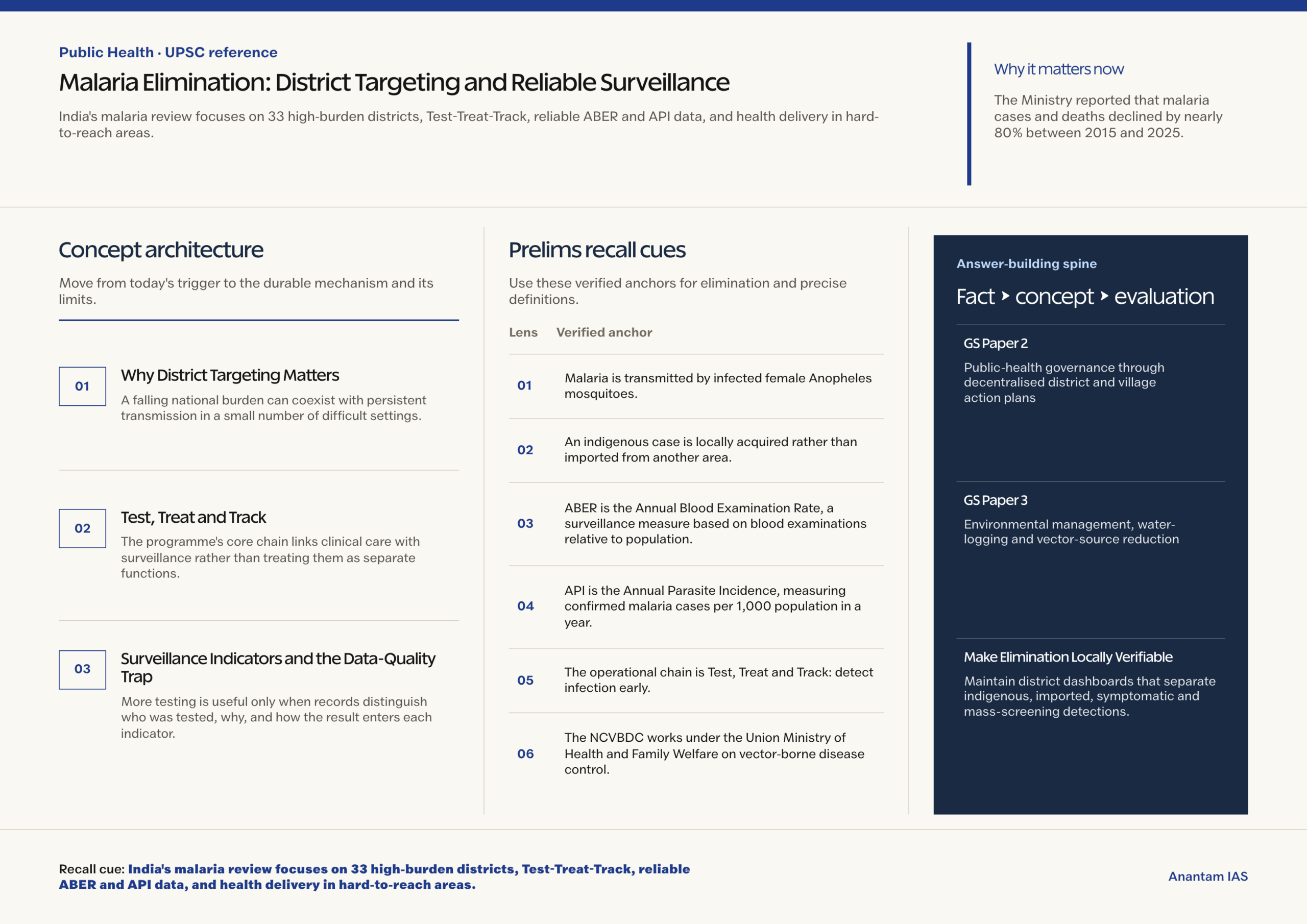
Background and Context
Why District Targeting Matters
A falling national burden can coexist with persistent transmission in a small number of difficult settings.
- The 33 priority districts form a concentrated transmission cluster, so equal distribution of resources across districts would ignore where reported cases and deaths are accumulating.
- District Action Plans can match staffing, testing, medicine stocks and vector control to local epidemiology rather than applying a uniform national package.
- Village Action Plans sharpen this approach within districts by identifying high-burden settlements, recurring fever patterns, breeding sites and barriers to reaching care.
- Zero indigenous cases must be sustained through surveillance because an imported infection can restart local transmission where competent vectors and vulnerable populations remain.
- Elimination is consequently a subnational operational task: national decline matters, but district-level interruption and prevention of re-establishment decide durability.
Test, Treat and Track
The programme’s core chain links clinical care with surveillance rather than treating them as separate functions.
- Test means detecting suspected cases promptly through accessible diagnostics, including active surveillance where people may not reach facilities on their own.
- Treat means beginning appropriate therapy quickly and ensuring completion; diagnostic or treatment delay increases the risk of severe disease, death and continuing transmission.
- Track means recording confirmed cases, locating transmission, investigating clusters and following responses so teams can distinguish persistent local spread from imported cases.
- Hard-to-reach areas need dependable diagnostic kits, medicines and outreach; a technically sound protocol fails when distance, terrain or stock-outs break any link in the chain.
- Community volunteers, Self-Help Groups and Panchayati Raj representatives can support early fever reporting, referral and identification of breeding conditions without replacing trained health workers.
Surveillance Indicators and the Data-Quality Trap
More testing is useful only when records distinguish who was tested, why, and how the result enters each indicator.
- A high ABER can suggest active case-finding, but an unusual value may also reflect duplicate tests, repeated entries or mixing routine testing with mass screening.
- API depends on confirmed cases and the population denominator; inconsistent case classification can distort comparisons across districts or across time.
- The review directed that asymptomatic infections found through mass screening be reported separately and excluded from API and ABER calculations to preserve indicator consistency.
- Cleaning an indicator is not the same as hiding infections: separately reported asymptomatic cases remain important for understanding a possible silent parasite reservoir.
- Administrative numbers show programme performance and reported disease patterns, but independent surveys, audits or evaluations may still be needed to assess missed cases and causal impact.
Way Forward
Make Elimination Locally Verifiable
- Maintain district dashboards that separate indigenous, imported, symptomatic and mass-screening detections, with routine checks for duplicates and inconsistent denominators.
- Pre-position diagnostics and anti-malarial medicines in hard-to-reach areas, and monitor the time from fever reporting to testing and treatment completion.
- Link health teams with rural development, urban bodies and Panchayats for water-logging removal, source reduction and environmental management.
- Use independent data-quality audits and targeted prevalence studies to test whether reported decline reflects real transmission reduction rather than only reporting practices.
Conclusion
- India’s reported progress is substantial, but the elimination challenge has narrowed into a last-mile district problem requiring precise surveillance and uninterrupted care.
- A strong Mains answer should connect Test-Treat-Track, clean ABER/API data, hard-to-reach delivery and intersectoral vector control while treating programme claims with appropriate evidentiary caution.
- Success should be judged by sustained interruption of indigenous transmission, rapid detection of imported cases and independently credible evidence that no vulnerable community is systematically missed.
UPSC Practice Questions
Prelims MCQ 1
With reference to malaria surveillance, consider the following statements:
- Annual Blood Examination Rate relates blood examinations for malaria to the population.
- Annual Parasite Incidence expresses confirmed malaria cases per 1,000 population in a year.
- An indigenous malaria case is necessarily acquired outside the reporting area.
How many of the above statements are correct?
(a) Only one (b) Only two (c) All three (d) None
Answer: (b) Only two
Explanation:
Statements 1 and 2 are correct. An indigenous case is locally acquired; a case acquired outside the area is classified as imported.
Prelims MCQ 2
Which one best explains the public-health logic of the Test, Treat and Track strategy for malaria?
(a) It replaces vector control with hospital-based treatment (b) It limits surveillance to patients who reach tertiary hospitals (c) It links early diagnosis and complete treatment with follow-up of cases and transmission (d) It counts all blood examinations as confirmed malaria cases
Answer: (c) It links early diagnosis and complete treatment with follow-up of cases and transmission
Explanation:
The strategy joins prompt detection, appropriate complete treatment and surveillance-based tracking. It complements, rather than replaces, vector and environmental control.
UPSC Mains Questions
- Why must malaria elimination be planned at district and village levels even when national cases are declining? Discuss with reference to surveillance and last-mile health delivery.
- Reliable indicators are as important as intensive testing in a disease-elimination programme. Explain with reference to ABER, API and malaria data quality.
Source: PIB, Ministry of Health and Family Welfare.
Frequently Asked Questions
What is the Test, Treat and Track strategy?
It links prompt malaria diagnosis, appropriate complete treatment and surveillance follow-up so health teams can reduce illness while identifying where local transmission persists.
Why are 33 high-burden districts receiving special attention?
According to the Ministry’s 2025 programme data, they accounted for 64% of reported malaria cases and 54% of reported deaths, making targeted action operationally important.
What is the difference between ABER and API?
ABER measures the extent of blood examination relative to population, while API measures confirmed malaria cases per 1,000 population in a year.
Why can an unusually high ABER be misleading?
It may reflect strong surveillance, but duplicate tests, repeated entries or the inclusion of mass-screening records can inflate it and weaken comparisons.
Do the reported declines independently prove programme impact?
No. They are important programme-reported trends, but independent surveys, audits or evaluations may still be needed to assess missed infections and causal impact.