Manipur KCP-PWG mass surrender: What it means for counter-insurgency
Why in News?
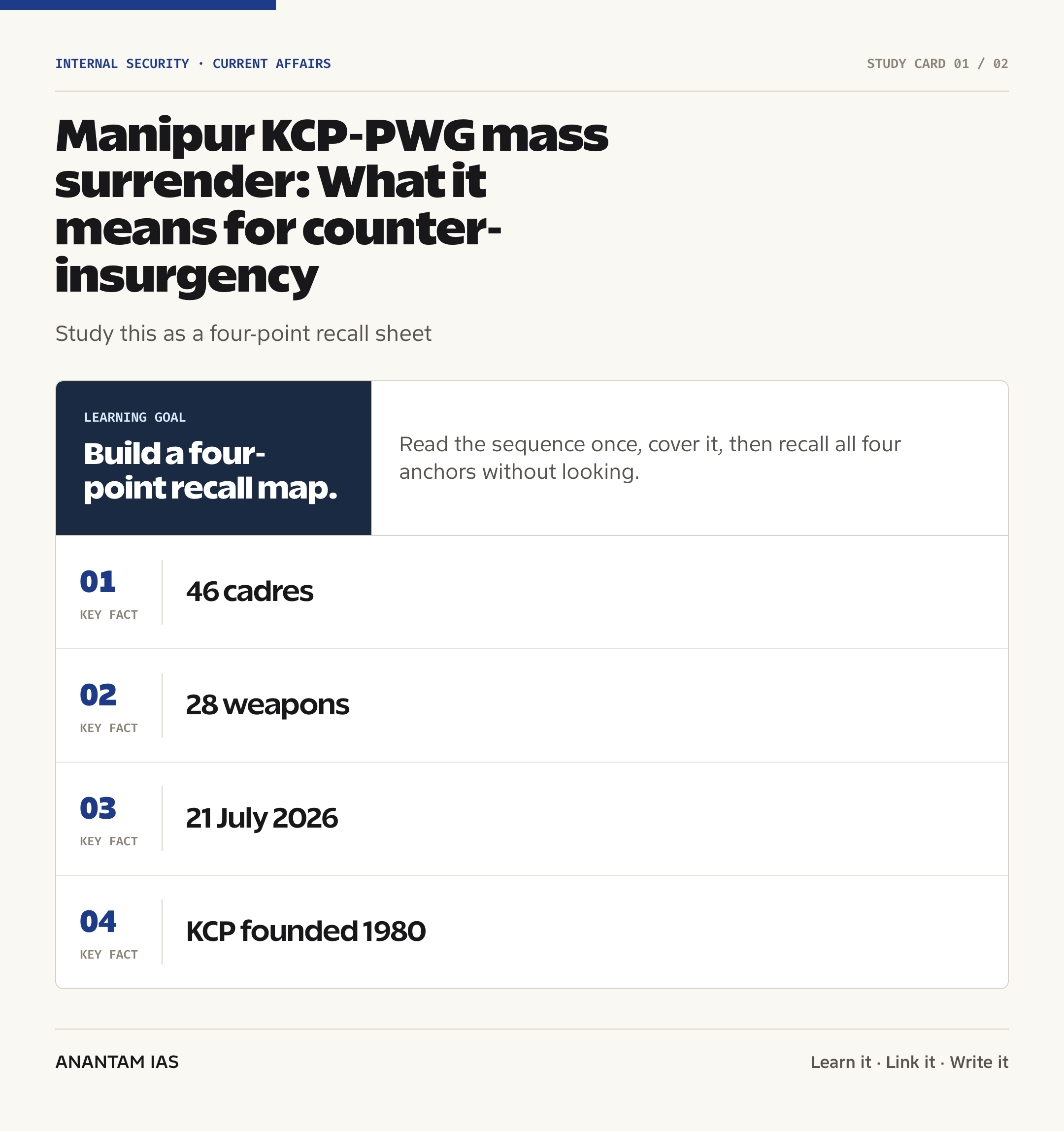
The Manipur KCP-PWG mass surrender took place on 21 July 2026, when 46 active cadres of the proscribed Kangleipak Communist Party (People’s War Group) laid down arms before Manipur Chief Minister Y. Khemchand Singh at the Mantripukhri Garrison, headquarters of Assam Rifles (South), in Imphal East.
The Ministry of Defence release said the group deposited 28 sophisticated weapons along with magazines, ammunition and explosives. The Hindu reported that some cadres had been in Myanmar, while others operated from the Imphal Valley and were primarily associated with extortion. The event is significant, but it shouldn’t be read as proof that the faction or Manipur’s wider insurgency has ended.
- A total of 46 active cadres surrendered together, compared with earlier KCP(PWG) surrenders that the Ministry described as groups of about five to twelve.
- The deposited arsenal included AK and INSAS rifles, .303 rifles, pistols, self-loading rifles, carbines and a rocket-propelled grenade launcher.
- The cadres were reported to be aged 22 to 53 years, showing that the group included both younger recruits and longer-serving members.
- None of the 46 was part of an earlier peace agreement, according to the Ministry, making this a fresh exit from the armed network.
- The surrender followed weeks of outreach by Assam Rifles, Manipur Police, allied agencies and State government officials.
The development matters in the context of:
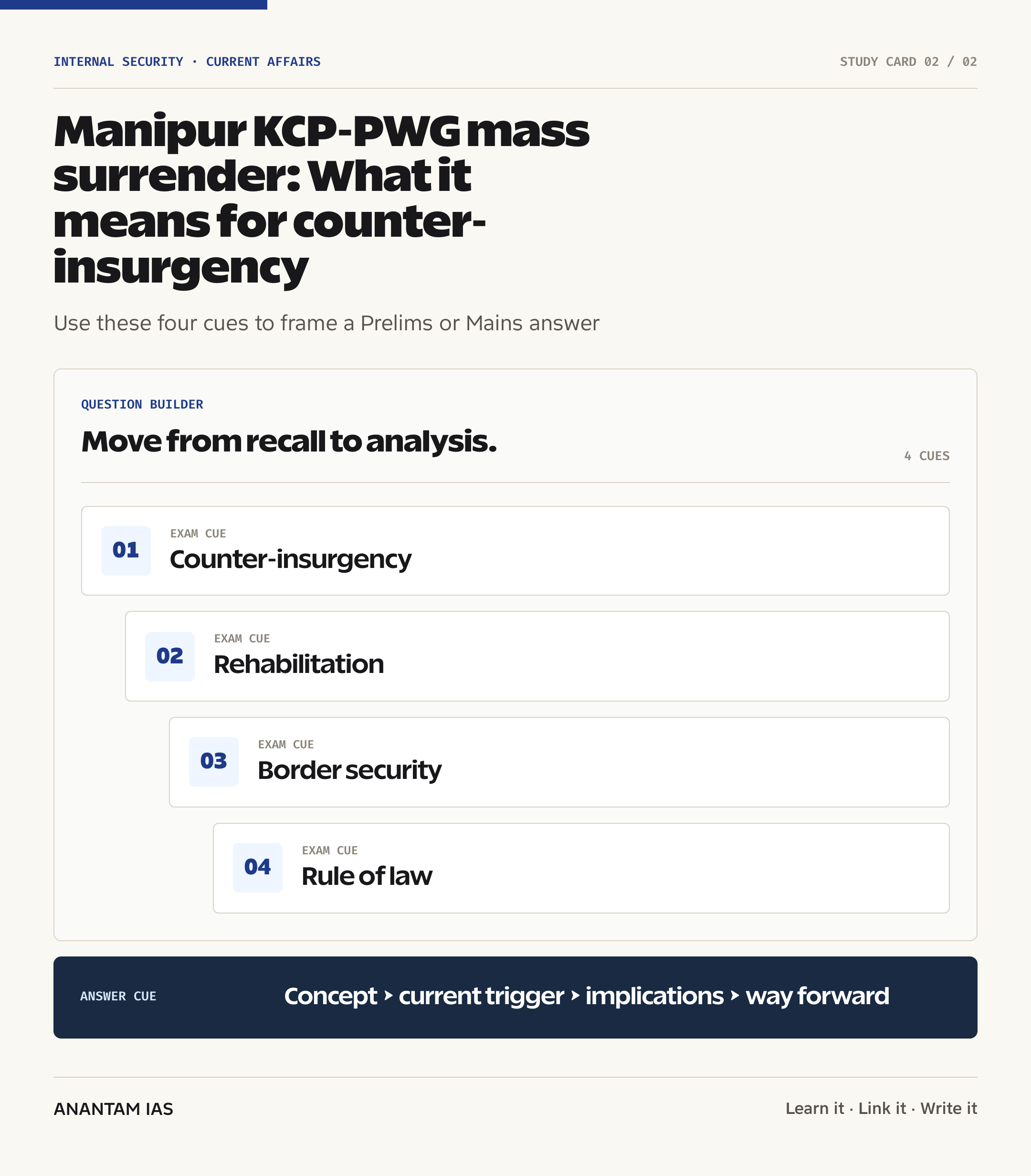
- The event matters in the context of counter-insurgency, where reducing recruitment, finance, weapons and local coercion can be as important as battlefield success.
- It tests whether a surrender-cum-rehabilitation policy can turn a security opening into durable civilian reintegration.
- The reported Myanmar connection links the development to the wider challenge of the India-Myanmar border, cross-border sanctuaries and intelligence coordination.
- It also raises a governance question: whether security gains create space for public services, livelihoods and political dialogue without weakening accountability under law.
UPSC Relevance
Prelims Relevance
- KCP stands for Kangleipak Communist Party; PWG is the People’s War Group faction discussed in this Manipur development.
- KCP(PWG) is described as a Meitei insurgent outfit connected to the Imphal Valley; it shouldn’t be confused with the separate Left Wing Extremism history of People’s War and CPI (Maoist).
- The KCP was founded on 14 April 1980 by Y. Ibohanbi and Ibopishak, according to the Ministry of Defence release.
- KCP and its factions, wings and front organisations are covered by a UAPA unlawful-association notification issued on 13 November 2023.
- The relevant power to declare an association unlawful is under Section 3 of the Unlawful Activities (Prevention) Act, 1967.
- Assam Rifles performs border-guarding and counter-insurgency roles in the Northeast and worked here with Manipur Police and other agencies.
- The surrender ceremony occurred at Mantripukhri in Imphal East, not at an international border post.
- The Union scheme for Northeast insurgents combines an immediate grant, stipend, vocational training, weapon incentives and rehabilitation support.
- The India-Myanmar border is relevant because insurgent movement, camps, arms routes and safe havens can cross an administrative security boundary.
Mains Relevance
GS Paper 3
- Internal security: insurgent fragmentation, extortion networks, arms recovery, intelligence coordination and the assessment of operational degradation.
- Border management: cross-border operating spaces, difficult terrain, community links and coordinated action along the India-Myanmar frontier.
- Counter-insurgency: calibrated force, civilian-first outreach, police legitimacy and rehabilitation as complementary tools.
GS Paper 2
- Governance and federalism: coordination among the Union, State administration, police, Assam Rifles and rehabilitation agencies.
- Rule of law: balancing security, due process, victim concerns, accountability and the rights of people returning to civilian life.
Essay
- Peace is sustained when the cost of returning to violence rises and the dignity of civilian life becomes credible.
- A surrender ceremony is a moment; reintegration is a long institutional process.
- Security and development work best as mutually reinforcing public goods, not as substitutes for one another.
Background and Context
What is the KCP-PWG?
The KCP(PWG) is a faction within Manipur’s fragmented Meitei insurgent landscape, and its identity needs to be understood without merging it with unrelated movements elsewhere in India.
- The Kangleipak Communist Party was founded in 1980 and subsequently split into several factions, reflecting leadership disputes, organisational fragmentation and competing operational networks.
- The People’s War Group faction operated mainly across valley districts such as Imphal East, Imphal West and Kakching, according to the Ministry’s account.
- The Hindu described the surrendered cadres as members of a Meitei insurgent outfit; this ethnic and geographic descriptor identifies the organisation but doesn’t implicate the wider community.
- The news acronym PWG belongs here to a KCP splinter. It shouldn’t be automatically equated with the former Andhra Pradesh-based People’s War organisation in the Left Wing Extremism context.
What the surrender changes operationally
A mass surrender can reduce a faction’s capacity, but its real effect depends on who surrendered, which networks were disrupted and whether replacements can be recruited.
- The simultaneous exit of 46 active cadres is larger than the faction’s recent surrender groups and can weaken local command, logistics, intimidation and intelligence-gathering capacity.
- Recovery of 28 weapons matters because it removes usable firepower and may also produce forensic or logistical leads about supply chains, ammunition and associates.
- The reported focus on extortion shows how insurgent violence can be sustained through coercive finance imposed on residents, businesses, contractors or public works.
- A reduction in extortion pressure can improve the operating environment for roads, schools, health services and private livelihoods, but that benefit needs local verification over time.
- The Ministry itself stopped short of claiming dissolution. A sound assessment should track residual cadres, leadership, financing, recruitment and violent incidents before declaring the network dismantled.
- Because The Hindu referred to two PWG factions, analysts should avoid treating the surrendering group as a perfectly unified organisation without further verified detail.
Cross-border and valley security context
Manipur’s internal-security environment joins valley-based networks with a difficult international border and the political instability of neighbouring Myanmar.
- The Hindu reported that some cadres were in Myanmar while others operated from the Imphal Valley, illustrating how personnel and support systems can span different security spaces.
- The Union’s 2023 UAPA notification records concerns about foreign contacts, camps in neighbouring countries and clandestine procurement of arms and ammunition by listed Meitei extremist organisations.
- The border challenge isn’t only physical fencing. It includes terrain, mobility, kinship networks, informal trade, arms trafficking and intelligence gaps that require differentiated responses.
- Recent India-Myanmar border security talks underline the importance of intelligence sharing and territorial assurances alongside local policing.
- The security risks facing Manipur’s border villages also show why border management must protect civilians and legitimate movement, not treat every border community as a threat.
Counter-insurgency beyond kinetic operations
Counter-insurgency is the coordinated effort to reduce an armed group’s violence, influence, recruitment and support while protecting civilians and restoring legitimate governance.
- Security operations remain necessary against imminent threats, illegal weapons and coercive networks, but indiscriminate force can create grievances and weaken cooperation.
- Police-led investigation is essential for evidence, prosecution and everyday legitimacy; specialised forces add intelligence, mobility and area expertise rather than replacing civil administration.
- The reported role of Assam Rifles, Manipur Police and allied agencies demonstrates an all-agency model in which operational pressure and negotiated outreach support each other.
- A civilian-first approach means protecting life, preventing collective punishment, maintaining access to services and creating safe channels for individuals who want to leave armed groups.
- The debate over the AFSPA rollback in the Northeast shows that security footprints should be reviewed against local conditions, police capability and the persistence of violence.
How surrender-cum-rehabilitation works
Surrender is an entry point; rehabilitation is the economic, social, legal and psychological process that helps a former cadre remain in civilian life.
- The Ministry of Home Affairs says the Northeast surrender-cum-rehabilitation scheme has operated since 1 January 1998 and was revised from 1 April 2018 for six Northeastern States other than Sikkim and Mizoram.
- The revised framework provides an immediate ₹4 lakh grant kept as a three-year fixed deposit, which may serve as collateral or margin money for a self-employment loan.
- It also provides a ₹6,000 monthly stipend for three years, incentives for surrendered weapons, vocational training and support for rehabilitation camps.
- The Centre reimburses 90% of eligible rehabilitation expenditure to Northeastern States under the Security Related Expenditure scheme, according to the official policy note.
- Screening and case review remain necessary because surrender doesn’t automatically erase criminal liability, victims’ claims or evidence requirements; treatment must follow applicable law and policy.
UAPA status and rule-of-law safeguards
The legal status of the organisation and the rehabilitation of individuals are related but distinct questions under India’s security framework.
- A 13 November 2023 notification declared the KCP, its armed wing, factions, wings and front organisations unlawful associations under Section 3 of the UAPA.
- An unlawful association declaration restricts an organisation under the statutory process; it shouldn’t be casually treated as identical to every other designation used in security law.
- Individual cases should be handled through verified identity, weapon documentation, questioning, evidence preservation and judicial process, alongside any policy-based rehabilitation benefits.
- Victim-centred peace requires mechanisms for truth, compensation, witness safety and grievance redress, especially where extortion or violence affected civilians.
- Transparent eligibility criteria reduce resentment among law-abiding citizens and prevent rehabilitation incentives from appearing to reward violence without accountability.
How to judge whether the peace dividend lasts
The success of this surrender should be measured by sustained changes in security and civilian welfare, not only by the size of one ceremony.
- Security indicators include fewer violent incidents, extortion demands, illegal arms recoveries and recruitment attempts across affected valley districts.
- Reintegration indicators include training completion, stable work, access to banking, absence of re-recruitment and community acceptance after six months, one year and three years.
- Governance indicators include resumed infrastructure, regular schooling and health services, faster grievance disposal and greater civilian confidence in police.
- Border indicators include better intelligence exchange, fewer clandestine arms movements and lawful facilitation of trade and civilian travel where permitted.
- Peacebuilding must remain sensitive to Manipur’s wider social tensions. A gain against one armed faction doesn’t resolve ethnic mistrust, displacement or political grievances.
- The most credible official claim is a bounded one: the surrender represents operational degradation of the faction, while lasting peace still requires verification and institutional follow-through.
Way Forward
Complete individual rehabilitation plans
- Prepare a verified case and needs assessment for each surrenderee covering legal status, education, skills, health, family support, threats and livelihood options.
- Link training to real district-level demand, apprenticeships and credit rather than providing certificate-only courses with no employment pathway.
- Use periodic, rights-respecting follow-up to detect re-recruitment, intimidation or financial distress without converting rehabilitation into indefinite surveillance.
Disrupt coercive finance and weapons chains
- Map extortion collection, intermediaries, digital transfers and contractor pressure through financial intelligence and evidence-led policing.
- Trace the surrendered weapons and ammunition to identify supply routes, armoury diversion or cross-border procurement while preserving forensic evidence.
Protect civilians and widen trusted exit channels
- Maintain confidential surrender channels through police, community leaders and civil society, backed by clear information on eligibility, legal consequences and benefits.
- Protect families, witnesses, former cadres and vulnerable communities from retaliation while ensuring victims can seek redress.
Coordinate the border and the valley
- Create shared threat pictures among Manipur Police, Assam Rifles, intelligence agencies and border units while defining responsibility for follow-up.
- Pair targeted border enforcement with local consultation, legal trade routes and development so that security measures don’t isolate border communities.
Report outcomes, not only ceremonies
- Publish aggregated progress on rehabilitation, employment, weapon verification and recidivism while protecting personal data and operational details.
- Commission periodic review by State and Union authorities with space for community, victim and independent expert feedback.
Conclusion
The KCP(PWG) surrender is a substantial operational setback for the network because it combines the exit of 46 active cadres with the recovery of 28 weapons. It also shows the value of coordinated outreach by the State administration, police and Assam Rifles.
But a surrender event is neither a peace agreement nor proof of organisational extinction. Its strategic value will depend on whether extortion falls, arms routes are disrupted, remaining cadres disengage and the returnees build stable civilian lives.
For Northeast security, the durable lesson is to combine lawful pressure, credible rehabilitation, border coordination and responsive governance. That mix can shrink the space for armed coercion while expanding the legitimacy of democratic institutions.
UPSC Practice Questions
Prelims MCQ 1
With reference to the KCP(PWG) and India’s security framework, consider the following statements:
- KCP(PWG) is a Meitei insurgent faction associated with Manipur.
- The 2023 UAPA notification applies only to KCP(PWG) and excludes other KCP factions and front organisations.
- The revised Northeast surrender-cum-rehabilitation scheme provides vocational training and incentives for surrendered weapons.
How many of the above statements are correct?
(a) Only one (b) Only two (c) All three (d) None
Answer: (b) Only two
Explanation:
Statements 1 and 3 are correct. The 2023 notification covers KCP along with its factions, wings and front organisations, so statement 2 is incorrect.
Prelims MCQ 2
Which one of the following best describes the strategic purpose of a surrender-cum-rehabilitation policy in an insurgency-affected region?
(a) To replace all criminal proceedings with cash assistance (b) To separate cadres from armed networks and support durable civilian reintegration (c) To transfer the State police’s functions permanently to the armed forces (d) To treat every border resident as a potential insurgent
Answer: (b) To separate cadres from armed networks and support durable civilian reintegration
Explanation:
The policy seeks to weaken armed organisations by enabling exits and reducing the incentive to return, while rehabilitation and legal accountability operate through their respective rules.
UPSC Mains Questions
- The mass surrender of KCP(PWG) cadres in Manipur shows that counter-insurgency success can’t be measured only through kinetic operations. Examine the roles of intelligence-led policing, civilian-first outreach and surrender-cum-rehabilitation in converting an operational opening into durable peace.
- Insurgent networks in the Northeast often connect local grievances and coercive finance with cross-border mobility. Discuss the administrative, security and diplomatic measures needed to address this challenge while preserving civilian trust and legitimate movement along the India-Myanmar border.
- A surrender ceremony is the beginning of reintegration, not its completion. Evaluate how accountability, victim redress, livelihood support, community acceptance and transparent monitoring can be combined to reduce recidivism without rewarding violence or weakening the rule of law.
Sources: PIB, Ministry of Defence and The Hindu.
Frequently Asked Questions
What happened in the KCP-PWG surrender?
On 21 July 2026, 46 active KCP(PWG) cadres surrendered at Mantripukhri Garrison in Imphal East before Manipur Chief Minister Y. Khemchand Singh. They deposited 28 weapons, magazines, ammunition and explosives. The Ministry of Defence called it an unprecedented surrender for this faction, while avoiding a definitive claim that the faction had dissolved.
What does KCP-PWG stand for?
KCP stands for Kangleipak Communist Party, and PWG refers to its People’s War Group faction in this Manipur context. The KCP was founded in 1980 and later split into several entities. This factional label shouldn’t be confused with the separate People’s War organisation associated with the history of Left Wing Extremism.
Why is the surrender operationally important?
The simultaneous exit of 46 active cadres can reduce the faction’s manpower, local intelligence, extortion capacity and territorial reach. Depositing 28 weapons also removes firepower and may reveal supply links. Its lasting effect must be tested through reductions in recruitment, extortion, arms movement and violence over time.
How does Northeast rehabilitation policy support surrenderers?
The revised Union scheme provides a ₹4 lakh immediate grant kept as a three-year fixed deposit, a ₹6,000 monthly stipend for three years, incentives for weapons, vocational training and rehabilitation-camp support. Effective reintegration also needs counselling, documents, employment pathways, family support, community acceptance and lawful case review.
What is Assam Rifles’ role in this case?
Assam Rifles worked with Manipur Police, allied agencies and State officials during weeks of outreach that preceded the surrender. Its regional presence and counter-insurgency experience can support intelligence, access and security, while civil police and the administration remain essential for investigation, legal process, rehabilitation and routine governance.
Does this surrender end insurgency in Manipur?
No. It is a significant operational setback for the KCP(PWG) network, but neither the Ministry nor available reporting establishes the end of the faction or Manipur’s wider insurgency. Remaining cadres, other groups, cross-border links, extortion systems and unresolved social and political grievances require continued, measured attention.