Manipur Violence: Kuki village torched in Noney district
Why in News?
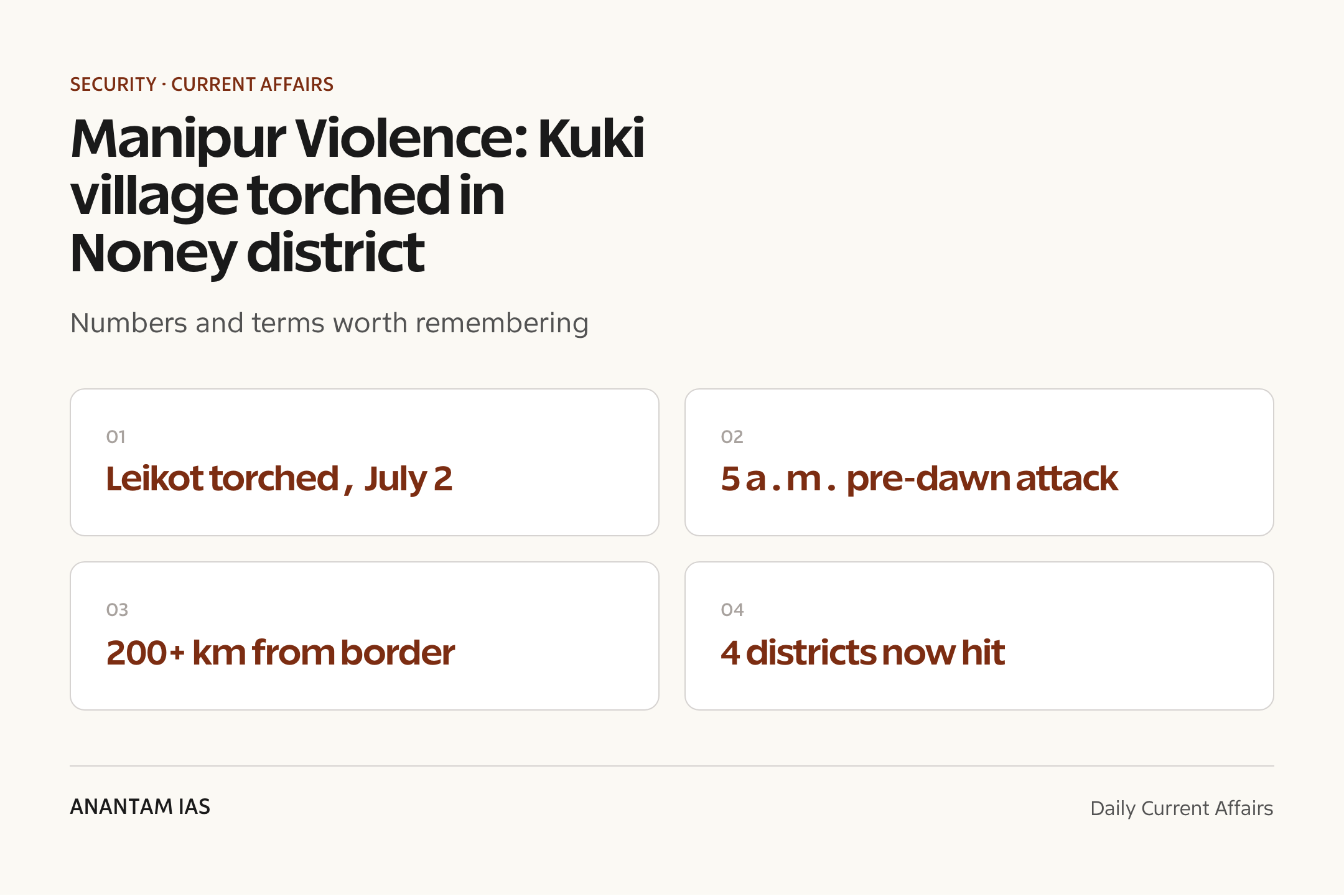
The Hindu reported that an armed group attacked and torched Leikot Kuki village in Manipur’s Noney district at around 5 a.m. on July 2, 2026. The Kuki Inpi — the apex body of the Kuki tribes — for Jiribam, Tamenglong and Noney districts alleged that suspected members of the National Socialist Council of Nagalim (NSCN) carried out the pre-dawn attack, reducing the village to ashes.
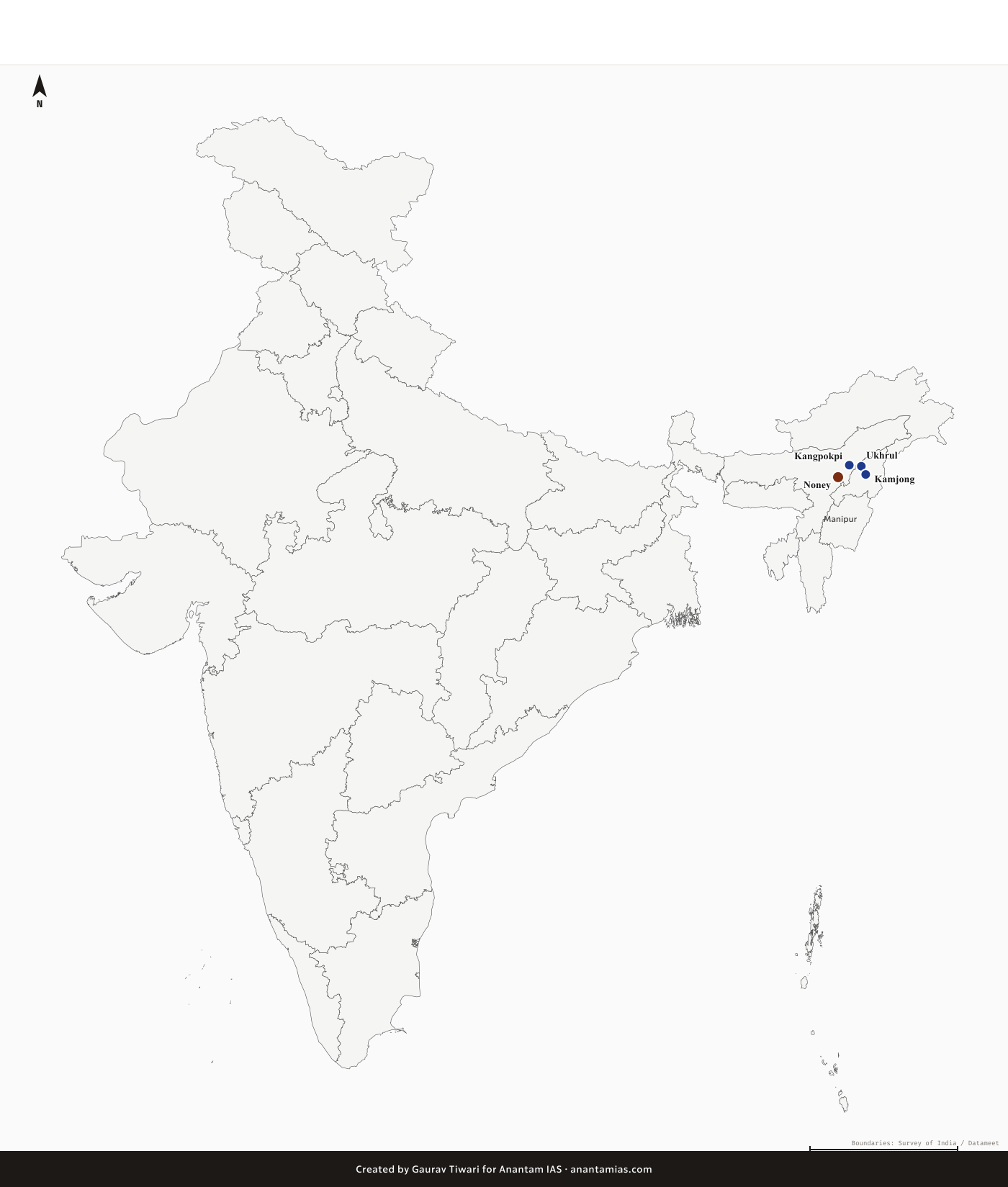
The attack follows similar violence on July 1 in Kamjong district, along the India-Myanmar border, where armed Naga groups allegedly torched Phaimol Kuki village and Kuki extremists reportedly destroyed Huimin Thana and Kherongram villages in retaliation. Noney lies more than 200 km west of the border — a sign the Kuki-Naga conflict zone is expanding across Manipur’s hill districts.
- Leikot village was attacked at around 5 a.m. on Thursday, July 2, 2026; the Kuki Inpi called it an “unprovoked” pre-dawn assault that reduced the village to ashes.
- Village volunteers armed with licensed single-barrel firearms were overwhelmed by attackers reportedly using automatic rifles and mortar shells.
- The site is over 200 km west of the India-Myanmar border, showing the violence is no longer confined to the border belt of Ukhrul and Kamjong.
- On July 1, in border-adjacent Kamjong district, Phaimol Kuki village was allegedly torched by armed Naga groups, and Huimin Thana and Kherongram villages were reportedly destroyed in a retaliatory attack.
- The Kuki Inpi demanded immediate government intervention and an impartial investigation; the NSCN did not react, while some Naga civil society organisations counter-claimed that the Noney incident may have been staged.
The development matters in the context of:
- The clashes mark a distinct Kuki-Naga axis of violence, separate from the Meitei-Kuki conflict that has convulsed Manipur since May 2023 — a state already stretched thin on security resources.
- Manipur was placed under President’s Rule under Article 356 in February 2025, making the Union government directly answerable for law and order in the new flashpoints.
- The spread of ethnic militia violence to interior districts tests India’s frameworks for ceasefire monitoring, Suspension of Operations (SoO) discipline, and border-area management along the Myanmar frontier.
UPSC Relevance
Prelims Relevance
- NSCN (Isak-Muivah): Naga insurgent group formed after splits in the Naga movement; signed a ceasefire with the Government of India in 1997 and the Framework Agreement in 2015.
- Kuki Inpi: the apex customary body of the Kuki tribes, organised at state and district levels in Manipur.
- Suspension of Operations (SoO), 2008: tripartite agreement (Centre-Manipur-Kuki armed groups under the KNO and UPF umbrellas); cadres confined to designated camps with weapons in locked storage.
- Article 356: President’s Rule imposed in Manipur in February 2025; Article 355 places a duty on the Union to protect states against internal disturbance.
- Article 371C: special provision for Manipur (27th Amendment Act, 1971) creating a Hill Areas Committee of the Legislative Assembly.
- Free Movement Regime (FMR): allowed visa-free movement up to 16 km either side of the India-Myanmar border; its discontinuation was announced in February 2024 alongside plans to fence the 1,643-km border.
- Districts in news: Noney (carved out of Tamenglong, 2016), Kamjong (carved out of Ukhrul, 2016), plus Ukhrul and Kangpokpi.
- Assam Rifles: guards the India-Myanmar border and functions under the operational control of the Army; AFSPA, 1958 applies to notified disturbed areas of Manipur.
Mains Relevance
GS Paper 3
- Internal security: expansion of ethnic militia violence to new districts as a failure of area domination, intelligence and buffer-zone strategy.
- Security challenges in border areas: Myanmar instability, cross-border movement of arms and cadres, FMR withdrawal and fencing debate.
- Effectiveness of ceasefire and SoO frameworks when signatory groups are accused of fresh violence.
GS Paper 1
- Society: ethnic identity, tribal land and territorial anxieties, and the hill-valley divide as structural drivers of recurring conflict in the Northeast.
GS Paper 2
- Article 355/356 and Centre-state responsibility for law and order during President’s Rule; role of customary apex bodies in governance and negotiation.
Essay
- Peace is not the absence of war but the presence of justice — the unfinished peace processes of the Northeast.
- Borders within borders: how identity conflicts fragment states from inside.
Background and Context
Manipur's Layered Ethnic Fault Lines
Manipur’s geography concentrates political power in a small valley and grievance in the surrounding hills, producing more than one axis of conflict.
- The Imphal valley is roughly a tenth of the state’s area but holds the majority Meitei population; the surrounding hills, about 90% of the territory, are home to Naga and Kuki-Zo tribes with constitutionally protected land rights.
- The Meitei-Kuki conflict that erupted on May 3, 2023 — triggered by disputes over Scheduled Tribe status, land and poppy-eradication drives — killed more than 250 people and displaced tens of thousands into relief camps.
- The Kuki-Naga axis is older: the clashes of 1992-97, driven by competing claims over land and village ownership in the hill districts, killed several hundred people and destroyed hundreds of villages.
- Overlapping homeland claims persist: the Naga movement has sought integration of Naga-inhabited areas of Manipur, while Kuki-Zo groups demand a separate administration carved from the same hill belt.
- Each community maintains armed groups, village volunteer forces and strong apex civil bodies — the Kuki Inpi, the United Naga Council, and Meitei organisations — which act as parallel centres of authority.
The Noney and Kamjong Attacks: What Happened
Within 48 hours, the Kuki-Naga confrontation jumped from the Myanmar border belt deep into western Manipur.
- July 1, 2026: armed Naga groups allegedly torched Phaimol Kuki village in Kamjong district near the India-Myanmar border; Kuki extremists reportedly destroyed Huimin Thana and Kherongram villages in retaliation, according to The Hindu.
- July 2, 2026, about 5 a.m.: an armed group attacked Leikot Kuki village in Noney district, more than 200 km west of the border, burning it down.
- The Kuki Inpi of Jiribam, Tamenglong and Noney districts blamed suspected members of the NSCN, describing defenders with licensed single-barrel guns facing automatic rifles and mortar shells.
- The conflict zone has now widened from Ukhrul to adjoining Kamjong and Kangpokpi, and onward to Noney — four hill districts drawn in.
- Competing narratives are already hardening: the Kuki Inpi demanded an impartial probe and better security cover, while some Naga civil society organisations alleged the Noney incident may have been staged; the NSCN itself made no statement.
The Armed-Group Landscape: Ceasefires and SoO
Both sides of this conflict include groups that are formally inside peace frameworks with the Government of India.
- The NSCN (Isak-Muivah), among the oldest insurgent organisations in the Northeast, has observed a ceasefire with New Delhi since August 1997 and signed the Framework Agreement in August 2015; final settlement remains stuck over demands such as a separate flag and constitution.
- The ceasefire’s ground rules formally apply within Nagaland, which has long complicated enforcement against NSCN activity in the Naga-inhabited hill districts of Manipur.
- Kuki-Zo armed groups under the Kuki National Organisation (KNO) and United People’s Front (UPF) umbrellas signed the tripartite Suspension of Operations agreement in August 2008: cadres must stay in designated camps and keep weapons in locked storage.
- Compliance has been contested for years — the Manipur government withdrew from the SoO with two groups in March 2023, alleging ground-rule violations, and renewal of the wider agreement has been repeatedly debated since the 2023 violence.
- When villages burn while ceasefires formally hold, the credibility of the entire ceasefire-monitoring architecture — joint monitoring groups, designated camps, weapon audits — comes under question.
Constitutional and Governance Framework
The legal machinery for handling Manipur’s breakdown spans emergency provisions, special provisions and policing statutes.
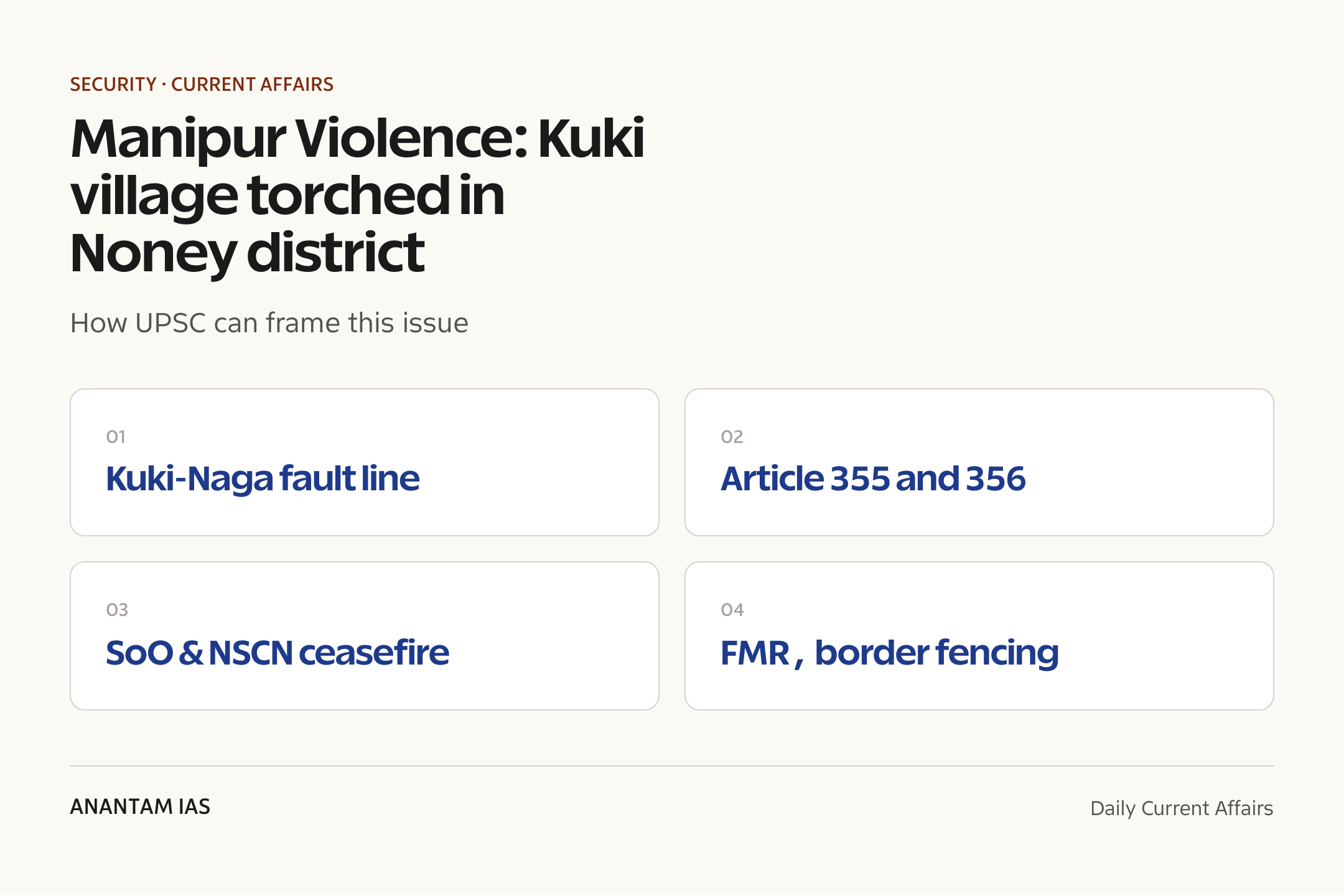
- Article 355 obliges the Union to protect every state against external aggression and internal disturbance; it is the constitutional basis for central intervention short of President’s Rule.
- Article 356 was invoked in February 2025 after the Chief Minister’s resignation, placing Manipur under President’s Rule with the Assembly in suspended animation — so responsibility for the Noney-Kamjong security lapses rests squarely with the Union government.
- Article 371C (inserted by the 27th Amendment Act, 1971) mandates a Hill Areas Committee of Manipur MLAs to safeguard hill interests; hill groups argue it is far weaker than the Sixth Schedule autonomy enjoyed in Assam, Meghalaya, Tripura and Mizoram.
- The Armed Forces (Special Powers) Act, 1958 operates in notified disturbed areas of Manipur, and central forces — Army, Assam Rifles, CRPF — man buffer zones between communities.
- The Ministry of Home Affairs (mha.gov.in) coordinates the peace talks, SoO oversight and deployment decisions that now determine whether the new front stabilises.
The Border Dimension: FMR, Fencing and Myanmar
The first round of the current Kuki-Naga clashes began in districts hugging an unstable international border.
- India and Myanmar share a 1,643-km border, of which about 398 km runs along Manipur — hilly, porous and historically governed by kinship ties that straddle the boundary.
- The Free Movement Regime, which allowed border residents visa-free movement up to 16 km on either side, was ordered discontinued in February 2024; the government simultaneously announced fencing of the entire border, and a stricter pass-based system now regulates crossings.
- Instability in Myanmar since the 2021 military coup has pushed refugees, arms and displaced cadres across the frontier, feeding both weapons availability and demographic anxieties inside Manipur.
- Kamjong’s torched villages sit directly on this frontier — border-area vulnerability and thin deployment make remote villages easy targets and hard crime scenes.
- The Noney attack shows the limits of a border-centric lens: once armed groups are mobilised, violence travels along ethnic geography, not administrative distance from the boundary.
Why This Escalation Matters for Internal Security
A second ethnic front in an already-broken state is a compounding, not additive, security problem.
- Security forces calibrated to hold Meitei-Kuki buffer zones in the valley-foothill interface now face a separate Kuki-Naga front across four hill districts, stretching deployment and intelligence grids.
- Asymmetry of arms — mortar shells and automatic rifles against licensed single-barrel guns — points to leakage from militant arsenals or cross-border supply, despite camps and ceasefires.
- Every unpunished village burning strengthens the case within each community for armed self-defence volunteers, deepening the militarisation of civil society.
- Mutual accusations — attack versus staged incident — show how quickly an information vacuum fills with competing propaganda when investigations lack credibility.
- Displacement from newly hit villages adds to Manipur’s existing internally displaced population, compounding relief-camp burdens and long-term land disputes.
Way Forward
Immediate Security and Investigative Response
- Rapid, visible deployment of neutral central forces in Noney, Tamenglong and Jiribam, with pickets at vulnerable minority villages identified jointly with district administrations.
- A time-bound, credibly independent investigation into the Leikot, Phaimol, Huimin Thana and Kherongram attacks — with findings published — to arrest the spiral of rumour and retaliation.
- Weapons audits of SoO camps and ceasefire-bound groups, with named consequences for ground-rule violations.
Rebuilding the Peace Architecture
- Convene the apex bodies — Kuki Inpi, United Naga Council and church and civil networks — in district-level peace committees before positions harden, reviving the mediation practices that ended the 1990s Kuki-Naga clashes.
- Insulate the Naga peace process and the SoO review from each other publicly, so a settlement with one community isn’t read as territorial loss by another.
- Under President’s Rule, pair security action with an explicit political roadmap — hill-area development, functioning Article 371C institutions, and clarity on how competing homeland demands will be addressed.
Border and Long-Term Measures
- Complete smart fencing and surveillance on the most trafficked stretches of the Manipur-Myanmar border while ensuring the pass system doesn’t criminalise legitimate kinship movement.
- Choke arms leakage through coordinated Assam Rifles-police interdiction and prosecution of gunrunners rather than only cadre-level seizures.
- Fund resettlement and compensation for burnt villages quickly — unresolved displacement is the raw material of the next round of conflict.
Conclusion
The burning of Leikot village is a warning that Manipur’s crisis is mutating, not settling. A state that has spent three years managing one ethnic fault line now confronts a second, older one — between communities both of which have armed groups formally inside ceasefire and SoO frameworks with the Indian state.
For the Union government, directly responsible under President’s Rule, the test is twofold: stop the geographic spread with impartial policing, and give every community a credible, non-violent route for its political claims. The durable lesson for internal-security management is that ceasefires without enforcement, and special provisions without substance, only park conflicts — they don’t resolve them.
Revise related themes from our daily current affairs archive to connect this with earlier developments in Manipur and the Naga peace process.
UPSC Practice Questions
Prelims MCQ 1
With reference to peace frameworks and border arrangements in India’s Northeast, consider the following statements:
- The National Socialist Council of Nagalim (Isak-Muivah) has observed a ceasefire with the Government of India since 1997.
- The Suspension of Operations (SoO) agreement in Manipur is a tripartite arrangement covering Kuki armed groups.
- The Free Movement Regime allowed residents to travel visa-free up to 50 km on either side of the India-Myanmar border.
How many of the above statements are correct?
(a) Only one (b) Only two (c) All three (d) None
Answer: (b) Only two
Explanation:
Statements 1 and 2 are correct: the NSCN-IM ceasefire dates to August 1997, and the SoO (2008) is a tripartite pact among the Centre, the Manipur government and Kuki groups under the KNO and UPF umbrellas. Statement 3 is incorrect — the FMR permitted movement up to 16 km, not 50 km, on either side of the border.
Prelims MCQ 2
Noney district of Manipur, recently in the news for ethnic violence, was carved out of which of the following districts?
(a) Ukhrul (b) Churachandpur (c) Tamenglong (d) Senapati
Answer: (c) Tamenglong
Explanation:
Noney was created in 2016 by bifurcating Tamenglong district in western Manipur. Kamjong, the other district in the news, was carved out of Ukhrul the same year.
UPSC Mains Questions
- The expansion of ethnic violence to new districts of Manipur exposes the limits of ceasefire and Suspension of Operations frameworks in the Northeast. Critically examine, and suggest measures to make such frameworks instruments of durable peace rather than managed stalemate.
- Border-area vulnerability and internal ethnic fault lines reinforce each other in India’s Northeast. Discuss with reference to the India-Myanmar border, the withdrawal of the Free Movement Regime, and the recent violence in Manipur’s hill districts.
- During President’s Rule, the Union government bears direct responsibility for internal security in a state. In the context of Manipur, examine the constitutional tools available under Articles 355, 356 and 371C, and evaluate their effectiveness in managing ethnic conflict.
Source: The Hindu.
Frequently Asked Questions
What happened in Manipur’s Noney district?
An armed group attacked and torched Leikot Kuki village in Noney district at about 5 a.m. on July 2, 2026. The Kuki Inpi alleged that suspected NSCN members carried out the pre-dawn attack, overwhelming village volunteers who had only licensed single-barrel firearms against automatic rifles and mortar shells.
How is this different from the Meitei-Kuki conflict?
The Meitei-Kuki conflict, ongoing since May 2023, pits the valley-based Meitei community against Kuki-Zo tribes. The Noney and Kamjong attacks fall on a separate Kuki-Naga axis — a rivalry over land and village ownership in the hill districts that previously exploded in the 1992-97 clashes.
Who are the NSCN (Isak-Muivah)?
The National Socialist Council of Nagalim (Isak-Muivah) is one of the oldest insurgent groups in the Northeast, seeking a unified Naga homeland. It has observed a ceasefire with the Government of India since 1997 and signed the Framework Agreement in 2015, though a final settlement remains unresolved.
What is the Suspension of Operations agreement?
The SoO is a tripartite agreement signed in 2008 among the Centre, the Manipur government and Kuki armed groups under the KNO and UPF umbrellas. Cadres must remain in designated camps with weapons in locked storage. Alleged violations and renewal disputes have dogged the pact since the 2023 violence.
Why was Manipur placed under President’s Rule?
President’s Rule was imposed under Article 356 in February 2025, after the Chief Minister resigned amid the prolonged ethnic crisis that began in May 2023. The Assembly was kept in suspended animation, making the Union government directly responsible for law and order in the state.
What was the Free Movement Regime?
The FMR allowed residents on both sides of the India-Myanmar border to travel up to 16 km into each other’s territory without a visa, respecting cross-border kinship ties. Citing security concerns after the Manipur violence, the government announced its discontinuation in February 2024 alongside plans to fence the 1,643-km border.