Manipur’s Widening Ethnic Conflict: Naga-Kuki Fault Line
Why in News?
Fresh violence between Naga and Kuki communities in Manipur’s hill districts has added a new dimension to the State’s prolonged ethnic crisis. At least seven persons from both communities were reportedly killed in Kangpokpi district, alongside attacks and arson in several villages.
Deputy Chief Minister of Manipur has warned that continuing violence could make the 2027 Assembly election difficult in the hill districts. Naga legislators have demanded action against armed groups and may reconsider their support to the State government.
| UPSC Relevance: GS-3 Internal Security: Insurgency and linkages with organised crime. Prelims: Key Constitutional & Statutory Provisions. Mains: Internal Security issue in Manipur. |
Manipur’s Ethnic Geography:
Manipur’s social geography broadly comprises:
- Meiteis: Constitute ~53% of the state’s population, largely Hindu and non-tribal. They inhabit the Imphal Valley and dominate the legislature and bureaucracy. They have long sought Scheduled Tribe (ST) status to access forest land and government benefits in hill areas.
- Kuki-Zo Tribals: A cluster of tribes (Kuki, Zo, Hmar, Mizo-related groups) with ethnic linkages extending into Mizoram and Myanmar’s Chin region. They inhabit the southern and western hill districts. Their demand for a separate Kukiland / Zomi homeland carved out of Manipur has intensified after the 2023 violence. Many allege they face existential threats from Meitei ST demands and state-backed evictions from “reserved forests.”
- Nagas: Comprising multiple tribes (Tangkhul, Mao, Maram, Zeme, etc.), Nagas dominate the northern and eastern hill districts. They have historically pursued Naga political sovereignty through bodies like NSCN (IM) and share contested border territory with both Meiteis and Kukis.
The valley accounts for only about one-tenth of Manipur’s territory but accommodates most of its population. The hills, inhabited predominantly by Scheduled Tribes, possess special land protections. This valley-hill divide has turned questions of land, representation and identity into zero-sum political contests.
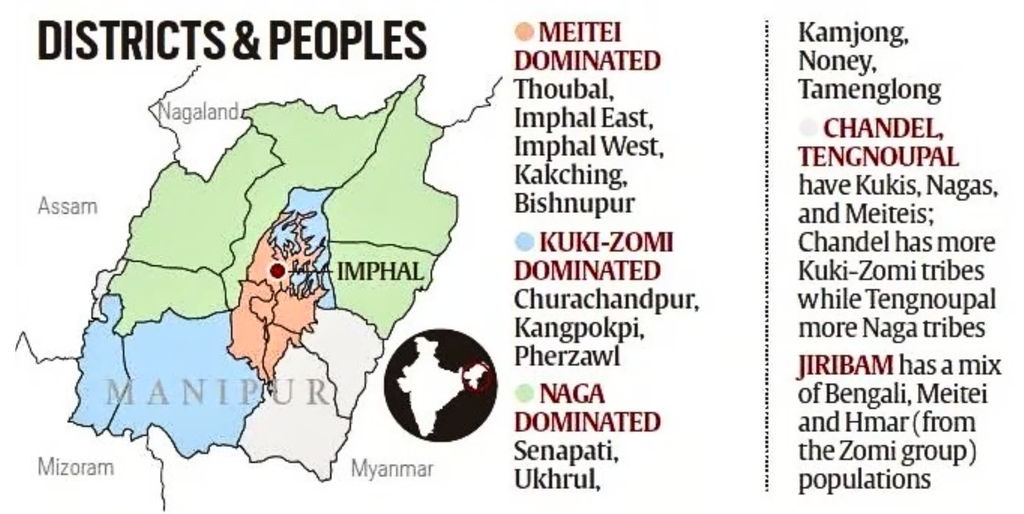
Evolution of the Conflict:
- The 2023 High Court order on Scheduled Tribe status for Meiteis was the proximate trigger of violence in Manipur, as tribal groups feared loss of their protected reservations in jobs, education, and land.
- Presently, Manipur is no longer confronting only a bipolar Meitei-Kuki conflict, but an ongoing conflict between the Kuki and Naga communities in Manipur has escalated into a triangular ethnic-security crisis.
Structural Drivers behind the Conflict in Manipur:
- ST Status demand of Meiteis: The 2023 Manipur HC order on Meitei ST status shattered the post-independence compact that gave tribal communities exclusive land and job protections in the hills, while keeping Meiteis confined to the valley.
- Weak hill governance: Manipur’s hill areas are protected by Article 371C, which provides for a Hill Areas Committee and a special responsibility for the Governor. However, the State’s Autonomous District Councils do not enjoy the extensive constitutional powers available to Sixth Schedule councils.
- Proliferation of armed groups: Meitei, Naga and Kuki insurgent organisations coexist with village volunteers and armed civilian groups. Weapons looted since 2023, weak enforcement of ceasefire conditions and community-based mobilisation have blurred the line between insurgency and ethnic vigilantism.
- Land and demographic anxieties: Traditional landholding systems, protected forests, evictions and the absence of widely accepted land records have created rival narratives of encroachment and dispossession.
- Myanmar linkage: The civil war in Myanmar has generated refugee flows and facilitated the movement of arms, narcotics and insurgent cadres across a difficult border. Ethnic kinship across the border further complicates security management.
- Governance and trust deficit: Perceptions of partisan policing, segregated settlements and ineffective administration have reduced confidence in the State. Difficult terrain and poor road connectivity also delay the response of security forces.
NRC-Census Controversy:
Several organisations have demanded an updated National Register of Citizens before the Census, citing illegal immigration. However, the two exercises serve different purposes:
- The Census is a confidential enumeration of the population under the Census Act, 1948;
- Citizenship determination and the NRC operate under the Citizenship Act, 1955 and related rules.
Conflating them could deepen ethnic profiling and exclusion. Any citizenship-verification exercise must therefore follow transparent legal procedures, provide documentary flexibility and guarantee appeals and judicial review.
Implications of the conflict:
- Persistent violence may undermine free and fair elections in hill constituencies.
- Withdrawal of Naga political support could destabilise the governing coalition.
- Inter-community violence may derail the Naga peace process and Kuki-Zo dialogue.
- Territorial segregation could become permanent, weakening Manipur’s social and administrative unity.
- Displacement, road blockades and disruption of the Moreh trade corridor undermine India’s Act East Policy.
- Armed ethnic mobilisation creates opportunities for insurgency, narcotics trafficking and cross-border criminal networks.
Way Forward:
- Establish a neutral unified security command, recover illegal weapons and ensure equal protection for all communities.
- Independently investigate recent killings while avoiding collective attribution of crimes to entire communities.
- Conduct strict, transparent monitoring of all ceasefire and Suspension of Operations camps.
- Initiate a Centre-mediated dialogue involving Meitei, Naga and Kuki-Zo representatives, women’s groups and traditional institutions.
- Create an impartial commission for village boundaries, customary land and forest rights disputes.
- Strengthen Article 371C institutions and examine greater legislative, financial and administrative autonomy for hill councils through consensus.
- Ensure safe return or voluntary resettlement of internally displaced persons, accompanied by livelihood support and community reconciliation.
- Improve border surveillance and road connectivity while creating a humane, legally regulated mechanism for refugees from Myanmar.
- Consider negotiated power-sharing arrangements that guarantee meaningful participation of all major communities in the executive, legislature and security institutions.
Durable peace requires neutral enforcement of law, meaningful hill autonomy, inter-ethnic dialogue and constitutional power-sharing, turning Manipur’s diversity from a source of insecurity into a framework for coexistence.
Key Constitutional & Statutory Provisions:
| Article 355 mandates the Union to protect states from external aggression and internal disturbances. It serves as a directive obligation and forms a basis for Central intervention (such as sending paramilitary forces) without immediately imposing President’s Rule under Article 356. |
| Article 356 authorises the President to impose President’s Rule on a state if its government cannot function according to constitutional provisions. |
| 5th vs 6th Schedule: Tribal areas of Manipur’s hills are NOT under the 6th Schedule (unlike Assam, Meghalaya, Mizoram). This is a key grievance as Kuki-Zo tribals demand the 6th Schedule or equivalent autonomous council protection. |
| Article 371(C): Provides special provisions to preserve the cultural, social, and administrative identity of the tribal communities in the hilly parts of Manipur. The President is empowered to form the Hill Areas Committee (HAC) of MLAs from designated hill areas in Manipur to oversee policy and development, protecting tribal interests.The Governor is given special responsibility to ensure the proper functioning of this committee. The Governor is required to report annually (or as requested) to the President regarding the administration of the hill areas. |
| The Inner Line Permit (ILP) regime was officially extended to Manipur in 2019, primarily to regulate the entry of outsiders and protect the indigenous population. ILP does not resolve and is not designed to address the underlying conflicts between the indigenous communities. |
| AFSPA, 1958: The Armed Forces (Special Powers) Act remains in force in parts of Manipur to maintain security. It grants armed forces special powers but is seen by tribal groups as enabling impunity. |
UPSC PYQ 2025
Q. What are the major challenges to internal security and the peace process in the North-Eastern States? Map the various peace accords and agreements initiated by the government in the past decade. (15 M)