Manufacturing PMI June 2026: Factory Growth Slows
Why in News?
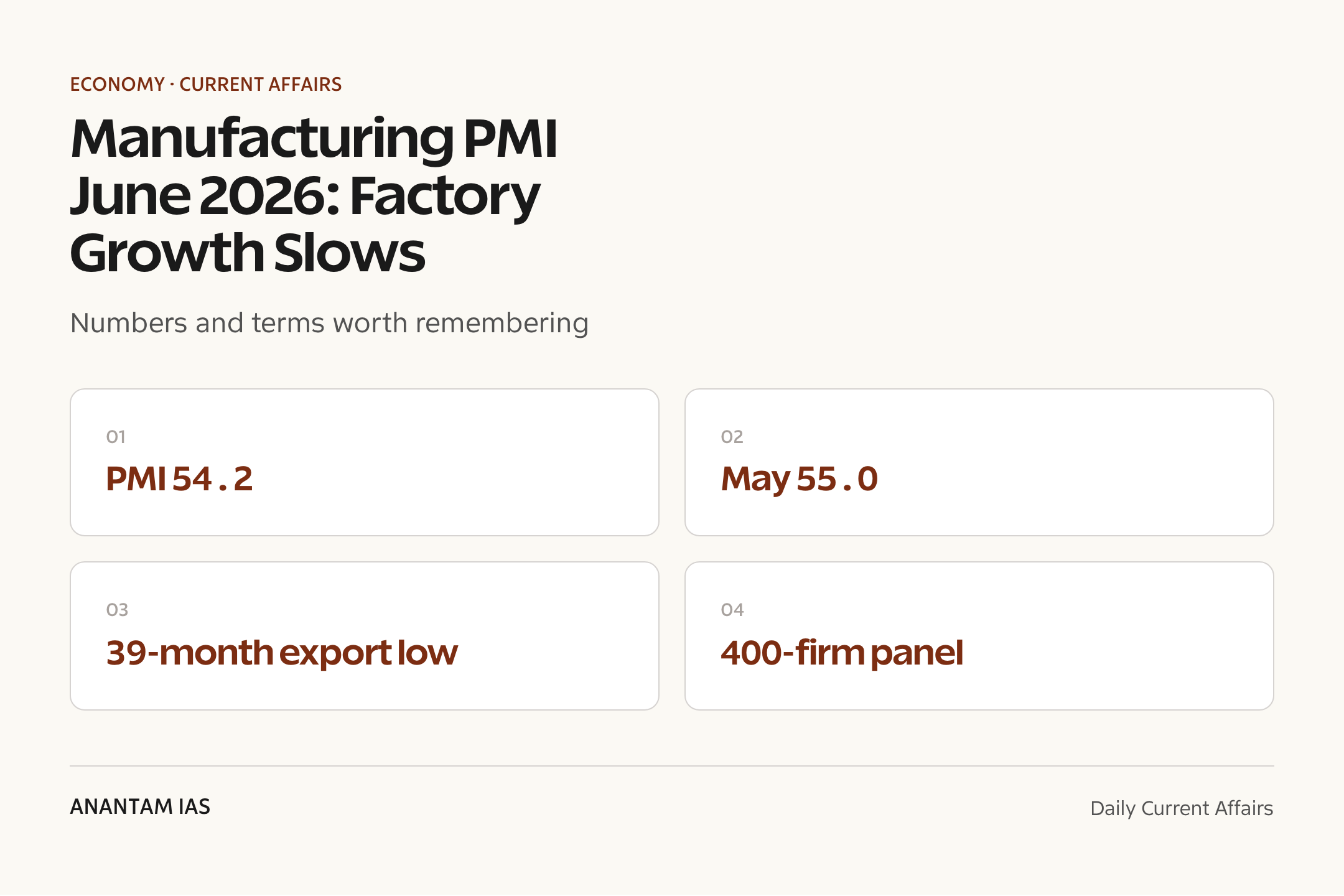
The Hindu reported on 1 July 2026 that India’s manufacturing PMI slowed to 54.2 in June, its second-lowest reading in four years.
S&P Global Market Intelligence and HSBC said the seasonally adjusted index fell from 55.0 in May, signalling continued factory expansion but at a slower pace.
- HSBC India Manufacturing PMI remained above the neutral 50.0 mark, so it still showed expansion over the previous month.
- New orders and output growth were among the weakest in four years, with March 2026 being the notable recent softer month.
- International sales increased at the slowest pace since March 2023, partly due to weaker demand from some European markets.
- Input-cost inflation and output-charge inflation eased, making the slowdown a mixed signal rather than a simple bad-news data point.
- Data collection for the release took place from 10-24 June 2026, giving it value as a high-frequency business survey.
The development matters in the context of:
- PMI is a survey-based early indicator, useful before official output data such as IIP and national accounts arrive.
- For GS3, the issue links industrial growth, exports, employment, inflation pressure and the limits of headline growth numbers.
- A still-expansionary reading with slower momentum helps explain why policymakers must read growth, prices and demand together, not in isolation.
UPSC Relevance
Prelims Relevance
- PMI stands for Purchasing Managers’ Index, a diffusion index based on month-on-month business survey responses.
- A PMI reading above 50.0 indicates expansion compared with the previous month; below 50.0 indicates contraction.
- The June 2026 HSBC India Manufacturing PMI was 54.2, down from 55.0 in May.
- The headline PMI is a weighted average of new orders, output, employment, suppliers’ delivery times and stocks of purchases.
- In the PMI formula, new orders carry the highest weight at 30 percent, followed by output at 25 percent and employment at 20 percent.
- Suppliers’ delivery times are inverted in the PMI calculation so that the index moves in the same broad direction as the other components.
- The India manufacturing PMI survey is compiled by S&P Global from responses from a panel of around 400 manufacturers.
- The topic connects directly to Indian economy, industrial policy, exports and inflation monitoring.
Mains Relevance
GS Paper 3
- Indian economy: industrial growth, high-frequency indicators, demand cycles and manufacturing competitiveness.
- Inclusive growth: the link between factory expansion, employment, MSME orders and wage demand.
- External sector: export-order softness, European market demand and vulnerability of manufacturing supply chains.
- Inflation: easing input and output price pressure, and its relevance for monetary policy reading.
GS Paper 2
- Governance: evidence-based policy making through timely, credible and comparable economic indicators.
- Regulatory capacity: using survey data with official statistics instead of replacing one with the other.
Essay
- Growth numbers need interpretation, not celebration or alarm.
- Manufacturing is both an economic and employment question.
- Data-led governance works best when quick indicators are checked against ground realities.
Background and Context
What PMI Measures
PMI is a fast monthly signal of business conditions, not a direct measure of factory output.
- Purchasing managers report whether key business variables improved, worsened or stayed unchanged compared with the previous month.
- The index is called a diffusion index because it measures the spread of improvement or deterioration across firms, not the exact value of production.
- A reading above 50.0 means more firms reported improvement than deterioration after weighting; it does not mean output grew by that percentage.
- The headline manufacturing PMI combines new orders, output, employment, supplier delivery times and stocks of purchases.
- For Prelims, remember the direction rule: above 50 means expansion, below 50 means contraction and 50 is the no-change line.
June 2026 Headline Signal
The June reading showed continued expansion, but the pace of improvement weakened.
- HSBC India Manufacturing PMI fell from 55.0 in May to 54.2 in June.
- S&P Global described the June reading as the second-weakest improvement in sector health since mid-2022, with March 2026 being weaker.
- The Hindu framed the reading as the second-lowest in four years, which makes the headline important for the daily economy watch.
- Because 54.2 is still above the neutral mark, the correct interpretation is slower expansion, not outright contraction.
- The release also noted that the June reading remained close to the long-run series average, so the signal is one of cooling momentum rather than a collapse.
Demand and Output Story
The most exam-relevant part of the release is the softening of demand-led growth.
- New orders and output grew at among the weakest rates seen in four years, apart from the March 2026 dip.
- Some firms still reported better demand conditions, but others cited subdued client appetite and intense market competition.
- The slowdown was concentrated in capital goods, while consumer and intermediate goods makers saw faster growth.
- Export orders continued to rise, but the pace was the weakest in 39 months, with weaker sales to some European markets.
- Capital goods matter here because they are investment-linked; weakness in this segment can signal caution about future capacity expansion.
- This matters for inclusive growth because demand softness can affect investment, supplier payments, MSME order books and hiring plans.
Prices and Inflation Reading
The same release that showed slower growth also pointed to easier price pressure.
- Input-cost inflation eased to its slowest pace since February 2026, even though firms still reported costlier chemicals, electronics, gas, metals, petroleum products, plastics, rubber and wood.
- Output charges rose at the least pronounced pace in three months, showing that firms were more cautious about raising selling prices.
- This is useful for inflation analysis because the PMI captures price pressure at the producer level before it may pass through to consumers.
- Lower cost pressure can support margins, but weaker demand can also limit firms’ ability to expand production and employment.
- For Mains, the nuanced answer is that a lower PMI can contain both a growth warning and a price-relief signal.
Employment, Inventories and Sentiment
The labour and inventory signals show why PMI is more useful than a single output headline.
- Employment still expanded in June, but at the weakest rate recorded in 2026 so far.
- S&P Global linked weaker hiring to limited capacity pressure, with backlogs of work broadly unchanged.
- Input buying grew at the weakest pace in two-and-a-half years, showing caution in purchasing raw materials and intermediates.
- Finished-goods stocks fell, with firms citing better alignment of production and inventories with current demand.
- Business confidence slipped to a five-month low, as concerns over demand and market conditions weighed on future output expectations.
How to Use PMI Carefully
PMI is valuable because it is quick, but it must be read with other data.
- Survey data can reveal turning points faster than official statistics, especially in business sentiment, orders and hiring intentions.
- But PMI does not replace IIP, corporate results, export data, GST collections or national accounts; it complements them.
- A broad economy answer should triangulate PMI with core-sector output, bank credit, capacity utilisation and external-demand trends.
- The June 2026 reading warns that headline manufacturing expansion can hide weaker orders, softer export momentum and slower employment growth.
- Exam answers should separate level and direction: the level stayed expansionary, but the direction pointed to cooling momentum.
- This is why the UPSC syllabus economy portion rewards interpretation of indicators, not memorisation of isolated numbers.
Way Forward
Triangulate high-frequency data
- Use PMI with IIP, core-sector data, GST collections, railway freight, export figures and corporate commentary before drawing policy conclusions.
- Track sub-indices such as new orders, export orders, employment and prices because they explain the source of a headline movement.
- Improve public communication so citizens understand that a PMI above 50 shows expansion even when the reading falls from the previous month.
Support demand and competitiveness
- Focus on MSME credit, logistics reliability, export-market diversification and timely payments to suppliers where order books are weakening.
- Use industrial policy to reduce avoidable input-cost shocks in sectors exposed to metals, electronics, petroleum-linked inputs and imported intermediates.
- Strengthen skilling and apprenticeship pathways so slower hiring phases do not become a long-term manufacturing employment bottleneck.
Watch inflation without ignoring growth
- Treat easing input prices as useful relief, but avoid reading it as proof that manufacturing demand is strong.
- Monitor whether lower cost pressure passes through to output prices, margins, investment and consumer prices over the next few months.
- For policy, the balance is to protect macro stability while keeping the manufacturing investment cycle alive.
Conclusion
The June 2026 PMI does not show a manufacturing contraction. It shows slower factory expansion, weaker order momentum, softer export growth, muted hiring and easier price pressure in the same data set.
For UPSC, the lesson is methodological as much as factual. A number like 54.2 must be read through its components, its direction of change and its relation to official output, employment, inflation and external-sector data.
UPSC Practice Questions
Prelims MCQ 1
With reference to the Purchasing Managers’ Index, consider the following statements:
- A reading above 50 indicates expansion compared with the previous month.
- The headline manufacturing PMI includes new orders, output, employment, suppliers’ delivery times and stocks of purchases.
- Suppliers’ delivery times are inverted in the PMI calculation.
How many of the above statements are correct?
(a) Only one (b) Only two (c) All three (d) None
Answer: (c) All three
Explanation:
All three statements are correct. PMI is a diffusion index; above 50 signals expansion, and the manufacturing headline index uses five weighted components with suppliers’ delivery times inverted.
Prelims MCQ 2
Which one of the following best describes India’s manufacturing PMI reading for June 2026?
(a) It fell below 50, showing contraction in manufacturing activity. (b) It rose to 55.0, showing faster expansion than in May. (c) It fell to 54.2, showing continued expansion at a slower pace. (d) It stayed unchanged at 50.0, showing no change in factory activity.
Answer: (c) It fell to 54.2, showing continued expansion at a slower pace.
Explanation:
The HSBC India Manufacturing PMI fell from 55.0 in May to 54.2 in June 2026. Since it remained above 50, it indicated expansion, but at a slower pace.
UPSC Mains Questions
- India’s June 2026 manufacturing PMI shows slower expansion but softer price pressure. Discuss how policymakers should interpret high-frequency indicators when growth, employment, exports and inflation send mixed signals.
- Purchasing Managers’ Index data can reveal turning points before official output data, but it cannot replace official statistics. Examine this statement in the context of India’s manufacturing sector.
- A slower manufacturing PMI can affect MSMEs, export competitiveness and job creation. Analyse the policy steps needed to sustain factory growth without worsening inflation.
Sources: S&P Global Market Intelligence, HSBC India Manufacturing PMI and The Hindu.
Frequently Asked Questions
What was India’s June PMI?
India’s manufacturing PMI was 54.2 in June 2026, down from 55.0 in May. Since the reading stayed above 50, it still showed expansion over the previous month, but the pace of factory growth slowed.
Who releases the manufacturing PMI?
The HSBC India Manufacturing PMI is compiled by S&P Global Market Intelligence from survey responses from around 400 manufacturers. The survey asks firms about changes in orders, output, employment, inventories, supplier delivery times and prices.
Why is 50 important in PMI?
The 50.0 mark is the no-change line. A reading above 50 means expansion compared with the previous month, while a reading below 50 means contraction. A falling reading above 50 means growth is continuing, but at a slower pace.
What weakened in June 2026?
New orders, output, export orders and employment grew more slowly in June. S&P Global also reported weaker input buying, a fall in finished-goods inventories and business confidence at a five-month low.
Was there any positive signal?
Yes. Input-cost inflation and output-charge inflation eased in June. This can reduce pressure on firms and consumers, but it must be read with the demand slowdown because softer prices can also appear when firms hesitate to raise prices.
Why does PMI matter for UPSC?
PMI helps connect GS3 topics such as industrial growth, exports, employment, inflation and evidence-based economic policy. It is a useful example of why exam answers should interpret indicators, not just quote headline numbers.