Satellite-Aided Rescue: Turning Distress Alerts Into Response
Why in News?
At the SAREX-2026 inauguration on 7 October, the government reported full operational capability of India’s MEOLUT ground terminal, highlighting the link between satellite alerts and maritime rescue preparedness.
- The sea exercise off Paradip was scheduled for 8 October; the inauguration release does not establish that those sea drills had already concluded.
- The official statement highlighted the transition towards Medium Earth Orbit Search and Rescue, or MEOSAR.
- The National Maritime Search and Rescue Board reviewed distress-alert management, vessel tracking, information sharing and inter-agency coordination.
- SAREX aims to test operational readiness and interoperability; exercise objectives are not measured rescue outcomes.
- An accurate distress alert is valuable only if the responsible authority can turn it into a coordinated rescue response.
- A ground terminal links space-based detection to operational agencies, making terrestrial infrastructure central to a satellite-enabled public service.
UPSC Relevance
Prelims Relevance
- Cospas-Sarsat: international satellite-aided search and rescue system.
- MEOSAR: Medium Earth Orbit Search and Rescue.
- MEOLUT: Medium Earth Orbit Local User Terminal.
- INMCC: Indian Mission Control Centre at ISTRAC, Bengaluru.
- Search and rescue regions are coordination areas, not declarations of sovereignty.
Mains Relevance
GS Paper 3
- Space technology for disaster response and maritime safety.
- Inter-agency coordination and resilient public infrastructure.
Essay
- Technology saves lives when institutions can act on information.
Background and Context
From a Beacon to a Rescue Authority
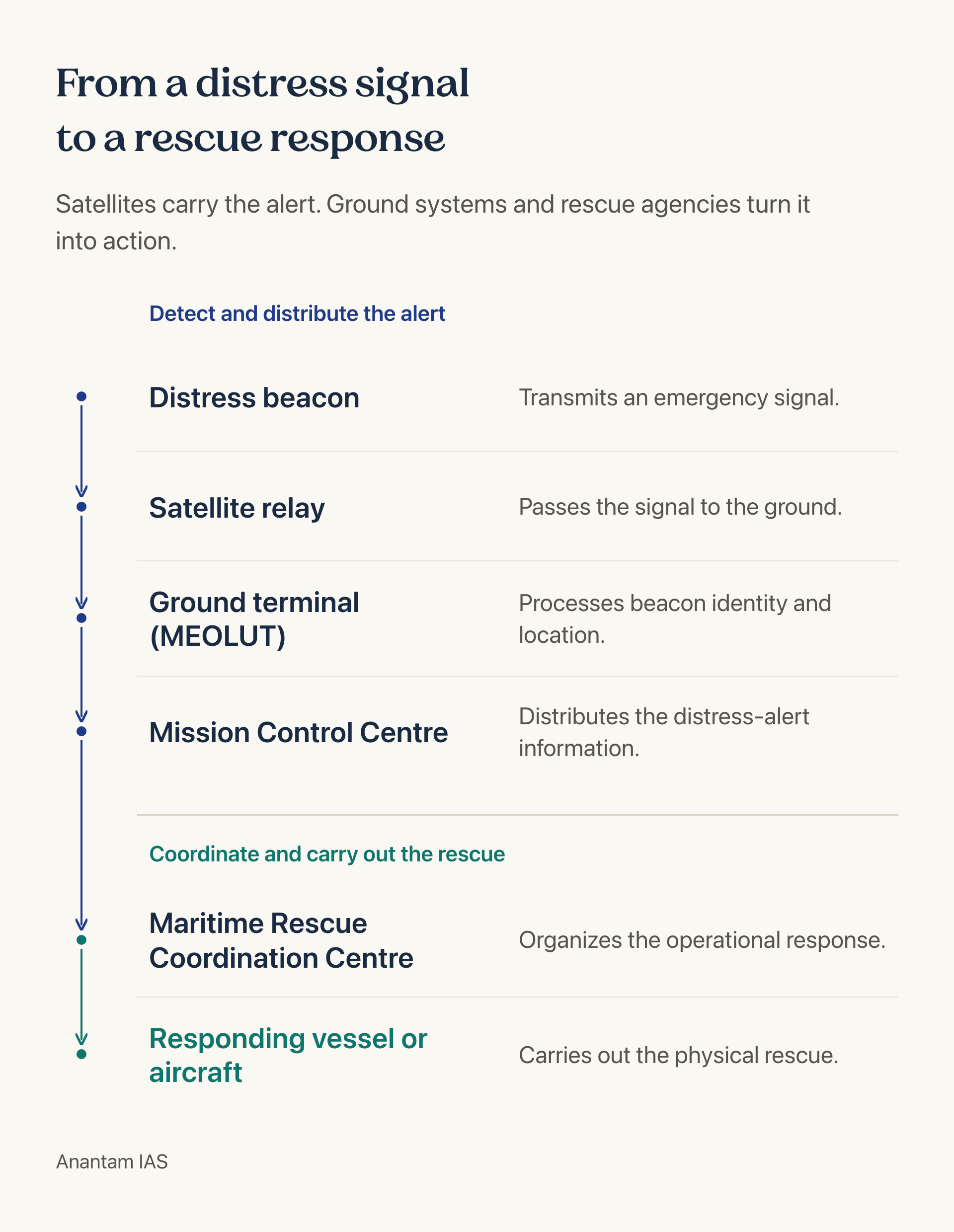
The rescue system separates detection, information processing and operational response; no single satellite or shore station performs all three jobs.
- A distress beacon originates the emergency signal. Search-and-rescue payloads on satellites receive it and relay information towards the ground segment, connecting a person or vessel in distress with agencies beyond local radio range.
- A Local User Terminal processes satellite downlinks. In MEOSAR, the relevant ground station is a MEOLUT, which provides beacon identification and location information for onward distribution rather than physically conducting the rescue mission.
- The Mission Control Centre passes distress-alert information through the search-and-rescue network. ISRO’s Indian centre receives information from local terminals and other centres, helping direct useful alerts to the relevant rescue authorities.
- A Maritime Rescue Coordination Centre organizes the operational response. It must connect the available information with suitable responding agencies and assets; receiving a beacon location is only the beginning of that practical task.
- Rescue craft and aircraft are the response end of the chain. Satellite-aided alerting supports their mission, but cannot substitute for crews, operational decisions and the ability to reach people safely at sea.
What the MEOSAR Ground Segment Changes
The new development concerns the readiness of a ground segment within a wider alerting system, not the creation of a self-sufficient rescue capability.
- MEOSAR uses search-and-rescue payloads associated with medium-Earth-orbit navigation satellite systems. Its role here is distress alerting and location support; a navigation constellation and a rescue service are related but not identical functions.
- MEOLUT processing converts received satellite downlinks into usable beacon information. The reported full operational capability is significant because a satellite signal becomes operationally valuable only when ground systems can process and distribute it.
- LEOSAR, GEOSAR and MEOSAR refer to search-and-rescue arrangements using different orbital categories. They should not be treated as three kinds of rescue boat or as interchangeable names for India’s mission control centre.
- The 7 October announcement supplies the current capability claim. Older technical descriptions explain how the system works, but their development-stage language should not be mistaken for a fresh assessment of operational readiness today.
- System capability and mission outcomes require different evidence. The release supports the ground-terminal milestone; it does not establish a universal rescue-time guarantee, a new location-accuracy figure or lives saved by the forthcoming sea drill.
Why Coordination Still Determines the Outcome
A functioning alert chain needs maintained equipment, usable information and agreed responsibilities, especially when an emergency involves several agencies or crosses coordination areas.
- Beacon registration and testing are part of operational preparedness. ISRO maintains a registration database and supports coding, testing and training, illustrating why reliable emergency services require routine work before an actual distress event occurs.
- Exercises connect agencies that normally operate separate systems. SAREX’s stated focus on joint response and interoperability matters because a well-received signal can still be mishandled when information, responsibilities or response procedures do not align.
- Information sharing should support decisions, not simply move messages between offices. The board’s review of distress-alert management and vessel tracking points to the need to connect the emergency with available operational response capacity.
- A search and rescue region allocates coordination responsibility; it does not establish sovereignty over the sea within it. Under the SAR framework, its delimitation does not prejudge boundaries between States or settle maritime disputes.
- International cooperation is a functional part of maritime rescue, supported by the IMO’s SAR framework. A useful assessment asks whether agencies can exchange alerts and organize assistance across responsibilities, rather than equating equipment acquisition with preparedness.
Way Forward
Test the Entire Alert-to-Response Chain
- Exercise handoffs between terminals, mission control and rescue coordinators, identifying where useful information is lost or delayed.
- Maintain beacon registration, testing and user training alongside technical infrastructure; published capability requires continuing operational support.
- Assess response readiness separately from alert detection, using exercise findings to correct coordination gaps before a real emergency.
Conclusion
- Satellite-aided search and rescue turns a distress signal into actionable information through ground processing and coordination. Its public value depends on the whole chain, from a functioning beacon to an operational rescue response.
- Use the MEOLUT milestone to explain technology-enabled disaster management, while distinguishing reported capability from proven mission outcomes. A search and rescue region defines responsibility for assistance, not ownership of the sea.
UPSC Practice Questions
Prelims MCQ 1
With reference to satellite-aided search and rescue, consider the following statements:
- A MEOLUT is a ground terminal that processes satellite downlinks for distress-alert information.
- A Mission Control Centre and a responding rescue craft perform the same function.
- The delimitation of a search and rescue region determines sovereignty over the waters within it.
How many of the above statements are correct?
(a) Only one (b) Only two (c) All three (d) None
Answer: (a) Only one
Explanation:
Only the first statement is correct. Mission control distributes alert information, while rescue units respond; SAR regions do not determine sovereignty.
Prelims MCQ 2
Which sequence best represents the broad satellite-aided maritime rescue chain?
(a) Beacon → satellite → ground terminal → mission control → rescue coordination → responding units (b) Satellite → rescue craft → beacon → ground terminal → mission control (c) Mission control → beacon → rescue coordination → satellite → distress event (d) Ground terminal → satellite → beacon → completed rescue
Answer: (a) Beacon → satellite → ground terminal → mission control → rescue coordination → responding units
Explanation:
The broad chain separates the initial distress signal, space relay, ground processing, alert distribution, coordination and physical response.
UPSC Mains Questions
- Explain how satellite-aided search and rescue illustrates the importance of ground infrastructure in space-enabled public services. (150 words)
- A distress alert is necessary but not sufficient for a successful maritime rescue. Discuss with reference to technology, institutional coordination and international cooperation. (250 words)
Sources: PIB, Ministry of Defence and ISRO, Search and Rescue.
Frequently Asked Questions
What is MEOSAR?
MEOSAR means Medium Earth Orbit Search and Rescue. It uses satellite search-and-rescue payloads and ground processing to support distress alerting and location information for the authorities responsible for organizing assistance.
What does a MEOLUT do?
A Medium Earth Orbit Local User Terminal processes satellite downlinks to provide distress-beacon identification and location information. That information is passed through mission control to the search-and-rescue authorities; the terminal does not conduct physical rescue.
Did the SAREX announcement establish completed sea-exercise outcomes?
No. The release reported the inauguration on 7 October and scheduled the sea exercise off Paradip for 8 October. It described objectives and preparedness, rather than verified outcomes from completed sea drills.
Does a search and rescue region establish maritime sovereignty?
No. A search and rescue region identifies coordination responsibility for assistance. The SAR framework separates its delimitation from boundaries between States, so the region should not be treated as territorial waters.
Why are beacon registration and testing important?
Registration, testing and user training support the operational reliability of distress-alert services. ISRO maintains beacon registration information and helps users with coding and testing, alongside the satellite and ground infrastructure.