Teen Social-Media Safety: What Meta’s Settlement Changes and Leaves Unresolved
Why in News?
On August 26, Meta and a multistate US coalition filed a settlement requiring product-design safeguards for teen accounts, subject to court entry and phased implementation.
- The filed agreement sets a combined two-hour daily default limit across Instagram and Facebook for users aged 13–17, changeable to a less restrictive setting only with parental approval.
- Its first-phase night access mode blocks most platform use from midnight to 6 a.m.; messaging and settings remain available with anti-circumvention limits.
- It also requires pauses after prolonged use, restricted notifications, stronger age assurance, safer content controls, parental tools and limits on selected social-comparison features.
- These are settlement obligations, not proof that the features are already live or that they will produce particular mental-health outcomes.
- The case shifts attention from harmful posts alone to product architecture: defaults, recommendations, notifications and feedback signals can shape attention and continued use.
- The settlement illustrates regulation through enforceable design duties, monitoring and independent audit rather than relying only on user choice or parental awareness.
UPSC Relevance
Prelims Relevance
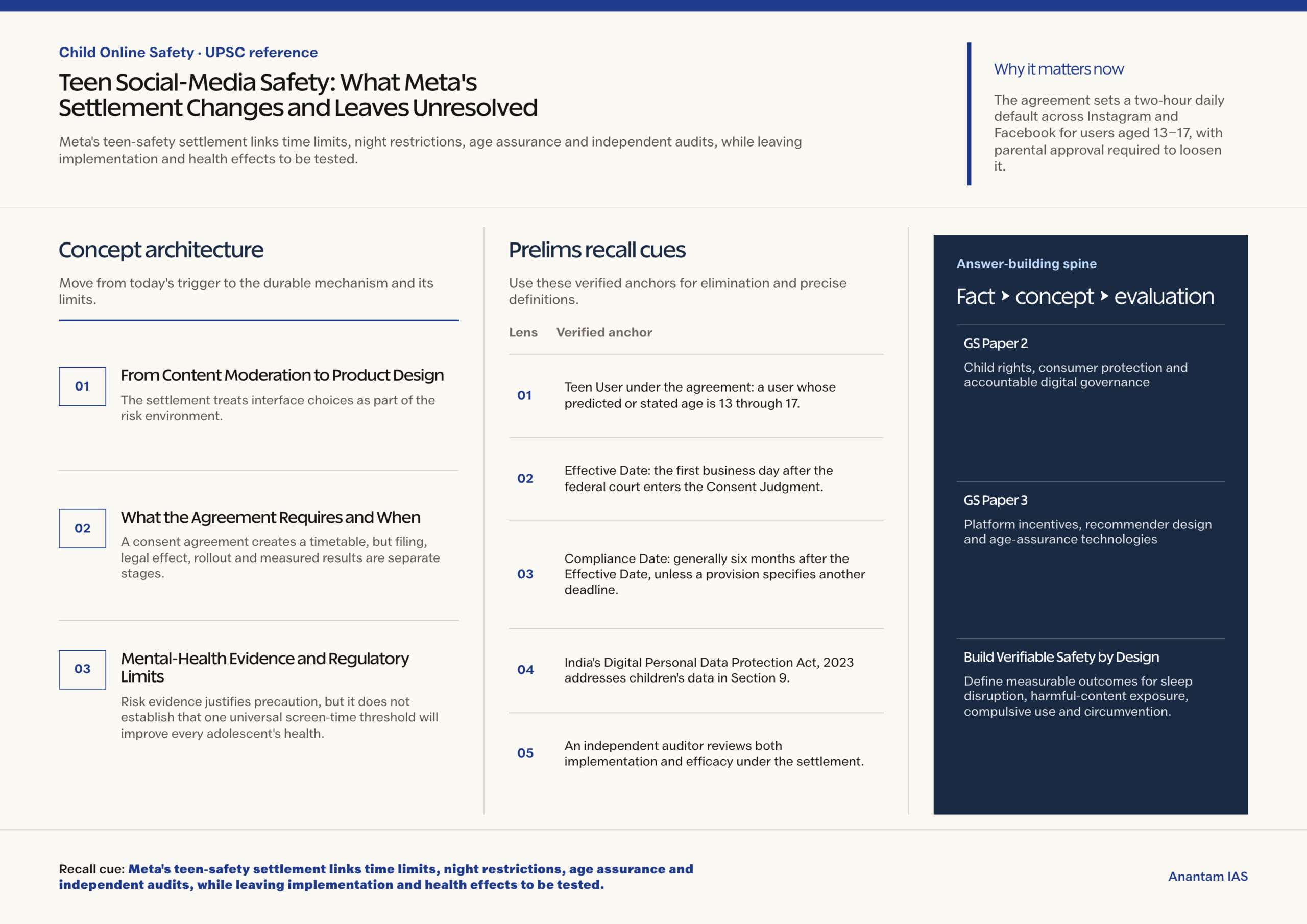
- Teen User under the agreement: a user whose predicted or stated age is 13 through 17.
- Effective Date: the first business day after the federal court enters the Consent Judgment.
- Compliance Date: generally six months after the Effective Date, unless a provision specifies another deadline.
- India’s Digital Personal Data Protection Act, 2023 addresses children’s data in Section 9.
- An independent auditor reviews both implementation and efficacy under the settlement.
Mains Relevance
GS Paper 2
- Child rights, consumer protection and accountable digital governance
- Design-based regulation, enforceable defaults and independent oversight
GS Paper 3
- Platform incentives, recommender design and age-assurance technologies
- Innovation-safety trade-offs in regulating large digital intermediaries
Essay
- When a platform profits from attention, safety cannot depend entirely on a child’s self-control.
Background and Context
From Content Moderation to Product Design
The settlement treats interface choices as part of the risk environment, not as neutral containers for user-generated content.
- Infinite feeds, repeated recommendations, visible popularity signals and timed notifications can reward continued engagement; changing defaults can alter exposure without banning lawful speech or individual expression.
- A default rule matters because many users keep preselected settings, while parental approval adds friction before protections are weakened for a young account.
- Time limits address duration, but the agreement also targets how attention is captured through pauses, notification controls and selected social-comparison features.
- Age assurance is the entry gate: safeguards cannot work reliably if children are classified as adults or maintain easily undetected secondary accounts across the same service.
- The agreement covers Meta’s US teen users in participating jurisdictions; it does not automatically create an international standard, legal precedent or duty in India.
What the Agreement Requires and When
A filed consent agreement creates a timetable, but filing, legal effect, product rollout and measured results are separate stages.
- The agreement was fully executed and filed, yet its Effective Date begins only after the federal court enters the Consent Judgment in the pending litigation.
- Most operational duties take effect on the Compliance Date, generally six months later; productive pauses have a specified four-month deadline after the Effective Date.
- The two-hour cap applies cumulatively across covered Meta platforms and excludes some messaging, settings and long-form viewing, so it is neither a total device-use limit nor a complete lockout.
- Night mode restricts access from midnight to 6 a.m., while notifications are generally disabled from 10 p.m. to 7 a.m.; parental approval is needed to relax defaults.
- Independent review can test whether Meta implemented the controls and examine their efficacy, converting a public promise into an auditable compliance process.
Mental-Health Evidence and Regulatory Limits
Risk evidence justifies precaution, but it does not establish that one universal screen-time threshold will improve every adolescent’s health.
- The US Surgeon General’s advisory says social media can provide benefits and risks, while evidence gaps prevent a conclusion that it is sufficiently safe for children.
- Observed associations between heavy use and poor mental health do not, by themselves, prove a single causal pathway; content, vulnerability, context and type of use differ.
- Usage controls may reduce exposure or interrupt compulsive patterns, but health effects require independent longitudinal evaluation across different adolescents, not inference from feature deployment alone.
- Rigid controls can also invite age misstatement, secondary accounts or migration to other platforms, making industry coverage and circumvention testing important.
- For India, Section 9 of the DPDP Act supplies a child-data framework; platform-design accountability requires wider safety, audit, transparency and independent research tools.
Way Forward
Build Verifiable Safety by Design
- Define measurable outcomes for sleep disruption, harmful-content exposure, compulsive use and circumvention, while separating these from broad claims about overall mental health.
- Require privacy-preserving age assurance, data minimisation and clear deletion rules so child protection does not become a justification for excessive identity collection.
- Give independent researchers access to sufficiently detailed, privacy-protected platform data and publish comparable audit findings across services.
- Combine enforceable platform duties with digital literacy, parental tools, grievance systems and accessible professional support for children who experience harm.
Conclusion
- The settlement’s durable lesson is that platform accountability can regulate defaults and engagement mechanisms, not merely remove unlawful content after harm occurs.
- In a UPSC answer, distinguish the legal promise, implementation timetable and independently measured outcome; treating them as one event would overstate both enforcement and evidence.
- A credible child-safety regime must protect attention and privacy together, because intrusive age checks can create a new risk while addressing an existing one.
UPSC Practice Questions
Prelims MCQ 1
With reference to the Meta teen-safety settlement, consider the following statements:
- Its Effective Date begins after the court enters the Consent Judgment.
- The two-hour daily limit became operational merely upon filing the agreement.
- The agreement provides for independent assessment of implementation and efficacy.
How many of the above statements are correct?
(a) Only one (b) Only two (c) All three (d) None
Answer: (b) Only two
Explanation:
Statements 1 and 3 are correct. Filing did not itself activate the product controls; court entry starts the Effective Date, followed by specified implementation deadlines.
Prelims MCQ 2
Which regulatory approach is best illustrated by mandatory teen defaults combined with independent auditing?
(a) Complete prohibition of social media (b) Exclusive reliance on parental awareness (c) Safety-by-design with accountable implementation (d) Removal of all intermediary protections
Answer: (c) Safety-by-design with accountable implementation
Explanation:
The approach changes product defaults and subjects compliance to outside assessment; it neither bans platforms nor relies solely on parents.
UPSC Mains Questions
- Platform design can create public risks even when individual pieces of content are lawful. Discuss the case for safety-by-design regulation of social media used by children.
- How can India combine child-data protection, age assurance and independent platform audits without creating excessive surveillance?
Sources: Pennsylvania Office of Attorney General and Indian Express Explained Health.
Frequently Asked Questions
Are Meta’s new teen protections already active?
Not merely because the agreement was filed. Court entry triggers the Effective Date, and most obligations follow on the Compliance Date or another specified deadline.
What is the daily limit in the first phase?
The default is two hours of covered use cumulatively across Instagram and Facebook, with some messaging, settings and long-form viewing excluded from the calculation.
Does the settlement prove that time limits improve mental health?
No. It creates risk-reduction measures and an evaluation mechanism, but particular mental-health outcomes must be established through independent evidence over time.
Why is age assurance central to child online safety?
Age-based protections fail when children are classified as adults. The challenge is improving classification without collecting more identity data than is necessary.
What is the main lesson for India?
Child-data duties should be complemented by enforceable product-design standards, transparent audits, researcher access and privacy safeguards for age-assurance systems.