Zinc-Air Catalysts: Improving the Oxygen Reaction Without Platinum
Why in News?
On 7 October 2026, the Department of Science and Technology highlighted Indian research on a metal-free catalyst called TTT-DHTD for the oxygen reaction in zinc-air batteries.
- Researchers from SNBNCBS, Kolkata, INST, Mohali, and SRM University, Amaravati, developed the porous organic material.
- The material was demonstrated as an air-electrode catalyst; the study appeared in Science Advances before the government announcement.
- The reported advance concerns oxygen reduction under laboratory conditions, rather than a commercially deployed battery system.
- Reducing reliance on precious-metal catalysts could widen material choices for energy storage, but lower manufacturing costs require separate evidence.
- The news connects materials design with a recurring science concept: catalysts change reaction rates, not the source of a battery’s energy.
UPSC Relevance
Prelims Relevance
- Oxidation and reduction
- Zinc-air battery electrodes
- Oxygen reduction reaction
- Covalent organic frameworks
- Catalyst versus reactant
Mains Relevance
GS Paper 3
- Materials research and energy-storage constraints
- Evidence needed to translate laboratory catalysts into deployable technology
Essay
- Scientific progress depends on both discovery and reliable translation.
Background and Context
What the New Catalyst Changes
The central advance is molecular design at the air electrode, where oxygen must react efficiently for the battery to deliver useful power.
- TTT-DHTD is a covalent organic framework: organic building blocks joined through covalent bonds into an extended porous network. Its composition and arrangement create sites where oxygen can attach and undergo reaction.
- A catalyst helps a reaction proceed through a more favourable pathway. Here, the target is oxygen reduction at the air electrode, rather than replacing zinc or supplying an independent source of electrical energy.
- Porosity provides access to internal surfaces, but pores alone do not establish catalytic performance. The chemistry of the accessible sites matters because oxygen must interact with them appropriately during the electrode reaction.
- Metal-free describes this catalyst material, not the entire battery. A zinc-air cell still uses metallic zinc; treating the phrase as proof of a metal-free storage device would confuse the component with the system.
- The DST account describes laboratory testing and computer simulations. Experiments assess behaviour, while modelling helps explain how molecular structure supports oxygen attachment and reaction; neither alone establishes commercial readiness.
How a Zinc-Air Battery Produces Current
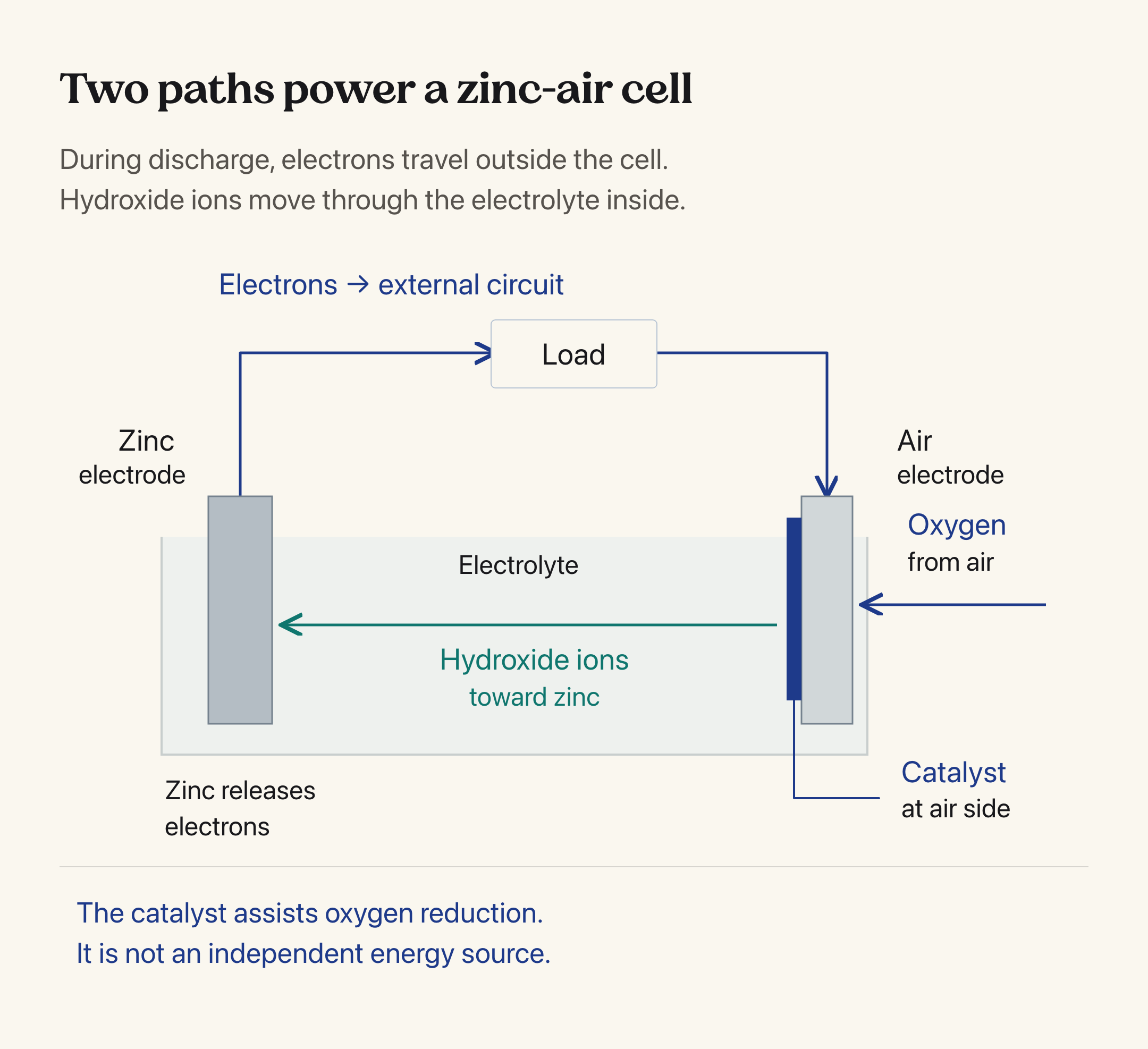
During discharge, separate electrode reactions are linked by an external electron path and an internal ion path through the electrolyte.
- At the zinc electrode, oxidation releases electrons. They travel through the external circuit toward the air electrode, allowing a connected load to draw power from the cell’s overall chemical reaction.
- At the air electrode, oxygen accepts electrons: this is reduction. Air supplies a reactant, not unlimited free energy; sustained discharge also depends on zinc participating in the paired electrode reaction.
- In an alkaline zinc-air cell, the oxygen reaction produces hydroxide ions. These move through the electrolyte toward the zinc side, completing the internal charge-transfer route while electrons take the external circuit.
- Oxygen reduction kinetics concern how readily the reaction proceeds. A suitable catalyst helps this electrode process; it does not remove every other limitation associated with electrolyte behaviour, electrodes or battery construction.
- The US Department of Energy assessment identifies oxygen electrochemistry as a development challenge. Its reaction description explains the generic battery mechanism, not the measured performance of this particular Indian catalyst.
Why a Catalyst Result Is Not a Finished Battery
The useful comparison is between catalyst activity and complete-device performance: they answer different questions and cannot be substituted for each other.
- Platinum is an established oxygen-reduction catalyst benchmark. Matching a selected laboratory measurement against platinum does not demonstrate identical performance across every operating condition or prove that the complete battery is equally efficient.
- Device efficiency concerns the complete energy-conversion system, including losses beyond a single catalyst. A percentage describing one experimental comparison should not be relabelled as the fraction of energy delivered by a battery.
- Rechargeability adds another requirement: reversing discharge chemistry reliably. Efficient oxygen reduction during discharge does not by itself establish oxygen evolution during charging, stable repeated cycling or a commercially useful battery lifetime.
- Material availability can motivate research without proving low production cost. Processing, reproducibility and integration must also be assessed before describing an experimental catalyst as an affordable replacement in a finished energy-storage product.
- Scale-up requires evidence from practical operating conditions and complete cells. Longer laboratory operation is useful, but should not be presented as proof of deployment, manufacturing readiness or performance over years of service.
Way Forward
Test the Full Storage System
- Evaluate complete-cell performance alongside catalyst activity, stating the conditions and comparison basis for every claimed improvement.
- Assess manufacturing reproducibility and processing costs before translating abundant ingredients into claims of affordable finished devices.
- For rechargeable applications, test charging behaviour and repeated cycling separately from oxygen reduction during discharge.
Conclusion
- TTT-DHTD illustrates how molecular engineering can expand the materials available for oxygen electrochemistry. The defensible advance is a laboratory catalyst result, with practical storage benefits still requiring evidence from complete devices.
- For UPSC, keep the chain clear: zinc oxidation releases electrons, oxygen reduction accepts them, and the catalyst assists the electrode reaction. Energy-storage promises should be judged against system performance rather than a material label alone.
UPSC Practice Questions
Prelims MCQ 1
With reference to zinc-air batteries during discharge, consider the following statements:
- Zinc undergoes oxidation at the zinc electrode.
- Oxygen accepts electrons at the air electrode.
- The catalyst is the independent source of electrical energy.
How many of the above statements are correct?
(a) Only one (b) Only two (c) All three (d) None
Answer: (b) Only two
Explanation:
Zinc oxidation supplies electrons and oxygen reduction accepts them. The catalyst assists the electrode reaction; energy comes from the overall chemical process, not the catalyst alone.
Prelims MCQ 2
Which conclusion follows directly from describing an air-electrode catalyst as metal-free?
(a) The entire battery contains no metal (b) The battery does not consume reactants (c) The catalyst material does not rely on metal constituents (d) The battery is commercially rechargeable
Answer: (c) The catalyst material does not rely on metal constituents
Explanation:
Metal-free describes the catalyst’s composition. A zinc-air battery still uses zinc, and the label does not establish commercial performance or rechargeability.
UPSC Mains Questions
- Explain the role of oxygen-reduction catalysts in zinc-air batteries. Why is catalyst performance insufficient to establish commercial viability?
- Materials innovation can reduce dependence on scarce inputs, but laboratory success alone does not ensure affordable energy storage. Discuss.
Sources: PIB, Department of Science and Technology and US Department of Energy, Zinc Batteries Technology Strategy Assessment.
Frequently Asked Questions
What is TTT-DHTD?
TTT-DHTD is a metal-free covalent organic framework investigated as an oxygen-reduction catalyst. Its porous organic structure provides accessible reaction sites at the air electrode of a zinc-air battery.
Does a zinc-air battery run on air alone?
No. Oxygen from air participates in reduction at the air electrode, while zinc undergoes oxidation. The paired chemical reactions produce electrical energy; air is not an unlimited independent energy source.
Does metal-free mean that the battery contains no metals?
No. The description applies to the catalyst material. Zinc remains part of the battery, and the composition of one component should not be confused with that of the complete device.
Does better oxygen reduction prove rechargeability?
No. Oxygen reduction is central to discharge. Rechargeable operation also requires suitable charging reactions and stable repeated cycling, which must be evaluated rather than inferred from a discharge-catalyst result.