Alchemy Near-Space Test and Microgravity Drug Manufacturing
Why in News?
Bhubaneswar-based Serendipity Space reported a near-space test of Alchemy , its autonomous pharmaceutical crystallisation payload, bringing attention to India’s emerging interest in microgravity drug manufacturing .
- The Indian Express reported that Alchemy processed commercial monoclonal-antibody and small-molecule samples and that the samples were preserved through recovery.
- The payload was designed to automate operations such as controlled crystallisation, monitoring and sample protection without an onboard human operator.
- The reported flight was a near-space mission. It was not described as a satellite placed in low Earth orbit, and the public report did not establish sustained orbital microgravity.
- A near-space platform validates hardware under low pressure, thermal variation, vibration and recovery loads. It does not automatically reproduce the long-duration microgravity available on an orbiting spacecraft.
- The result is relevant because autonomous payloads and recoverable spacecraft are two enabling technologies for future in-space research and manufacturing.
- Gravity influences fluid motion, sedimentation and crystal growth. Reducing those effects can change how proteins and pharmaceutical compounds nucleate, grow and arrange themselves.
- NASA notes that microgravity protein-crystal experiments can sometimes produce larger or more orderly crystals, supporting molecular-structure studies and drug formulation research.
- Scientific promise is not the same as commercial readiness: material made in space must still pass analytical, safety, efficacy, regulatory and cost tests on Earth.
UPSC Relevance
Prelims Relevance
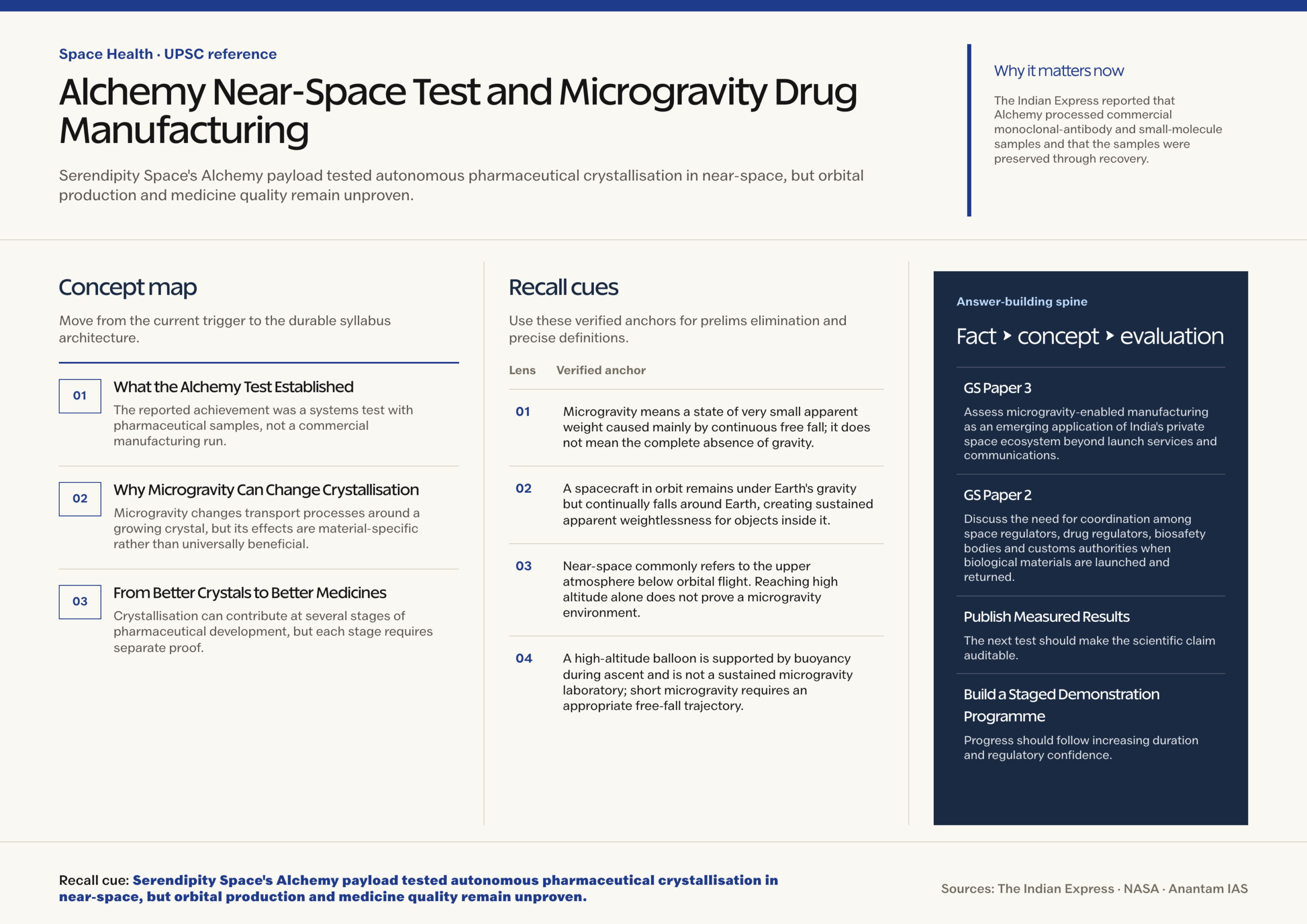
- Microgravity means a state of very small apparent weight caused mainly by continuous free fall; it does not mean the complete absence of gravity.
- A spacecraft in orbit remains under Earth’s gravity but continually falls around Earth, creating sustained apparent weightlessness for objects inside it.
- Near-space commonly refers to the upper atmosphere below orbital flight. Reaching high altitude alone does not prove a microgravity environment.
- A high-altitude balloon is supported by buoyancy during ascent and is not a sustained microgravity laboratory; short microgravity requires an appropriate free-fall trajectory.
- Low Earth orbit is the region of Earth orbit generally used by crewed stations and many research satellites; an object must have sufficient horizontal velocity to remain in orbit.
- Crystallisation is the ordered formation of a solid crystal from a solution, melt or vapour, and it can affect purity, particle size, solubility and stability.
Mains Relevance
GS Paper 3
- Assess microgravity-enabled manufacturing as an emerging application of India’s private space ecosystem beyond launch services and communications.
- Explain how automation, miniaturised laboratories and recoverable spacecraft can connect space science with biotechnology and advanced manufacturing.
GS Paper 2
- Discuss the need for coordination among space regulators, drug regulators, biosafety bodies and customs authorities when biological materials are launched and returned.
- Examine how public research infrastructure and transparent validation standards can support innovation while protecting patient safety.
Essay
- Frontier technologies become socially valuable only when spectacular demonstrations are converted into reproducible evidence, affordable systems and trustworthy regulation.
Background and Context
What the Alchemy Test Established
The reported achievement was a systems test with pharmaceutical samples, not a commercial manufacturing run.
- Alchemy is described as an autonomous crystallisation module intended eventually to operate on a reusable satellite and return processed samples to Earth.
- According to the company account carried by The Indian Express, the payload initiated pharmaceutical crystallisation and protected the samples during recovery.
- That result can provide evidence about automation, sample handling, environmental control, telemetry and recovery robustness under a demanding flight profile.
- The publicly available report does not provide peer-reviewed measurements of crystal size, defect density, polymorph, purity, yield, microgravity level or exposure duration.
- It also does not show that the payload completed an orbit. Calling the event an orbital factory would erase a crucial distinction between a precursor test and the intended operational system.
Why Microgravity Can Change Crystallisation
Microgravity changes transport processes around a growing crystal, but its effects are material-specific rather than universally beneficial.
- On Earth, density differences can produce buoyancy-driven convection, while gravity can make particles or crystals settle. Both processes influence how solute reaches a crystal surface.
- In sustained microgravity, diffusion becomes more important because sedimentation and buoyancy-driven convection are greatly reduced. Under suitable conditions, growth can be slower and more orderly.
- NASA reports that some protein-crystal experiments have produced larger or more uniform crystals, which can yield clearer diffraction data and a more precise view of molecular structure.
- For small-molecule drugs, the important questions can include crystal form or polymorph, particle-size distribution, stability, dissolution and manufacturability.
- Microgravity does not guarantee a better crystal. Temperature gradients, vibrations, impurities, nucleation conditions, hardware design and mission duration can all change the outcome. A ground-control sample is essential for comparison.
From Better Crystals to Better Medicines
Crystallisation can contribute at several stages of pharmaceutical development, but each stage requires separate proof.
- Well-ordered protein crystals can help researchers resolve a target’s molecular structure and identify where a potential drug might bind. This supports drug discovery rather than directly producing a treatment.
- Crystal engineering can also help select a stable solid form, improve processability or study how a compound dissolves. These are formulation advantages, not automatic evidence of clinical benefit.
- NASA describes International Space Station work on monoclonal-antibody crystallisation that explored whether concentrated crystalline suspensions could support easier routes of administration than prolonged intravenous infusion.
- A candidate formulation must still undergo physical and chemical characterisation, stability studies, pre-clinical work where applicable, controlled clinical trials and regulatory review.
- Claims such as ‘purer’, ‘more soluble’ or ‘more effective’ must be tied to measurements for the specific compound. They cannot be inferred merely from the word microgravity.
What Decades of Orbital Research Show
Established space-station research gives the idea a scientific basis while also showing why careful qualification matters.
- NASA says protein-crystal growth has been one of the most extensively studied categories of research aboard the International Space Station. The objective is often to obtain crystals suitable for structural analysis, not to mass-produce a.
- NASA’s macromolecular-crystal guide explains that reduced sedimentation and convection can support larger and more ordered crystals. Its wording is conditional because results vary across proteins, crystallisation methods and flight environments.
- Space-station experiments have examined proteins linked to disease targets and the crystallisation behaviour of monoclonal antibodies. Such experiments can generate structural knowledge or formulation leads that researchers then test on Earth.
- An orbiting laboratory offers long exposure and well-characterised environmental data, but it is expensive and dependent on launch schedules. A free-flying autonomous payload seeks to reduce crew time and make missions more repeatable.
- A commercially useful platform needs a matched terrestrial experiment with the same sample, hardware, thermal history and operating sequence. Without this control, researchers cannot isolate the contribution of microgravity from other flight stresses.
Way Forward
Publish Measured Results
- Release the flight profile, acceleration record, temperature history, exposure duration and recovery timeline alongside results from a matched ground-control sample.
- Use independent laboratories to compare crystal structure, polymorph, purity, particle size, stability and dissolution with pre-declared methods.
- Separate engineering success, process success and pharmaceutical improvement in all public reporting.
Conclusion
- Alchemy’s near-space flight is a credible signal that Indian start-ups are exploring autonomous laboratories and recoverable manufacturing payloads.
- The larger opportunity is real but conditional.
UPSC Practice Questions
Prelims MCQ 1
With reference to microgravity and pharmaceutical crystallisation, consider the following statements:
- An orbiting spacecraft experiences microgravity mainly because it and its contents are in continuous free fall.
- Every payload taken to near-space necessarily experiences sustained microgravity.
- Reduced sedimentation and buoyancy-driven convection can alter crystal growth in microgravity.
How many of the above statements are correct?
(a) Only one (b) Only two (c) All three (d) None
Answer: (b) Only two
Explanation:
Statements 1 and 3 are correct. Orbit produces apparent weightlessness through continuous free fall, and reduced sedimentation and convection can affect crystal growth. Near-space denotes a region or flight environment; altitude alone does not guarantee sustained microgravity.
Prelims MCQ 2
Which one of the following most accurately describes a pharmaceutical protein-crystal experiment in microgravity?
(a) It proves that the resulting medicine is safe and effective in humans (b) It eliminates the need for ground-control samples (c) It may improve structural or formulation research, but the specific result still requires measurement and regulatory validation (d) It can operate only when astronauts manually handle every sample
Answer: (c) It may improve structural or formulation research, but the specific result still requires measurement and regulatory validation
Explanation:
Microgravity can sometimes improve crystal order or enable useful formulation studies, but it does not establish clinical safety, efficacy or commercial manufacturability. Autonomous payloads can also operate without continuous astronaut handling.
UPSC Mains Questions
- Microgravity manufacturing is as much a problem of evidence and regulation as it is of spacecraft engineering. Discuss with reference to pharmaceutical crystallisation. (250 words)
- Differentiate near-space testing, suborbital microgravity and orbital manufacturing. How should India design a staged pathway for commercial space-biotechnology missions? (250 words)
Sources: The Indian Express and NASA.
Frequently Asked Questions
What is microgravity drug manufacturing?
Microgravity drug manufacturing uses the near-weightless environment of a free-falling spacecraft to study or process pharmaceutical materials. Reduced sedimentation and buoyancy-driven convection can alter protein or small-molecule crystallisation. The phrase covers research and formulation work; it does not mean every.
What did Serendipity Space test with Alchemy?
The company reported that its autonomous Alchemy payload initiated crystallisation of monoclonal-antibody and small-molecule samples during a near-space mission and preserved them through recovery. The public report supports an early technology demonstration, not a completed orbital manufacturing campaign or a.
Is near-space the same as low Earth orbit?
No. Near-space generally refers to high-altitude atmospheric flight below orbit. An orbital spacecraft has enough horizontal velocity to keep falling around Earth. A near-space test can validate hardware and recovery, but sustained orbital microgravity requires a different trajectory and usually.
Why can microgravity produce different crystals?
On Earth, gravity drives sedimentation and can contribute to buoyancy-driven fluid motion around a growing crystal. In microgravity those effects are reduced, so diffusion can dominate transport. Under suitable conditions this may support larger or better-ordered crystals, though the outcome.
Do better crystals automatically mean a better drug?
No. Better-ordered protein crystals may improve structural analysis, while a useful pharmaceutical crystal form may affect stability or dissolution. Each claim requires compound-specific measurements. Any medicine or formulation must still pass quality, safety, efficacy and regulatory requirements before it can.