Middle Income Trap
Why in news?
According to the author, India faces a “middle-income, low-productivity trap” where jobless growth, low wages, and stagnant private investment reinforce each other, driven by socio-institutional norms that undervalue vocational skills and manual labor.
UPSC relevance
GS3 Mains, Indian Economy
What is the Middle Income Trap?
The Middle-Income Trap refers to an economic development situation where a nation rapidly grows out of low-income status, reaches a middle-income level (as defined by the World Bank, currently between $1,136 and $13,845 per capita GNI), but fails to transition into a high-income economy.
- Loss of Competitive Advantage: Cheap labor and basic resource exploitation drive initial growth. Once wages rise, the country loses its price edge to lower-cost nations.
- Inability to Innovate: The country lacks the advanced skills, proprietary technology, strong institutions, and productivity growth needed to compete with high-income economies.
- Growth Squeeze: Stuck in the middle, growth slows significantly, and per-capita GDP plateaus.
Global Examples of Economies Facing the Trap
| Region / Economy | Trajectory & Trap Status | Drivers of Stagnation |
| Latin America (e.g., Brazil, Argentina, Mexico) | Classic Trap Example: Reached middle-income status by mid-20th century but remained stuck for decades. | Over-reliance on primary commodity exports, low R&D investment, volatile fiscal policies, and persistent inequality. |
| Southeast Asia (e.g., Thailand, Malaysia, South Africa) | Protracted Middle-Income Status: Successfully industrialized, but struggle to breach high-income thresholds. | Dependence on foreign technology transfers, skill shortages, political instability, and failure to transition to domestic innovation. |
| South Korea & Taiwan (Success Stories / Escaped the Trap) | Successfully Escaped: Transitioned from low-income to fully developed, high-income economies. | Heavy state investment in secondary and tertiary education, massive private R&D spending, global brand creation (e.g., Samsung, TSMC), and deep export integration. |
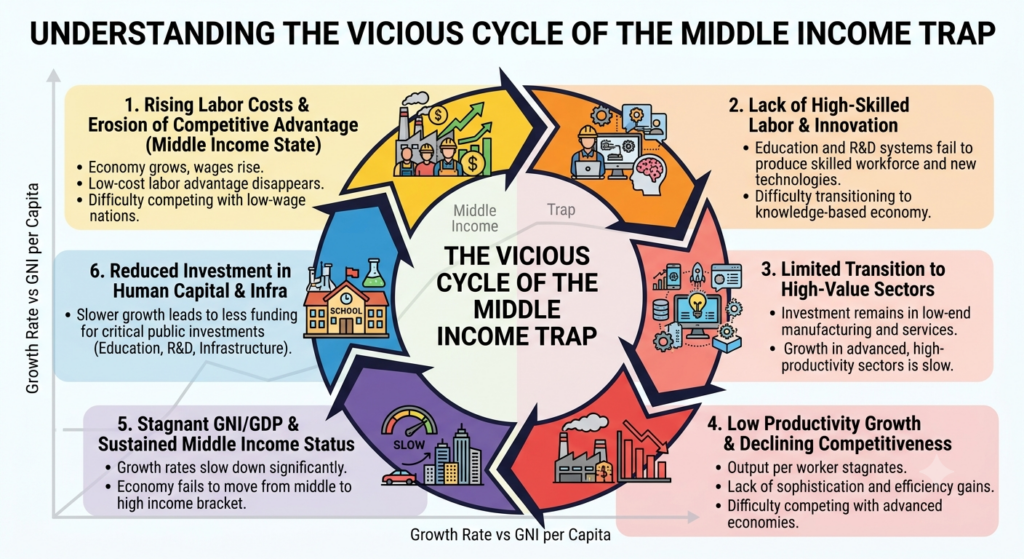
Causes of the Middle-Income Trap in developing countries like India
- Premature Deindustrialization: Economies like India skipped the labor-intensive manufacturing phase (textiles, simple electronics assembly) and jumped straight into services (IT, finance).
- Because services require skilled labor, millions of low-skilled workers remain trapped in low-productivity agriculture (~45% of India’s workforce) rather than transitioning to high-productivity factory jobs.
- The Dual Engine Failure: Neither market-led reforms (1991 model) nor Keynesian state-led interventions have solved structural bottlenecks; capital intensive industries receive subsidies while labor-intensive sectors lack productivity growth.
- The Human Capital & Employability Gap: Inadequate investment in foundational education, vocational training, and health creates a structural skill deficit where graduates lack market-relevant capabilities, capping total factor productivity (TFP).
- According to the India Skills Report 2026, overall youth employability is 56.35%.
- Premature Automation Risk: AI and capital-intensive technologies threaten labor intensity, risking lower employment generation even in traditional labor-heavy sectors.
- Low R&D Spending and Weak Domestic Innovation: Research and development (R&D) expenditure in developing nations often lingers under 1% of GDP (India spends 0.65%, compared to South Korea’s 4.8% or China’s 2.4%). Without proprietary IP, advanced manufacturing capabilities, and global tech brands, economies remain dependent on low-margin foreign tech imports.
- Missing “Scale” and Missing Middle Enterprises: High regulatory friction, compliance burdens, and land/labor bottlenecks encourage firms to stay small and informal.
- A dual economy forms: a few highly productive global conglomerates alongside millions of micro-enterprises that lack access to capital, tech adoption, and economies of scale.
- Automation & AI: Low-cost back-office outsourcing and basic software coding face automation threats, squeezing the service-led growth model.
- Global Protectionism: Unlike East Asian economies during 1970–2000, current developing nations operate under rising tariffs, friend-shoring, and stricter climate-compliance demands (e.g., carbon border adjustments), making export-led industrialization significantly harder.
What Has the Economic Survey of India Said?
The Economic Survey of India (2023–24) directly addresses the structural hurdles that expose lower-middle-income nations like India to the middle-income trap. The Survey underscores several key insights and strategic mandates:
- The Skill & Human Capital Gap: Pointing to data showing that only around 51% (now 56%) of Indian graduates are employable and a minimal fraction of the workforce has undergo formal skill training, the Survey warns that poor human capital quality limits transition to high-value industrial and service sectors.
- The AI and De-Globalization Threat: Unlike early-industrializing East Asian nations, India faces headwinds such as rising global protectionism, friend-shoring, and AI-driven automation. These factors threaten traditional growth pathways like low-end service outsourcing (e.g., BPOs) and low-tech manufacturing.
- Missing “Middle Layers” in Manufacturing: The Survey emphasizes that moving beyond lower-middle-income status requires building dense, high-productivity manufacturing ecosystems—such as specialized component suppliers and precision engineering—rather than relying solely on high-level IT or low-productivity informal work.
- The “3Is” Strategy for Growth: To avoid falling into the trap, the Survey advocates for a 3Is strategy: Investment, Innovation, and Infusion (of technology). It calls for a tripartite compact between government, private enterprise, and academia to re-skill the workforce and scale up R&D.
India Can Avoid the Trap
- Demographic Dividend & High Domestic Demand: Unlike aging middle-income nations in East Asia or Eastern Europe, India possesses a young, expanding workforce. When paired with a large domestic consumer market, this provides high long-term growth resilience and high domestic savings potential.
- Public Infrastructure & Institutional Momentum: Massive state-led expansion in physical infrastructure (highways, ports, renewable energy) and public digital infrastructure (UPI, Aadhaar, ONDC) has drastically reduced transaction costs and integrated the national economy.
- Proactive Structural Policy Shift (The “3I Strategy”): India is actively pivoting from pure investment (1i) toward technology Infusion and domestic Innovation (3i)—the exact formula recommended by the World Bank to escape the trap. Initiatives like the Production-Linked Incentive (PLI) scheme, National Skill Development Mission, and semiconductor policy aim to construct dense manufacturing ecosystems.
- Global Tech & Service Leadership: India is moving up the services value chain beyond basic BPOs toward high-end Global Capability Centers (GCCs), software design, and pharmaceutical R&D, showing strong momentum toward high-value growth.
UPSC Mains Practice Question
Q. “To escape the ‘Middle-Income Trap’, developing economies must transition from a strategy based purely on investment to one driven by infusion of technology and innovation.” In light of this statement, critically evaluate India’s readiness to avoid the Middle-Income Trap. (10 Marks / 150 Words)