Mission Zero: Mechanising Sanitation Work to Prevent Worker Deaths
Why in News?
A national workshop on Mission Zero in Bhubaneswar on 22 August 2026 reviewed institutional preparedness, technology and mechanised sanitation for ending worker fatalities.
- The workshop placed zero fatalities, mechanisation and operational readiness at the centre of sanitation-service reform.
- The government said NAMASTE has been extended to 2031 and will use Emergency Response Sanitation Units for systematic service delivery.
- The Swachhata Sarthi component, introduced in 2024, brings waste pickers within social and economic empowerment measures.
- NAMASTE and Odisha’s GARIMA approach connect safety with health, education, social security and livelihood support for workers and dependants.
- A sewer emergency is a public-system failure, not an individual worker’s occupational choice.
- Mechanisation succeeds only when equipment, trained teams, rapid response, procurement and municipal accountability operate as one chain.
- Welfare convergence matters because unsafe sanitation work is sustained by caste-linked vulnerability, informality and weak bargaining power.
UPSC Relevance
Prelims Relevance
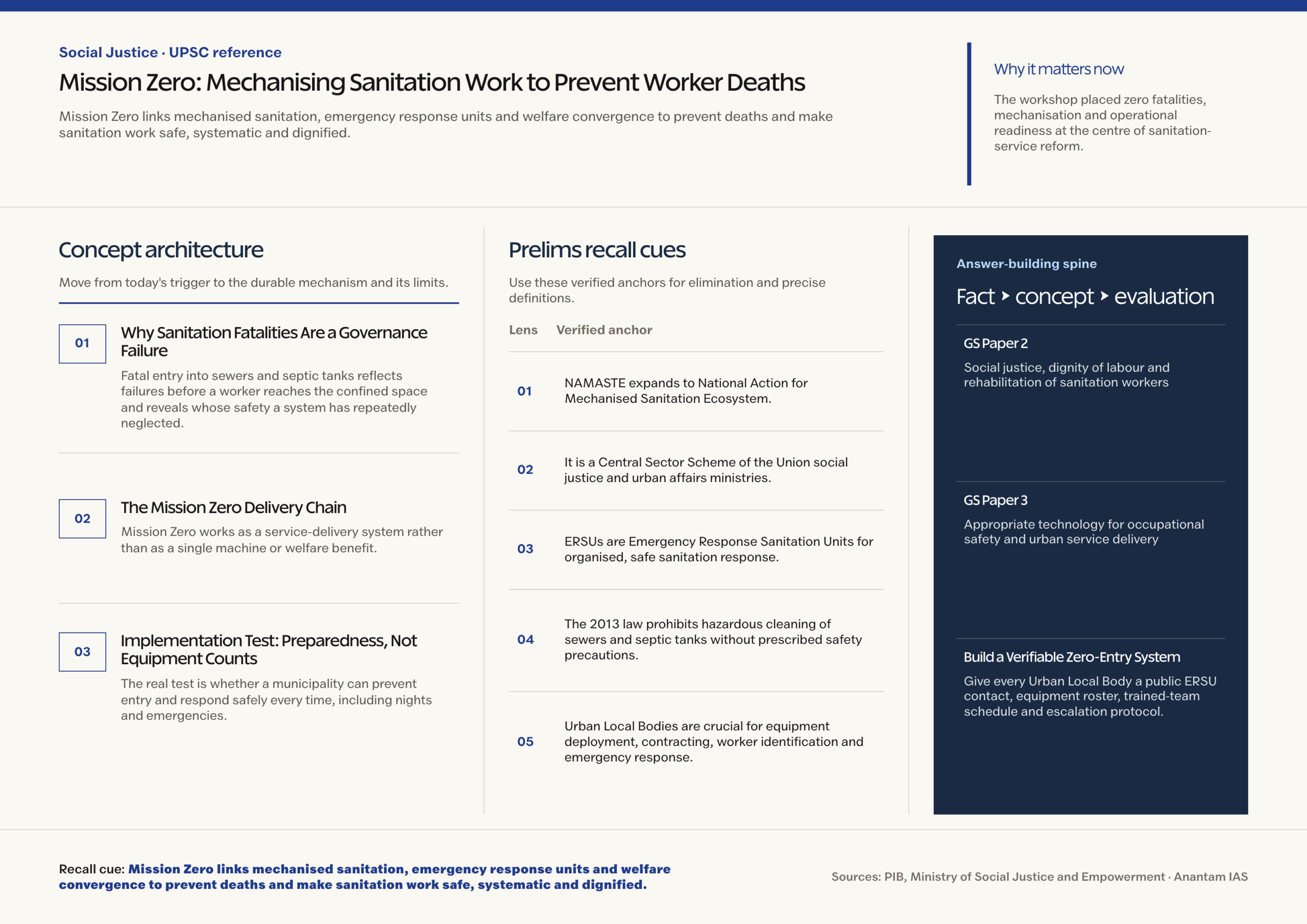
- NAMASTE expands to National Action for Mechanised Sanitation Ecosystem.
- It is a Central Sector Scheme of the Union social justice and urban affairs ministries.
- ERSUs are Emergency Response Sanitation Units for organised, safe sanitation response.
- The 2013 law prohibits hazardous cleaning of sewers and septic tanks without prescribed safety precautions.
- Urban Local Bodies are crucial for equipment deployment, contracting, worker identification and emergency response.
Mains Relevance
GS Paper 2
- Social justice, dignity of labour and rehabilitation of sanitation workers
- Municipal capacity, accountability and convergence across government levels
GS Paper 3
- Appropriate technology for occupational safety and urban service delivery
- Formalisation, skilling and livelihood diversification in sanitation work
Essay
- Technology advances justice only when institutions redesign unsafe work instead of transferring risk to invisible workers.
Background and Context
Why Sanitation Fatalities Are a Governance Failure
Fatal entry into sewers and septic tanks reflects failures before a worker reaches the confined space and reveals whose safety a system has repeatedly neglected.
- Sewers may contain toxic gases, oxygen-deficient air, pathogens and sudden liquid flows, making unplanned entry capable of killing workers and would-be rescuers.
- An informal contractor chain can blur responsibility for training, protective equipment, insurance, supervision and emergency rescue while the public authority still receives the service.
- Protective gear alone cannot make avoidable human entry safe; the first control should be elimination or mechanisation of exposure, followed by strict protocols for exceptional entry.
- The constitutional lens combines Article 21 dignity and life with Article 17’s anti-untouchability commitment, because hazardous sanitation work remains tied to entrenched social exclusion.
- The 2013 prohibition and rehabilitation law treats hazardous sewer or septic-tank cleaning without prescribed precautions as unlawful, shifting attention from charity to enforceable duty.
The Mission Zero Delivery Chain
Mission Zero works as a service-delivery system rather than as a single machine or welfare benefit.
- A citizen complaint or blockage alert should reach an ERSU that can assess risk, deploy suitable machinery and coordinate rescue capacity before any confined-space decision.
- Jetting, suction, desilting and inspection equipment move sanitation from manual exposure toward machine-led operations; equipment availability must match local sewer and septic-tank conditions.
- Worker profiling and training convert dispersed labour into a skilled workforce whose competencies, health needs and entitlements can be recorded rather than left to informal contractors.
- Occupational health coverage, personal protective equipment and social-security convergence reduce vulnerability, while livelihood assistance helps workers or dependants avoid returning to hazardous work.
- The workshop’s whole-of-government framing connects Union ministries, states, Urban Local Bodies, technology suppliers and worker organisations around a common zero-fatality outcome.
Implementation Test: Preparedness, Not Equipment Counts
The real test is whether a municipality can prevent entry and respond safely every time, including nights and emergencies.
- Machines can remain unused when procurement ignores maintenance, operators, spare parts, narrow lanes or the geometry of local sanitation assets; lifecycle readiness matters more than purchase.
- A credible ERSU needs an accessible contact route, trained crews, hazard-assessment protocols, response-time tracking and links to fire, health and police services for complex rescues.
- Contracts should prohibit unauthorised human entry, identify the responsible officer and contractor, and create auditable records of each call, deployment and exception to mechanised cleaning.
- Waste pickers and sewer or septic-tank workers face different hazards; expanding welfare coverage should not erase the need for occupation-specific safeguards and worker participation.
- Fatality reporting, independent inquiry and corrective action must close the feedback loop; a zero-fatality mission cannot rely on self-reported compliance alone.
Way Forward
Build a Verifiable Zero-Entry System
- Give every Urban Local Body a public ERSU contact, equipment roster, trained-team schedule and escalation protocol.
- Link sanitation contracts and payments to machine deployment records, safety checks and prohibition of unauthorised confined-space entry.
- Provide worker-led safety audits, health surveillance, insurance access and time-bound rehabilitation or livelihood choices.
- Publish fatality and near-miss reviews with responsibility fixed across the municipal and contractor chain.
Conclusion
- Mission Zero is best understood as institutional redesign: prevent exposure through mechanisation, prepare emergency units, formalise responsibility and secure workers against occupational and economic risk.
- In a Mains answer, connect technology with municipal capacity, legal accountability, social protection and worker voice; machinery without this chain cannot guarantee dignity or safety.
UPSC Practice Questions
Prelims MCQ 1
With reference to NAMASTE, consider the following statements:
- It seeks to promote a mechanised sanitation ecosystem.
- It is a Central Sector Scheme involving the Union social justice and urban affairs ministries.
- Emergency Response Sanitation Units are part of its systematic sanitation-service approach.
How many of the above statements are correct?
(a) Only one (b) Only two (c) All three (d) None
Answer: (c) All three
Explanation:
NAMASTE promotes mechanisation and coordinated worker safety. PIB stated that its extension uses ERSUs to support systematic sanitation-service delivery.
Prelims MCQ 2
Which one of the following best captures the role of an Emergency Response Sanitation Unit?
(a) It conducts household sanitation surveys only (b) It organises trained and mechanised response to sanitation emergencies (c) It certifies all municipal solid-waste facilities (d) It adjudicates compensation claims under labour law
Answer: (b) It organises trained and mechanised response to sanitation emergencies
Explanation:
ERSUs are intended to institutionalise safe, systematic sanitation response, including risk assessment, trained deployment and mechanised operations.
UPSC Mains Questions
- Sanitation-worker deaths are failures of urban governance, not unavoidable occupational accidents. Discuss with reference to Mission Zero and mechanised sanitation.
- How can Emergency Response Sanitation Units combine technology, accountability and social protection to eliminate hazardous human entry into sewers and septic tanks?
Source: PIB, Ministry of Social Justice and Empowerment.
Frequently Asked Questions
What is Mission Zero in sanitation work?
Mission Zero is the zero-fatality approach that combines mechanisation, institutional preparedness, worker safety, social security and livelihood support in sanitation-service delivery.
What does NAMASTE stand for?
NAMASTE stands for National Action for Mechanised Sanitation Ecosystem, a Central Sector Scheme focused on safe, skilled and mechanised sanitation work.
What is an ERSU?
An Emergency Response Sanitation Unit is an organised municipal response mechanism intended to deploy trained personnel, appropriate machinery and safety protocols during sanitation emergencies.
Why is personal protective equipment not enough?
Protective equipment reduces some exposure but cannot remove confined-space hazards. Prevention requires machine-first cleaning, risk assessment, trained supervision and rescue readiness.
How should Mission Zero be used in a UPSC answer?
Present it as a governance chain linking dignity, legal duty, municipal capacity, mechanisation, occupational health, contractor accountability and rehabilitation rather than as an equipment scheme.