Mithun Behaviour AI: What a Single-Farm Study Can Establish
Why in News?
PIB reported on 8 September 2026 that ICAR-NRC on Mithun, Nagaland, developed a camera-based AI framework for detecting and tracking Mithun behaviour.
- The framework combines YOLOv8n for behaviour detection with DeepSORT for tracking individual animals across video frames.
- Its dataset contains 3,000 annotated images covering feeding, standing, lying and mounting at one research farm.
- The release reports 99.5% [email protected], a detection evaluation metric; this is not an estimate of disease-diagnosis accuracy or performance across farmers’ herds.
- Researchers identify wider validation and quantitative evaluation of identity tracking as outstanding work; proposed health and breeding uses remain potential applications.
- Mithun has social, cultural and economic importance for tribal communities in Northeast India, linking livestock research with locally important livelihoods.
- Manual observation is difficult to maintain continuously. Camera monitoring could extend observation, but useful interpretation still requires evidence about the animal and its setting.
UPSC Relevance
Prelims Relevance
- Mithun and Northeast Indian livelihoods
- YOLOv8n behaviour detection
- DeepSORT identity tracking
- Annotated training images
- Single-farm validation and generalisation
Mains Relevance
GS Paper 3
- Precision livestock farming and animal welfare
- Evaluating AI performance before wider deployment
- Locally relevant agricultural research and rural livelihoods
Essay
- Seeing more is not the same as knowing more.
Background and Context
Detection asks what; tracking asks which animal
The system joins two tasks that must work together to turn separate camera frames into information about individual animals.
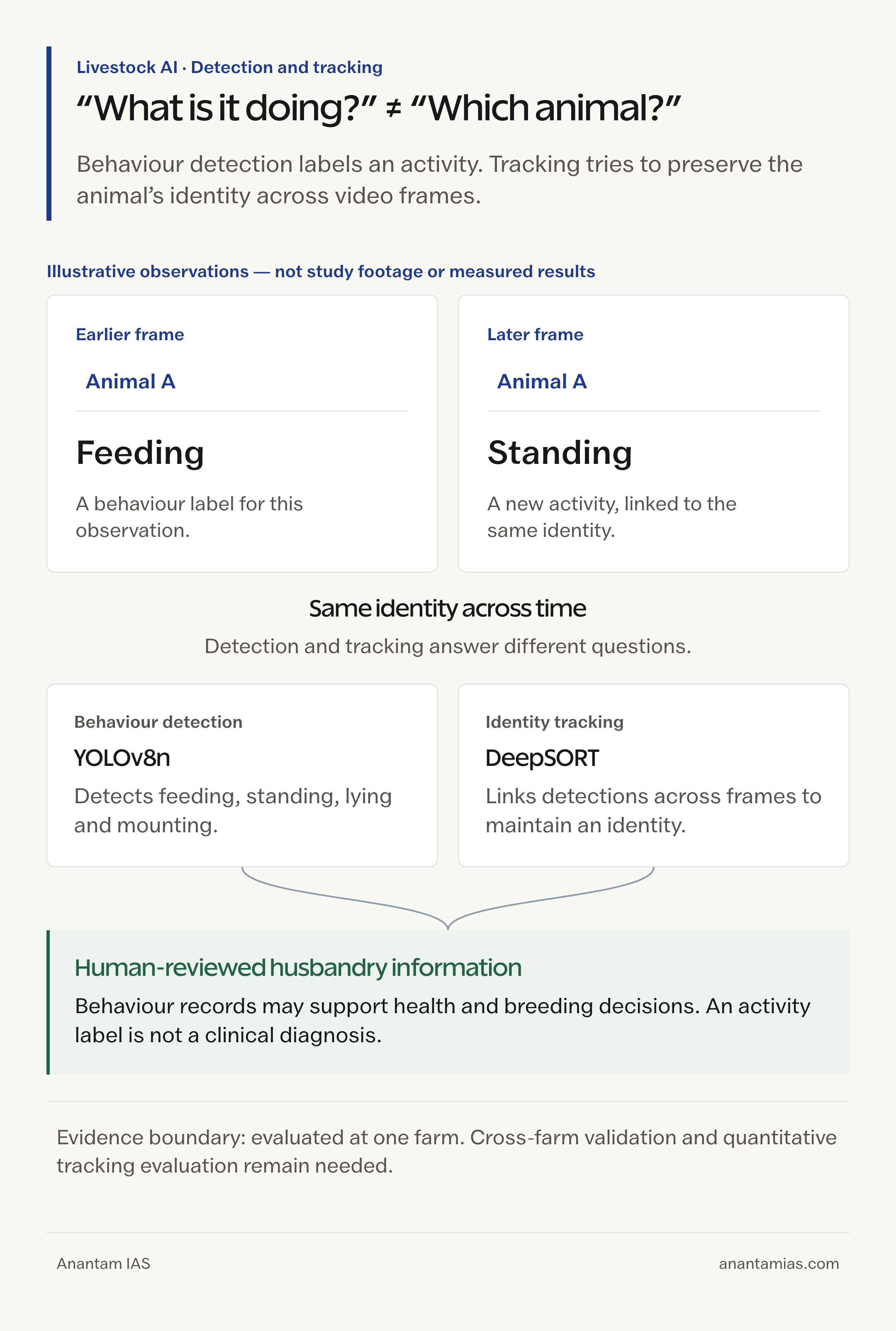
- Behaviour detection identifies the activity visible in an image. Here, YOLOv8n distinguishes feeding, standing, lying and mounting, rather than recognising every possible behaviour an animal can perform.
- Identity tracking links an animal’s appearances across successive frames. DeepSORT assigns persistent identities so observations can be associated with an individual rather than treated as unrelated detections.
- Illustrative example: detecting a feeding animal in successive frames answers what is happening. Maintaining the same identity across those frames helps establish which animal is being observed.
- Separate errors can occur: the activity label may be wrong, or observations may be assigned to the wrong animal. Strong behaviour detection does not independently demonstrate reliable identity tracking.
- Human-reviewed interpretation is a sensible management safeguard: use a behaviour record to guide inspection and husbandry decisions, instead of treating every detected activity as an automatic instruction.
What the research actually evaluated
The reported achievement is a non-contact framework evaluated in a natural farm environment, with explicit limits on what its results establish.
- Annotated images provide examples with human-assigned labels. The model learns from this dataset; the scope and variety of its examples matter when assessing what it has been taught.
- Farm conditions included shadows, clutter, motion blur and nighttime infrared footage. Testing these challenges is useful evidence, but it does not make the study geographically or seasonally representative.
- Reported mAP summarises detection performance under the study’s evaluation. It should retain its metric name and context, rather than being rewritten as a universal percentage of correct farm decisions.
- Tracking evidence remains incomplete: researchers call for quantitative assessment using standard tracking metrics. Persistent identity labels in a demonstration cannot substitute for systematic measurement of tracking performance.
Behaviour is a management signal, not a diagnosis
Observed activities may help managers notice changes, but the same visible change can require further interpretation.
- Feeding, standing and lying patterns can provide information relevant to comfort, nutrition and health. The study detects activities; it does not establish a validated diagnosis for a named disease.
- Mounting behaviour could support reproductive management by drawing attention to events. Detection alone should not be equated with a confirmed reproductive assessment or evidence of improved breeding outcomes.
- Continuous observation can reduce gaps left by occasional manual checks, especially at night. Its practical value depends on whether managers receive interpretable information they can act on.
- Decision quality is a separate evaluation question: researchers would need to test whether using the information improves welfare or management, rather than infer benefits solely from detecting behaviours.
Why deployment needs validation beyond one farm
A model’s performance in its research setting does not establish dependable performance under every farmer’s operating conditions.
- Generalisation means performing usefully in settings beyond those already evaluated. Different farms, regions and seasons may present appearances and conditions that the original examples do not adequately represent.
- Camera arrangements and stocking density change how animals appear and overlap. Wider validation must examine these differences rather than assume that the original camera setting represents ordinary deployment.
- Severe occlusion, where animals are substantially hidden, remains a limitation. Missing visual information can disrupt detection and identity continuity, so uncertainty should be visible to the operator.
- Future work includes additional behaviours, larger datasets and possible edge-device deployment. These are research directions, not capabilities or low-cost installations already demonstrated by the reported study.
Way Forward
Validate the full observation-to-decision chain
- Test on independent farms across seasons, camera layouts and herd densities, reporting where performance deteriorates.
- Evaluate detection and identity tracking separately; measure errors relevant to individual animal records.
- Develop human-reviewed alerts and test their usefulness before making health, welfare or reproductive-benefit claims.
- Assess deployment requirements, including equipment, maintenance and operator capacity, before recommending wider farm adoption.
Conclusion
- Mithun behaviour AI illustrates a useful combination of activity detection and identity tracking, supported by promising but bounded evidence from one research farm.
- For an answer, separate model performance, deployment reliability and management outcomes. Progress at the first level cannot automatically establish success at the other two.
UPSC Practice Questions
Prelims MCQ 1
With reference to the reported Mithun AI framework, consider the following statements:
- YOLOv8n detects the studied behaviours.
- DeepSORT tracks individual animals across video frames.
- A high detection mAP alone establishes clinically validated disease diagnosis.
How many of the above statements are correct?
(a) Only one (b) Only two (c) All three (d) None
Answer: (b) Only two
Explanation:
Statements 1 and 2 are correct. A detection metric measures a particular model task; it does not establish clinical diagnosis or performance across other farms.
Prelims MCQ 2
Which next step would best address the Mithun study’s stated generalisation limitation?
(a) Replacing the metric name with field accuracy (b) Assuming every mounting event establishes a reproductive diagnosis (c) Evaluating independent farms across seasons and camera arrangements (d) Treating more frames from the same setup as proof of geographic reliability
Answer: (c) Evaluating independent farms across seasons and camera arrangements
Explanation:
The system has been evaluated at one farm. Independent settings test whether performance transfers beyond that context, while separately assessing tracking remains necessary.
UPSC Mains Questions
- Distinguish behaviour detection from identity tracking in precision livestock farming. Explain why both require separate evaluation. (150 words)
- A high model evaluation score does not automatically establish successful agricultural deployment. Discuss with reference to the reported Mithun behaviour study. (250 words)
Source: PIB, Ministry of Agriculture and Farmers Welfare.
Frequently Asked Questions
What does the Mithun AI system observe?
It detects feeding, standing, lying and mounting from camera footage and tracks individual animals across frames. The reported framework is non-contact and was evaluated at the ICAR research farm in Nagaland.
How do YOLOv8n and DeepSORT differ?
YOLOv8n detects the studied behaviours in images. DeepSORT links individual animals across successive frames using persistent identities. Correct activity detection and correct identity continuity are related but separate performance questions.
Does 99.5% mAP mean 99.5% field accuracy?
No. It is the reported detection metric at [email protected] under the study’s evaluation. It does not establish that proportion of correct farm decisions, accurate disease diagnoses or successful identity tracking.
Why is more validation needed?
The evaluation covered one farm. Different regions, seasons, camera arrangements and stocking densities may affect performance. Severe occlusion remains a challenge, and quantitative evaluation using standard identity-tracking metrics is still needed.