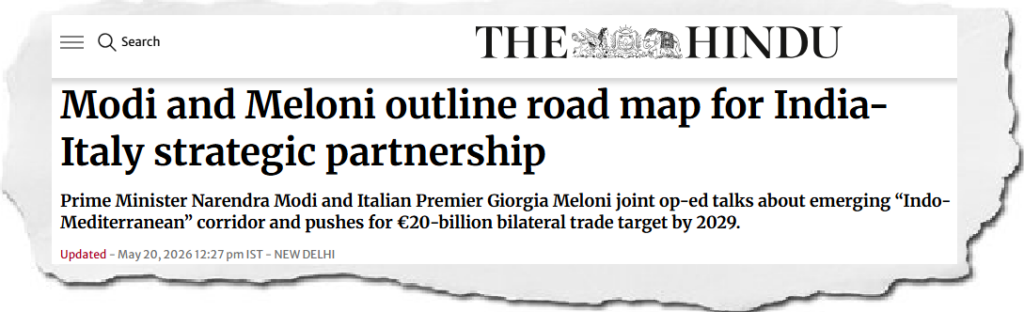
Modi and Meloni outline road map for India-Italy strategic partnership
Why in News?
Prime Minister Narendra Modi and Giorgia Meloni outlined an expanded roadmap for India–Italy relations in a joint op-ed, emphasising trade, technology, energy, space and security cooperation. The leaders highlighted the emergence of an “Indo-Mediterranean” corridor and strengthened commitment toward the India–Middle East–Europe Economic Corridor (IMEC).
UPSC Relevance
Prelims:
IMEC, International Solar Alliance (ISA), Coalition for Disaster Resilient Infrastructure (CDRI), Global Biofuels Alliance, G7, Mediterranean region.
Mains:
GS II (India and bilateral relations, international groupings and agreements),
GS III (infrastructure, energy security, technology, artificial intelligence, economic development).
Background/Context
India and Italy have witnessed growing engagement in recent years, transforming bilateral relations from traditional diplomatic cooperation into a broader strategic partnership.
The changing geopolitical environment, supply-chain diversification, technological competition, and emerging connectivity initiatives have increased the importance of partnerships between the Indo-Pacific and Europe.
The recent roadmap reflects efforts to create stronger economic and strategic linkages between these interconnected regions.
India–Italy Strategic Partnership
Expanding Bilateral Cooperation
The roadmap seeks to strengthen cooperation across multiple sectors:
- Trade and investment
- Technology and innovation
- Energy transition
- Space cooperation
- Defence and security
- Digital infrastructure
- Artificial intelligence
The partnership aims to combine India’s scale and technological capacity with Italy’s industrial and manufacturing strengths.
Indo-Mediterranean Concept
Meaning of the Indo-Mediterranean Corridor
The “Indo-Mediterranean” idea refers to growing connectivity between:
- The Indo-Pacific region
- Middle Eastern economies
- Mediterranean and European regions
The concept recognises that trade routes, technology networks, energy flows and supply chains increasingly operate across interconnected regions rather than isolated geographic spaces.
Strategic Importance
The emerging corridor may contribute to:
- Diversification of global supply chains
- Improved connectivity between Asia and Europe
- Strengthened energy security
- Increased strategic cooperation
- Reduced dependence on vulnerable routes
India–Middle East–Europe Economic Corridor (IMEC)
About IMEC
India-Middle East-Europe Economic Corridor was announced during the G20 New Delhi Summit 2023.
The initiative seeks to connect participating regions through:
- Railway and transport networks, Ports and logistics infrastructure, Energy systems, Digital connectivity, Supply chains
Importance for India
IMEC may:
- Strengthen India’s role in global trade networks
- Improve connectivity with Europe
- Support export growth
- Enhance strategic presence in West Asia
- Contribute to resilient supply chains
Major Areas of Cooperation
Trade and Economic Cooperation
India and Italy seek to achieve and exceed bilateral trade targets through stronger economic engagement.
Important sectors include: Defence and aerospace, Pharmaceuticals, Textiles, Chemicals, Machinery, Automotive components, Tourism, Agriculture
Technology and Artificial Intelligence
Both countries emphasised responsible and human-centred AI development.
Areas of cooperation include: Digital Public Infrastructure (DPI), Artificial intelligence, Cybersecurity, Supercomputing, Capacity building
Energy and Climate Cooperation
Partnership areas include: Renewable energy, Hydrogen technologies, Smart grids, Energy security, Resilient infrastructure
Space and Security Cooperation
The roadmap also highlights cooperation in:
- Space technologies
- Strategic technologies
- Maritime security
- Defence collaboration
Significance for India
Strengthening Strategic Diversification
The partnership contributes to India’s policy of diversifying international partnerships beyond traditional alliances.
Supporting Supply Chain Resilience
India seeks to emerge as an alternative manufacturing and investment destination amid changing global supply chains.
Boosting Technology Transfers and Investments
Greater collaboration with technologically advanced countries may support domestic innovation and industrial growth.
Enhancing Global South Cooperation
India’s Digital Public Infrastructure and inclusive technology approach may strengthen India’s engagement with developing countries.
Challenges
Geopolitical Uncertainty: Conflicts in regions such as West Asia and Europe can affect connectivity initiatives and trade routes.
Implementation Challenges: Large infrastructure and connectivity projects often face delays arising from financing, coordination and political factors.
Balancing Strategic Interests: India must maintain strategic autonomy while expanding partnerships with multiple powers.
Regulatory and Economic Differences: Trade negotiations and differing standards between India and European countries may create challenges.
Way Forward
Accelerate Connectivity Projects
Implementation of projects such as IMEC should be prioritised through coordinated investments and infrastructure planning.
Deepen Technology Partnerships
Joint research and innovation initiatives in AI, cybersecurity and digital infrastructure should be expanded.
Strengthen Energy Cooperation
Collaboration in renewable energy and hydrogen technologies can support long-term sustainability goals.
Expand People-to-People Ties
Educational exchanges, cultural cooperation and tourism can strengthen the social foundation of strategic relations.
Ensure Inclusive Digital Development
Technology partnerships should focus on accessibility, transparency and ethical use.
Conclusion
The India–Italy strategic partnership reflects the growing interconnection between economic, technological and geopolitical priorities in the twenty-first century. By combining strengths in technology, connectivity and sustainable development, both countries seek to shape an emerging Indo-Mediterranean framework with wider implications for global cooperation.
Practice Questions
1. With reference to the India–Middle East–Europe Economic Corridor (IMEC), consider the following statements:
- It seeks to improve transport and connectivity infrastructure between India and Europe.
- It includes energy and digital connectivity components.
- It was announced during the G20 Summit held in New Delhi.
Which of the statements given above is/are correct?
(a) 1 and 2 only
(b) 2 and 3 only
(c) 1 and 3 only
(d) 1, 2 and 3
Correct Answer: (d)
Explanation: IMEC was announced during the G20 New Delhi Summit and includes transport, digital connectivity and energy infrastructure components.
2. Consider the following initiatives:
- International Solar Alliance
- Coalition for Disaster Resilient Infrastructure
- Global Biofuels Alliance
Which of the above are India-led initiatives?
(a) 1 only
(b) 1 and 2 only
(c) 2 and 3 only
(d) 1, 2 and 3
Correct Answer: (d)
Explanation: All three initiatives are India-led global platforms promoting renewable energy, resilient infrastructure and biofuel cooperation.
Mains Questions
- Examine the strategic importance of the India–Middle East–Europe Economic Corridor (IMEC) for India’s geopolitical and economic interests.
- Discuss the significance of the India–Italy Strategic Partnership in the context of emerging global connectivity initiatives and supply-chain diversification.