Deficit Monsoon: Why Bajra Is Emerging as the Kharif Crop of Choice
Why in News?
The India Meteorological Department (IMD) reported that all-India cumulative monsoon rainfall was running about 43 per cent below normal as of June 22, 2026, with the southwest monsoon stalled over southern Maharashtra and large rain deficits across central, eastern, northwestern India and the southern peninsula. Government and media accounts (Indian Express) flag that the slow advance has compressed the kharif sowing window in rainfed districts.
As farmers wait for reliable rain, an Indian Express Explained piece notes a growing pivot to bajra (pearl millet) — a short-duration, drought-tolerant cereal that can be sown late and still mature on limited moisture. The shift sits at the intersection of monsoon dynamics, food security, the government’s millet push (Shree Anna), minimum support prices and the inflation-growth risks the RBI has flagged.
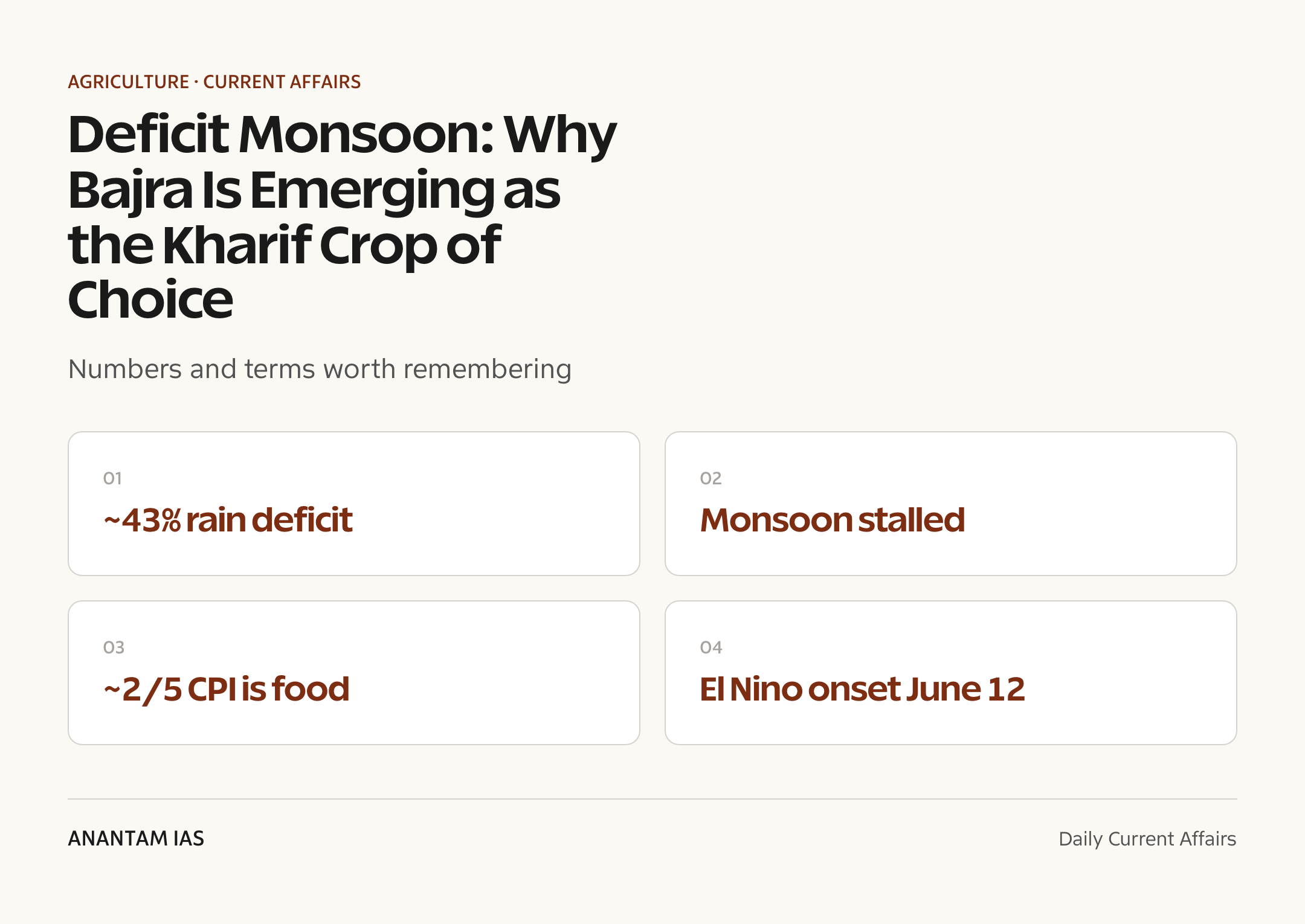
- IMD pegged the all-India season-to-date rainfall deficit at about 43 per cent as of June 22, 2026, with the monsoon’s northward advance stalled.
- The shortfall narrows the kharif sowing window, and several states have advised farmers not to rush sowing until rain stabilises.
- Rainfed belts are turning to bajra (pearl millet), valued for short duration and drought tolerance, as the kharif crop of choice.
- IMD had confirmed an El Nino onset over the equatorial Pacific on June 12, raising the risk of a weak-to-erratic monsoon.
- Because food carries roughly two-fifths of the CPI basket, a deficient monsoon quickly becomes a growth-and-inflation concern for the RBI.
The development matters in the context of:
- The southwest monsoon normally delivers the bulk of India’s annual rainfall between June and September and underwrites the kharif harvest.
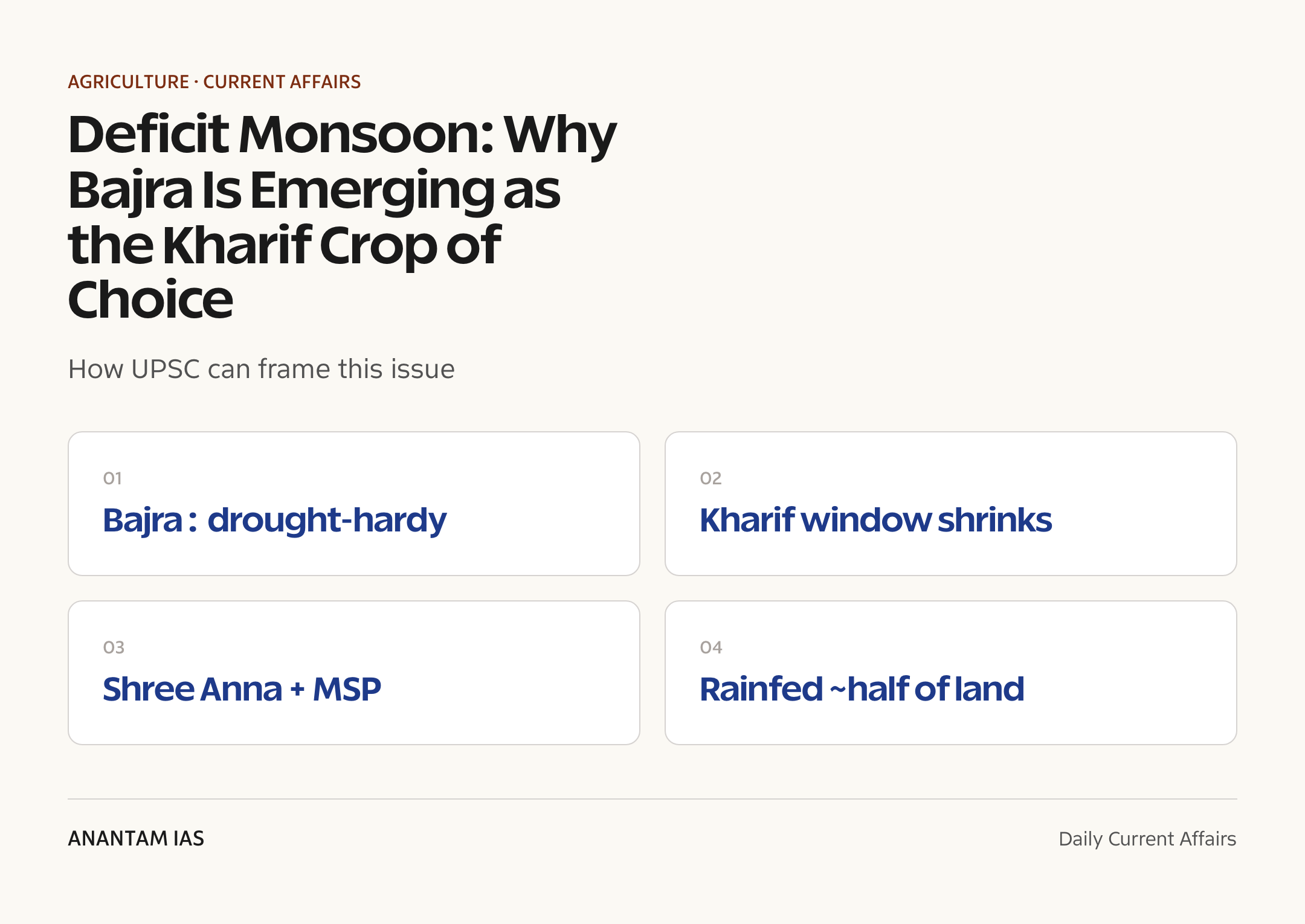
- Roughly half of India’s net sown area remains rainfed, so the timing and spread of monsoon rain — not just the seasonal total — shapes sowing decisions.
- Coarse cereals such as bajra, jowar and ragi are climate-resilient fallbacks when rains are late or scanty.
UPSC Relevance
Prelims Relevance
- Southwest monsoon: onset over Kerala (around June 1), northward advance, role of the Long Period Average (LPA) in defining ‘normal’ rainfall.
- IMD rainfall categories: normal rainfall is 96-104 per cent of LPA; below 90 per cent is ‘deficient’.
- Kharif vs rabi: kharif crops are sown with the monsoon (June-July) and harvested in autumn; rabi crops are winter-sown.
- Bajra (pearl millet): a kharif coarse cereal, drought- and heat-tolerant, grown largely in arid and semi-arid rainfed soils.
- El Nino: an abnormal warming of the central-eastern equatorial Pacific, generally associated with weaker Indian monsoons.
- Major bajra-growing states include Rajasthan, Maharashtra, Gujarat, Uttar Pradesh and Haryana.
- Shree Anna is the government’s branding for millets; 2023 was observed as the International Year of Millets.
- Minimum Support Price (MSP) is recommended by the Commission for Agricultural Costs and Prices (CACP) and covers bajra among the kharif crops.
- Food articles carry close to two-fifths weight in the Consumer Price Index (CPI), linking rainfall to retail inflation.
- Millets are nutri-cereals: bajra is rich in iron, protein and fibre and has a relatively low water footprint.
Mains Relevance
GS Paper 3
- Cropping pattern shifts under monsoon variability and climate stress, and the case for crop diversification toward resilient cereals.
- Food security and buffer-stock management when a deficient monsoon threatens kharif output.
- Transmission from rainfall shocks to food inflation and monetary policy under the RBI’s flexible inflation-targeting mandate.
- Effectiveness of MSP, procurement and the millet mission in incentivising drought-hardy crops.
Essay
- Resilience over yield: rethinking what India grows in an age of erratic rainfall.
- Water, climate and the politics of the plate.
Background and Context
The monsoon picture: a slow, deficient advance
The early-season shortfall is the trigger event behind the kharif anxiety.
- IMD reported an all-India deficit of about 43 per cent as of June 22, 2026, with the monsoon stalled over southern Maharashtra.
- ‘Normal’ is benchmarked against the Long Period Average (LPA) — the multi-decadal mean of seasonal rainfall — so a 43 per cent gap means cumulative rain is far short of that mean to date.
- Deficits were spread across central India, the east and northeast, the southern peninsula and northwest India, hitting precisely the rainfed sowing belts.
- IMD had confirmed an El Nino onset on June 12, a pattern historically linked to weaker or more erratic Indian monsoons.
- It is the spread and timing of rain, not only the seasonal total, that governs whether farmers can sow on schedule.
Why bajra becomes the crop of choice
Pearl millet’s agronomy makes it the natural hedge when rains fail or arrive late.
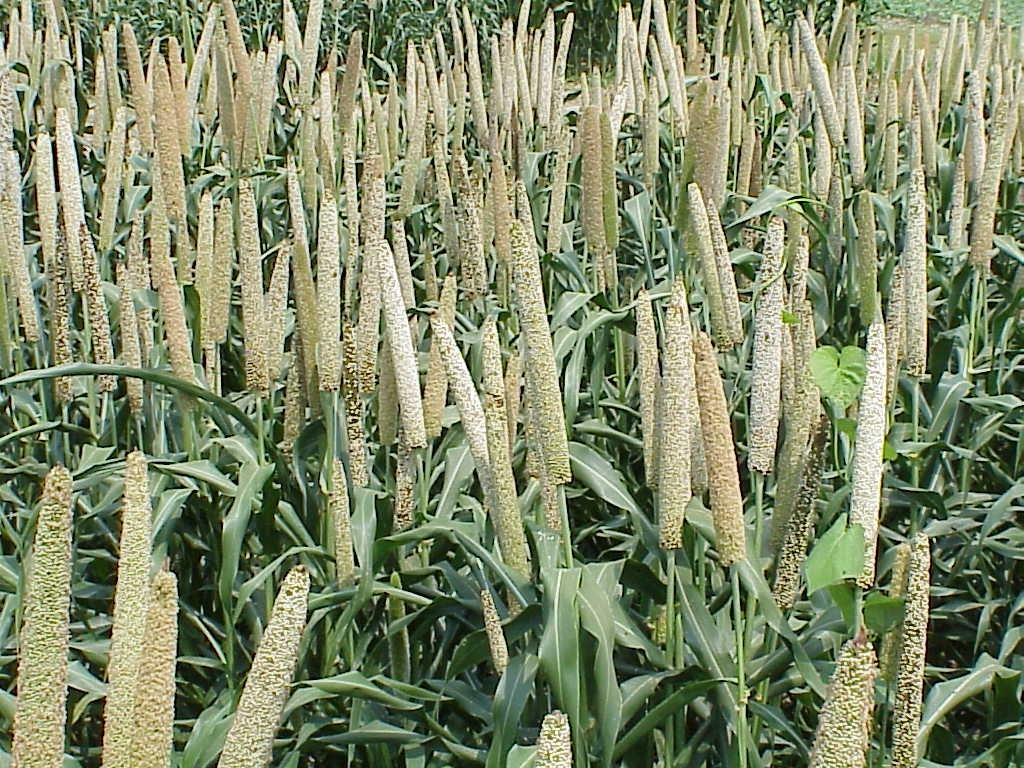
- Bajra (pearl millet) is a hardy kharif coarse cereal that thrives in hot, dry, sandy and low-fertility soils where rice and maize struggle.
- It is short-duration and can be sown later in the window, so farmers can wait out a delayed monsoon and still get a crop.
- Deep roots and efficient water use give it strong drought tolerance, with a far smaller water footprint than paddy.
- Major producing states — Rajasthan, Maharashtra, Gujarat, Haryana and Uttar Pradesh — overlap with the arid and semi-arid zones most exposed to rain failure.
- The grain doubles as food and fodder, adding a livelihood cushion in dryland farming systems.
The kharif basket under pressure
A compressed window forces a reshuffle across the whole rainfed crop mix.
- Kharif crops — paddy, maize, pulses, oilseeds, cotton, sugarcane and coarse cereals — are sown with the monsoon and depend on its early spread.
- Several states advised farmers not to rush sowing until rainfall stabilises, to avoid germination failure and re-sowing costs.
- Water-intensive crops like paddy and sugarcane carry the highest risk when reservoirs and soil moisture run low.
- A pivot toward bajra and other coarse cereals trades headline yield for reliability and lower input risk.
- Late or patchy sowing can shrink acreage and delay the harvest, with knock-on effects for rural incomes.
Millet policy and Shree Anna
A weak monsoon meets an existing policy push to mainstream millets.
- The government brands millets as Shree Anna and has promoted them through a dedicated mission and procurement support.
- 2023 was the International Year of Millets, championed by India at the United Nations, which lifted the profile of bajra, jowar and ragi.
- Bajra is covered under the Minimum Support Price (MSP) regime for kharif crops, giving farmers a price floor.
- Millets are positioned as nutri-cereals — bajra is high in iron, protein and fibre — supporting nutrition-security goals.
- Their climate resilience and low water need align millet promotion with sustainable agriculture in dryland regions.
The macro link: food security and inflation
Rainfall shocks travel quickly from the field to monetary policy.
- Food articles carry close to two-fifths of the weight in the Consumer Price Index, so a monsoon shortfall can stoke retail inflation.
- The RBI operates under flexible inflation targeting (a 4 per cent target with a 2-6 per cent band), making food-price spikes a central policy concern.
- A weak kharif can dent rural demand and farm incomes, weighing on broader growth.
- Buffer stocks of rice and wheat and timely imports of pulses and edible oils are the standard food-security buffers.
- A resilient crop mix and assured procurement of millets can soften the blow when the monsoon underperforms.
Way Forward
Use real-time IMD advisories and contingency cropping plans to steer farmers toward short-duration, drought-hardy crops in deficit districts.
Strengthen millet procurement, storage and market linkages so the pivot to bajra is backed by assured offtake, not just survival sowing.
Expand micro-irrigation, watershed development and soil-moisture conservation to cut the rainfed sector’s exposure to monsoon swings.
Keep buffer stocks and import windows ready to anchor food prices and shield the inflation outlook.
Conclusion
A 43 per cent early-season rainfall gap turns an abstract weather statistic into a hard farm-gate decision: what to sow when the rains do not arrive on time. The pivot to bajra is the rational answer, marrying agronomy with risk management in India’s rainfed heartland.
It also shows why climate resilience now belongs at the centre of agricultural policy. Millets like bajra, backed by MSP and the Shree Anna push, offer a template for an India that must grow food on a less predictable monsoon while keeping inflation and rural incomes in check.
UPSC Practice Questions
Prelims MCQ 1
With reference to the southwest monsoon and India’s crop calendar, consider the following statements: 1. The southwest monsoon normally sets in over Kerala around the beginning of June. 2. Kharif crops are sown at the onset of the monsoon and harvested in autumn. 3. The India Meteorological Department defines ‘normal’ monsoon rainfall with reference to the Long Period Average (LPA). How many of the above statements are correct?
Only one Only two All three None
Answer: All three
Explanation:
The southwest monsoon typically reaches Kerala around June 1 and advances northward. Kharif crops are monsoon-sown (June-July) and harvested in autumn, unlike winter-sown rabi crops. IMD benchmarks ‘normal’ rainfall against the LPA, with 96-104 per cent of LPA counted as normal.
Prelims MCQ 2
Bajra (pearl millet) is increasingly favoured during a deficient monsoon. Which of the following best explains why?
It requires standing water through its growth cycle like paddy It is short-duration, drought-tolerant and suited to hot, dry rainfed soils It can only be grown in high-rainfall coastal regions It is a rabi crop sown after the monsoon withdraws
Answer: It is short-duration, drought-tolerant and suited to hot, dry rainfed soils
Explanation:
Bajra is a kharif coarse cereal that matures quickly, tolerates drought and heat, and grows in arid and semi-arid sandy soils with a low water footprint. This makes it a reliable fallback when the monsoon is late or scanty, unlike water-intensive paddy.
UPSC Mains Questions
- A deficient monsoon repeatedly exposes the vulnerability of India’s rainfed agriculture. Examine how a shift toward drought-resilient crops such as bajra, supported by appropriate policy, can strengthen food security. (250 words)
- Discuss the transmission of monsoon and rainfall shocks to food inflation in India, and assess the policy options available to the government and the RBI to manage the resulting growth-inflation trade-off. (250 words)
- Evaluate the role of the millet mission (Shree Anna) and the MSP framework in promoting climate-resilient cropping patterns in India’s arid and semi-arid regions. (150 words)
Sources: Indian Express and Indian Express Explained.
Frequently Asked Questions
How large is the monsoon rainfall deficit this season?
The India Meteorological Department reported that all-India cumulative rainfall was running about 43 per cent below normal as of June 22, 2026, with the monsoon’s northward advance stalled over southern Maharashtra and deficits spread across most regions.
Why are farmers turning to bajra during a deficient monsoon?
Bajra (pearl millet) is a short-duration, drought- and heat-tolerant kharif cereal that grows well in hot, dry, sandy soils. It can be sown later in the season and still mature on limited moisture, making it a reliable choice when rains are delayed or scanty.
What is the difference between kharif and rabi crops?
Kharif crops are sown at the onset of the southwest monsoon (around June-July) and harvested in autumn; examples include paddy, maize, bajra and cotton. Rabi crops are winter-sown (around October-December) and harvested in spring, such as wheat and gram.
What is Shree Anna and how does it relate to millets?
Shree Anna is the government’s branding for millets such as bajra, jowar and ragi, promoted through a dedicated mission and procurement support. The push gained momentum after 2023, observed globally as the International Year of Millets at India’s initiative.
How does a weak monsoon affect inflation and the RBI?
Food articles carry close to two-fifths of the weight in the Consumer Price Index, so a deficient monsoon can push up food prices and stoke retail inflation. Under flexible inflation targeting, this makes a poor monsoon a direct concern for the RBI’s policy outlook.
Which states are the main producers of bajra in India?
Bajra is grown largely in arid and semi-arid rainfed zones, with Rajasthan, Maharashtra, Gujarat, Haryana and Uttar Pradesh among the leading producing states.