Musi Riverfront Development Project (MRDP)
Why in News?
The Musi Riverfront Development Project in Hyderabad is in news due to Government of Telangana plans to rejuvenate the polluted Musi River
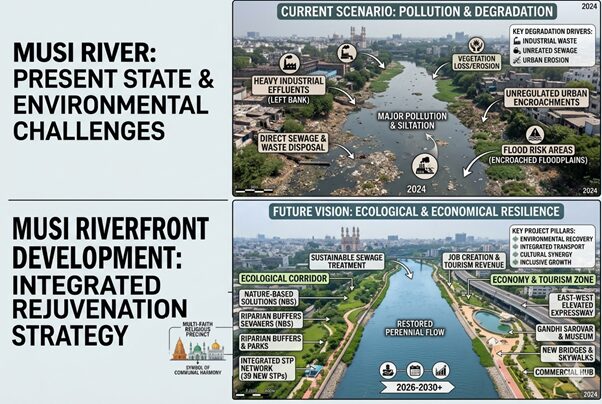
- The Musi Riverfront Development Project (MRDP) is a flagship urban rejuvenation initiative by the Telangana government. It aims to transform the Musi River —the lifeline of Hyderabad— from a polluted “open sewer” into a vibrant, ecologically healthy, and economically productive urban corridor
UPSC Relevance:
GS-I: Geography, GS-II: Governance, GS-III: Environment & Economy, GS-IV Ethics: Balancing development vs. displacement;
What is Musi River?
- The Musi River is a tributary of the Krishna River.
- Source: Originates in the Ananthagiri Hills (Vikarabad district, Telangana).
- It flows through Hyderabad
Today, it is one of the most polluted urban rivers in India
Historical Significance: Known for the Great Musi Flood of 1908, which led to the birth of modern Hyderabad’s city planning and the construction of twin reservoirs: Osman Sagar and Himayat Sagar
Current State: Severely degraded due to unchecked industrial effluents, domestic sewage, and urban encroachments.
What is the Musi Riverfront Development Project?
It is a large urban renewal and river rejuvenation project aimed at:
- Cleaning and restoring the river
- Developing riverfront infrastructure
- Improving urban living conditions
Objectives of the Project
- Ecological restoration: Ensure perennial flow and pollution-free water; transform the river into a living urban asset.
- Flood mitigation: Reduce man-made flooding disasters through engineering solutions.
- Urban development and economy: Create public spaces, tourism, heritage zones, commercial areas, and a 24×7 economy along the riverbanks — aiming for the world’s longest riverfront (55 km).
- Sustainability and livability: Improve Hyderabad’s environment, mobility, green cover, and quality of life.
- Heritage and recreation: Revitalize historical sites along the river corridor.
Key Components
- Sewage Treatment Plants (STPs)
- River cleaning and desilting
- Construction of riverfront infrastructure
- Development of transport corridors and public spaces
Major Issues & Challenges
| Challenge | Context |
| Social Justice | Over 10,000 households in the riverbed face displacement. The “Musi Jan Andolan” protest highlights concerns over rehabilitation and livelihood loss. |
| Environmental Risk | Experts warn that “concretization” (riverfront beautification) might interfere with the river’s natural flood-absorption capacity. |
| Legal Issues | Cases are pending in the National Green Tribunal (NGT) regarding environmental clearances and land acquisition. |
| Hydrological Engineering | Diverting Godavari water is energy-intensive and raises questions about the long-term sustainability of artificial flow. |
Comparation with Sabbarmato Riverfront (Ahmedabad)
| Aspect | Musi Riverfront Project | Sabarmati Riverfront Project |
|---|---|---|
| Location | Hyderabad | Ahmedabad |
| River | Musi River (tributary of Krishna) | Sabarmati River |
| Stage | Proposed / Under development | Completed (operational model) |
| Primary Objective | Pollution control + urban renewal | Urban beautification + flood control |
| Pollution Level | Extremely high (sewage-dominated river) | Initially polluted but improved |
| Core Strategy | STPs + river cleaning + redevelopment | Channelisation + embankments + regulated flow |
| Water Source | Natural + sewage (currently degraded) | Largely dependent on Narmada canal water |
| Ecological Approach | Focus on rejuvenation (yet debated) | Criticised for artificial river flow |
| Flood Management | Important objective (Hyderabad floods history) | Major success (controlled flooding) |
| Displacement Issue | Significant concern (slum eviction) | Large-scale displacement happened |
| Economic Impact | Expected (tourism, real estate) | Already boosted tourism & land value |
| Environmental Criticism | Risk of over-concretisation | Loss of natural river ecosystem |
| Model Value | Still evolving | Considered a “model project” |
Lessons: Success depends on pollution control + sustainable planning
Significance for India
- Model for urban river rejuvenation
- Improves urban ecology and public health
- Supports sustainable urbanisation
Way Forward for the Project
- Inclusive Rehabilitation: Strictly adhering to the LARR Act, 2013, ensuring that displacement is followed by “upgrade” in living standards, not just relocation.
- Nature-Based Solutions: Prioritizing bioremediation, permeable pavements, and “sponge city” concepts over heavy concrete embankments.
- Transparency: Making the Detailed Project Report (DPR) public to build trust and mitigate political friction.
Practice Questions
The Musi River is a tributary of which of the following rivers?
(a) Godavari
(b) Krishna
(c) Tungabhadra
(d) Cauvery
Answer: (b)
Mains Question
“Riverfront development projects in India often face a trade-off between urban development and ecological sustainability.” Discuss with reference to the Musi Riverfront Development Project.