Nalanda University revives Śāstrārtha, an ancient debate tradition
Why in News?
Nalanda University organised “Shastrarth 2026” ahead of its third convocation, reviving the ancient tradition of scholarly debate linked to the historic Nalanda Mahavihara.
| UPSC Relevance: GS-1: History: Medieval India, Heritage Prelims: Nalanda Mahavihara, Śāstrārtha (key idea) |
What is Śāstrārtha?
- Śāstrārtha (Sanskrit: शास्त्रार्थ) refers to the tradition of formal, rigorous debate on philosophical and scriptural questions, rooted in the guru-shishya (teacher-student) tradition of ancient India.
- It was a defining feature of the intellectual culture at historic centres of learning like Nalanda, Takshashila, and Vikramashila.
For the first time, the university has formally included Shastrarth in its academic calendar to promote intellectual dialogue, logical reasoning and research-based discussions.
About the Modern Nalanda University:
- Location: Rajgir, Nalanda district, Bihar (close to the ruins of the ancient Mahavihara)
- The University was established under the Nalanda University Act 2010, by the Ministry of External Affairs. The new campus was inaugurated in 2024.
- It is an Institution of National Importance, supported by 18 East Asia Summit member countries. The University now has over 1200 students.
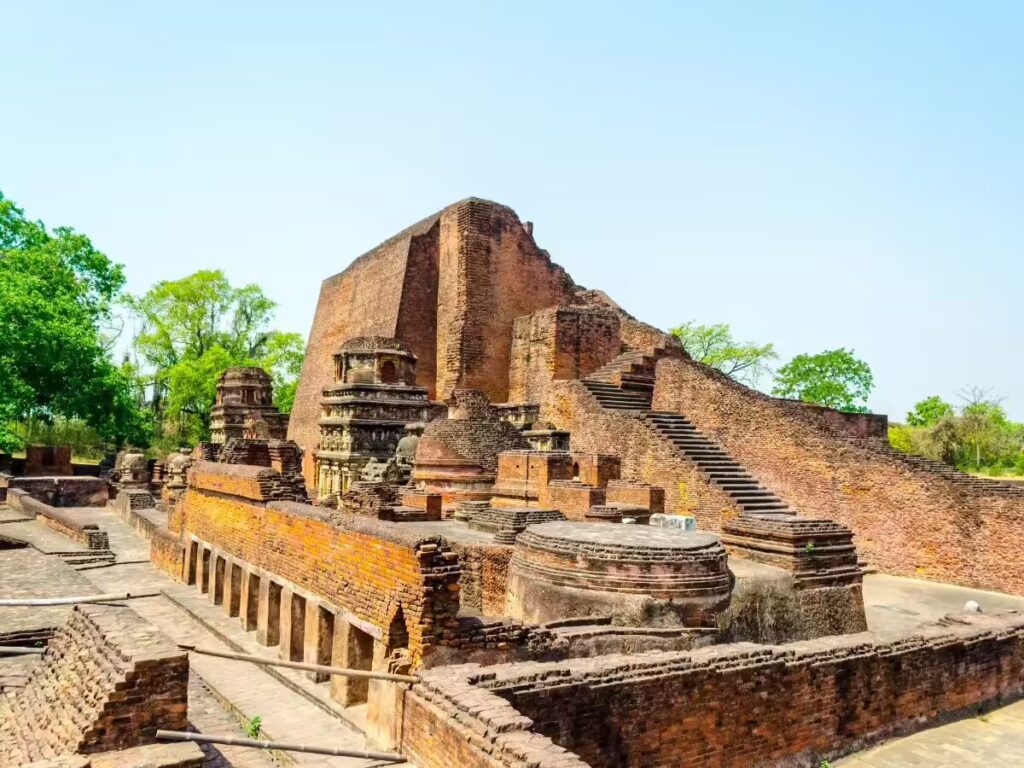
About Nalanda Mahavihara (Ancient University):
- Nalanda Mahavihara (5th-12th century CE) was one of the world’s greatest residential centres of learning, located near Rajagriha (modern Rajgir) in the ancient kingdom of Magadha (present-day Bihar). It operated for nearly a thousand years, from approximately 427 CE to around 1200 CE.
- Founder Patron:
- Numismatic evidence suggests Kumaragupta I of the Gupta Empire (5th century CE) was the founder patron. He is sometimes referred to as Shakraditya in inscriptions linked to Nalanda.
- Kumaragupta’s successors, Budhagupta, Tathagatagupta, Baladitya, and Vajra, extended and expanded the institution by constructing additional monasteries and temples.
- Patronage continued under King Harshavardhana of Kannauj (7th century CE) and reached a second peak under the Pala rulers (8th-12th century CE).
- After the decline of the Palas, monks were patronised by the Pithipatis of Bodh Gaya.
Key facts about Nalanda Mahavihara:
- Curriculum and Scholarship:
- Buddhist Philosophies taught: Mahayana, Madhyamaka, Yogachara, Sarvastivada, and Hinayana (all students studied Mahayana alongside the 18 Hinayana sects).
- Other subjects included: the Vedas, Sanskrit grammar, logic, medicine, mathematics, astronomy, Samkhya philosophy, and alchemy.
- The Mahavihara maintained a vast library known as Dharma Gunj (Mountain of Knowledge) that was a key repository for Sanskrit texts transmitted to East Asia by pilgrim-scholars.
- Notable Texts Composed at Nalanda: These texts played crucial roles in the development of both Mahayana and Vajrayana Buddhism across Asia.
- Works of Dharmakirti (Buddhist logician)
- Bodhisattvacharyavatara of Shantideva
- Mahavairocana Tantra
- Famous Scholars Associated with Nalanda: Nagarjuna, Aryadeva, Vasubandhu, Asanga, Dharmakirti, Shantideva, Chandrakirti, Śīlabhadra, and Vajrabodhi. Nalanda was famed for its learned professors or Upajjhaya (Upadhaya).
- Scale and International Character: At its height (7th century CE), Nalanda housed approximately 10,000 students and 1,500-2,000 teachers, according to the accounts of Chinese pilgrim Xuanzang (also known as Huang Tsang).
- Nalanda attracted students from Korea, Japan, China, Tibet, Sri Lanka, and other parts of Asia.
- Entry was highly competitive: oral examinations were conducted at the gates of the institution.
Decline and Destruction:
Nalanda was reportedly destroyed three times in its history, but was rebuilt after the first two attacks:
- First destruction: By the Huns under Mihirakula.
- Second destruction: During the 7th century CE by the Gaudas.
- Third and final destruction (c. 1200 CE): By forces under Muhammad Bakhtiyar Khilji, a military commander serving under Qutb al-Din Aibak of the Ghurid Sultanate.
Nalanda gradually ceased to function by around 1400 CE. The ruins of Nalanda were declared a UNESCO World Cultural Heritage Site in 2016.
Practice MCQ:
Q. With reference to Śāstrārtha in ancient India, consider the following statements:
1. It referred to a formal tradition of philosophical and scriptural debate.
2. It was associated with centres of learning such as Nalanda and Vikramashila.
3. It primarily focused on military strategy and statecraft discussions.
Which of the statements given above is/are correct?
(a) 1 and 2 only
(b) 2 only
(c) 1 and 3 only
(d) 2 and 3 only
Answer: (a)