NAMASTE scheme turns three: mechanising sanitation and ending hazardous cleaning
Why in News?
India observes the 3rd NAMASTE Day on 14 July 2026, marking three years of the National Action for Mechanised Sanitation Ecosystem (NAMASTE) — the government’s flagship scheme to protect sanitation workers and mechanise hazardous cleaning. The Ministry of Social Justice & Empowerment leads a national event at Rabindra Sadan, Kolkata, with parallel programmes across urban local bodies, framing the anniversary as a review of how far the state has moved sewer cleaning from a caste-bound, life-threatening chore toward an equipment-led, formal occupation.
On the day, eligible sewer and septic-tank workers (SSWs) and waste pickers receive PPE kits, Ayushman Bharat cards and NAMASTE ID cards — a visible marker of the scheme’s shift from welfare charity to entitlement-based occupational safety. PIB confirmed that the anniversary doubles as a progress audit, with fresh profiling data, PPE distribution figures and insurance-enrolment numbers placed before the public to show whether the promised move to a death-free, contact-free cleaning ecosystem is actually taking hold on the ground.
The observance also lands amid a running debate over how sanitation deaths are counted: the government maintains that classified ‘manual scavenging’ deaths have fallen to near zero, while civil-society trackers keep recording fatalities inside sewers and septic tanks, making NAMASTE’s third birthday as much a test of data honesty as of welfare delivery.
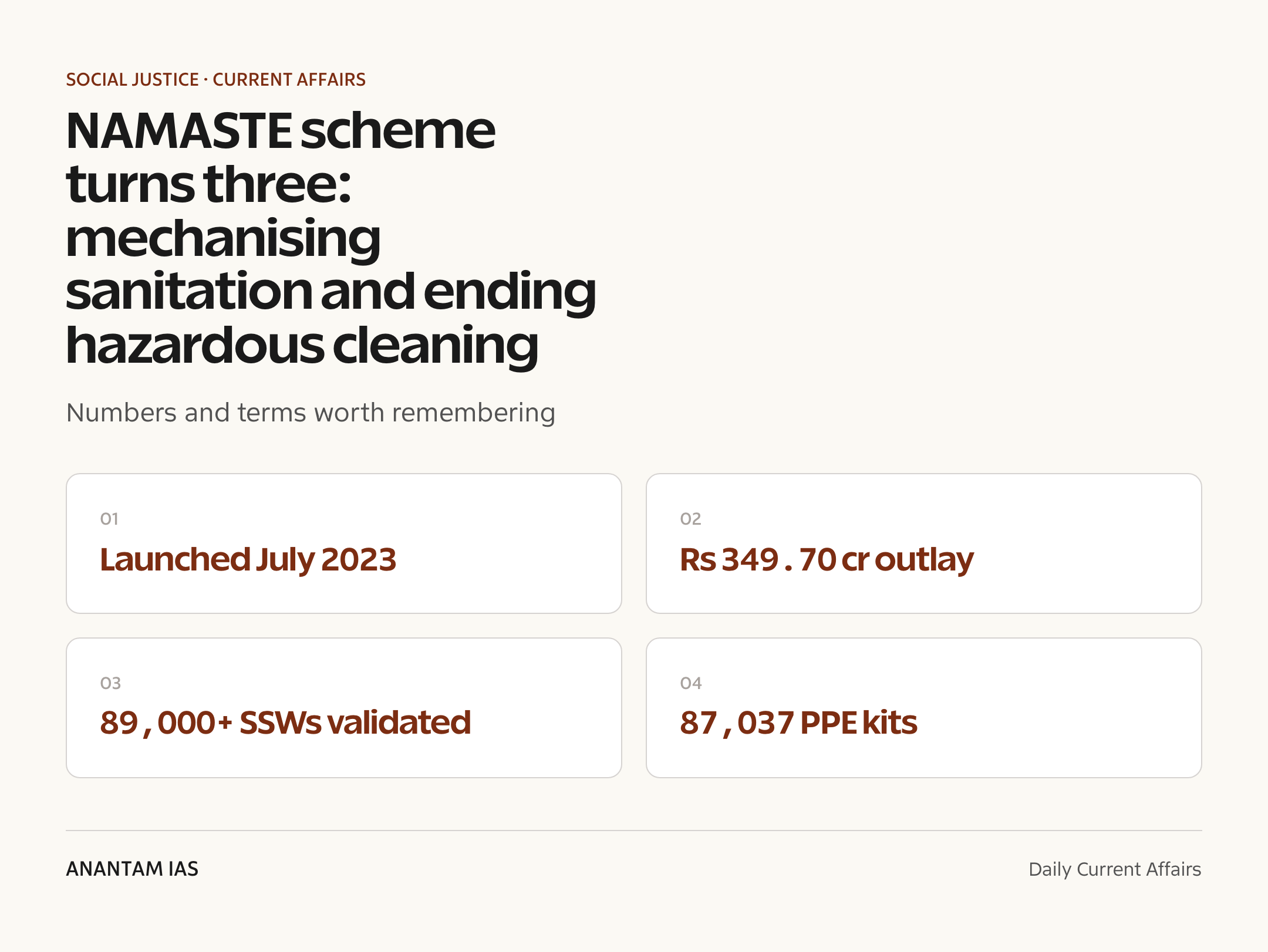
- NAMASTE launched in July 2023; jointly run by the Ministry of Social Justice & Empowerment (MoSJE) and the Ministry of Housing & Urban Affairs (MoHUA).
- Total outlay of Rs 349.70 crore, targeting all 4,800+ urban local bodies (ULBs) by 2025-26.
- As of 2026, over 89,000 SSWs profiled and validated and about 87,037 PPE kits distributed.
- Around 76,000+ workers covered under health insurance via AB-PMJAY.
- Coverage widened in 2026 to include waste pickers, with roughly 37,980 waste pickers validated.
- NAMASTE replaces the earlier Self Employment Scheme for Rehabilitation of Manual Scavengers (SRMS).
The development matters in the context of:
- The scheme operationalises the Prohibition of Employment as Manual Scavengers and their Rehabilitation Act, 2013, which outlawed manual scavenging.
- It reflects the constitutional promise of Article 17 (abolition of untouchability) and Article 46 (protection of weaker sections).
- Sanitation work in India is deeply tied to caste, making occupational safety a question of both labour rights and social justice.
UPSC Relevance
Prelims Relevance
- NAMASTE full form — National Action for Mechanised Sanitation Ecosystem.
- Nodal ministries — MoSJE and MoHUA (originally with the Department of Drinking Water & Sanitation).
- Implementing body for training — National Safai Karamcharis Finance & Development Corporation (NSKFDC).
- Health cover routed through Ayushman Bharat PM-JAY (AB-PMJAY).
- Target beneficiaries — Sewer and Septic-Tank Workers (SSWs) and, from 2026, waste pickers.
- Emergency Response Sanitation Units (ERSUs) — city-level mechanised response teams with safety devices.
- Governing law — Prohibition of Employment as Manual Scavengers and their Rehabilitation Act, 2013.
- Predecessor law — Employment of Manual Scavengers and Construction of Dry Latrines (Prohibition) Act, 1993.
- Predecessor challenge — Safaimitra Suraksha Challenge, 2020.
- Outlay — Rs 349.70 crore; target — all 4,800+ ULBs.
Mains Relevance
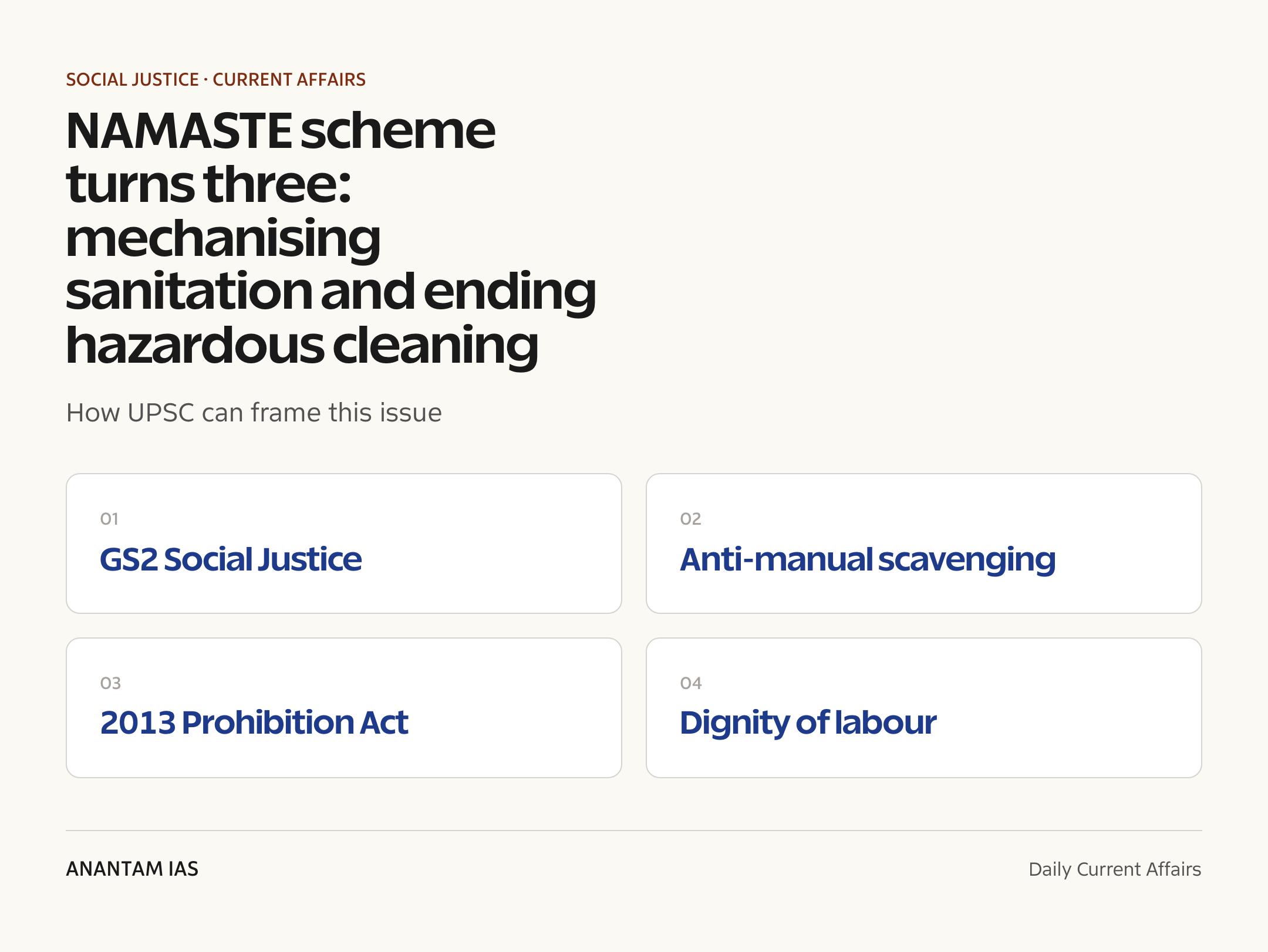
GS Paper 2
- Welfare schemes for vulnerable sections and mechanisms for their protection and betterment.
- Issues relating to the development and management of the social sector — health, safety and dignity of sanitation workers.
- Government policies aimed at operationalising the 2013 anti-manual-scavenging law.
GS Paper 1
- Social empowerment and caste; the persistence of caste-linked occupations despite legal prohibition.
Essay
- Dignity of labour and the unfinished journey against caste-based occupations.
- Technology as an instrument of social justice — mechanising the most degrading work.
Background and Context
What NAMASTE is and why it was created
NAMASTE is a national action plan to make sanitation work safe, mechanised and dignified, replacing charity-style rehabilitation with a rights-based occupational-safety ecosystem.
- Launched in July 2023 as a joint venture of MoSJE and MoHUA, replacing the Self Employment Scheme for Rehabilitation of Manual Scavengers (SRMS), which had focused narrowly on one-time cash and loan-based rehabilitation.
- Its stated outcomes — zero fatalities in sanitation work, no direct human contact with faecal matter, all cleaning via mechanised safety devices, and work done only by skilled, formalised workers.
- The scheme is built on the recognition that manual scavenging and hazardous sewer entry are illegal, dangerous and caste-linked, so a purely welfare framing was inadequate for a problem rooted in social hierarchy and informal labour.
- It reframes the sanitation worker from a passive beneficiary into a recognised, insured, tooled-up service provider with a formal identity in municipal systems.
- Total outlay of Rs 349.70 crore, aiming to cover all 4,800+ ULBs nationwide within the 2023-24 to 2025-26 window.
The scheme's core components
NAMASTE bundles profiling, safety gear, insurance, training and equipment subsidies into one ecosystem so that recognition, protection and livelihood support move together.
- Profiling and validation of every SSW and, from 2026, waste pickers, each issued a NAMASTE ID card that anchors them in a verifiable national database.
- Occupational safety training delivered through the NSKFDC and state agencies, covering safe entry protocols, gas-hazard awareness and the correct use of equipment.
- PPE kits (protective suits, masks, gloves, boots, gas detectors) plus safety devices for city response units, so that any unavoidable intervention is protected by gear rather than bare hands.
- Health insurance for workers and families under AB-PMJAY, extending a financial cushion against occupational illness and injury.
- Upfront capital subsidy for workers or self-help groups procuring sanitation vehicles and equipment, turning them into ‘sanipreneurs’ who own the machines that displace manual entry.
- Linkage to livelihood and credit support so that workers exiting hazardous cleaning have an alternative income path rather than being pushed back into it.
- An IEC (awareness) campaign to change public and municipal behaviour and reduce the demand for illegal manual cleaning.
Emergency Response Sanitation Units (ERSUs)
ERSUs are the institutional muscle for mechanised, on-call sanitation response, converting the promise of no manual entry into a standing operational capacity.
- Set up in larger municipal corporations and districts to respond to sewer and septic-tank emergencies without manual entry, so that no blockage or overflow forces a worker into a hazardous confined space.
- Equipped with mechanised cleaning machines, jetting-suction vehicles and rescue gear, and staffed by trained crews who follow standardised safety drills.
- Roughly 753 safety devices had been dispatched to ERSUs by early 2026, seeding cities with the hardware needed to retire manual entry.
- Designed to give each participating city a single accountable unit for hazardous cleaning, rather than leaving the task to ad-hoc contractors and informal labour.
- The goal is a 0-manual-entry protocol — machines and trained crews replace a worker climbing into a manhole, making mechanisation the routine response instead of the exception.
Progress after three years
The scheme’s reach has expanded steadily, though from a low base of formal recognition and with wide state-to-state variation.
- Over 89,000 SSWs profiled and validated across states and ULBs by 2026, giving the state its first credible, name-by-name picture of who does this work.
- About 87,037 PPE kits distributed to sanitation workers, pushing protective gear into the field rather than leaving it on paper.
- More than 76,000 workers brought under health-insurance cover through AB-PMJAY.
- Around 37,980 waste pickers validated after the 2026 expansion of coverage, marking the scheme’s move beyond sewer and septic-tank work into the wider sanitation workforce.
- The widening to waste pickers acknowledges that hazardous, low-status sanitation labour extends well past manholes into dumpsites and streets.
- On the 3rd NAMASTE Day, MoS B.L. Verma distributed PPE kits and Ayushman cards to SSWs and waste pickers, with the flagship event in Kolkata.
The legal and constitutional backbone
NAMASTE is the delivery arm of a long legal effort to abolish degrading sanitation labour.
- The Prohibition of Employment as Manual Scavengers and their Rehabilitation Act, 2013 bans manual scavenging and mandates rehabilitation.
- It replaced the weaker Employment of Manual Scavengers and Construction of Dry Latrines (Prohibition) Act, 1993.
- The Safaimitra Suraksha Challenge (2020) pushed cities toward mechanised, death-free sewer cleaning.
- The mission draws constitutional strength from Article 17 (untouchability), Article 21 (life and dignity), Article 23 (against forced labour) and Article 46.
- The Supreme Court, in Safai Karamchari Andolan v. Union of India (2014), directed compensation of Rs 10 lakh for each sewer or septic-tank death.
The gap between claims and ground reality
Official figures and civil-society data diverge sharply on deaths, exposing a definitional problem.
- The government has told Parliament there have been no ‘manual scavenging’ deaths in recent years — because deaths in sewers and tanks are classified as ‘hazardous cleaning’ deaths, not manual scavenging.
- Activist body Safai Karamchari Andolan (SKA) records dozens of sewer and septic-tank deaths every year, pointing to persistent illegal manual entry.
- Weak data tracking, caste stigma and informal, sub-contracted work keep many workers outside official rolls.
- Mechanisation coverage remains uneven — small towns and private septic-tank cleaning lag behind large corporations.
Way Forward
Close the definitional and data gap
- Adopt a single, transparent definition so every sewer or septic-tank death is counted, investigated and compensated.
- Build a real-time national registry linking NAMASTE ID cards, insurance and death-audit data.
Make mechanisation the default
- Scale ERSUs and mechanised equipment to smaller ULBs and rural areas, not just metros.
- Enforce a strict zero-manual-entry protocol with penalties for violating municipalities and contractors.
Formalise and uplift the workforce
- Convert validated workers into sanipreneurs through capital subsidy, skilling and assured municipal contracts.
- Guarantee living wages, social security and caste-sensitive rehabilitation for exiting families.
Conclusion
Three years on, NAMASTE has done the hard, unglamorous work of counting, insuring and equipping people who were long invisible to the state. Validation numbers, PPE kits and Ayushman cards are real gains, and the widening to waste pickers signals ambition beyond a single occupation. By tying identity, safety gear, insurance and livelihood support into one package, the scheme has begun to treat sanitation labour as a formal occupation rather than a caste-fixed burden.
But dignity is measured by deaths avoided, not kits distributed. As long as sewer fatalities are recorded under a softer label and mechanisation stops at the big-city boundary, the scheme’s promise stays partly unmet. Small towns, rural areas and the vast informal septic-tank cleaning market remain the weakest links, where equipment is scarce and enforcement thin.
The next phase must turn an entitlement ecosystem into an enforceable guarantee that no Indian dies cleaning another’s waste — by counting every death honestly, extending ERSUs and mechanised equipment far beyond the metros, and giving formalised workers secure, well-paid livelihoods. Only then does an anniversary of profiling and PPE distribution mature into the deeper social-justice goal behind the 2013 law.
UPSC Practice Questions
Prelims MCQ 1
With reference to the NAMASTE scheme, consider the following statements:
- It is jointly implemented by the Ministry of Social Justice & Empowerment and the Ministry of Housing & Urban Affairs.
- It provides health insurance coverage to sanitation workers through Ayushman Bharat PM-JAY.
- Its coverage is restricted only to sewer and septic-tank workers and excludes waste pickers.
How many of the above statements are correct?
(a) Only one (b) Only two (c) All three (d) None
Answer: (b) Only two
Explanation:
Statements 1 and 2 are correct. Statement 3 is wrong — coverage was expanded in 2026 to include waste pickers alongside SSWs.
Prelims MCQ 2
The ‘Prohibition of Employment as Manual Scavengers and their Rehabilitation Act’ was enacted in which year?
(a) 1993 (b) 2005 (c) 2013 (d) 2020
Answer: (c) 2013
Explanation:
The 2013 Act replaced the 1993 Act, widened the definition of manual scavenging to hazardous cleaning, and mandated rehabilitation. The Safaimitra Suraksha Challenge came in 2020.
UPSC Mains Questions
- The NAMASTE scheme reflects a shift from rehabilitating manual scavengers to mechanising sanitation itself. Examine how far this approach addresses the caste and safety dimensions of sanitation work in India. (250 words)
- Despite a robust legal framework, deaths during sewer and septic-tank cleaning persist in India. Critically analyse the reasons and suggest measures to ensure genuine mechanisation and dignity of sanitation labour. (250 words)
Sources: PIB, Ministry of Social Justice & Empowerment and DD News / Akashvani News.
Frequently Asked Questions
What does NAMASTE stand for?
NAMASTE is the National Action for Mechanised Sanitation Ecosystem, a central scheme launched in July 2023. It is jointly run by the Ministry of Social Justice & Empowerment and the Ministry of Housing & Urban Affairs to make sanitation work safe, mechanised and dignified, and to protect sewer and septic-tank workers.
Which workers does NAMASTE cover?
The scheme covers sewer and septic-tank workers (SSWs) across urban local bodies. In 2026 its coverage was widened to include waste pickers. Each validated worker receives a NAMASTE ID card, a PPE kit, occupational-safety training and health cover under Ayushman Bharat PM-JAY.
How is NAMASTE different from manual scavenging law?
The Prohibition of Employment as Manual Scavengers Act, 2013 legally bans manual scavenging. NAMASTE is the delivery mechanism that operationalises that ban — by profiling workers, supplying safety equipment, funding mechanised cleaning machines and rehabilitating workers into safer, formal livelihoods.
What is an Emergency Response Sanitation Unit (ERSU)?
An ERSU is a city or district-level mechanised sanitation team set up under NAMASTE. Equipped with jetting-suction machines and safety devices, it responds to sewer and septic-tank emergencies without any worker manually entering a manhole, supporting the scheme’s zero-manual-entry goal.
Why do sanitation deaths still occur despite the ban?
The government counts these as hazardous-cleaning deaths rather than manual-scavenging deaths, so official figures show near-zero manual scavenging fatalities. Civil-society groups like Safai Karamchari Andolan record dozens of sewer deaths yearly, driven by informal sub-contracting, weak enforcement and uneven mechanisation.
What has NAMASTE achieved so far?
By 2026 the scheme had profiled and validated over 89,000 SSWs, distributed about 87,037 PPE kits, covered more than 76,000 workers under health insurance, and validated nearly 37,980 waste pickers. It targets all 4,800-plus urban local bodies with an outlay of Rs 349.70 crore.