India’s Narcotics-Control Roadmap: From Seizures to Network Disruption
Why in News?
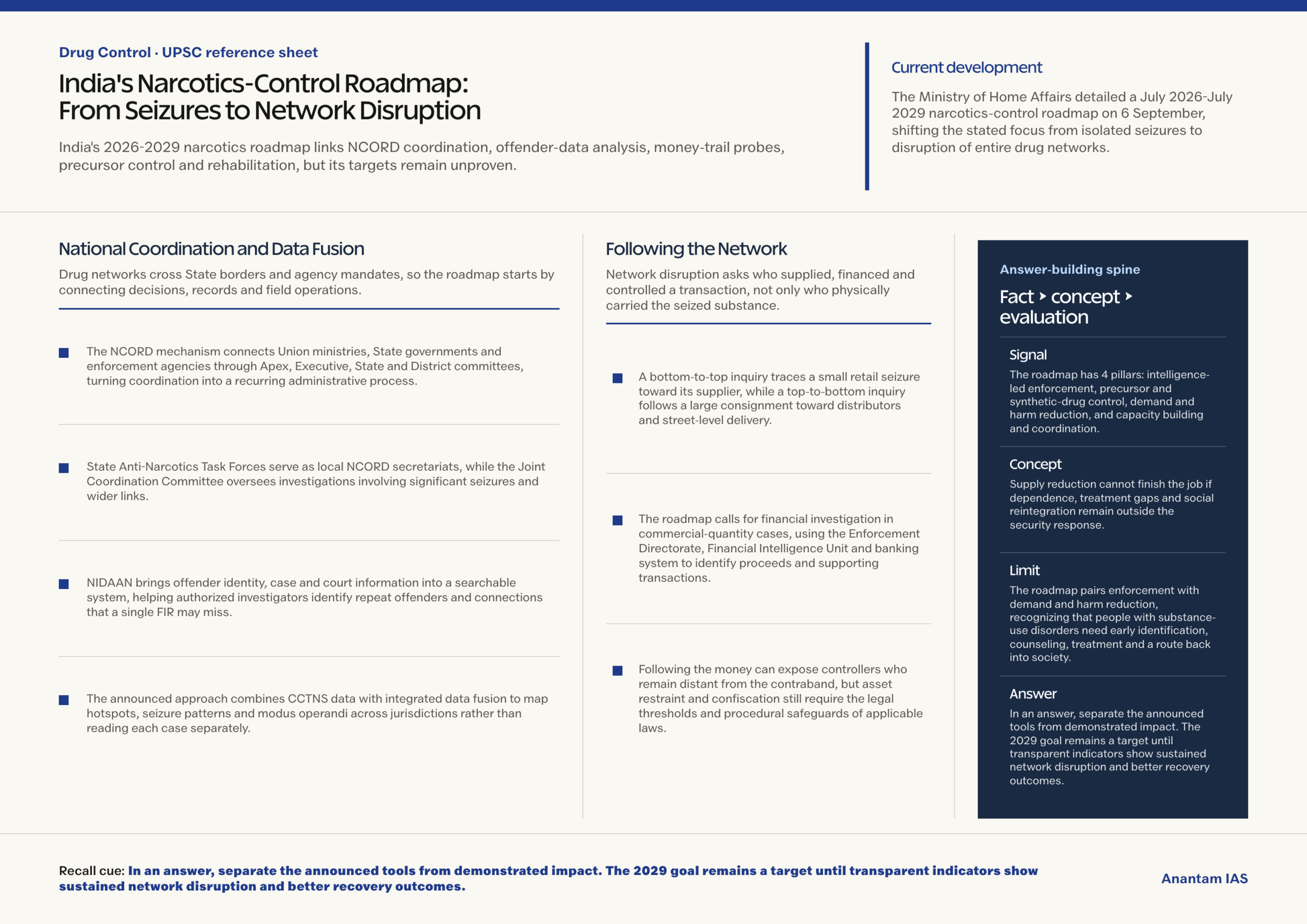
The Ministry of Home Affairs detailed a July 2026-July 2029 narcotics-control roadmap on 6 September, shifting the stated focus from isolated seizures to disruption of entire drug networks.
- The roadmap has 4 pillars: intelligence-led enforcement, precursor and synthetic-drug control, demand and harm reduction, and capacity building and coordination.
- It assigns timelines, measurable targets and quarterly reviews to Union ministries, central agencies and State governments.
- The announcement emphasizes backward and forward linkages: tracing a retail packet to its source and a large consignment to its intended distribution chain.
- The claim of achieving a drug-free India by 2029 is a government target, not an outcome established by the announcement.
- Drug trafficking crosses police, customs, border, financial and public-health jurisdictions, so a seizure by one agency may reveal only one part of the network.
- The policy test is whether shared intelligence produces prosecutions, confiscation of proceeds, lower precursor diversion and sustained treatment access, not only larger seizure totals.
UPSC Relevance
Prelims Relevance
- The Narcotics Control Bureau is India’s nodal agency for drug-law-enforcement coordination and functions under the Ministry of Home Affairs.
- The NCORD mechanism has Apex, Executive, State and District levels for Centre-State and inter-agency coordination.
- NIDAAN is the National Integrated Database on Arrested Narco-Offenders, developed by NCB with the Inter-Operable Criminal Justice System.
- Section 9A of the NDPS Act, 1985 empowers the Union government to control and regulate substances that may be diverted for illicit drug manufacture.
- The Ministry of Social Justice and Empowerment is the nodal ministry for drug-demand reduction, including treatment and rehabilitation measures.
Mains Relevance
GS Paper 3
- Linkages between organized crime, illicit finance, darknet-enabled trafficking and internal security.
- Role of intelligence sharing, financial investigation and border-management agencies in dismantling narcotics networks.
GS Paper 2
- Functions and responsibilities of the Union and the States, and mechanisms for coordinated policy implementation.
- Government policies in health and social sectors, with emphasis on rehabilitation rather than treating dependence only as a policing issue.
Essay
- A durable security response must be firm against organized traffickers while keeping treatment, dignity and social reintegration available to people with substance-use disorders.
Background and Context
National Coordination and Data Fusion
Drug networks cross State borders and agency mandates, so the roadmap starts by connecting decisions, records and field operations.
- The NCORD mechanism connects Union ministries, State governments and enforcement agencies through Apex, Executive, State and District committees, turning coordination into a recurring administrative process.
- State Anti-Narcotics Task Forces serve as local NCORD secretariats, while the Joint Coordination Committee oversees investigations involving significant seizures and wider links.
- NIDAAN brings offender identity, case and court information into a searchable system, helping authorized investigators identify repeat offenders and connections that a single FIR may miss.
- The announced approach combines CCTNS data with integrated data fusion to map hotspots, seizure patterns and modus operandi across jurisdictions rather than reading each case separately.
- Data fusion should generate testable leads, but a shared database isn’t proof of guilt; investigators must still establish admissible evidence, protect access and correct inaccurate records.
Following the Network
Network disruption asks who supplied, financed and controlled a transaction, not only who physically carried the seized substance.
- A bottom-to-top inquiry traces a small retail seizure toward its supplier, while a top-to-bottom inquiry follows a large consignment toward distributors and street-level delivery.
- The roadmap calls for financial investigation in commercial-quantity cases, using the Enforcement Directorate, Financial Intelligence Unit and banking system to identify proceeds and supporting transactions.
- Following the money can expose controllers who remain distant from the contraband, but asset restraint and confiscation still require the legal thresholds and procedural safeguards of applicable laws.
- Precursor chemicals have legitimate industrial uses but may be diverted to manufacture synthetic drugs; control must track suspicious transactions without treating lawful chemical trade as criminal.
- India regulates notified controlled substances under Section 9A of the NDPS Act and the Regulation of Controlled Substances Order, linking industry records with enforcement oversight.
Rehabilitation and the Evidence Limit
Supply reduction cannot finish the job if dependence, treatment gaps and social reintegration remain outside the security response.
- The roadmap pairs enforcement with demand and harm reduction, recognizing that people with substance-use disorders need early identification, counseling, treatment and a route back into society.
- The Ministry of Social Justice and Empowerment leads drug-demand reduction through Nasha Mukt Bharat Abhiyaan and the National Action Plan for Drug Demand Reduction.
- Health departments, social-justice institutions and prison administrations must coordinate referrals, because an arrest or prison term by itself doesn’t treat dependence or prevent relapse after release.
- The MANAS helpline separates two needs within one access point: citizens may report drug activity and people seeking help may ask for counseling or rehabilitation support.
- The hard exam distinction is between inputs and outcomes: meetings, databases, targets and seizure figures show activity, while reduced availability, disrupted finances and recovery require separate evidence.
Way Forward
Measure Network-Level Results
Quarterly review will matter only if agencies measure what changed beyond the immediate seizure.
- Track cases that identify financiers, controllers and cross-State links, alongside the value of proceeds frozen or confiscated after judicial scrutiny.
- Audit NIDAAN and CCTNS data quality, authorized access and correction procedures so intelligence sharing does not magnify errors across agencies.
- Monitor precursor diversion through risk-based industry compliance, Customs intelligence and suspicious-transaction analysis while protecting legitimate pharmaceutical and chemical supply chains.
- Publish treatment entry, completion, relapse-support and reintegration indicators separately from enforcement statistics, with privacy safeguards for people seeking care.
Conclusion
- India’s narcotics roadmap is strongest as an administrative design: coordinate nationally, connect the data, follow the money, control diversion and keep rehabilitation inside the response.
- In an answer, separate the announced tools from demonstrated impact. The 2029 goal remains a target until transparent indicators show sustained network disruption and better recovery outcomes.
UPSC Practice Questions
Prelims MCQ 1
With reference to India’s narcotics-control architecture, consider the following statements:
- NCORD operates through Apex, Executive, State and District levels.
- NIDAAN is a database concerning arrested narco-offenders.
- The Ministry of Social Justice and Empowerment is the nodal ministry for drug-demand reduction.
How many of the above statements are correct?
(a) Only one (b) Only two (c) All three (d) None
Answer: (c) All three
Explanation:
All 3 statements are correct. NCORD provides the coordination structure, NIDAAN supports offender-data analysis and the Social Justice Ministry leads demand-reduction policy.
Prelims MCQ 2
Which provision most directly empowers the Union government to regulate substances that may be diverted for illicit drug manufacture?
(a) Section 9A of the NDPS Act, 1985 (b) Section 66A of the Information Technology Act, 2000 (c) Article 263 of the Constitution (d) Section 144 of the Bharatiya Nagarik Suraksha Sanhita, 2023
Answer: (a) Section 9A of the NDPS Act, 1985
Explanation:
Section 9A authorizes the Union government to control and regulate controlled substances, including notified precursor chemicals vulnerable to diversion.
UPSC Mains Questions
- Drug seizures are necessary but insufficient for dismantling organized narcotics networks. Examine the role of data fusion, financial investigation and precursor control in moving from interdiction to network disruption.
- A narcotics policy must distinguish traffickers from people who need treatment. Discuss how Centre-State coordination can combine firm enforcement with demand reduction, rehabilitation and accountable outcome measurement.
Source: PIB, Ministry of Home Affairs.
Frequently Asked Questions
What is the 2026-2029 narcotics-control roadmap?
It is a Ministry of Home Affairs plan built around intelligence-led enforcement, precursor and synthetic-drug control, demand and harm reduction, and capacity building and coordination.
What is NCORD?
The Narco-Coordination Centre is a 4-tier mechanism that links Union, State and District authorities for policy review, intelligence sharing and coordinated action against drug trafficking.
How does NIDAAN help investigators?
NIDAAN consolidates authorized offender, case and court information so investigators can spot repeat offenders and cross-jurisdiction links. Database matches remain leads, not substitutes for admissible evidence.
Why are precursor chemicals part of drug control?
Precursors are dual-use chemicals with lawful industrial roles that can also be diverted for illicit manufacture. Regulation focuses on notified substances, records, transactions and suspicious diversion risks.
Has India achieved the roadmap’s 2029 goal?
No. The announcement states a government target and an implementation plan. Outcomes require later evidence on network disruption, illicit finance, drug availability, treatment access and sustained recovery.