NASA-ISRO Moon Base Programme: India’s Next Space-Cooperation Choice
Why in News?
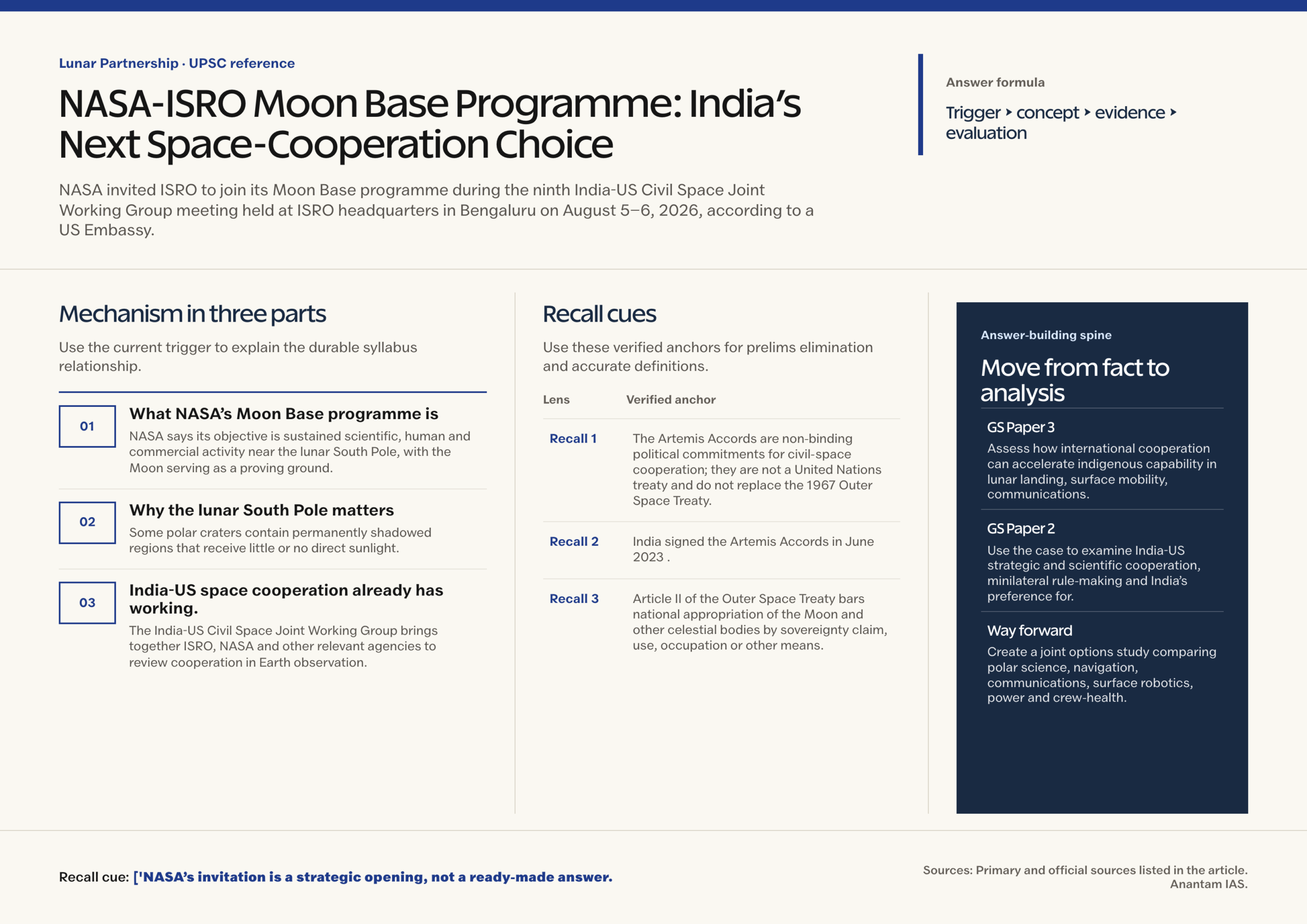
NASA invited ISRO to join its Moon Base programme during the ninth India-US Civil Space Joint Working Group meeting held at ISRO headquarters in Bengaluru on August 5–6, 2026, according to a US Embassy statement reported by The Hindu and.
- The US statement linked the invitation to the two countries’ existing partnership under the Artemis Accords, which India signed in June 2023.
- The two sides also agreed to intensify discussions on open sharing of scientific data, a named principle of the Artemis Accords and a practical requirement for multinational lunar science.
- NASA describes Moon Base as a long-term initiative for sustained human presence, scientific activity and commercial operations near the lunar South Pole.
- NASA’s announced early architecture relies on robotic cargo landers, surface instruments, autonomous and crewed rovers, communications, navigation and later human-support infrastructure rather than one self-contained ‘base’ mission.
- No publicly reported document yet specifies India’s contribution, financing, procurement rights, data access, technology-transfer terms, schedule or decision-making role. These details must be negotiated before participation can be evaluated.
- The real policy question is not whether India should cooperate in space. It is which contribution advances India’s own roadmap while preserving freedom to design, operate and learn from critical systems.
- Participation could give Indian instruments, scientists and industry repeated access to lunar missions, but a narrow payload-supplier role may produce less capability than co-development of complete subsystems.
- The lunar South Pole is scientifically attractive because permanently shadowed regions may preserve water ice and other volatiles; it is operationally difficult because of extreme temperatures, difficult terrain, long shadows and limited communications.
UPSC Relevance
Prelims Relevance
- The Artemis Accords are non-binding political commitments for civil-space cooperation; they are not a United Nations treaty and do not replace the 1967 Outer Space Treaty.
- India signed the Artemis Accords in June 2023. Their principles include peaceful purposes, transparency, interoperability, emergency assistance, registration, release of scientific data, heritage preservation, space resources, deconfliction and orbital-debris mitigation.
- Article II of the Outer Space Treaty bars national appropriation of the Moon and other celestial bodies by sovereignty claim, use, occupation or other means.
- The Outer Space Treaty requires due regard for other states’ interests and consultation where an activity may cause potentially harmful interference.
- NASA’s Moon Base is centred on the lunar South Pole and is designed as a sequence of robotic and crewed missions with international and commercial participation.
- NASA’s Commercial Lunar Payload Services, or CLPS, buys delivery services from commercial providers for science and technology payloads sent to the Moon.
Mains Relevance
GS Paper 3
- Assess how international cooperation can accelerate indigenous capability in lunar landing, surface mobility, communications, navigation, power, life support, robotics and sample science.
- Distinguish access to a foreign-led mission from technology absorption: India gains most when its institutions and firms design, qualify, operate and retain knowledge of mission-critical systems.
GS Paper 2
- Use the case to examine India-US strategic and scientific cooperation, minilateral rule-making and India’s preference for issue-based partnerships rather than exclusive blocs.
- Evaluate lunar governance through the Outer Space Treaty, the Artemis Accords, open-data commitments, safety zones, non-appropriation and equitable access to space resources.
Essay
- Scientific autonomy is strengthened not by isolation but by partnerships that expand a country’s capacity to choose.
Background and Context
What NASA’s Moon Base programme is
Moon Base is best understood as an evolving lunar infrastructure programme, not a single habitat launched in one mission.
- NASA says its objective is sustained scientific, human and commercial activity near the lunar South Pole, with the Moon serving as a proving ground for deeper-space exploration and eventual human missions to Mars.
- The first announced missions are robotic. NASA’s May 2026 update described cargo landers carrying instruments and rovers to gather operational data and reduce risk before crewed surface activity.
- Moon Base I is targeted no earlier than fall 2026 for the Shackleton Connecting Ridge. Its announced payloads include an instrument to study thruster-plume interaction with lunar soil and a laser retroreflector for precise positioning.
- Moon Base II is planned to carry more than 1,100 pounds of cargo, including a rover, while Moon Base III includes the Lunar Vertex investigation and payload participation from the European Space Agency and the Korea.
- NASA has also contracted crew-capable lunar terrain vehicles and is developing MoonFall, a planned 2028 mission of four hopping drones to image difficult terrain near candidate landing areas.
Why the lunar South Pole matters
The South Pole combines high scientific value with severe engineering constraints.
- Some polar craters contain permanently shadowed regions that receive little or no direct sunlight. These cold traps can preserve water ice and other volatiles delivered or produced over long periods.
- Water can support science and, if extraction proves technically and economically viable, may contribute to drinking water, oxygen and hydrogen-oxygen propellant. Resource potential is not the same as a proven reserve or an immediately usable supply.
- Elevated ridges can receive longer periods of sunlight than nearby depressions, which may help solar-power planning, while line-of-sight to Earth and lunar-orbit relays shapes communications architecture.
- Low Sun angles create long shadows; rough terrain complicates landing and mobility; abrasive regolith threatens seals and mechanisms; radiation, vacuum and large temperature swings raise reliability requirements.
- India’s Chandrayaan-1 helped establish evidence of lunar water-related signatures, Chandrayaan-3 achieved a soft landing in the southern high latitudes, and planned polar missions give ISRO a credible science and operations base for negotiations.
India-US space cooperation already has working models
The invitation rests on an institutional relationship that predates Moon Base.
- The India-US Civil Space Joint Working Group brings together ISRO, NASA and other relevant agencies to review cooperation in Earth observation, planetary science, human spaceflight, space weather and related fields.
- NISAR shows how complementary contributions can produce a jointly integrated mission: NASA supplied the L-band synthetic aperture radar and key payload elements, while ISRO supplied the S-band radar, spacecraft bus, launch vehicle and associated services.
- Indian astronaut Shubhanshu Shukla’s Axiom-4 mission and training links with NASA added operational human-spaceflight experience before India’s independent Gaganyaan crewed mission.
- Joint work need not follow one template. A science instrument, a data partnership, a complete rover subsystem, a communications service or a crew-support contribution each creates a different balance of risk, learning and control.
- India should use NISAR as a benchmark for clear work-sharing, joint governance, scientific access and visible domestic capability rather than assume that participation alone guarantees technology transfer.
How Moon Base fits India’s lunar roadmap
India’s own sequence gives it both bargaining power and a test for relevance.
- Chandrayaan-3 proved soft landing and rover operation in the lunar southern high latitudes. Chandrayaan-4 is designed to add lunar ascent, orbital rendezvous and sample return, capabilities with direct value for a larger exploration architecture.
- The ISRO-JAXA LUPEX mission is aimed at investigating lunar polar volatiles and surface conditions. Its science can inform where and how future systems operate without treating suspected ice as an established commercial resource.
- Gaganyaan develops crew safety, life support, human-rated launch and recovery for low-Earth orbit. The Bharatiya Antariksh Station would extend duration, docking, maintenance and microgravity operations before India attempts a crewed lunar landing.
- A Moon Base contribution should fill a real capability gap in this sequence. Candidate areas include precision navigation, surface communications, polar instruments, autonomous rovers, thermal management, regolith-dust mitigation and biological research.
- The strongest project would be useful to the multinational base and reusable in India’s 2040 crewed-lunar objective. A contribution that cannot be independently tested, upgraded or applied elsewhere offers weaker strategic value.
Way Forward
Negotiate a capability-based contribution
- Create a joint options study comparing polar science, navigation, communications, surface robotics, power and crew-health contributions against cost, schedule, readiness and reuse in Indian missions.
- Prefer co-development of an end-to-end subsystem with Indian design authority, qualification work and mission operations over a small payload with little domestic learning.
- Define intellectual-property rights, export-control boundaries, liability, procurement access, data rights, interface ownership and failure responsibility before committing public funds.
Conclusion
- NASA’s invitation is a strategic opening, not a ready-made answer.
- India’s best course is selective, capability-building cooperation : join where the programme advances Chandrayaan, Gaganyaan, BAS and the 2040 lunar goal; retain independent options; and use its seat at the table to press for peaceful, transparent and inclusive lunar governance.
UPSC Practice Questions
Prelims MCQ 1
With reference to the Artemis Accords, consider the following statements:
- They are a legally binding treaty adopted by the United Nations General Assembly.
- They support interoperability and the open release of scientific data.
- They envisage temporary safety zones for notification and coordination to avoid harmful interference.
How many of the above statements are correct?
(a) Only one (b) Only two (c) All three (d) None
Answer: (b) Only two
Explanation:
Statements 2 and 3 are correct. The Artemis Accords are non-binding political commitments implemented through cooperative arrangements, not a UN treaty. They promote interoperability, scientific-data release and coordination through temporary safety zones consistent with due regard and free access.
Prelims MCQ 2
Which one of the following best describes the main technological objective of India’s Chandrayaan-4 mission?
(a) Placing the first Indian space station in lunar orbit (b) Mapping Earth with dual-frequency synthetic aperture radar (c) Collecting lunar samples and returning them safely to Earth (d) Carrying an Indian crew to the lunar surface
Answer: (c) Collecting lunar samples and returning them safely to Earth
Explanation:
ISRO describes Chandrayaan-4 as a lunar sample-return mission. It is intended to demonstrate sample collection, ascent from the lunar surface, docking or transfer operations needed for return, and safe delivery of protected samples to Earth.
UPSC Mains Questions
- NASA’s invitation to ISRO to join the Moon Base programme can strengthen India’s space capability only if participation is aligned with an independent national roadmap. Discuss. (250 words)
- Examine how the Artemis Accords seek to translate principles of the Outer Space Treaty into operational rules for sustained lunar activity. What concerns should India address while participating? (250 words)
Sources: The Hindu and The Indian Express.
Frequently Asked Questions
Has India formally joined NASA’s Moon Base programme?
NASA has invited ISRO to join, according to a US Embassy statement reported after the August 5–6, 2026 Civil Space Joint Working Group meeting. The public reports do not identify a signed mission agreement, a confirmed Indian contribution, funding, schedule.
Is NASA’s Moon Base the same as the Artemis programme?
Moon Base is part of NASA’s broader Artemis exploration strategy. Artemis covers crewed and uncrewed missions and the systems used to return humans to the Moon and prepare for Mars. Moon Base focuses on building sustained surface capability near the.
Why is NASA interested in ISRO as a partner?
ISRO brings lunar-science and mission experience from Chandrayaan, polar-exploration plans through LUPEX, growing human-spaceflight capability and a record of joint engineering through NISAR. India can contribute instruments, robotics, communications, navigation or operations, although the agencies have not publicly announced which.
Do the Artemis Accords permit countries to own parts of the Moon?
No. The Accords reaffirm the Outer Space Treaty, whose Article II bars national appropriation of the Moon by sovereignty claim, use or occupation. The Accords support extraction and use of space resources in accordance with the treaty, but resource ownership.
How could Moon Base participation support India’s 2040 lunar goal?
A well-chosen contribution could give India repeated experience in polar navigation, surface mobility, communications, power, thermal control, life support, dust mitigation or crew health. The value depends on Indian participation in design, testing and operations, and on whether the subsystem.