National Career Service Portal: AI, Employment Matching and Public Delivery
Why in News?
In a written Lok Sabha reply on 3 August 2026 , the Ministry of Labour and Employment set out the scale and recent technological upgrades of the National Career Service (NCS) portal.
- NCS offers jobs from private and government sectors, job fairs, job search and matching, career counselling, vocational guidance, and information on skill and training programmes.
- The upgraded platform is cloud-based and uses an open architecture, with integration across public and private job and skill portals.
- The listed AI-enabled functions are intelligent job matching, skill-gap analysis, personalized job recommendations and an AI interview coach.
- The portal includes multilingual support through Bhashini, verification mechanisms, cloud-based applications for jobseekers and employers, and a mobile application.
- More than 40 MoUs with public and private employers, portals and platforms are intended to broaden employment opportunities and related services.
- The issue connects digital service delivery with the older public function of collecting vacancies, registering jobseekers and providing career guidance.
- It helps distinguish a platform that facilitates matching and information from a programme that itself creates every job displayed on it.
- It raises an answer-writing question: how should public systems combine scale, accessibility, verification and human support when AI-assisted recommendations are introduced?
UPSC Relevance
Prelims Relevance
- The Ministry of Labour and Employment implements the National Employment Service, which has been transformed into the National Career Service.
- NCS is a digital platform for employment assistance, career counselling, vocational guidance, job fairs and information on skill and training programmes.
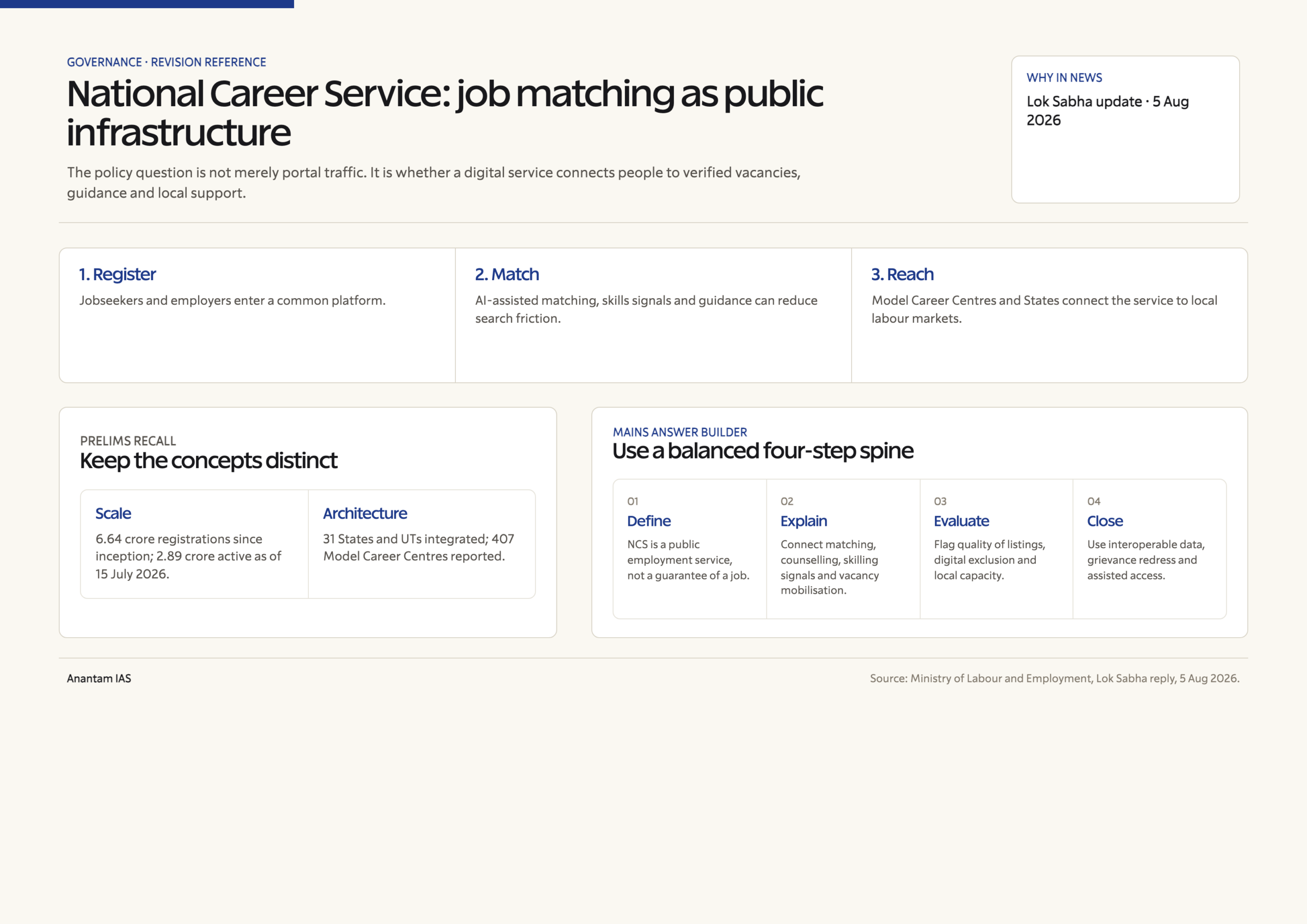
- As on 15 July 2026, the ministry reported more than 6.64 crore registered jobseekers since inception and 2.89 crore active jobseekers.
- As on the same date, more than 10.05 crore vacancies had been mobilized since inception and 17.68 lakh vacancies were active.
- The portal has been upgraded to a cloud-based, open-architecture platform.
- Its stated AI features include intelligent matching, AI skill-gap analysis, personalized recommendations and an AI interview coach.
Mains Relevance
GS Paper 2
- Examine digital public-service delivery as a means to improve access to information, counselling and grievance-responsive employment assistance.
- Assess the importance of multilingual access, verification and local outreach in preventing a digital platform from excluding those who need public support most.
GS Paper 3
- Use NCS to discuss labour-market intermediation, employability information and the connection between skilling and employment opportunities.
- Evaluate AI-assisted job matching through the lenses of data quality, transparency, bias, privacy, accountability and human counselling.
Essay
- Technology improves public capacity only when it expands a citizen’s ability to understand choices, access services and question an unsuitable decision.
Background and Context
From Employment Exchanges to a Career-Service Platform
The official reply places NCS in a longer public-employment-service continuum. The National Employment Service has been transformed into NCS, but the underlying functions remain recognisable: bring jobseekers and.
- The portal brings together private- and government-sector job information, online and offline job fairs, search and matching, career counselling, vocational guidance, and information about skill-development courses and training programmes.
- This is why NCS should not be described merely as a job-listing website. Its declared function includes employment assistance, career-related information and guidance alongside the display of vacancies.
- At the same time, a platform’s record of vacancies mobilized is not identical to a count of jobs created by government. It records vacancies brought onto the portal; placement, retention and job quality require separate evidence.
- For UPSC, this distinction is useful. Employment policy includes job creation, labour-market information, employer outreach, counselling, skilling, mobility and social-security linkages. NCS sits mainly at the intermediation and information layer while connecting users to several of.
- The portal model can reduce information gaps between a person looking for work and an employer looking for workers. Its public value depends on whether information is current, accessible and understandable, and whether users can obtain.
Scale: Read the Portal Numbers Carefully
The 3 August reply gives both cumulative and active figures. Reading the two columns separately is essential because a cumulative count since inception answers a different question from.
- More than 6.64 crore jobseekers had registered on NCS since inception. Of these, 2.89 crore were reported as active jobseekers as on 15 July 2026.
- More than 10.05 crore vacancies had been mobilized since inception, while 17.68 lakh were active vacancies on 15 July 2026.
- Cumulative figures show the scale of participation and activity over time. Active figures are more useful for understanding the immediate pool visible on a specified date. Neither number by itself establishes the number of people placed.
- This is not a criticism of the portal’s reported figures; it is a basic rule of policy analysis. A Mains answer should avoid converting registrations into employment outcomes without a verified placement indicator.
- The reply also notes that portal improvement is a continuous and dynamic process, with changes planned in response to evolving requirements. That makes periodic evaluation important: policymakers need to know who is using the platform, which.
Open Architecture, Interoperability and Local Access
NCS has been upgraded to a cloud-based, open-architecture platform. In public delivery, this design matters because a person seeking work may also need identity documents, skill information, social-security.
- The ministry lists integration with Udyam, eShram, Skill India Digital Hub, EPFO, ESIC, MHRD and DigiLocker. It also records linkages with bodies such as UPSC, SSC, ASRB and Railway Recruitment Boards.
- Interoperability can reduce repeated data entry and make a public service easier to navigate. It should be built with clear purpose limitation, user awareness and secure handling of personal information, especially where employment history, skills or.
- The reply records more than 40 MoUs with employers, portals and platforms. Such partnerships can widen the pool of information and service options, but public systems still need robust verification mechanisms so that users can trust.
- Digital reach cannot eliminate the value of proximate guidance. The NCS project envisages Model Career Centres that organize job fairs, mobilize employers and provide online or offline career counselling with States and other institutions.
- The government has approved 407 MCCs, including 370 employment exchanges upgraded as MCCs. This shows an important design choice: retain a local institutional route while a national digital platform expands its reach.
AI-Enabled Matching: Opportunity With Public Safeguards
The latest upgrades add intelligent job matching, AI skill-gap analysis, personalized recommendations and an AI interview coach. These tools can help users sort a large volume of information.
- Intelligent matching can compare the information supplied by jobseekers and employers. Its usefulness depends on complete and accurate descriptions of skills, location, experience, workplace conditions and vacancies.
- AI skill-gap analysis may point a user toward relevant training. The advice needs to remain intelligible: a candidate should know why a recommendation was made and should be able to seek human guidance where the result.
- Personalized recommendations can make a large portal easier to use, while an AI interview coach may help a candidate prepare. Neither function should conceal a lack of access, poor data quality or discrimination in a labour.
- The reply pairs AI features with multilingual support through Bhashini, robust verification mechanisms and a mobile application. This combination is significant because a public platform must address language and access as well as technical sophistication.
- A balanced answer can welcome AI as an aid to scale while insisting on data protection, transparent criteria, regular bias checks, grievance channels, human review and independent evaluation. These safeguards make the system more reliable for.
Way Forward
Measure Outcomes, Not Only Activity
- Separate cumulative registrations and mobilized vacancies from date-specific active figures, and publish clear definitions for each indicator.
- Track verified vacancies, completed matches, repeat use, satisfaction and accessibility outcomes without turning a single dashboard number into a substitute for employment-quality assessment.
- Use regular review before Finance Commission cycles, as stated in the reply, to identify services that need redesign or additional support.
Conclusion
- The National Career Service illustrates a practical transition from an employment-exchange model to a digital public employment service .
- For UPSC, the strongest conclusion is balanced: AI-enabled matching and personalised guidance can improve navigation of employment information, but public value rests on verified vacancies, meaningful access, privacy, fairness, explainability and a human route for counselling and redress.
UPSC Practice Questions
Prelims MCQ 1
With reference to the National Career Service portal, consider the following statements:
- It is the transformed form of the National Employment Service.
- It has been upgraded to a cloud-based open-architecture platform.
- The portal’s stated services include information on online and offline job fairs.
How many of the above statements are correct?
(a) Only one (b) Only two (c) All three (d) None
Answer: (c) All three
Explanation:
All three statements are correct according to the Ministry of Labour and Employment’s 3 August 2026 Lok Sabha reply. NCS is the transformed National Employment Service and offers career-related services, including job-fair information, on a cloud-based open-architecture platform.
Prelims MCQ 2
Which one of the following was specifically listed as an AI-enabled feature of the National Career Service portal in the 3 August 2026 Lok Sabha reply?
(a) Automatic issuance of employment contracts (b) AI skill-gap analysis (c) Algorithmic adjudication of labour disputes (d) Automated approval of social-security claims
Answer: (b) AI skill-gap analysis
Explanation:
The reply lists intelligent job matching, AI skill-gap analysis, personalized job recommendations and an AI interview coach. It does not state that NCS performs the other listed functions.
UPSC Mains Questions
- Digital public employment services can reduce information gaps, but they cannot be evaluated by registration counts alone. Discuss with reference to the National Career Service portal.
- How can AI-assisted job matching improve employment-service delivery? Examine the safeguards needed to ensure fairness, transparency, privacy and meaningful human support.
Sources: PIB, Ministry of Labour and Employment and PIB, Lok Sabha written reply.
Frequently Asked Questions
What is the National Career Service portal?
The National Career Service, or NCS, is the digital form of the National Employment Service. It provides employment assistance and career-related services, including job search and matching, job-fair information, career counselling, vocational guidance and information on skill and training programmes.
How many jobseekers and vacancies are on NCS?
In its 3 August 2026 Lok Sabha reply, the Ministry of Labour and Employment reported more than 6.64 crore registered jobseekers and more than 10.05 crore vacancies mobilized since inception. As on 15 July 2026, it reported 2.89 crore active.
What AI features does the NCS portal use?
The ministry lists intelligent job matching, AI skill-gap analysis, personalized job recommendations and an AI interview coach. The upgraded platform also has multilingual support through Bhashini, verification mechanisms and a mobile application. These are decision-support and navigation tools; accountable public.
What are Model Career Centres?
Model Career Centres are part of the NCS project and are intended to transform employment exchanges into local delivery points. They can organize job fairs, mobilize employers and provide online or offline career counselling in collaboration with States and other.
Which government systems are linked with NCS?
The ministry reports integration with Udyam, eShram, Skill India Digital Hub, EPFO, ESIC, MHRD and DigiLocker. NCS also has linkages with recruitment bodies including UPSC, SSC, ASRB and Railway Recruitment Boards. Such connections can make service journeys easier, provided data.