National Mission on Natural Farming: Chemical-Free Agriculture Scales Up
Why in News?
The National Mission on Natural Farming (NMNF) returns to focus as the Prime Minister’s 20-21 June visit to West Bengal foregrounds rural and agriculture development packages, with chemical-free farming a recurring theme. The Mission, a standalone Centrally Sponsored Scheme launched in November 2024 under the Department of Agriculture & Farmers Welfare, has now scaled past 21 lakh enrolled farmers on its official tracking portal.
NMNF promotes traditional, chemical-free agriculture built on locally available cow-based and bio inputs — branded Bharatiya Prakritik Krishi — through farmer clusters, demonstration farms and a last-mile network of Bio-input Resource Centres (BRCs) and Krishi Sakhis. For UPSC, it sits at the intersection of soil health, input-cost reduction, climate-resilient agriculture and sustainable-livelihood policy.
- PM’s 20-21 June West Bengal visit spotlights agriculture and rural development, reviving attention on chemical-free farming policy.
- NMNF’s official portal shows over 21 lakh farmers enrolled and nearly 20,000 clusters activated.
- Scheme is the first standalone national mission dedicated to natural farming, distinct from earlier BPKP/PKVY sub-components.
The development matters in the context of:
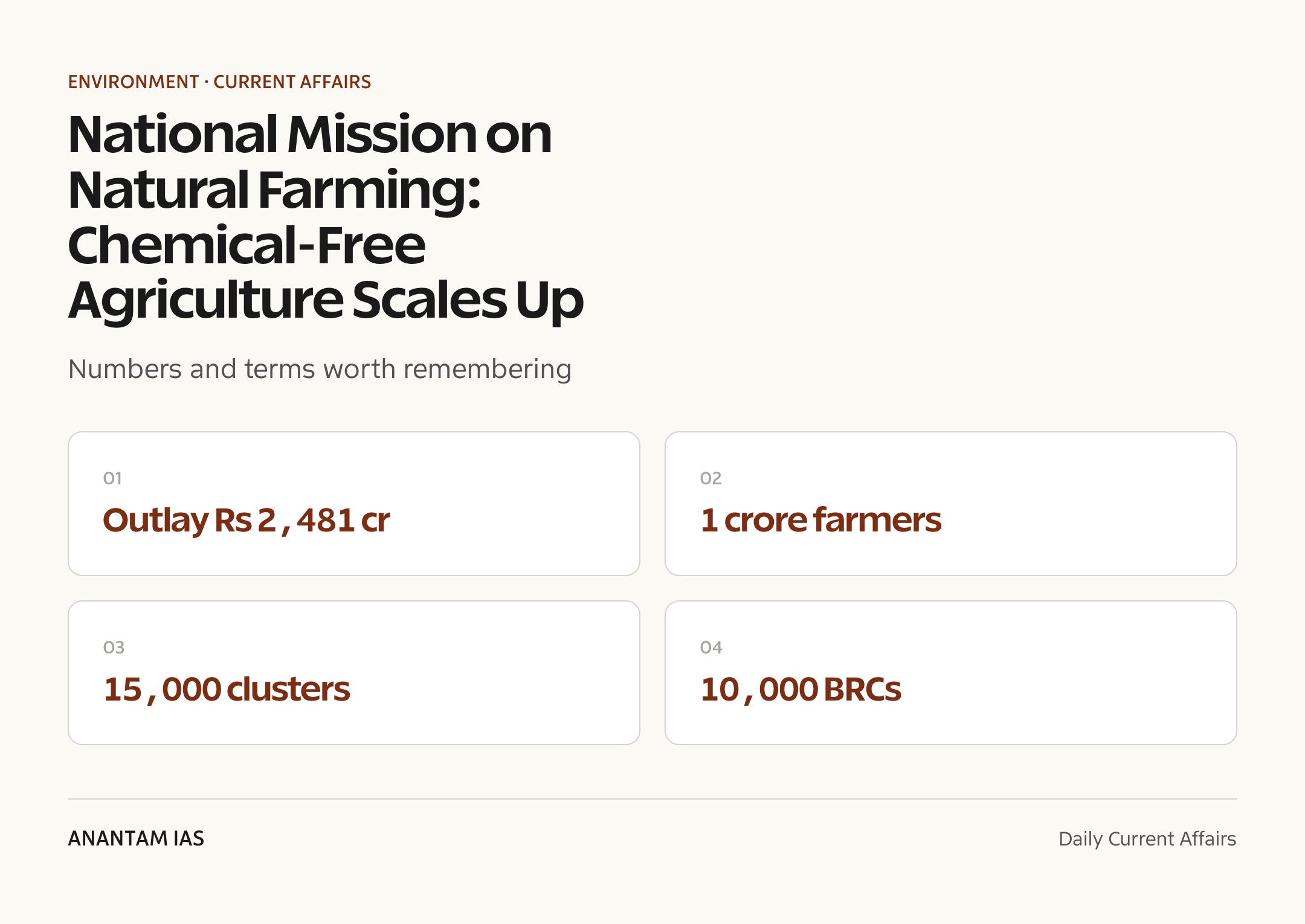
- Approved by the Union Cabinet with a total outlay of ₹2,481 crore (Centre ₹1,584 cr + States ₹897 cr) up to the 15th Finance Commission cycle.
- Targets 1 crore farmers across 15,000 clusters covering 7.5 lakh hectares over the mission period.
UPSC Relevance
Prelims Relevance
- NMNF is a standalone Centrally Sponsored Scheme (Nov 2024) under the Department of Agriculture & Farmers Welfare, Ministry of Agriculture & Farmers Welfare.
- Total outlay ₹2,481 crore; Centre share ₹1,584 cr, State share ₹897 cr.
- Targets: 1 crore farmers, 15,000 clusters, 7.5 lakh hectares.
- Last-mile delivery via 10,000 Bio-input Resource Centres (BRCs) and trained Krishi Sakhis.
- Branded inputs come under Bharatiya Prakritik Krishi (BPK); the scheme restructures the earlier BPKP run under PKVY.
- Natural farming relies on on-farm inputs like Jeevamrit and Beejamrit; it discourages synthetic chemical fertilisers and pesticides.
- Andhra Pradesh (APCNF) is widely cited as India’s largest community-managed natural-farming programme.
- ICAR and Krishi Vigyan Kendras (KVKs) provide research and demonstration backing.
- Natural farming differs from organic farming: it avoids off-farm purchased inputs and emphasises minimal external cost.
- Soil Health Cards and Krishi Sakhis (a convergence with DAY-NRLM women extension workers) support farmer guidance.
Mains Relevance
GS Paper 3
- Examine natural farming as a strategy for reducing input costs and improving farm-level resilience while sustaining yields and food security.
- Assess institutional design of NMNF — cluster approach, BRCs, Krishi Sakhis — and the challenges of scaling chemical-free agriculture nationally.
Essay
- Sustainability versus productivity: can chemical-free agriculture feed a growing nation without compromising food security?
Background and Context
What the National Mission on Natural Farming is
A dedicated mission to mainstream chemical-free, tradition-rooted farming.
- Launched in November 2024 as a standalone Centrally Sponsored Scheme under the Department of Agriculture & Farmers Welfare.
- Promotes natural farming — agriculture using locally available, mostly cow-based and plant-based inputs, with little or no synthetic fertiliser or pesticide.
- Inputs are branded Bharatiya Prakritik Krishi, drawing on indigenous preparations such as Jeevamrit (microbial culture) and Beejamrit (seed treatment).
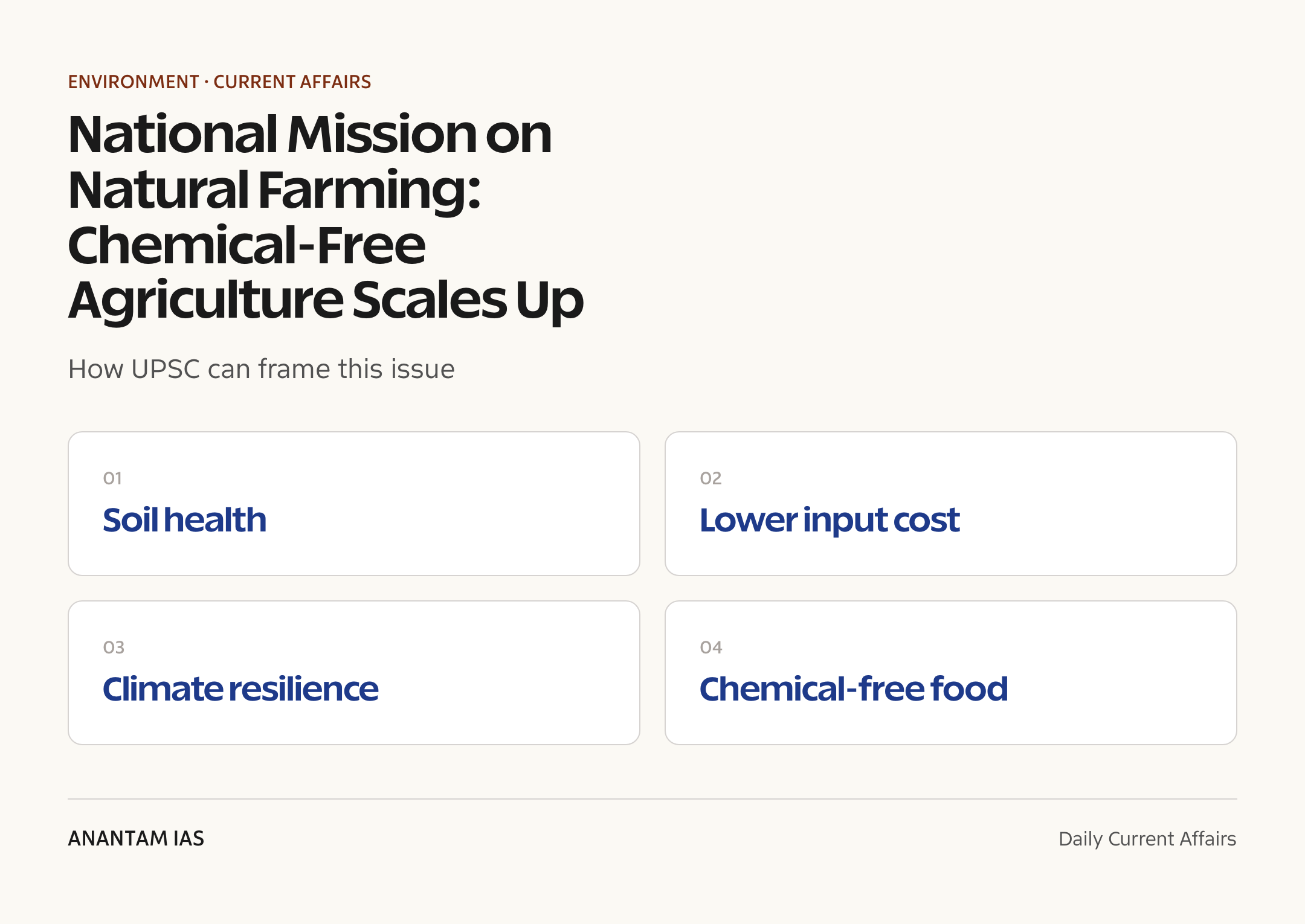
- Core goals: lower input costs, restore soil health, cut chemical residue in food, and build climate resilience.
Outlay, targets and architecture
A cluster-based mission with a defined budget and reach.
- Total outlay ₹2,481 crore up to the 15th Finance Commission period — Centre ₹1,584 crore, States ₹897 crore.
- Targets 1 crore farmers across 15,000 clusters, covering about 7.5 lakh hectares.
- Plans roughly 10,000 Bio-input Resource Centres (BRCs) for easy, local access to natural-farming inputs.
- Deploys trained Krishi Sakhis and Community Resource Persons for farmer hand-holding and last-mile extension.
Rollout so far
Early-stage scaling is visible on the Mission’s tracking portal.
- Over 21 lakh farmers enrolled and nearly 20,000 clusters activated, per the official NMNF dashboard.
- Thousands of BRCs already set up, alongside tens of thousands of Community Resource Persons.
- Supporting infrastructure includes Natural Farming Centres, training institutions and master trainers for capacity building.
- A digital layer — Krishi Mapper field registration and Soil Health Cards — tracks plots and monitors soil parameters.
From BPKP and PKVY to a standalone mission
NMNF consolidates scattered natural-farming efforts into one programme.
- Natural farming earlier ran as Bharatiya Prakritik Krishi Paddhati (BPKP), a sub-scheme of the Paramparagat Krishi Vikas Yojana (PKVY).
- BPKP supported cluster-based adoption but lacked a dedicated national mission structure and scale.
- NMNF gives natural farming its own budget line, institutional architecture and measurable targets.
- The term Zero Budget Natural Farming (ZBNF), associated with Subhash Palekar, popularised the input-cost-minimising philosophy that informs the approach.
Andhra Pradesh as the proof-of-concept
A state-led programme offers lessons for national scaling.
- Andhra Pradesh Community-Managed Natural Farming (APCNF) is widely cited as the largest agroecology programme of its kind.
- It works through women’s self-help groups and community institutions for peer-to-peer extension.
- APCNF demonstrates that cluster + community-resource-person models can reach lakhs of farmers.
- Its experience shapes NMNF’s reliance on Krishi Sakhis and local resource persons.
Why it matters for the economy and ecology
Natural farming links farm incomes with environmental goals.
- Cutting purchased chemical inputs can lower cultivation costs and reduce farmer debt exposure.
- Reduced fertiliser use eases pressure on India’s large fertiliser subsidy bill over time.
- Healthier soils improve water retention and carbon content, supporting climate-resilient agriculture.
- Chemical-free produce can open premium and export markets if certification and traceability mature.
Concerns and open questions
Scaling chemical-free farming is not without trade-offs.
- Yield transition risk: a possible dip during the shift from chemical to natural inputs worries farmers.
- Scientific evidence on yields is mixed, and large-scale, long-term trials are still limited.
- Input availability — quality bio-inputs and adequate BRCs — must keep pace with enrolment.
- Market linkage, premium pricing and credible certification remain weak links for adopters.
Way Forward
Strengthen evidence and research
- Commission long-term, multi-location ICAR/KVK trials comparing yields, costs and soil parameters.
- Publish transparent data so farmers can weigh transition risk against input savings.
Secure input and extension supply
- Accelerate quality-assured BRCs so bio-inputs are reliably available within each cluster.
- Train and incentivise Krishi Sakhis and resource persons for sustained farmer hand-holding.
Build markets and pricing
- Develop credible certification and traceability for natural-farming produce.
- Link clusters to premium, institutional and export buyers to reward adopters.
De-risk the transition
- Offer transition-period support or insurance to cushion any early yield dip.
- Converge with Soil Health Cards, FPOs and credit so adoption is financially viable.
Conclusion
The National Mission on Natural Farming marks India’s first dedicated, budgeted push to mainstream chemical-free agriculture at scale. With over 21 lakh farmers already enrolled, its cluster model, Bio-input Resource Centres and Krishi Sakhi network are being tested against the realities of input supply, market access and yield assurance.
Its long-term success will hinge on rigorous evidence, dependable bio-input availability and remunerative markets. If natural farming can pair lower input costs with stable yields and healthier soils, it offers a credible bridge between farm incomes and environmental sustainability — a central concern of India’s agricultural policy.
UPSC Practice Questions
Prelims MCQ 1
With reference to the National Mission on Natural Farming (NMNF), consider the following statements:
- It is a standalone Centrally Sponsored Scheme launched in 2024.
- It is implemented by the Department of Agriculture & Farmers Welfare.
- It restructured the earlier Bharatiya Prakritik Krishi Paddhati that ran under the Paramparagat Krishi Vikas Yojana.
How many of the above statements are correct?
(a) Only one (b) Only two (c) All three (d) None
Answer: (c) All three
Explanation:
NMNF (Nov 2024) is a standalone CSS under DA&FW that gives natural farming — earlier run as BPKP under PKVY — its own mission structure and budget.
Prelims MCQ 2
Which of the following best describes ‘Bio-input Resource Centres (BRCs)’ under NMNF?
(a) Centres that supply subsidised chemical fertilisers to farmer clusters (b) Local centres providing easy access to natural-farming bio-inputs (c) Research labs that issue genetically modified seeds (d) Cold-storage hubs for organic produce exports
Answer: (b) Local centres providing easy access to natural-farming bio-inputs
Explanation:
BRCs are last-mile centres (target ~10,000) that make natural-farming bio-inputs locally available to farmers in clusters.
UPSC Mains Questions
- Natural farming is increasingly presented as a pathway to sustainable and remunerative agriculture. Examine the rationale, design and challenges of the National Mission on Natural Farming. (GS Paper 3)
- Distinguish natural farming from organic farming and discuss whether chemical-free agriculture can be scaled nationally without compromising food security. (GS Paper 3)
Sources: Ministry of Agriculture & Farmers Welfare and The Tribune.
Frequently Asked Questions
What is the National Mission on Natural Farming (NMNF)?
NMNF is a standalone Centrally Sponsored Scheme launched in November 2024 under the Department of Agriculture & Farmers Welfare. It promotes chemical-free, tradition-rooted farming using local, mostly cow-based bio-inputs through farmer clusters, demonstration farms, Bio-input Resource Centres and Krishi Sakhis.
How much funding does NMNF have?
The mission has a total outlay of ₹2,481 crore up to the 15th Finance Commission period, with ₹1,584 crore from the Centre and ₹897 crore from the States. It targets about 1 crore farmers across 15,000 clusters covering roughly 7.5 lakh hectares.
How is natural farming different from organic farming?
Both avoid synthetic chemicals, but natural farming relies on on-farm, locally prepared inputs like Jeevamrit and Beejamrit and minimises purchased external inputs. Organic farming permits certified off-farm organic inputs. So natural farming emphasises very low external cost and self-reliance.
What are Bio-input Resource Centres and Krishi Sakhis?
Bio-input Resource Centres (BRCs) are local hubs — around 10,000 planned — that make natural-farming inputs easily available within clusters. Krishi Sakhis are trained women extension workers and community resource persons who guide farmers, demonstrate practices and provide last-mile hand-holding during the transition.
What is the relationship between NMNF, BPKP and PKVY?
Earlier, natural farming was supported as Bharatiya Prakritik Krishi Paddhati (BPKP), a sub-scheme of the Paramparagat Krishi Vikas Yojana (PKVY). NMNF restructures and elevates this effort into a dedicated standalone national mission with its own budget, targets and institutional architecture.
What are the main challenges to scaling natural farming?
Key challenges include the risk of a yield dip during transition, mixed long-term scientific evidence, ensuring reliable supply of quality bio-inputs and BRCs, and weak market linkages and certification. Addressing these through research, extension, de-risking support and premium markets is central to NMNF’s success.