National Quantum Mission: Over Half of Targets Met Within Three Years
Why in News?
Speaking at a media conclave on 26 June 2026, Union Minister of State (Independent Charge) for Science and Technology Dr. Jitendra Singh said the National Quantum Mission (NQM) has already achieved more than half of its targeted outcomes within three years of its launch in 2023, per a PIB release from the Ministry of Science and Technology.
The Minister flagged that several milestones were met ahead of schedule, with substantial progress in quantum-secure communication — a domain with direct applications in defence, strategic communications, cyber security and the protection of sensitive information — placing India alongside leading nations in frontier technology.
- NQM has crossed the 50% mark on its targeted outcomes within three years of a 2023 start, per Dr. Jitendra Singh (PIB).
- Headline gains are in quantum-secure communication, plus parallel advances in quantum computing and allied research.
- The Minister framed quantum, AI, space and nuclear as the technologies that will decide India’s future growth, national security and global competitiveness.
- PIB cites the pace as evidence India is now progressing alongside global leaders rather than playing catch-up.
The development matters in the context of:
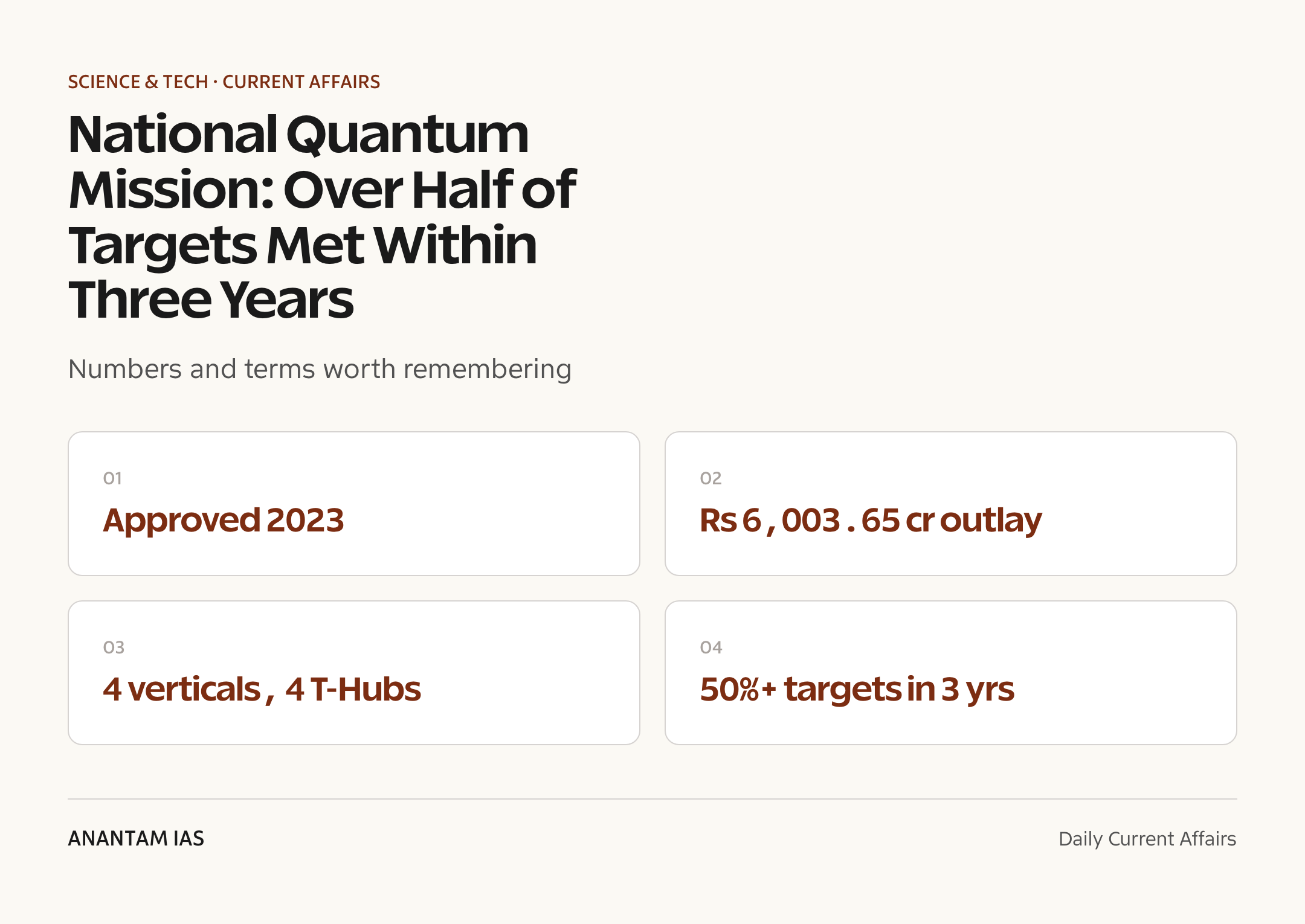
- NQM was approved on 19 April 2023 with an outlay of Rs 6,003.65 crore for 2023-24 to 2030-31, implemented by the Department of Science and Technology (DST).
- The Mission runs on four verticals delivered through four Thematic Hubs (T-Hubs) hosted at IISc and the IITs.
- This update is a progress checkpoint, distinct from the broader emerging-tech ecosystem narrative that also features the Mission.
UPSC Relevance
Prelims Relevance
- Launch: approved 19 April 2023; period 2023-24 to 2030-31.
- Outlay: Rs 6,003.65 crore; nodal department is DST, Ministry of Science and Technology.
- Four verticals: Quantum Computing, Quantum Communication, Quantum Sensing and Metrology, Quantum Materials and Devices.
- Four T-Hubs: IISc Bengaluru (Computing), IIT Madras with C-DOT (Communication), IIT Bombay (Sensing and Metrology), IIT Delhi (Materials and Devices).
- Computing target: intermediate-scale machines of 50-1000 physical qubits in 8 years (20-50 qubits in 3 years, 50-100 in 5 years).
- Communication target: satellite-based secure quantum communication over 2,000 km within India, plus long-distance inter-city quantum key distribution.
- Metrology target: high-precision atomic clocks for timing and navigation, and high-sensitivity magnetometers.
- Status (June 2026): more than half of targeted outcomes met within three years, per PIB.
Mains Relevance
GS Paper 3
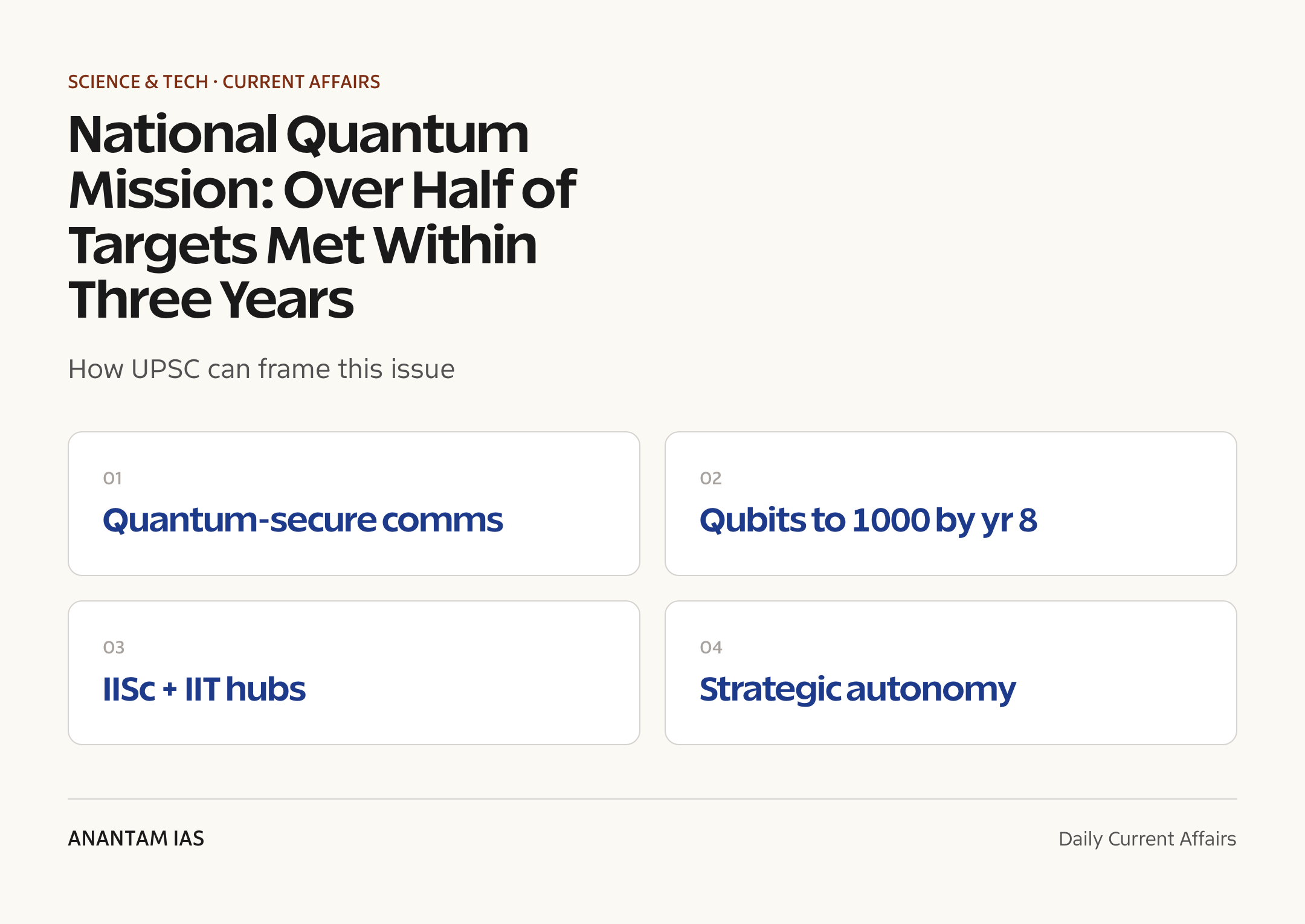
- Assess how the National Quantum Mission’s hub-and-vertical design accelerates indigenous capability in a dual-use frontier technology.
- Evaluate quantum-secure communication as a strategic asset for national security, defence and cyber resilience, and the gaps that remain.
Essay
- Frontier technologies and the new race for strategic autonomy.
- Science as the engine of national power: from import dependence to indigenous capability.
Background and Context
NQM design and the four verticals
A mission built to take India from quantum research to deployable systems.
- The National Quantum Mission was approved on 19 April 2023 at Rs 6,003.65 crore for the period 2023-24 to 2030-31, run by the Department of Science and Technology.
- It is organised around four verticals: Quantum Computing (machines built on qubits), Quantum Communication (tamper-evident key sharing), Quantum Sensing and Metrology (ultra-precise clocks and sensors) and Quantum Materials and Devices (the hardware substrate).
- A qubit (quantum bit) is the basic unit of quantum information; unlike a classical bit fixed at 0 or 1, it can hold a superposition of both, letting quantum computers explore many states at once and crack problems classical machines find intractable.
- Targets are staged: 20-50 physical qubits in 3 years, 50-100 in 5 years and 50-1,000 in 8 years, alongside 2,000 km secure satellite communication and precision atomic clocks.
- The mission also pursues high-sensitivity magnetometers and atomic clocks for navigation and timing, and the new materials and devices that make all of the above physically possible — a deliberately full-stack design rather than a single bet.
The three-year achievements
What the June 2026 milestone actually claims.
- Per PIB, NQM has met more than half of its targeted outcomes within three years of its 2023 launch — several milestones reached ahead of schedule.
- The standout area is quantum-secure communication, where progress feeds directly into defence, strategic communication, cyber security and the protection of sensitive data.
- Dr. Jitendra Singh placed quantum advances next to AI, space and nuclear as the cluster that will shape India’s economic and strategic future.
- PIB’s framing is comparative: India is described as advancing alongside global leaders in critical technology domains, not lagging them.
- The Minister linked the quantum push to a wider policy shift, with reforms in the space and nuclear sectors and the National Education Policy 2020 cited as foundations for a stronger research and innovation ecosystem.
Thematic Hubs and host institutions
Four hubs, one per vertical, anchored at premier institutions.
- Quantum Computing hub: the Foundation for QC Innovation at IISc Bengaluru.
- Quantum Communication hub: the IITM-CDOT Samgnya Technologies Foundation at IIT Madras, working with the Centre for Development of Telematics (C-DOT).
- Quantum Sensing and Metrology hub: the Qmet Tech Foundation at IIT Bombay.
- Quantum Materials and Devices hub: the QMD Foundation at IIT Delhi.
- The hubs run technology development, human-resource development, entrepreneurship and industry collaboration, and international partnerships — turning lab research into a domestic supply chain.
Why quantum-secure communication matters
The security payoff that makes quantum a strategic priority.
- Quantum Key Distribution (QKD) uses the laws of physics to share an encryption key so that any eavesdropping disturbs the signal and is detected — making intercepted traffic useless to an adversary.
- This is a hedge against the ‘harvest now, decrypt later’ risk, where encrypted data is stolen today to be broken once large quantum computers exist.
- NQM’s communication vertical targets satellite-based secure links over 2,000 km and long-distance inter-city QKD, with C-DOT giving the effort a telecom backbone.
- For defence, finance and critical infrastructure, sovereign quantum-secure channels reduce dependence on foreign cryptographic systems.
- Because the protection comes from physics rather than the difficulty of a maths problem, QKD-secured links stay safe even against a future adversary armed with a powerful quantum computer.
The global quantum race
India is one of a small group of states with a national quantum programme.
- Major economies — including the United States, China, the European Union, the United Kingdom and Japan — run large public quantum programmes, treating the field as strategically decisive.
- Dr. Jitendra Singh warned that countries falling behind in quantum, AI, space and nuclear risk falling behind in both development and security.
- The dual-use nature of quantum — civilian computing plus military-grade cryptography and sensing — drives heavy state funding worldwide.
- NQM positions India to set standards and build export-capable hardware rather than remain a technology importer.
Challenges that remain
Crossing the 50% mark is not the same as crossing the finish line.
- Scaling qubits from tens to the 50-1,000 range demands error correction and stable hardware that few labs anywhere have mastered.
- Talent is scarce — a deep pool of quantum physicists, engineers and cryogenics specialists takes years to build.
- Supply chains for specialised components (dilution refrigerators, photonic devices, control electronics) are still largely import-dependent.
- Translating hub research into deployed, standardised products needs sustained industry uptake and procurement demand beyond the mission’s grant window.
- The PIB statement reports the more-than-half figure as an aggregate claim by the Minister; granular target-by-target data, peer-reviewed results and independent benchmarks will matter for judging how durable the lead really is.
Way Forward
Hold the qubit roadmap
- Keep the staged targets honest — demonstrate working intermediate-scale machines with verifiable qubit counts, not just prototypes, before the 5- and 8-year gates.
- Invest early in quantum error correction, the hard problem that decides whether qubit counts translate into usable computing.
Build the talent pipeline
- Scale quantum curricula, fellowships and industry internships through the T-Hubs to widen the specialist base.
- Use international collaborations to bring back expertise while protecting strategic know-how.
Anchor a domestic supply chain
- Incentivise local manufacture of cryogenics, photonics and control electronics to cut import dependence.
- Seed quantum startups around each hub so research converts into deployable, export-ready products.
Operationalise quantum-secure networks
- Pilot QKD on government, defence and banking networks with C-DOT to move from lab demos to live deployment.
- Develop and adopt post-quantum cryptography standards in parallel as a transition layer.
Conclusion
Crossing half its targets in three years gives the National Quantum Mission genuine momentum, and the early lead in quantum-secure communication is the most strategically valuable place to be ahead. The hub-and-vertical structure has given each domain an institutional home and a route from research to product.
The harder half lies ahead — scaling qubits, deepening the talent pool and localising a fragile supply chain. Whether India ends the decade as a quantum standard-setter or a fast follower depends on converting these milestones into deployed, sovereign systems rather than headline demonstrations.
UPSC Practice Questions
Prelims MCQ 1
With reference to the National Quantum Mission (NQM), consider the following statements:
- It is implemented by the Department of Science and Technology.
- It was approved in 2023 with an outlay exceeding Rs 6,000 crore for an eight-year period.
- Its four verticals include Quantum Computing, Quantum Communication, Quantum Sensing and Metrology, and Quantum Materials and Devices.
How many of the above statements are correct?
(a) Only one (b) Only two (c) All three (d) None
Answer: (c) All three
Explanation:
NQM is run by DST, was approved on 19 April 2023 at Rs 6,003.65 crore for 2023-24 to 2030-31 (eight years), and rests on the four verticals named. All three statements are correct.
Prelims MCQ 2
The Thematic Hub for Quantum Communication under the NQM is anchored at which institution, working alongside C-DOT?
(a) IISc Bengaluru (b) IIT Bombay (c) IIT Madras (d) IIT Delhi
Answer: (c) IIT Madras
Explanation:
The Quantum Communication T-Hub (IITM-CDOT Samgnya Technologies Foundation) is at IIT Madras with C-DOT. IISc Bengaluru leads Computing, IIT Bombay leads Sensing and Metrology, and IIT Delhi leads Materials and Devices.
UPSC Mains Questions
- The National Quantum Mission has met more than half its targets within three years. Examine its design and assess the challenges India must overcome to become a global quantum leader. (250 words)
- Quantum-secure communication is a strategic asset, not merely a scientific goal. Discuss in the context of India’s National Quantum Mission and national security. (150 words)
Sources: PIB, Ministry of Science & Technology and Department of Science & Technology.
Frequently Asked Questions
What is the National Quantum Mission’s recent milestone?
On 26 June 2026, Dr. Jitendra Singh announced that the NQM has met more than half of its targeted outcomes within three years of its 2023 launch, with several milestones reached ahead of schedule.
When was the NQM approved and what is its outlay?
It was approved on 19 April 2023 with an outlay of Rs 6,003.65 crore for the period 2023-24 to 2030-31, implemented by the Department of Science and Technology.
What are the four verticals of the NQM?
Quantum Computing, Quantum Communication, Quantum Sensing and Metrology, and Quantum Materials and Devices.
Where are the four Thematic Hubs located?
Quantum Computing at IISc Bengaluru, Quantum Communication at IIT Madras with C-DOT, Quantum Sensing and Metrology at IIT Bombay, and Quantum Materials and Devices at IIT Delhi.
What are the NQM’s qubit targets?
Intermediate-scale quantum computers of 20-50 physical qubits in 3 years, 50-100 in 5 years and 50-1,000 in 8 years.
Why does quantum-secure communication matter strategically?
It uses Quantum Key Distribution, where any eavesdropping disturbs the signal and is detected, protecting defence, financial and critical-infrastructure data against current and future attacks, including ‘harvest now, decrypt later’ threats.