National Security Strategies Conference and India’s Internal-Security Coordination
Why in News?
The ninth two-day National Security Strategies Conference began in New Delhi on August 24, bringing national and state security officials together to examine interconnected internal-security threats.
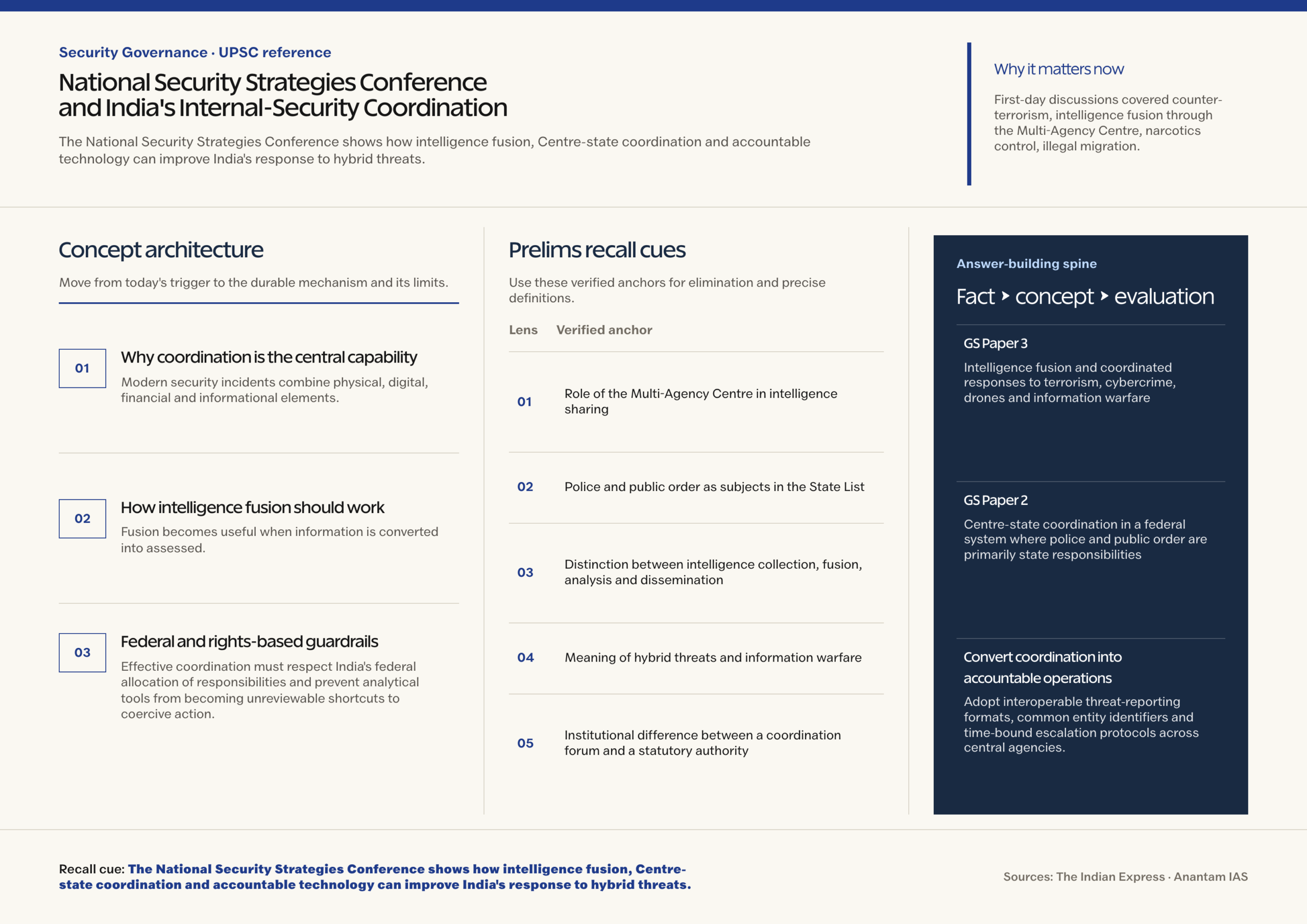
- First-day discussions covered counter-terrorism, intelligence fusion through the Multi-Agency Centre, narcotics control, illegal migration, cybercrime and cross-border proxy warfare.
- The conference called for AI-assisted analysis of information available on MAC platforms to help develop standard operating procedures for different security challenges.
- The second-day agenda included sub-aerial threats, protection of the blue economy, information warfare and a national bio-security framework.
- Held annually since 2021, the conference connects senior decision-makers with state police leaders, field-level officers and specialised domain experts.
- Hybrid threats cross territorial and departmental boundaries, while the information needed to detect them is often distributed across police units, intelligence agencies, regulators and infrastructure operators.
- A conference matters only when shared diagnosis becomes timely intelligence, clear ownership, interoperable procedures and measurable operational follow-up.
UPSC Relevance
Prelims Relevance
- Role of the Multi-Agency Centre in intelligence sharing
- Police and public order as subjects in the State List
- Distinction between intelligence collection, fusion, analysis and dissemination
- Meaning of hybrid threats and information warfare
- Institutional difference between a coordination forum and a statutory authority
Mains Relevance
GS Paper 3
- Intelligence fusion and coordinated responses to terrorism, cybercrime, drones and information warfare
- Technology-assisted threat analysis, operational interoperability and capacity gaps
GS Paper 2
- Centre-state coordination in a federal system where police and public order are primarily state responsibilities
- Accountability, due process and data safeguards in security governance
Essay
- National security depends as much on institutional trust and coordination as on the accumulation of coercive power.
Background and Context
Why coordination is the central capability
Modern security incidents combine physical, digital, financial and informational elements, so no single agency usually possesses the complete operational picture.
- A cyber intrusion may reveal financing, foreign direction or planned physical violence only when technical logs are connected with financial, criminal and human intelligence.
- Counter-terrorism, narcotics trafficking, illegal migration and proxy networks may share routes or facilitators, yet each is investigated under different mandates, laws and evidentiary requirements.
- Coordination creates a common threat picture: agencies compare fragments, remove duplication, identify gaps and decide which lead requires immediate collection or operational action.
- Field officers contribute local behaviour, language and network knowledge, while national agencies add cross-state patterns, strategic intelligence and access to specialised analytical capabilities.
- The conference is a coordination forum, not a substitute for statutory powers, lawful investigation or the established command responsibilities of participating institutions.
How intelligence fusion should work
Fusion becomes useful when information is converted into assessed, timely and appropriately shared intelligence rather than merely accumulated in a central database.
- The Multi-Agency Centre provides a platform for intelligence exchange; its value depends on prompt contributions, common identifiers and access rules suited to operational need.
- Analysts must evaluate source reliability, corroborate claims and distinguish facts from assessments before disseminating a lead, because unverified volume can create false confidence.
- AI can help cluster records, flag anomalies and connect recurring entities, but a human analyst must test context, alternative explanations and operational relevance.
- A standard operating procedure should define who validates an alert, which agency leads, how states are informed, what evidence is preserved and when escalation becomes necessary.
- The intelligence cycle needs feedback: recipients should report whether a lead proved accurate, which action followed and what additional collection would sharpen later assessments.
Federal and rights-based guardrails
Effective coordination must respect India’s federal allocation of responsibilities and prevent analytical tools from becoming unreviewable shortcuts to coercive action.
- Because police and public order are State List subjects, state forces remain central to local intelligence, investigation, public order management and courtroom evidence.
- Central bodies add value where threats cross state or national borders, but protocols should preserve clear jurisdiction, documented requests and accountable transfer of leads.
- AI-assisted analysis can reproduce biased inputs, generate false associations and obscure reasoning; consequential outputs require verification, audit trails, access controls and periodic error review.
- Investigations under security laws still require individualised evidence, lawful procedure and judicial scrutiny; attendance in a network or an automated match cannot establish criminal guilt.
- Success should be measured through faster validated alerts, reduced duplication, completed follow-up and better prosecutions, not by conference frequency, data volume or the number of agencies connected.
Way Forward
Convert coordination into accountable operations
- Adopt interoperable threat-reporting formats, common entity identifiers and time-bound escalation protocols across central agencies, state police and relevant infrastructure operators.
- Create joint analytical teams for complex threats while retaining a named lead agency, recorded decisions and an evidence-preservation plan for every operational referral.
- Audit AI-assisted outputs for false positives, discriminatory patterns and explainability, and prohibit adverse action based solely on an automated association.
- Use after-action reviews and state-level feedback to revise standard operating procedures, training priorities and information-sharing permissions after major incidents and exercises.
Conclusion
- India’s internal-security advantage will come from a disciplined cycle of collection, fusion, assessment, dissemination and feedback, not from centralising every decision or accumulating unfiltered information.
- A strong Mains answer should connect multi-agency coordination with federal clarity, field capacity, interoperable procedures, human-reviewed technology, evidentiary discipline and judicially enforceable safeguards.
UPSC Practice Questions
Prelims MCQ 1
With reference to internal-security coordination in India, consider the following statements:
- Police and public order are subjects in the State List.
- The Multi-Agency Centre facilitates intelligence sharing among agencies.
- The National Security Strategies Conference is a constitutional authority that can direct state police forces.
How many of the above statements are correct?
(a) Only one (b) Only two (c) All three (d) None
Answer: (b) Only two
Explanation:
Statements 1 and 2 are correct. The conference is a coordination forum, not a constitutional authority with command power over state police.
Prelims MCQ 2
Which one best describes intelligence fusion?
(a) Collecting the largest possible quantity of unfiltered data (b) Replacing field intelligence with automated predictions (c) Integrating and assessing information from multiple sources into actionable intelligence (d) Transferring all state police powers to a central agency
Answer: (c) Integrating and assessing information from multiple sources into actionable intelligence
Explanation:
Fusion combines, corroborates and assesses information from different sources so that decision-makers receive a usable threat picture rather than disconnected raw inputs.
UPSC Mains Questions
- Intelligence sharing is not merely a technological problem but an institutional coordination challenge. Discuss with reference to India’s internal-security architecture.
- How can India use AI-assisted security analysis while preserving federal accountability, evidentiary reliability and civil liberties?
Source: The Indian Express.
Frequently Asked Questions
What is the National Security Strategies Conference?
It is an annual coordination forum that brings central and state security officials, field officers and experts together to discuss major national-security challenges and possible operational responses.
What is the Multi-Agency Centre?
The Multi-Agency Centre is an intelligence-sharing and coordination platform that enables participating agencies to exchange inputs, connect threat information and support timely operational assessment.
Why are states essential to internal-security coordination?
Police and public order are State List subjects. State forces provide local intelligence, conduct much of the investigation and convert shared national inputs into lawful ground-level action.
How can AI support security analysis?
AI can cluster records, detect patterns and prioritise anomalies, but human analysts must verify context, document reasoning and prevent automated associations from becoming unsupported adverse action.
How should coordination success be measured?
Useful measures include timely validated alerts, reduced duplication, completed operational follow-up, improved evidence quality and lessons incorporated into revised procedures, rather than meetings or data volume alone.