NATO’s Ankara Summit: Defence Production and Allied Resilience
Why in News?
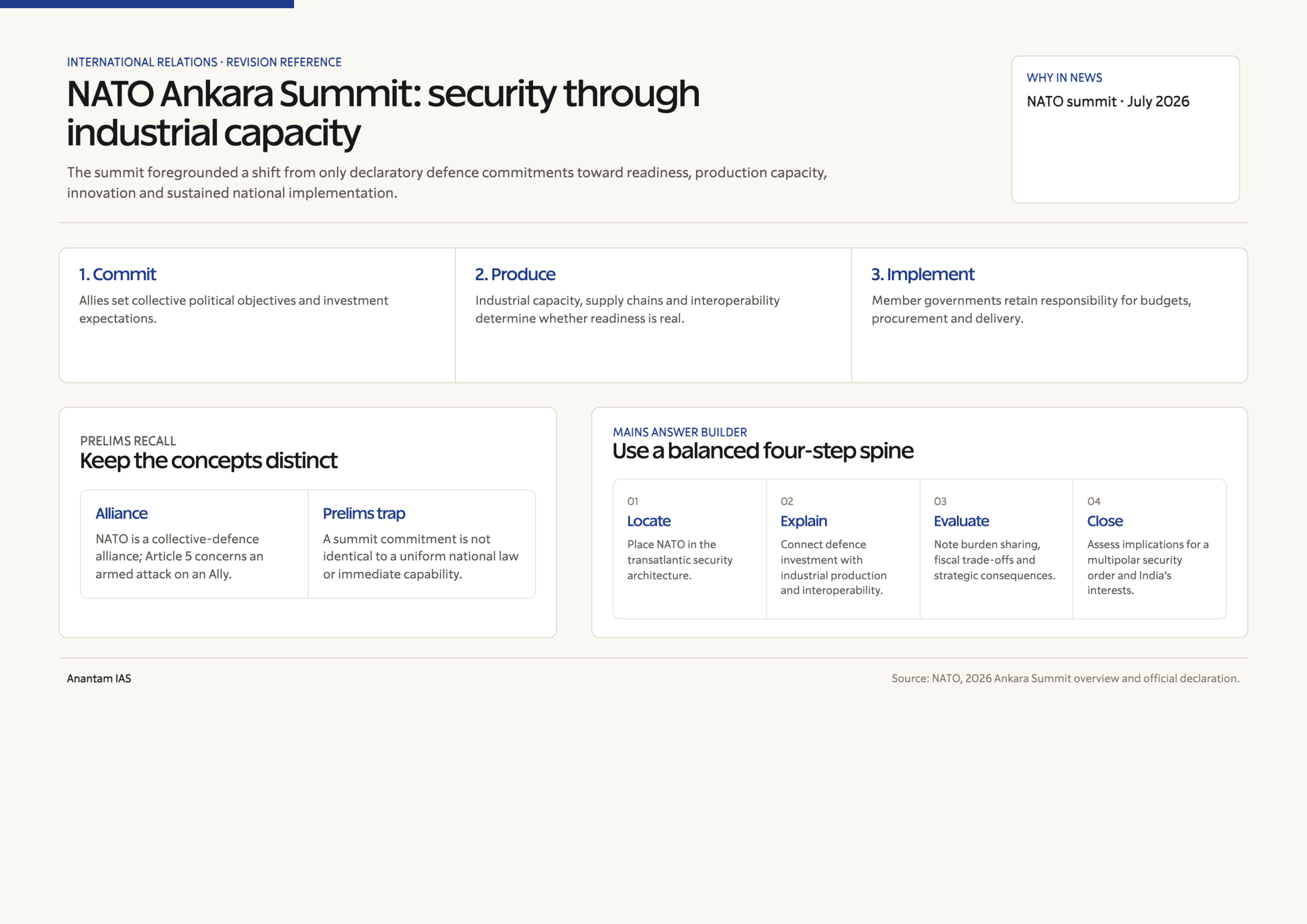
NATO’s 2026 Ankara Summit reviewed progress after the 2025 Hague summit and placed defence production, joint procurement, resilient fuel logistics and implementation of higher defence-investment commitments at the centre of allied security planning.
- NATO states that Allies reaffirmed their commitment to collective defence under Article 5 and to a 360-degree approach to deterrence and defence.
- According to NATO, European Allies and Canada had increased core defence investments by more than USD 139 billion since the 2025 commitment to reach 5% of GDP by 2035.
- The Ankara announcements included a EUR 27 billion investment to modernise fuel storage and distribution infrastructure, including facilities and pipelines extending to the Alliance’s eastern part.
- NATO says Allies pledged EUR 70 billion in military equipment, assistance and training for Ukraine in 2026, with a commitment to sustain at least an equivalent level in 2027.
- The NATO Summit Defence Industry Forum on 7 July 2026 focused on turning the 5% investment plan into increased production, cooperation and joint procurement.
- The development connects security studies with the defence-industrial base, critical-infrastructure resilience and the political economy of armaments.
- It offers a comparison point for India’s own pursuit of defence manufacturing, supply-chain resilience and strategic autonomy without treating NATO’s alliance model as directly transferable to India.
- It helps distinguish a treaty-based collective-defence alliance from looser security dialogues, ad hoc coalitions and international organisations with universal membership.
UPSC Relevance
Prelims Relevance
- NATO is the North Atlantic Treaty Organization, a collective-defence alliance founded on the 1949 Washington Treaty.
- Article 5 provides that an armed attack against one or more Allies is considered an attack against them all; the response is determined by each Ally in accordance with the treaty.
- NATO identifies three core tasks: deterrence and defence, crisis prevention and management, and cooperative security.
- The 2025 Hague declaration set a target for Allies to invest 5% of GDP annually by 2035 in core defence and defence- and security-related spending.
- Under that 2025 formulation, at least 3.5% of GDP is for core defence requirements, while up to 1.5% may be counted for resilience, critical infrastructure, networks, innovation and the defence-industrial base.
- The 2025 plan calls for annual national plans and a review of its trajectory and balance in 2029.
Mains Relevance
GS Paper 2
- Explain how alliances translate political commitments into credible deterrence through institutions, interoperability and burden-sharing.
- Assess the implications of a stronger Euro-Atlantic defence-industrial ecosystem for India’s security partnerships and strategic autonomy.
GS Paper 3
- Analyse defence production, resilient logistics and critical infrastructure as parts of national-security capacity.
- Discuss why procurement reform, technology partnerships and domestic industrial depth matter alongside headline defence expenditure.
Essay
- Security in an interdependent world rests as much on the capacity to sustain systems as on the capacity to deploy force.
Background and Context
NATO and the Meaning of Collective Defence
NATO is a treaty-based regional alliance, not a world government or a universal collective-security institution. Its central political commitment is that an armed attack against one Ally is.
- Article 5 of the Washington Treaty is NATO’s collective-defence clause. It creates an obligation to assist, but it does not prescribe one identical military response for every Ally.
- Deterrence aims to persuade a potential adversary that aggression will fail or impose unacceptable costs. It works through credible capabilities, readiness, communication and alliance cohesion.
- NATO’s stated 360-degree approach means that threats and vulnerabilities are assessed across directions and domains, rather than only through a single geographic front.
- The Alliance’s core tasks combine deterrence and defence, crisis prevention and management, and cooperative security. This wider agenda includes partnership, resilience and interoperability as well as conventional military capability.
- For an Indian answer, NATO should be described accurately as a regional alliance. India is not a NATO Ally, and its strategic-autonomy doctrine differs from membership in a collective-defence bloc.
From a Spending Target to Usable Capability
A spending promise is an input. Its security value depends on whether money is converted into deployable, interoperable and sustainable capability.
- The 2025 Hague declaration committed Allies to invest 5% of GDP annually by 2035 in core defence requirements and defence- and security-related spending. It also required annual national plans showing a credible incremental path.
- The declaration distinguishes at least 3.5% of GDP for core defence requirements from up to 1.5% for critical infrastructure, networks, civil preparedness, resilience, innovation and the defence-industrial base.
- This distinction matters because ammunition production, secure communications, ports, railways, energy networks and repair capacity can determine whether forces can move and endure during a crisis.
- The planned 2029 review recognises that targets need reassessment against the strategic environment and capability requirements. A target is not self-executing merely because leaders announce it.
- Fiscal pressure, procurement delays, shortages of skilled labour, competing domestic priorities and fragmented standards can all slow the conversion of expenditure into operational readiness.
Why the Defence-Industrial Base Matters
The defence-industrial base comprises the public and private capacity to design, manufacture, maintain, repair and replenish military equipment and enabling systems.
- The Ankara Defence Industry Forum focused on increased production, cooperation and joint procurement. Joint demand can help producers plan capacity, standardise equipment and reduce duplication, though it also requires agreement on specifications and sharing of industrial.
- Industrial deterrence is the ability to replace stocks, repair systems and scale output in time. It becomes especially important when a conflict is prolonged and consumes munitions, spare parts, fuel and electronic components faster than peacetime.
- Innovation is relevant when it improves reliable production, secure software, sensing, communications, air defence, cyber resilience or maintenance. It should not be reduced to a slogan about new technology.
- Private investment may be necessary for expansion, but governments still shape the market through procurement certainty, export controls, standards, security clearances and long-term demand signals.
- For India, the comparable policy questions are domestic design capability, quality assurance, test infrastructure, supply chains, maintenance ecosystems and technology partnerships, not replication of NATO’s institutional structure.
Resilient Logistics and Fuel Security
Military capability cannot be separated from the civilian systems that supply energy, transport equipment and keep networks functioning.
- NATO’s announced EUR 27 billion fuel investment covers modernised storage and distribution infrastructure and new facilities, including pipelines extending to the Alliance’s eastern part.
- Fuel logistics illustrate a basic security principle: a platform may be technically advanced but cannot operate without predictable access to fuel, spares, transport routes and protected storage.
- Resilience involves redundancy, dispersed storage, repair capacity, cyber protection, alternative routes and the ability to shift rapidly from peacetime logistics to crisis requirements.
- Critical infrastructure has dual-use value. Ports, rail corridors, pipelines, power systems, data networks and warehouses may serve civilian economic activity in normal times and become vital to defence mobility during emergencies.
- Large infrastructure announcements need careful evaluation. The relevant questions are implementation timelines, environmental safeguards, vulnerability to disruption, cost-sharing and whether systems are interoperable across jurisdictions.
Way Forward
Measure Delivery, Not Only Announcements
- Publish credible national investment paths, procurement schedules and capacity targets while protecting legitimate security-sensitive details.
- Track production lead times, stockpile availability, maintenance capacity, interoperability and logistics resilience instead of using expenditure alone as the measure of preparedness.
- Use the 2029 review to correct imbalances between core capability, civil resilience and industrial support.
Conclusion
- The Ankara summit underlines that deterrence in a prolonged period of insecurity is an industrial and logistical problem as well as a military one.
- In a UPSC answer, connect the summit to the distinction between collective defence and strategic autonomy, then show how finance, production, infrastructure and institutional follow-through shape real security capacity.
UPSC Practice Questions
Prelims MCQ 1
With reference to NATO’s 2025 Hague defence-investment commitment, consider the following statements:
- Allies committed to invest 5% of GDP annually by 2035 in core defence requirements and defence- and security-related spending.
- At least 3.5% of GDP was intended for core defence requirements.
- The trajectory and balance of the plan are to be reviewed in 2029.
How many of the above statements are correct?
(a) Only one (b) Only two (c) All three (d) None
Answer: (c) All three
Explanation:
The Hague declaration sets a 5% target by 2035, allocates at least 3.5% to core defence requirements, and provides for a 2029 review of the plan’s trajectory and balance.
Prelims MCQ 2
Which one of the following best explains why fuel storage, pipelines and transport corridors are relevant to deterrence?
(a) They replace the need for military personnel (b) They make all security commitments legally binding (c) They sustain the mobility and endurance of forces and can reduce logistical vulnerability (d) They convert a regional alliance into a universal international organisation
Answer: (c) They sustain the mobility and endurance of forces and can reduce logistical vulnerability
Explanation:
Military readiness depends on energy, transport, protected storage, repair and supply routes. Resilient logistics supports capability but does not replace personnel, law or diplomacy.
UPSC Mains Questions
- Deterrence is increasingly shaped by industrial capacity and logistics, not only by force levels. Discuss with reference to NATO’s Ankara Summit.
- Differentiate collective defence from collective security. How does the distinction help assess contemporary alliance commitments?
Sources: NATO, 2026 NATO Summit in Ankara and NATO, The Hague Summit Declaration.
Frequently Asked Questions
What was the focus of NATO’s Ankara Summit in 2026?
NATO’s Ankara summit reviewed progress after the 2025 Hague meeting and highlighted collective defence, higher investment, defence production, joint procurement and resilient logistics. NATO also linked these themes to support for Ukraine. The announcements describe Alliance priorities; delivery still relies.
What is NATO Article 5?
Article 5 is the collective-defence clause of the 1949 Washington Treaty. It treats an armed attack against one or more NATO Allies as an attack against all. Each Ally must assist, but the treaty does not dictate one uniform form.
What is NATO’s 5% defence-investment commitment?
At the 2025 Hague summit, Allies committed to invest 5% of GDP annually by 2035 in core defence requirements and defence- and security-related spending. At least 3.5% is directed to core defence requirements, while up to 1.5% can cover resilience.
Why does a defence-industrial base matter?
A defence-industrial base provides the ability to design, manufacture, maintain, repair and replenish equipment and enabling systems. In a long crisis, available stocks, production lead times, skilled workers, components, quality assurance and supply routes can be as consequential as the.
Why did NATO announce investment in fuel infrastructure?
NATO announced investment in modernised fuel storage and distribution, including pipelines and facilities in the Alliance’s eastern part. The purpose is logistical resilience: forces need dependable fuel, protected storage and transport networks to move and operate. Such infrastructure also needs.