NATO summit outcomes: ‘ironclad’ Article 5 pledge and €70 billion Ukraine aid
Why in News?
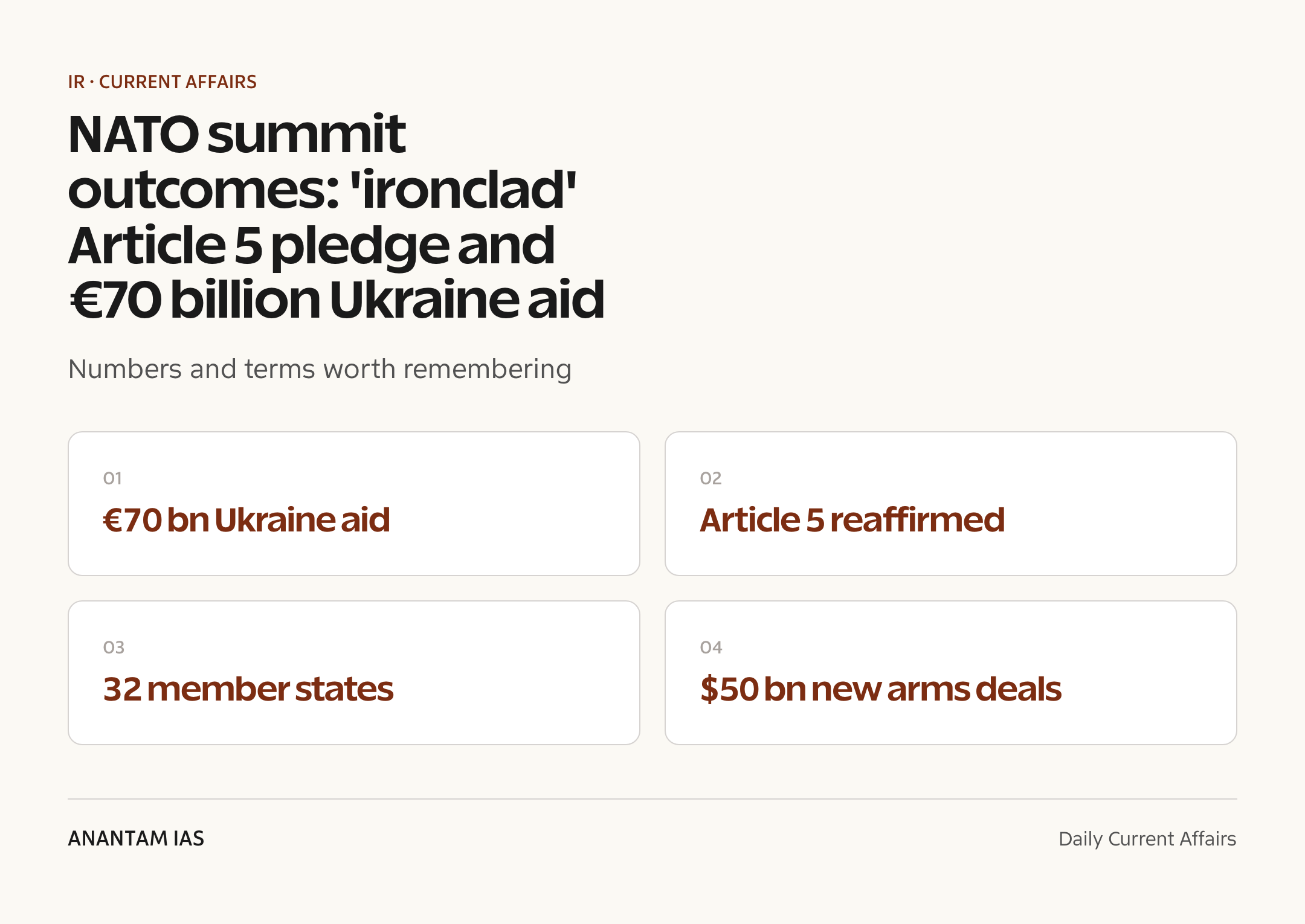
The 32-member North Atlantic Treaty Organization (NATO) concluded its annual summit in Ankara, Türkiye, on July 8, 2026, with a declaration reaffirming the allies’ “ironclad commitment” to collective defence under Article 5 of the Washington Treaty — “an attack on one is an attack on all”.
The Ankara Summit Declaration pledged €70 billion (about $80 billion) in military equipment, assistance and training for Ukraine in 2026, with at least equivalent levels affirmed for 2027, and announced more than $50 billion in new defence procurements. Russia denounced the outcome, warning of “catastrophic consequences”.
- Summit held on July 7–8, 2026 in Ankara under Secretary-General Mark Rutte, with all 32 heads of state and government attending.
- The declaration reaffirmed Article 5 in explicit language to calm doubts about the US commitment, after President Donald Trump publicly criticised allies over Greenland and their refusal to back his Iran campaign.
- The Hindu reported that behind closed doors Trump reassured leaders — “We want to remain with you” — and pledged to license Ukraine to manufacture Patriot air-defence missiles.
- European allies and Canada, who now finance the vast majority of security assistance to Ukraine, raised core defence investment by over $139 billion in 2025 under the Hague defence commitment (5% of GDP by 2035).
- Russian Foreign Ministry spokesperson Maria Zakharova called the decisions “irresponsible”, accusing NATO of the “militarisation of the European continent”.
The development matters in the context of:
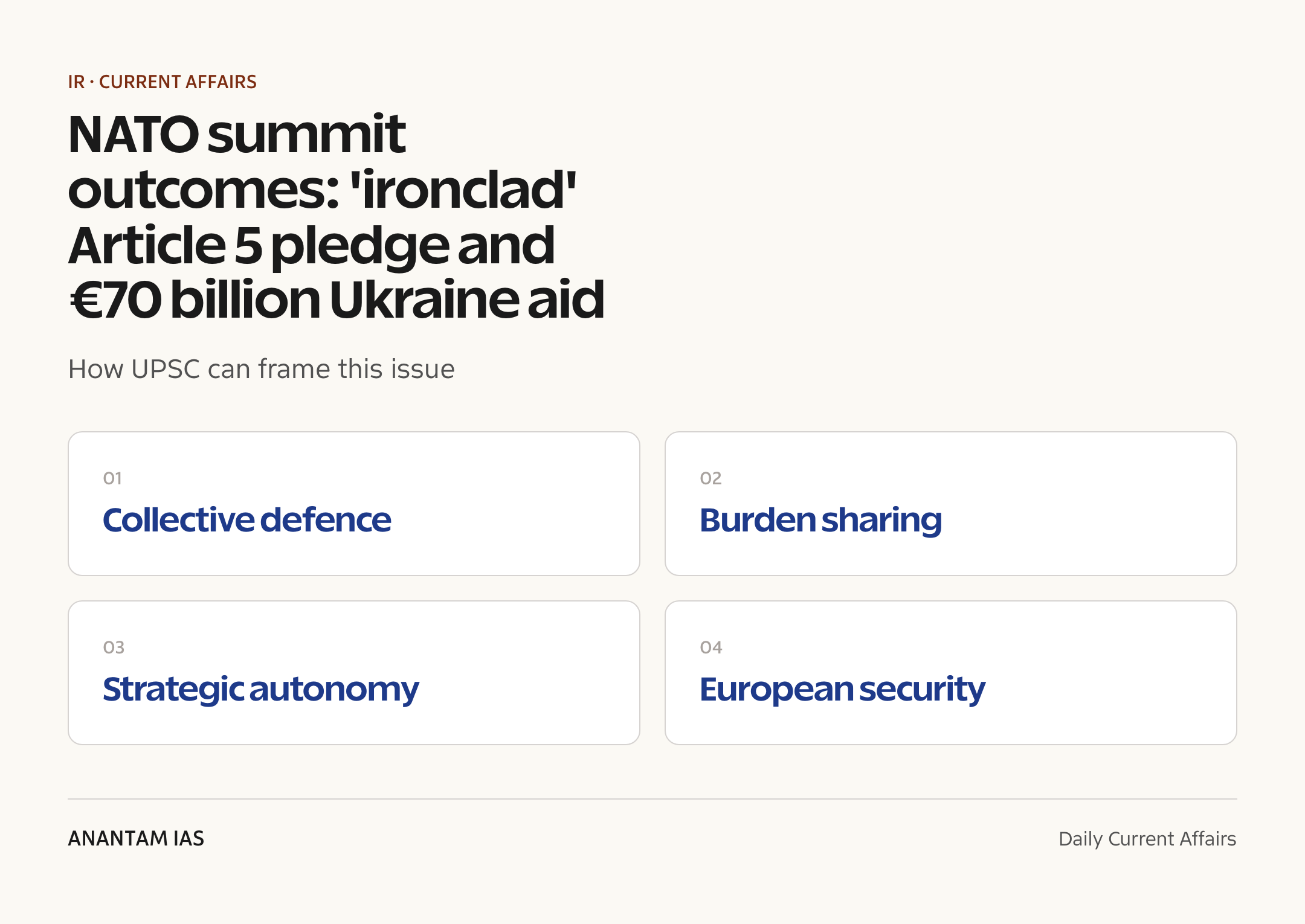
- The summit tests whether the transatlantic alliance, now 77 years old, can hold together as Washington pushes Europe to shoulder its own defence burden.
- For India, the outcome shapes the European security architecture within which it balances ties with the US, Europe and Russia — a live test of strategic autonomy.
- A Europe that arms itself at 5% of GDP changes global defence-industrial supply chains, energy politics and the wider Russia-Ukraine war trajectory that affects Indian trade and diaspora interests.
UPSC Relevance
Prelims Relevance
- NATO: founded April 4, 1949 by the Washington Treaty (North Atlantic Treaty); headquarters at Brussels, Belgium; currently 32 members.
- Article 5 — collective defence clause: an armed attack on one member is treated as an attack on all; invoked only once, by the US after the 9/11 attacks (2001).
- Article 4 provides for consultations when any member’s territorial integrity, political independence or security is threatened.
- Newest members: Finland (2023, 31st) and Sweden (2024, 32nd) — both abandoned decades of neutrality after Russia’s 2022 invasion of Ukraine.
- Hague Summit 2025 commitment: defence spending of 5% of GDP by 2035 (3.5% core defence + 1.5% defence-related resilience spending).
- Ankara Summit Declaration 2026: €70 billion Ukraine military aid for 2026; $50 billion+ new procurements; “360-degree” deterrence posture.
- NATO-Ukraine Council — created at the Vilnius Summit 2023; Ukraine is a partner, NOT a member of NATO.
- Secretary-General: Mark Rutte (former Dutch PM, took office October 2024); India is NOT a NATO member or formal partner.
Mains Relevance
GS Paper 2
- Groupings and agreements involving and/or affecting India’s interests — NATO’s burden-shift to Europe and what a militarised Europe means for India’s multi-alignment.
- Effect of the policies of developed countries on India’s interests — US transactional diplomacy (Greenland, trade threats to Spain) and the reliability of alliance guarantees vs India’s strategic autonomy.
- Bilateral and global groupings: contrast NATO’s collective defence (Article 5) with India’s issue-based coalitions (Quad, BRICS, SCO) that carry no mutual-defence obligation.
GS Paper 3
- Security implications: NATO’s push into deep precision strike, integrated air and missile defence, uncrewed systems and an AI-enabled “warfighting cloud” — signals for India’s own defence modernisation.
- Defence economics: the 5% of GDP benchmark vs India’s roughly 2% — trade-offs between guns, growth and welfare.
Essay
- Alliances promise security but can outsource sovereignty — the price of collective defence.
- Strategic autonomy in a world re-dividing into blocs: is non-alignment a luxury or a necessity?
- War in one theatre, insecurity in all: the indivisibility of security in a connected world.
Background and Context
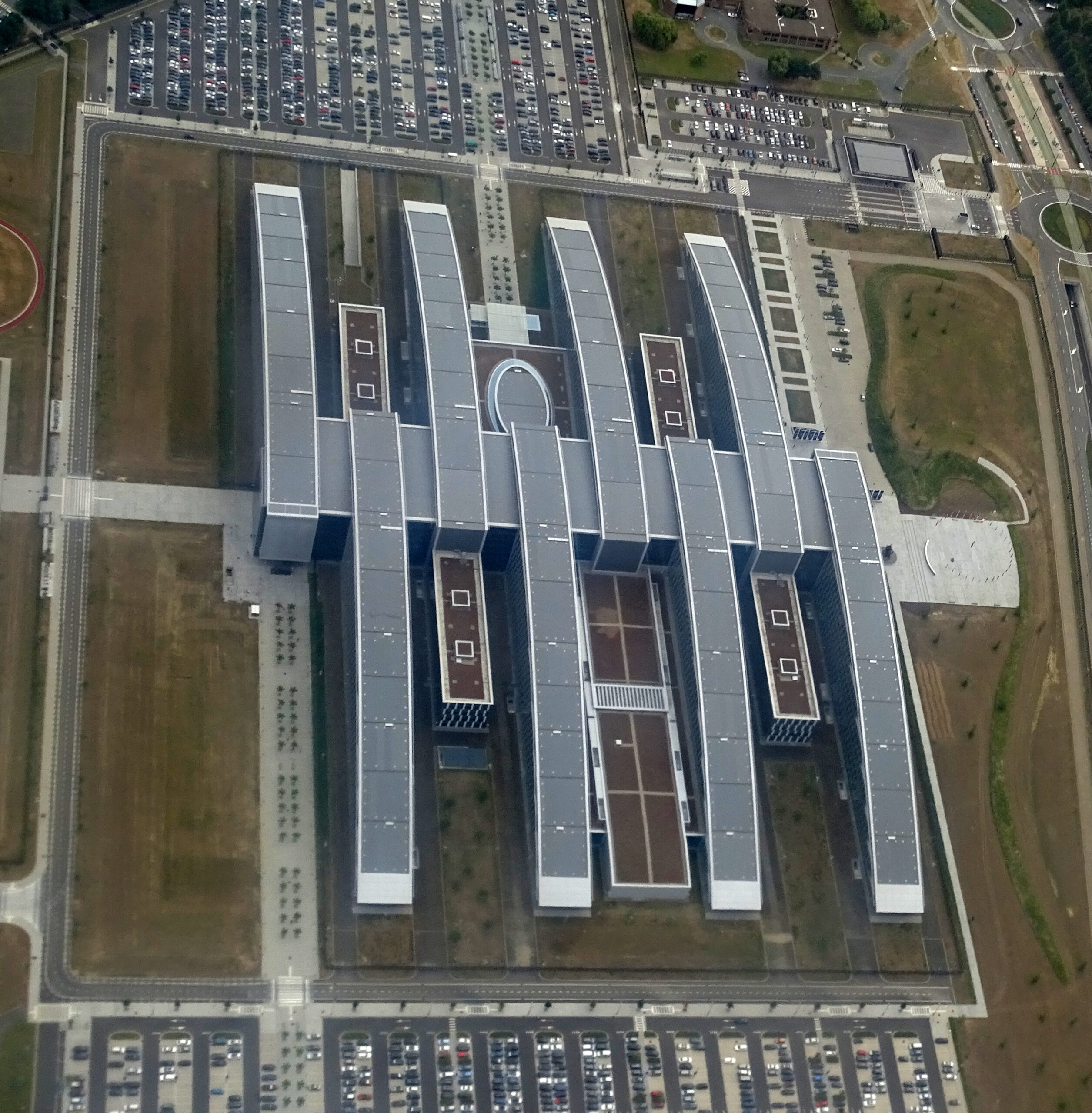
NATO in brief: the world's largest military alliance
Anchor the news to the institution — NATO’s design explains why every word of the Ankara declaration was scrutinised.
- NATO was created on April 4, 1949 by 12 founding states through the Washington Treaty, as a collective-defence bulwark against the Soviet Union; its headquarters is in Brussels, Belgium.
- Article 5 is the alliance’s core: an armed attack against one member in Europe or North America “shall be considered an attack against them all”. It has been invoked only once — after the September 11, 2001 attacks on the US.
- Membership has grown from 12 to 32 states; Finland (2023) and Sweden (2024) joined after Russia’s full-scale invasion of Ukraine — the very expansion Moscow said it fought to prevent.
- The alliance describes itself as protecting about one billion citizens and follows a “360-degree” approach — deterring threats from state actors (chiefly Russia) and terrorism across land, sea, air, cyber and space.
- Decisions are taken by consensus in the North Atlantic Council, which is why a single sceptical leader — as Trump’s conduct showed — can dominate an entire summit.
What the Ankara Summit Declaration says
The July 8 declaration packs four headline commitments into a deliberately short text.
- Article 5 reaffirmed: an “ironclad commitment” to collective defence and the transatlantic bond — wording chosen to end speculation that Washington might dilute its security guarantee.
- Ukraine aid: allies pledged €70 billion in military equipment, assistance and training for Ukraine in 2026, and affirmed “at least equivalent levels” for 2027; the EU’s multi-year Ukraine Support Loan was welcomed.
- Defence industry: more than $50 billion in new procurements announced at Ankara, plus commitments to expand collective manufacturing capacity and cut defence-trade barriers among allies.
- Capability priorities: deep precision strike, integrated air and missile defence, uncrewed systems, an interoperable transatlantic “warfighting cloud” and adoption of powerful AI models.
- On West Asia, the declaration said Iran must never acquire a nuclear weapon and must respect freedom of navigation in the Strait of Hormuz.
The burden shift: Europe pays, America watches
The deeper story of Ankara is a structural rebalancing of who funds European security.
- European allies and Canada now finance the vast majority of security assistance to Ukraine — a reversal from 2022–24, when the US was the largest single donor.
- Under the Hague Summit 2025 commitment, members will raise defence spending to 5% of GDP by 2035 — split as 3.5% on core defence and 1.5% on defence-related resilience and infrastructure.
- Delivering on that pledge, European allies and Canada increased core defence investment by more than $139 billion in 2025 alone, and unveiled tens of billions in fresh arms contracts on the summit’s opening day.
- The Hindu reported Trump’s sideline pledge to give Ukraine a licence to manufacture Patriot missiles — shifting even high-end air-defence production towards the recipient, as Kyiv struggles against Russian ballistic-missile barrages.
- For comparison, India spends roughly 2% of GDP on defence; the NATO benchmark illustrates how sharply threat perception can reorder national budgets.
The Trump factor: friction inside the family
The summit swung between public antagonism and private reassurance within hours.
- Before the session, Trump attacked allies for refusing to back his military campaign against Iran, threatened to cut trade with Spain, and repeated his demand for Greenland, an autonomous territory of NATO member Denmark.
- Behind closed doors, The Hindu reported, he told the 32 leaders “We want to remain with you” and later declared there was “a lot of love in that room, a lot of unity”.
- Estonian PM Kristen Michal read the message as constructive — Europe must “step up, invest more in defence”; Lithuania’s foreign minister cautioned against reading the outbursts as alliance decay.
- Secretary-General Mark Rutte argued the open disputes displayed the alliance’s democratic strength — pointedly contrasting it with decision-making in Moscow.
- The episode underlines a durable exam theme: alliance guarantees are only as stable as the domestic politics of the guarantor.
Russia's response and the escalation question
Moscow framed the summit as proof that NATO is preparing for war with Russia.
- Foreign Ministry spokesperson Maria Zakharova said the decisions could bring “catastrophic consequences”, accusing NATO of “militarisation of the European continent” and preparation for armed conflict with Russia.
- She highlighted “cracks” between the US and its partners — over Greenland and the allies’ refusal to back the US on Iran — arguing the transatlantic rift persists beneath the summit unity.
- On the battlefield, Ukraine has stabilised the front line and is striking deep into Russia; Trump called the strikes “an escalation that can help lead to an end”, claiming both Zelenskyy and Putin want a deal.
- Ukraine remains outside NATO — it engages through the NATO-Ukraine Council (created at Vilnius, 2023) — so aid flows as national and EU commitments, not Article 5 protection.
Why it matters for India
India is not a NATO member, but the alliance’s trajectory directly touches Indian interests.
- Strategic autonomy: India buys arms from Russia, the US, France and Israel while joining no military bloc; a hardening Europe-Russia divide narrows the space for such multi-alignment.
- Defence supply chains: European rearmament at 5% of GDP will crowd global order books for ammunition, air defence and drones — affecting prices and delivery timelines for Indian procurement and openings for Indian defence exports.
- Russia dependence: the longer the war and sanctions persist, the greater the pressure on India’s discounted Russian crude imports and rupee-rouble payment channels.
- Precedent debates: NATO’s Indo-Pacific outreach (partnerships with Japan, South Korea, Australia, New Zealand) raises the recurring question of whether Asian security should be alliance-based; India has consistently preferred issue-based coalitions like the Quad.
- India-NATO contact has been limited to occasional political dialogue (first held in Brussels in 2019) — New Delhi keeps engagement deliberately low-key to preserve ties with Moscow.
Way Forward
For the alliance
- Convert the €70 billion pledge into predictable multi-year disbursal — the declaration itself demands aid that is “equitable, predictable, and sustainable”.
- Pair rearmament with a credible diplomatic track on Ukraine so that deterrence doesn’t foreclose a negotiated settlement.
- Manage intra-alliance disputes — Greenland, trade threats, Iran policy — through NATO’s consultation mechanisms (Article 4) rather than public ultimatums.
For India
- Track the European rearmament market as an opportunity for defence exports (ammunition, components, shipbuilding) under Make in India.
- Deepen diversification of military sourcing and energy supplies so that any Russia-West escalation doesn’t leave critical dependencies exposed.
- Keep advocating dialogue and diplomacy — the consistent Indian line that “this is not an era of war” — while avoiding entanglement in bloc politics.
Conclusion
The Ankara summit delivered what NATO needed most: an unambiguous restatement of Article 5 and hard money — €70 billion for Ukraine, $50 billion in new procurements — to back it. But the theatrics around it showed an alliance whose biggest member now treats commitment as leverage, and whose European members are rearming partly as insurance against their own ally.
For UPSC, the summit is a live case study in collective defence, burden-sharing and the remaking of the European security order — and a foil for India’s own doctrine of strategic autonomy. Revise it alongside the broader Russia-Ukraine timeline in our monthly current affairs compilations and the daily digests at Anantam IAS current affairs.
UPSC Practice Questions
Prelims MCQ 1
With reference to the NATO Ankara Summit (2026), consider the following statements:
- The summit declaration reaffirmed the collective-defence commitment under Article 5 of the Washington Treaty.
- NATO allies pledged €70 billion in military equipment, assistance and training for Ukraine for 2026.
- Ukraine was admitted as the 33rd member of NATO at the summit.
How many of the above statements are correct?
(a) Only one (b) Only two (c) All three (d) None
Answer: (b) Only two
Explanation:
Statements 1 and 2 are correct — the Ankara Summit Declaration reaffirmed the “ironclad commitment” to Article 5 and pledged €70 billion for Ukraine in 2026. Statement 3 is wrong: Ukraine remains a partner engaging through the NATO-Ukraine Council, not a member; NATO still has 32 members.
Prelims MCQ 2
Which of the following countries is the most recent state to join NATO?
(a) Finland (b) Sweden (c) North Macedonia (d) Montenegro
Answer: (b) Sweden
Explanation:
Sweden became NATO’s 32nd and newest member in 2024, a year after Finland (31st, 2023). Both ended long-standing military non-alignment after Russia’s 2022 invasion of Ukraine. North Macedonia joined in 2020 and Montenegro in 2017.
UPSC Mains Questions
- The 2026 NATO summit signals a structural shift of Europe’s defence burden from Washington to European capitals. Examine the implications of this rebalancing for the European security architecture and for India’s policy of strategic autonomy. (250 words)
- “Collective defence alliances provide security guarantees that issue-based coalitions cannot, but at the cost of strategic flexibility.” Discuss in the context of NATO’s response to the Russia-Ukraine war and India’s preference for multi-alignment. (250 words)
- European NATO members have committed to spending 5% of GDP on defence by 2035. Critically analyse what such large-scale rearmament means for global defence-industrial supply chains and for India’s defence procurement and export ambitions. (150 words)
Sources: NATO, Ankara Summit Declaration and The Hindu.
Frequently Asked Questions
What did the NATO Ankara Summit 2026 decide?
The July 8, 2026 declaration reaffirmed the “ironclad” Article 5 collective-defence commitment, pledged €70 billion in military aid to Ukraine for 2026 (with equivalent levels affirmed for 2027), announced over $50 billion in new defence procurements, and recommitted members to the Hague target of 5% of GDP on defence by 2035.
What is Article 5 of the NATO treaty?
Article 5 of the 1949 Washington Treaty is NATO’s collective-defence clause: an armed attack against one member in Europe or North America is treated as an attack against all, allowing each ally to respond, including with armed force. It has been invoked only once — after the 9/11 attacks in 2001.
Is Ukraine a member of NATO?
No. Ukraine is a partner, not a member. It engages the alliance through the NATO-Ukraine Council created at the 2023 Vilnius Summit. Aid to Kyiv flows as national and EU commitments — such as the €70 billion pledged for 2026 — not as an Article 5 guarantee.
How many members does NATO have now?
NATO has 32 members. Finland joined in 2023 as the 31st and Sweden in 2024 as the 32nd, both abandoning decades of military non-alignment after Russia’s full-scale invasion of Ukraine in February 2022. The alliance began with 12 founding states in 1949.
Why did Russia denounce the summit?
Russian Foreign Ministry spokesperson Maria Zakharova said the decisions could have “catastrophic consequences”, accusing NATO of militarising Europe and preparing for armed conflict with Russia. Moscow views continued Ukraine aid and NATO’s eastward expansion as direct threats to its security.
Is India a member or partner of NATO?
Neither. India has no formal relationship with NATO beyond occasional political dialogue, the first held in Brussels in 2019. India follows strategic autonomy — buying arms and building partnerships across blocs (US, Russia, France, Israel) without joining any military alliance or accepting mutual-defence obligations.