National Board for Wildlife: 91st Standing Committee weighs 100+ projects and conservation strategy
Why in News?
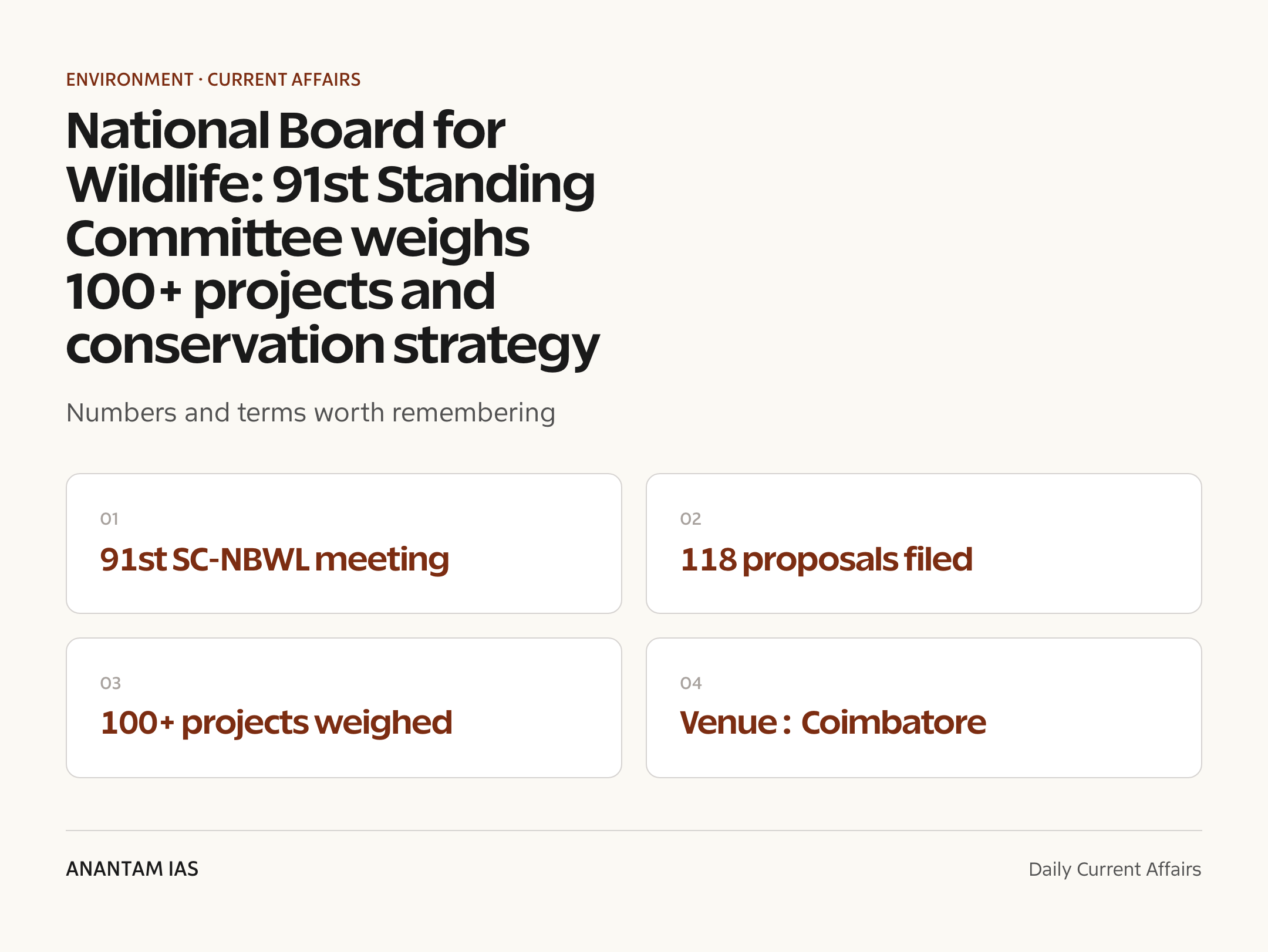
Union Minister for Environment, Forest and Climate Change Bhupender Yadav chaired the 91st Meeting of the Standing Committee of the National Board for Wildlife (SC-NBWL) on 9 July 2026 at the Central Academy for State Forest Service, Coimbatore. PIB confirmed the Committee took up more than 100 development proposals that need wildlife clearance and reviewed progress on directions from the 7th NBWL meeting chaired by the Prime Minister.
The SC-NBWL is the statutory forum where nearly every road, transmission line, pipeline or defence work planned inside a national park, wildlife sanctuary or eco-sensitive zone is appraised under the Wild Life (Protection) Act, 1972. So a single meeting like this effectively decides how India resolves the standing tension between infrastructure expansion and habitat protection.
Beyond clearances, the meeting doubled as a conservation-strategy session: it advanced long-term plans for the Greater One-horned Rhinoceros using the Rhino DNA Indexing System (RhoDIS), set the future course for the critically endangered Great Indian Bustard, and brought the Pygmy Hog under the Species Recovery Programme.
- State governments had forwarded 118 proposals relating to infrastructure and defence for appraisal.
- Projects spanned roads, bridges, defence infrastructure, power transmission lines, optical-fibre networks, pipelines, mining and renewable energy in and around wildlife habitats.
- The Committee released scientific publications on the Rhinoceros, Sloth Bear and Great Indian Bustard.
- It advanced strategy for the Greater One-horned Rhinoceros via the Rhino DNA Indexing System (RhoDIS) and included the Pygmy Hog under the Species Recovery Programme.
The development matters in the context of:
- The SC-NBWL is the key statutory gatekeeper balancing development clearances against habitat connectivity under the Wild Life (Protection) Act, 1972.
- Almost every road, transmission line or defence work inside a protected area or its eco-sensitive zone must clear this forum, making it central to India’s development-vs-conservation debate.
UPSC Relevance
Prelims Relevance
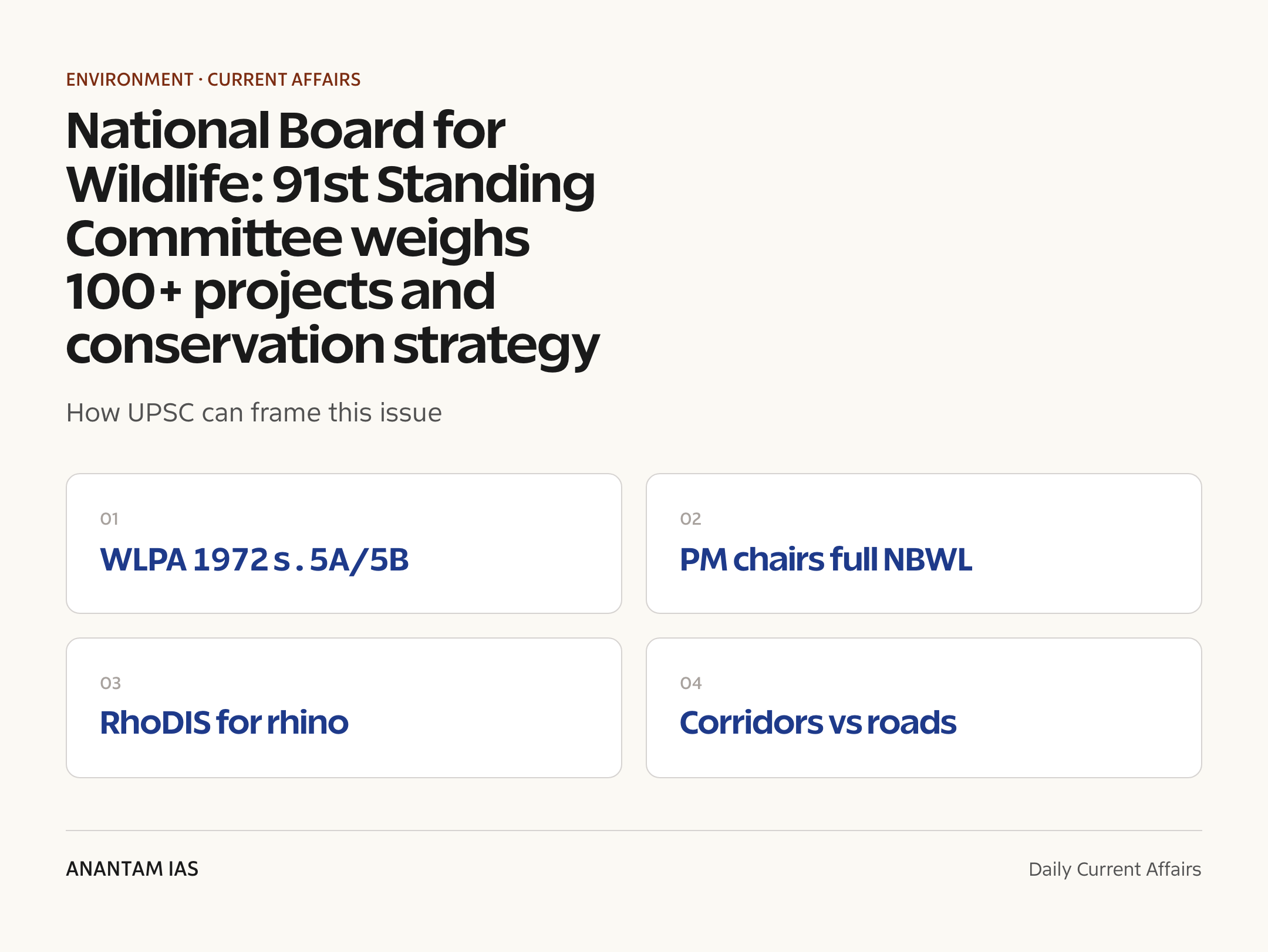
- National Board for Wildlife (NBWL) — statutory body under Section 5A of the Wild Life (Protection) Act, 1972.
- The NBWL is chaired by the Prime Minister; the Union Environment Minister is Vice-Chairperson.
- The Standing Committee (SC-NBWL) is constituted under Section 5B and chaired by the Environment Minister.
- NBWL is an advisory body; its clearance is mandatory for projects in protected areas.
- Rhino DNA Indexing System (RhoDIS) — DNA database for the Greater One-horned Rhinoceros.
- Great Indian Bustard — critically endangered, state bird of Rajasthan; Pygmy Hog — smallest wild pig, found in Assam.
- Eco-Sensitive Zones (ESZ) notified around protected areas as shock absorbers.
- Central Academy for State Forest Service, Coimbatore, hosted the 91st meeting.
Mains Relevance
GS Paper 3
- Institutional mechanisms for reconciling infrastructure development with wildlife conservation.
- Species-recovery programmes and science-based conservation (RhoDIS, Species Recovery Programme).
GS Paper 2
- Role of statutory advisory bodies and the Standing Committee in environmental governance and clearances.
Essay
- Development and ecology need not be adversaries — the case for science-led conservation.
Background and Context
What the National Board for Wildlife is
The NBWL is the apex statutory advisory body for wildlife in India.
- Constituted under Section 5A of the Wild Life (Protection) Act, 1972, which replaced the non-statutory Indian Board for Wildlife (set up in 1952) after the Act’s 2002 amendment.
- Chaired by the Prime Minister, with the Union Environment Minister as Vice-Chairperson; it has up to 47 members, including 5 NGOs, 10 eminent ecologists and conservationists, and several officials.
- Its mandate is to promote the conservation and development of wildlife and forests and to advise the government on policy for protection of wild animals, plants and their habitats.
- It has a key structural power: no de-notification or boundary change of a national park or sanctuary, and no diversion of protected-area land, can proceed without a recommendation of the NBWL.
- Its role was reinforced by the Supreme Court, which requires NBWL vetting for projects within protected areas and their notified eco-sensitive zones.
The Standing Committee's gatekeeper role
Day-to-day clearances flow through the Standing Committee, not the full Board.
- The Standing Committee (SC-NBWL) is constituted under Section 5B and chaired by the Union Environment Minister, with official and non-official members.
- Because the full NBWL meets rarely, the SC does the operational work — it appraises project proposals that fall inside national parks, wildlife sanctuaries, tiger reserves and eco-sensitive zones.
- Each proposal is tested on three counts: its ecological impact, its public-welfare or national-development importance, and the adequacy of mitigation measures to protect wildlife and habitat.
- The Committee can approve, reject, defer, or approve-with-conditions, and often attaches safeguards such as compensatory afforestation, corridor protection or wildlife-passage structures.
- It also monitors compliance and reviews progress on directions issued at earlier NBWL and SC meetings — at the 91st meeting it reviewed decisions of the 7th NBWL meeting chaired by the Prime Minister.
Projects considered at the 91st meeting
Over 100 proposals across the country were placed before the Committee.
- State governments had forwarded 118 proposals relating to infrastructure and defence; the SC considered more than 100 requiring clearance under the Wild Life (Protection) Act, 1972.
- Categories spanned roads and bridges, defence infrastructure, drinking-water supply, communication towers, power transmission lines, optical-fibre networks, pipelines, mining, renewable energy, educational institutions and other public works.
- Each proposal was appraised on the basis of its ecological cost, its importance for public welfare and national development, and the adequacy of mitigation to conserve wildlife and habitat.
- Minister Bhupender Yadav stressed that scientific planning, habitat connectivity and effective mitigation should guide decision-making on projects in and around wildlife habitats.
- The Committee reiterated that projects of national importance should proceed with appropriate safeguards that minimise adverse impacts, in line with the Act and other environmental laws.
Species-recovery strategy and RhoDIS
The meeting also set direction for several flagship species.
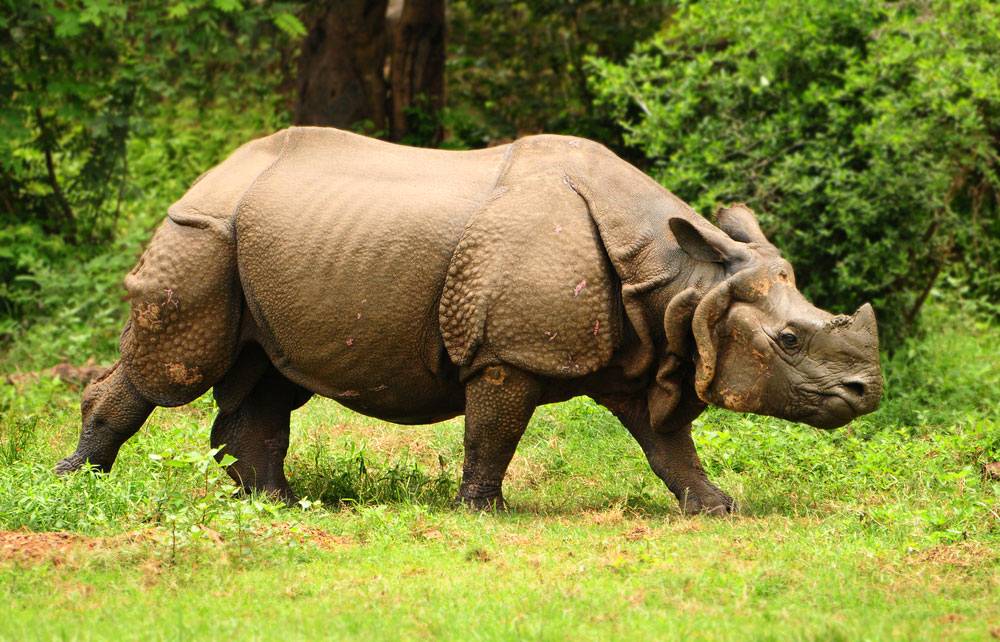
- It framed a long-term strategy for the Greater One-horned Rhinoceros built on the Rhino DNA Indexing System (RhoDIS) — a DNA database that fingerprints individual rhinos to aid anti-poaching forensics, population monitoring and forensic prosecution.
- India holds the bulk of the world’s Greater One-horned Rhinos, concentrated in Assam’s Kaziranga and other habitats, making a national DNA registry central to their protection.
- It settled a future conservation strategy for the critically endangered Great Indian Bustard (GIB), whose wild population has collapsed to roughly a few hundred, mainly in Rajasthan and Gujarat, threatened by power lines and habitat loss.
- It brought the Pygmy Hog — the world’s smallest wild pig, surviving in the grasslands of Assam — under the Species Recovery Programme.
- The Committee released scientific publications on the Rhinoceros, Sloth Bear and Great Indian Bustard to strengthen the evidence base for conservation.
Protected areas, eco-sensitive zones and the Species Recovery Programme
The durable framework behind the clearances is worth mapping.
- India’s protected-area network has over 100 national parks and 500-plus wildlife sanctuaries, plus 50-plus tiger reserves and conservation and community reserves under the Act.
- Eco-Sensitive Zones (ESZ) are notified around protected areas by the Environment Ministry as shock absorbers, regulating (not banning) activity to buffer the core habitat; the Supreme Court has repeatedly ruled on minimum ESZ widths.
- The Species Recovery Programme is a component of the centrally sponsored scheme Integrated Development of Wildlife Habitats (IDWH), funding focused recovery of critically endangered species.
- Its earlier list covered species such as the Snow Leopard, Hangul, Nilgiri Tahr, Asiatic Lion, Great Indian Bustard, Dugong and Gangetic Dolphin; the Pygmy Hog is the latest addition.
- The Act also underpins dedicated projects like Project Tiger and Project Elephant, and species schedules that grant graded legal protection.
The development-vs-conservation tension
The forum sits at the heart of a recurring policy clash.
- Conservationists argue that very high clearance approval rates risk turning the Committee into a formality rather than a genuine ecological filter.
- Linear infrastructure — roads, railways, transmission lines, canals — fragments habitat and severs wildlife corridors, raising human-wildlife conflict and roadkill.
- Defence and border-area works in eco-sensitive terrain (for example in the Himalayas and the Northeast) sharpen the trade-off between national security and habitat integrity.
- Minister Yadav pitched solution-based policy interventions that combine technological and sociological studies with traditional knowledge in wildlife conservation.
- The intended shift is from case-by-case approvals toward a science-based, connectivity-first model where mitigation and corridors are designed in, not bolted on.
Way Forward
Connectivity-first appraisal
- Make wildlife-corridor mapping and cumulative-impact assessment mandatory before clearing linear projects, so that fragmentation is judged across a landscape, not one project at a time.
- Treat mitigation infrastructure — animal underpasses, overpasses, eco-bridges and canal ramps — as a default design condition rather than an afterthought, with independent monitoring of whether animals actually use them.
Science and community in the loop
- Scale up DNA-based tools like RhoDIS and structured species-recovery plans across more threatened species, building on the Great Indian Bustard and Pygmy Hog decisions.
- Blend traditional ecological knowledge and sociological study with technology, as the Minister urged, and involve local and forest-dependent communities as partners in conservation.
Transparency and accountability
- Publish SC-NBWL agendas, minutes and conditions promptly to answer the criticism of routine, opaque approvals.
- Strengthen compliance auditing of clearance conditions and compensatory measures so that safeguards on paper translate into outcomes on the ground.
Conclusion
The 91st SC-NBWL meeting captured the permanent balancing act of India’s environmental governance — clearing the roads, power lines and defence works a growing economy demands, while defending increasingly shrinking and fragmented wildlife habitats.
By pairing more than 100 project appraisals with concrete species-recovery decisions for the rhino, Great Indian Bustard and Pygmy Hog, the Committee signalled that clearances and conservation are meant to move together, not in opposition.
Its credibility ultimately rests on treating mitigation and habitat connectivity as binding conditions rather than paperwork, and on letting science-based recovery — not project pressure — set the terms on which development enters India’s protected landscapes.
UPSC Practice Questions
Prelims MCQ 1
With reference to the National Board for Wildlife (NBWL), consider the following statements:
- It is a statutory body constituted under the Wild Life (Protection) Act, 1972.
- It is chaired by the Union Minister for Environment, Forest and Climate Change.
- Its Standing Committee appraises projects seeking clearance in protected areas.
How many of the above statements are correct?
(a) Only one (b) Only two (c) All three (d) None
Answer: (b) Only two
Explanation:
Statements 1 and 3 are correct. The full NBWL is chaired by the Prime Minister, not the Environment Minister (who chairs the Standing Committee), so statement 2 is wrong.
Prelims MCQ 2
The ‘Rhino DNA Indexing System (RhoDIS)’ discussed at the 91st SC-NBWL meeting is associated with the conservation of which species?
(a) Great Indian Bustard (b) Pygmy Hog (c) Greater One-horned Rhinoceros (d) Sloth Bear
Answer: (c) Greater One-horned Rhinoceros
Explanation:
RhoDIS is a DNA database underpinning the long-term conservation strategy for the Greater One-horned Rhinoceros.
UPSC Mains Questions
- The Standing Committee of the National Board for Wildlife sits at the intersection of development and conservation. Examine its statutory role and the criticism that it has become a clearance formality. (250 words)
- Discuss how science-based tools and habitat-connectivity planning can reconcile India’s infrastructure needs with the protection of critical wildlife habitats. (250 words)
Sources: PIB, Ministry of Environment, Forest and Climate Change and Ministry of Environment, Forest and Climate Change.
Frequently Asked Questions
What is the National Board for Wildlife?
The NBWL is India’s apex statutory advisory body on wildlife, constituted under Section 5A of the Wild Life (Protection) Act, 1972. It is chaired by the Prime Minister and advises the government on conservation policy and on projects that affect protected areas and wildlife habitats.
Who chairs the Standing Committee of the NBWL?
The Standing Committee (SC-NBWL), constituted under Section 5B of the Wild Life (Protection) Act, 1972, is chaired by the Union Minister for Environment, Forest and Climate Change. It handles the routine appraisal of project proposals that need wildlife clearance.
Why does the SC-NBWL clear development projects?
Projects inside national parks, wildlife sanctuaries or their eco-sensitive zones need clearance so their ecological impact can be weighed against public and national interest. The Committee attaches mitigation conditions to reduce harm to wildlife and their habitats.
What was decided at the 91st meeting?
Held at Coimbatore on 9 July 2026, the meeting considered over 100 development proposals, reviewed 7th NBWL directions, advanced strategy for the Greater One-horned Rhinoceros and Great Indian Bustard, and added the Pygmy Hog to the Species Recovery Programme.
Is NBWL clearance legally binding?
The NBWL is an advisory body, but its recommendation is effectively mandatory: no protected-area boundary can be altered and no project inside such areas can proceed without going through the Board or its Standing Committee under the Wild Life (Protection) Act, 1972.
What is the Species Recovery Programme?
It is a component of the centrally sponsored scheme for wildlife-habitat development that funds focused recovery of critically endangered species. The 91st meeting brought the Pygmy Hog, the world’s smallest wild pig found in Assam, under its ambit.