NCDC Bill and the Reform of Cooperative Development Finance
Why in News?
The Lok Sabha passed the NCDC Bill by voice vote during the Monsoon Session, as reported by The Indian Express on August 12, 2026.
- The Lok Sabha cleared the Bill by a voice vote; it must still complete the remaining constitutional stages before any enacted provisions can replace or amend the existing law.
- The existing corporation was established under the National Co-operative Development Corporation Act, 1962, which received assent on August 31, 1962 and came into force on March 14, 1963.
- NCDC operates under the administrative control of the Ministry of Cooperation and provides financial assistance directly to cooperatives or through State governments.
- The reform debate must be judged on three tests: whether it widens useful access to finance, preserves professional appraisal and recovery discipline, and strengthens transparent, federal governance.
- The text finally enacted, rather than speeches or headline descriptions, will determine the corporation’s revised powers, governance structure and accountability safeguards.
- Cooperatives pool member capital and distribute benefits among users, but many cannot raise long-tenure funds for storage, processing, dairy, fisheries, health or other infrastructure. NCDC helps bridge this patient-capital gap.
- Official July 2026 data show a cooperative ecosystem of more than 8.5 lakh societies with about 30 crore members. The quality of its development-finance architecture has wide livelihood and public-policy consequences.
- A statutory lender can correct market failures, but weak project selection, politically directed credit or opaque restructuring can transfer risk to public finances. Governance is inseparable from credit expansion.
UPSC Relevance
Prelims Relevance
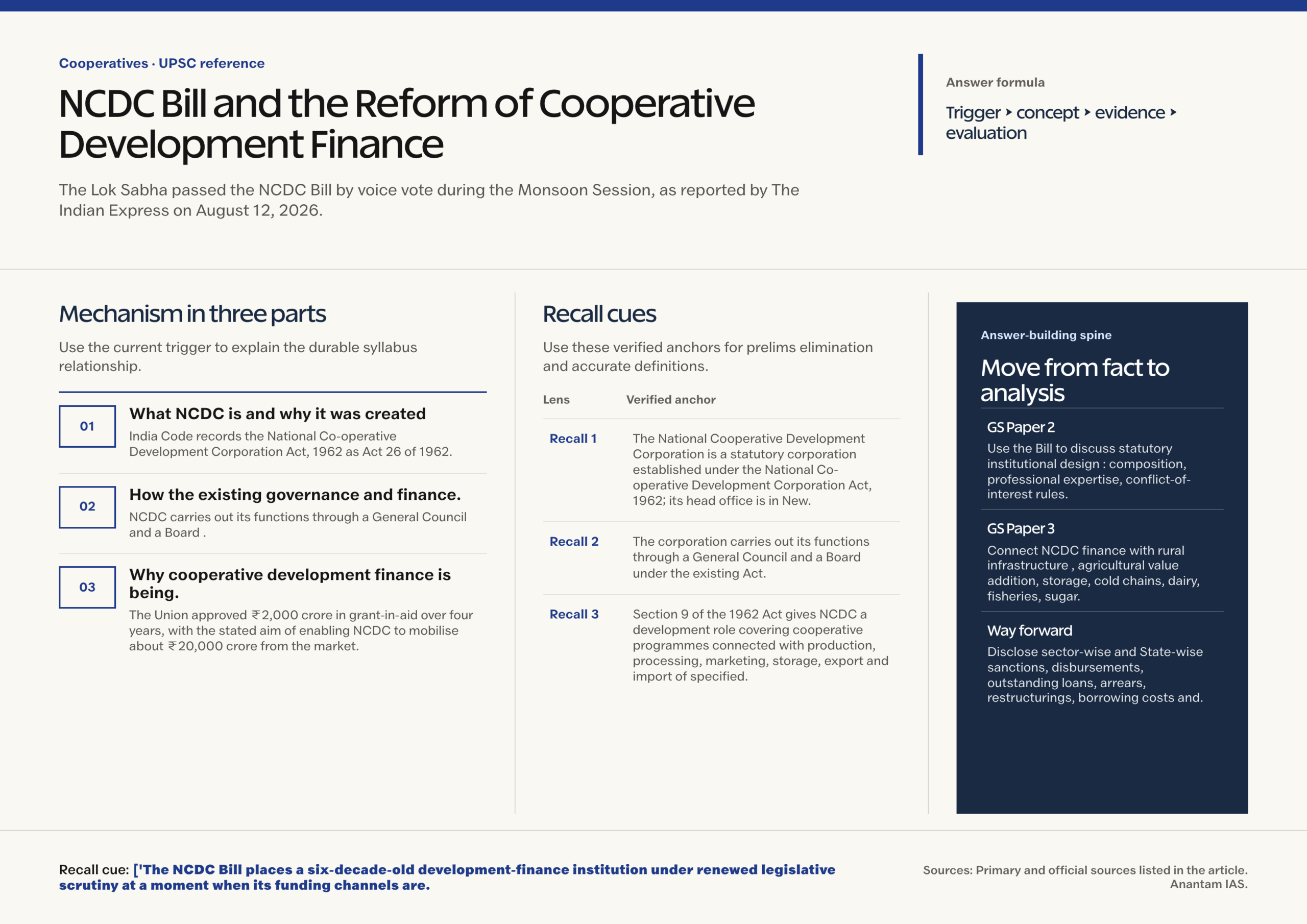
- The National Cooperative Development Corporation is a statutory corporation established under the National Co-operative Development Corporation Act, 1962; its head office is in New Delhi.
- The corporation carries out its functions through a General Council and a Board under the existing Act.
- Section 9 of the 1962 Act gives NCDC a development role covering cooperative programmes connected with production, processing, marketing, storage, export and import of specified produce, goods, livestock, commodities and services.
- The law allows assistance through loans and subsidies for approved cooperative programmes, subject to its statutory design and schemes.
- The existing Act provides for Central government grants, borrowing powers, an NCDC fund, annual reporting, accounts and audit, Central directions, delegation, rules and regulations.
- NCDC is under the Ministry of Cooperation; it is not a cooperative bank and does not perform the Reserve Bank of India’s monetary or banking-regulation functions.
Mains Relevance
GS Paper 2
- Use the Bill to discuss statutory institutional design: composition, professional expertise, conflict-of-interest rules, delegated powers, reporting and legislative oversight.
- Examine cooperative federalism because ordinary cooperatives are primarily a State subject, while NCDC is a Union statutory development-finance institution that often works through State governments.
GS Paper 3
- Connect NCDC finance with rural infrastructure, agricultural value addition, storage, cold chains, dairy, fisheries, sugar, textiles, services and working capital.
- Evaluate the trade-off between cheaper, wider credit and prudent appraisal, repayment capacity, asset quality and contingent fiscal liabilities.
Essay
- Cooperation is neither charity nor conventional private enterprise; it converts shared ownership into economic capability.
Background and Context
What NCDC is and why it was created
The 1962 law created a specialised corporation to plan, promote and finance economic activity organised on cooperative principles.
- India Code records the National Co-operative Development Corporation Act, 1962 as Act 26 of 1962. It established NCDC as a body corporate with perpetual succession and the capacity to hold property, contract, sue and be sued.
- Its statutory purpose extends beyond crop loans. It supports cooperative activity in production, processing, marketing, storage and trade, with later amendments widening the range of eligible commodities and services.
- The corporation can prepare programmes, assist State plans and finance approved projects. Assistance may be routed through State governments or, where the legal and scheme conditions permit, provided directly to cooperative societies.
- This makes NCDC a development-finance institution. It can fund assets and working capital that commercial lenders may consider too small, dispersed, long-gestation or institutionally complex.
- NCDC must not be confused with NABARD. NABARD is the apex development bank for agriculture and rural development with refinancing and supervisory roles defined by its own statute; NCDC is a statutory corporation focused on.
How the existing governance and finance architecture works
The existing Act separates broad representation, executive management and financial accountability across several statutory mechanisms.
- NCDC carries out its functions through a General Council and a Board. The existing composition combines Union institutions, State and Union Territory representation, banking and cooperative-sector representatives.
- Its resources flow into a statutory fund. The Act provides for Central grants, borrowing and other receipts, while expenditures must serve authorised functions.
- The corporation submits programmes of activities and financial estimates and prepares returns and reports. Its accounts and audit are governed by Section 17, which includes a role for auditors appointed with prior approval of the Comptroller.
- The Central government may issue directions under the Act. This can align NCDC with national policy, but sound governance also requires documented appraisal, transparent delegation and protection against credit decisions driven by short-term political incentives.
- Any new framework should keep a clear chain from public support to market borrowing to end-use lending, so Parliament, governments, cooperatives and members can see who bears each risk.
Why cooperative development finance is being scaled up
Policy changes in 2025-26 sought to give NCDC cheaper and deeper access to funds for on-lending.
- The Union approved ₹2,000 crore in grant-in-aid over four years, with the stated aim of enabling NCDC to mobilise about ₹20,000 crore from the market.
- The Ministry of Cooperation reported that ₹500 crore was released in 2025-26 and ₹250 crore in 2026-27 by July 2026. On the back of this support, NCDC had disbursed more than ₹10,672 crore up to May 2026.
- The funds are intended for long-term and working-capital needs across sectors such as dairy, poultry, fisheries, sugar, textiles, food processing, storage, cold chains, labour cooperatives and women-led cooperatives.
- RBI’s January 19, 2026 clarification made eligible bank lending to NCDC for permitted on-lending count towards priority sector lending. The measure can broaden NCDC’s funding pool and lower intermediation constraints.
- Leverage magnifies both development impact and governance risk. If a relatively small fiscal grant supports much larger market mobilisation, disclosure of borrowing costs, maturity mismatches, sector concentration, arrears and recoveries becomes essential.
The federal question in cooperative reform
The Constitution protects space for State cooperative law while allowing national institutions to support cross-state and development objectives.
- Entry 32 of the State List covers incorporation, regulation and winding up of cooperative societies, subject to the constitutional field for institutions whose objects are not confined to one State.
- The 97th Constitutional Amendment added the right to form cooperative societies to Article 19(1)(c), inserted Article 43B and added Part IXB. In 2021, the Supreme Court held that Part IXB could not govern State cooperatives without.
- NCDC does not erase this division merely because it is a Union corporation. Its effectiveness depends on State departments, registrars, cooperative banks and member societies that identify projects, supervise institutions and resolve local constraints.
- A good reform framework should use national finance to complement State capacity, not convert funding conditions into indirect control over matters reserved to States.
- Consultative programme design, published eligibility criteria and State-wise outcome reporting can reduce both regional imbalance and the perception of discretionary allocation.
Way Forward
Publish a complete risk and results dashboard
- Disclose sector-wise and State-wise sanctions, disbursements, outstanding loans, arrears, restructurings, borrowing costs and maturity profiles in machine-readable form.
- Report member-level outcomes, project utilisation and jobs or income created, not only the volume of credit released.
- Create a public methodology for classifying stressed projects and evaluating whether restructuring protects a viable cooperative or merely postpones recognition of loss.
Conclusion
- The NCDC Bill places a six-decade-old development-finance institution under renewed legislative scrutiny at a moment when its funding channels are expanding.
- The reform will be credible only if wider finance comes with professional appraisal, federal partnership and member-facing accountability .
UPSC Practice Questions
Prelims MCQ 1
With reference to the National Cooperative Development Corporation (NCDC), consider the following statements:
- It is a statutory corporation established under a law enacted in 1962.
- It performs its functions through a General Council and a Board under the existing law.
- It is a cooperative bank regulated by the Reserve Bank of India.
How many of the above statements are correct?
(a) Only one (b) Only two (c) All three (d) None
Answer: (b) Only two
Explanation:
Statements 1 and 2 are correct under the National Co-operative Development Corporation Act, 1962. NCDC is a statutory development corporation, not a cooperative bank, so statement 3 is incorrect.
Prelims MCQ 2
Which one of the following best describes the constitutional position of cooperative societies in India?
(a) All cooperative societies are regulated exclusively by Parliament (b) Cooperative societies are principally a State subject, while Parliament has a field concerning multi-state cooperative institutions (c) Cooperative societies are listed only in the Concurrent List (d) The Constitution makes no reference to cooperative societies
Answer: (b) Cooperative societies are principally a State subject, while Parliament has a field concerning multi-state cooperative institutions
Explanation:
Entry 32 of the State List covers cooperative societies within the State field. Parliament legislates for multi-state cooperative societies within the Union’s constitutional competence; Article 19(1)(c), Article 43B and Part IXB also refer to cooperatives.
UPSC Mains Questions
- A larger lending mandate for the National Cooperative Development Corporation must be matched by stronger risk governance and member-facing accountability. Discuss.
- Explain the constitutional and administrative issues that arise when a Union development-finance institution supports cooperatives that are primarily regulated by States.
Sources: The Indian Express and India Code, Government of India.
Frequently Asked Questions
What is the National Cooperative Development Corporation?
NCDC is a statutory corporation established under the National Co-operative Development Corporation Act, 1962. It plans, promotes and finances cooperative development programmes in areas such as production, processing, marketing, storage and services. It operates under the Ministry of Cooperation and.
Why is the NCDC Bill important for UPSC preparation?
The Bill connects statutory governance, cooperative federalism, rural credit and public financial accountability. It allows a candidate to discuss how institutional design affects inclusive growth, why State participation matters in cooperative policy, and how expanded borrowing and lending powers should.
Is NCDC a bank like NABARD?
No. NCDC is a statutory corporation that finances cooperative development programmes. NABARD is an apex development bank created under a separate law, with refinancing, development and supervisory functions in rural finance. NCDC also is not a cooperative bank and does.
How does NCDC raise money for cooperative lending?
The 1962 Act provides for Central government grants, borrowing and a statutory fund. The Union has approved ₹2,000 crore grant-in-aid over four years to help NCDC mobilise about ₹20,000 crore from the market. Eligible bank lending to NCDC for permitted.
Are cooperative societies controlled by the Union government?
Not as a general rule. Cooperative societies are principally within Entry 32 of the State List, while Parliament legislates for multi-state cooperative societies in its constitutional field. A Union institution such as NCDC can finance and promote cooperative development, but.