From Fingerprint to Conviction: NCRB’s Four New Apps and the Digital Criminal-Justice Chain
Why in News?
On 19 June 2026, at the 26th All India Fingerprint Conference in New Delhi, Union Home Minister Amit Shah launched four National Crime Records Bureau (NCRB) applications — Abhigyan, CrPI, e-Forensics 2.0 and e-Prosecution 2.0 — designed, the PIB release says, to speed up disposal of pending cases and deliver justice within three years from FIR to conviction.
The four apps are meant to operate as a single digital chain: the National Automated Fingerprint Identification System (NAFIS) and CrPI identify the offender, CCTNS and Cri-MAC support the investigation, e-Forensics strengthens the evidence, and e-Prosecution drives the case to conviction — all stitched into the Integrated Criminal Justice System (ICJS). The rollout has also renewed concern, voiced by outlets such as MediaNama and NewsDrum, over street-level biometric scanning and whether it will withstand legal scrutiny.
- NCRB-Abhigyan is a mobile app that lets field police search the National Fingerprint Database from any location using a certified scanner to identify a suspect — moving fingerprint checks from the lab to the street.
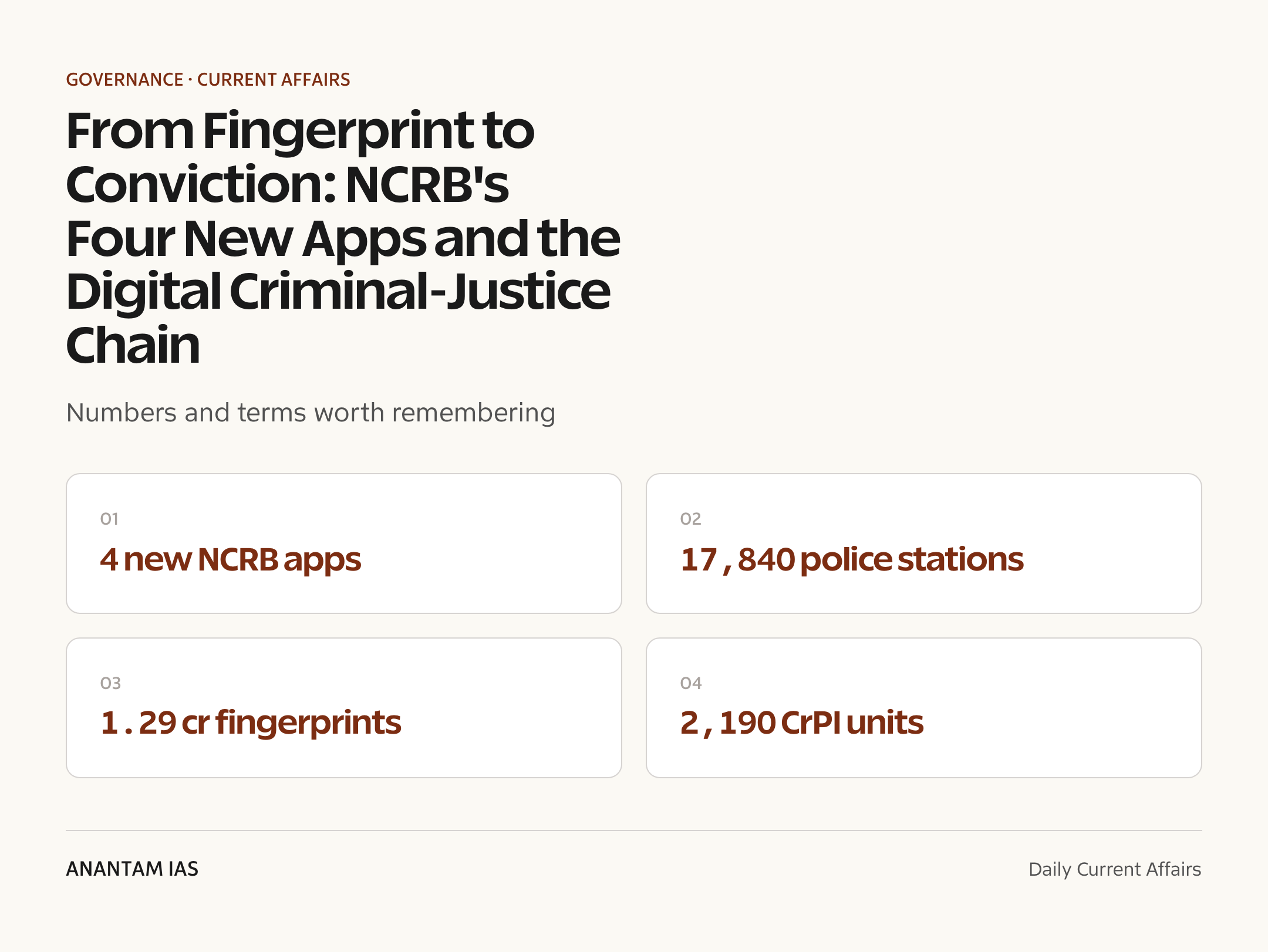
- CrPI adds multi-modal biometrics — facial recognition, iris matching and DNA matching — aimed at repeat-offender and CCTV-based identification; per PIB, 2,190 CrPI units have been distributed and over 5.53 lakh enrollments completed.
- e-Forensics 2.0 digitally links forensic laboratories with investigating agencies, covering sample registration, lab workflow, report generation and the chain of custody.
- e-Prosecution 2.0 builds digital coordination among police, prosecution and the judiciary so that once an offender is identified, timely prosecution can follow.
- MediaNama reports the Abhigyan fingerprint check is pitched as returning a match in roughly 35 seconds at the field level — a claim not specified in the PIB release itself.
- The launch is framed as part of the shift from force-based policing toward scientific, evidence-based investigation, with AI and machine learning flagged for future predictive policing.
The development matters in the context of:
- The apps sit on top of the three new criminal laws that took effect on 1 July 2024 — the Bharatiya Nyaya Sanhita (BNS), Bharatiya Nagarik Suraksha Sanhita (BNSS) and Bharatiya Sakshya Adhiniyam (BSA), 2023 — which replaced the IPC, CrPC and Indian Evidence Act and expand the role of forensic and digital evidence.
- Per the PIB release, CCTNS now covers all 17,840 police stations, the country holds about 1.29 crore fingerprint records, and the e-Forensics database carries data on about 34.48 lakh cases.
UPSC Relevance
Prelims Relevance
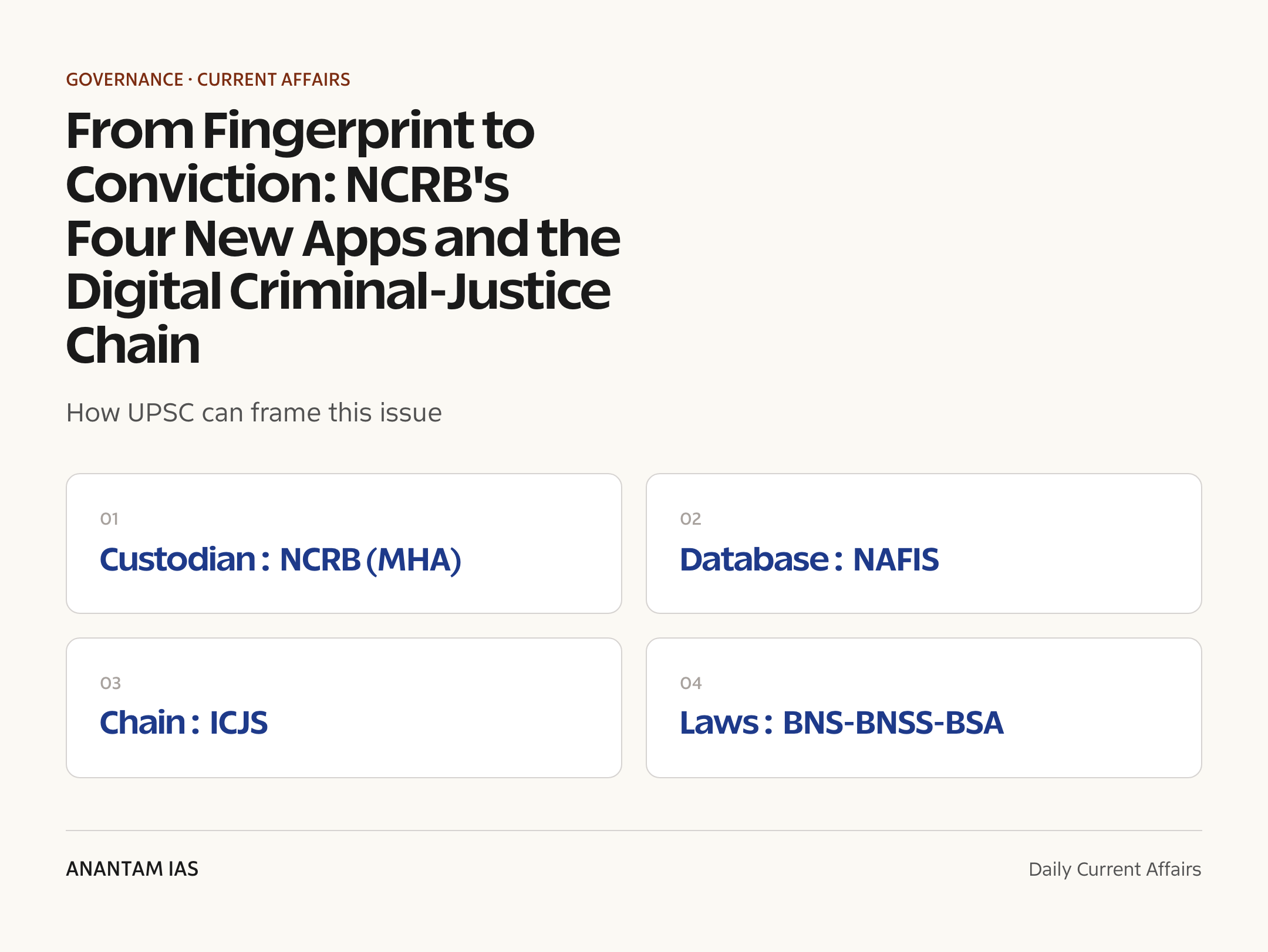
- NCRB: set up in 1986 under the Ministry of Home Affairs (MHA); custodian of national crime data and the NAFIS database; merged the erstwhile Central Fingerprint Bureau functions.
- NAFIS: National Automated Fingerprint Identification System — a centralised, searchable fingerprint database maintained by NCRB that assigns each record a unique 10-digit National Fingerprint Number.
- CCTNS: Crime and Criminal Tracking Network and Systems — links police stations on a common platform; per PIB it now covers all 17,840 stations.
- ICJS: Integrated Criminal Justice System — connects the five pillars: police, forensics, prosecution, courts (e-Courts) and prisons (e-Prisons).
- New criminal laws: BNS replaced the IPC, BNSS replaced the CrPC, and BSA replaced the Indian Evidence Act; all three came into force on 1 July 2024.
- Cri-MAC: Crime Multi-Agency Centre under NCRB, used to share crime alerts across agencies.
- K.S. Puttaswamy v. Union of India (2017): held privacy a fundamental right under Article 21 and laid down the legality–necessity–proportionality test for state intrusion.
- DPDP Act, 2023: Digital Personal Data Protection Act — governs processing of digital personal data; carries exemptions for state agencies notified in the interest of, among others, prevention of offences.
- BPR&D: Bureau of Police Research and Development — works with NCRB on police modernisation and training.
- Modus Operandi Bureau: an NCRB unit, set up four years before this conference, for crime-pattern analysis.
Mains Relevance
GS Paper 2
- e-governance and digital delivery of justice: how the ICJS integrates police, forensics, prosecution, courts and prisons, and the governance gains of a single digital chain.
- Government policies and institutions: NCRB and BPR&D evolving from record-keeping bodies into intelligence-driven crime-prevention organisations under the new criminal laws.
- Rights and accountability: balancing real-time biometric policing with the Puttaswamy proportionality test and the absence of a dedicated facial-recognition or biometric-data statute.
GS Paper 3
- Science and technology in internal security: use of NAFIS, multi-modal biometrics (face, iris, DNA), AI and machine learning for crime detection and predictive policing.
- Data governance and cybersecurity: securing large biometric and criminal databases through access logs, audits, SOP-based use and penalties for misuse, as flagged in the release.
- Challenges of predictive policing: risk of profiling, false positives in field-level biometric matching, and the need for legal safeguards before pre-emptive identification.
Essay
- Technology can make justice faster, but speed without safeguards can erode the very rights the criminal-justice system exists to protect.
- The line between a smarter state and a surveillance state is drawn not by the tools it builds but by the limits it accepts on their use.
Background and Context
The Four New Applications
The Home Minister launched four NCRB applications, each owning one link in the journey from a crime scene to a conviction.
- NCRB-Abhigyan: a mobile app letting field officers search the National Fingerprint Database from any location with a certified scanner, identifying a suspect by fingerprint match and making field policing more responsive.
- CrPI: a multi-modal biometric system combining facial recognition, iris matching and DNA matching, used mainly for repeat-offender and CCTV-based identification; PIB notes 2,190 units distributed and over 5.53 lakh enrollments.
- e-Forensics 2.0: digitally connects forensic labs and investigating agencies — sample registration, lab workflow, report generation and a strengthened chain of custody.
- e-Prosecution 2.0: links police, prosecution and the judiciary so prosecution follows quickly once an offender is identified.
How NAFIS and ICJS Knit the Chain Together
The apps are not standalone tools; they plug into databases that already span the criminal-justice system.
- NAFIS, run by NCRB, is the searchable national fingerprint database that Abhigyan queries; the release stresses it is a ‘two-way’ system that must be continuously fed with crime-scene prints to stay useful.
- CCTNS now reaches all 17,840 police stations and holds legacy data including about 37.68 crore FIRs, per the PIB figures.
- The ICJS connects police, forensics, prosecution, the e-Courts system (about 22,000 courts linked) and the e-Prisons system (data on about 2.29 crore prisoners).
- The intended flow, as the release puts it: NAFIS and CrPI identify the offender, CCTNS and Cri-MAC connect the investigation, e-Forensics strengthens the evidence, and e-Prosecution drives the case to conviction.
The New Criminal Laws as Backdrop
These tools were built for a legal framework rewritten in 2023 and enforced from mid-2024.
- Bharatiya Nyaya Sanhita (BNS), 2023 replaced the Indian Penal Code as the substantive criminal code.
- Bharatiya Nagarik Suraksha Sanhita (BNSS), 2023 replaced the Code of Criminal Procedure and pushes mandatory forensic investigation for serious offences and digital case management.
- Bharatiya Sakshya Adhiniyam (BSA), 2023 replaced the Indian Evidence Act and broadens the admissibility of electronic and digital records.
- All three came into force on 1 July 2024; the stated goal of completing the process from FIR to conviction within three years rests heavily on this digital evidence backbone.
The Privacy and Legal-Scrutiny Debate
Real-time, street-level biometric identification reopens questions the courts have only partly answered.
- The proportionality argument: under K.S. Puttaswamy (2017), any state intrusion into privacy must satisfy legality, necessity and proportionality — critics ask whether routine field fingerprint and face checks meet this bar absent a dedicated law.
- The data-protection gap: the DPDP Act, 2023 governs digital personal data but carries broad exemptions for state agencies, and India still has no specific statute governing facial recognition or large biometric databases.
- Reliability and error: civil-liberties commentators (cited by MediaNama and NewsDrum) flag false-positive risk in field biometric matching and the danger of profiling and function creep toward predictive policing.
- The state’s case: the government argues that scientific, time-bound investigation strengthens convictions and that safeguards — access logs, SOP-based usage, third-party audits and penalties for misuse — were explicitly stressed at the conference, with database security framed as a state responsibility.
Why It Matters
The launch is a marker in how India is re-architecting policing around data rather than manpower.
- It signals a shift from a force-based model to an evidence-and-intelligence-driven one, with NCRB and BPR&D recast as crime-prevention bodies.
- It pairs ambitious efficiency goals — three-year FIR-to-conviction timelines — with an expanding biometric state, making the safeguards question central rather than peripheral.
- For aspirants, it is a clean case study linking governance reform, technology in justice and fundamental rights in a single story.
Way Forward
Legislate the Safeguards
- Enact a dedicated framework governing facial recognition and biometric databases, with clear purpose limitation, retention limits and independent oversight, rather than relying on exemptions under the DPDP Act.
- Codify the Puttaswamy proportionality test into operating procedures for field-level biometric checks — defining when an officer may scan, on what suspicion, and with what record.
Build Accountability into the Tech
- Operationalise the audit measures named at the conference — access logs, SOP-based usage, third-party audits and penalties for misuse — and publish periodic transparency reports on match accuracy and false positives.
- Invest in data quality and security at the state level so that databases like NAFIS and CrPI are accurate, secure and not vehicles for wrongful identification.
Train the Whole Chain
- Extend training beyond app use to evidence collection, preservation and concise charge-sheeting, involving prosecutors, forensic experts and the judiciary as the release urges.
- Pilot grievance and redressal mechanisms for individuals wrongly flagged by biometric matching before scaling field deployment.
Conclusion
NCRB’s four apps are, on paper, an elegant solution to a real problem: India’s criminal-justice system has long been slowed by paper files, disconnected databases and evidence that decays before it reaches a courtroom. Stitching NAFIS, CrPI, e-Forensics and e-Prosecution into one ICJS chain promises faster, more scientific convictions under the new criminal laws.
The harder question is institutional, not technical. Real-time biometric policing from a constable’s phone is exactly the kind of intrusion the Supreme Court asked the state to justify in Puttaswamy. Whether this digital chain becomes a model of efficient justice or a quietly expanding surveillance grid will depend less on the apps and more on the laws, audits and limits the country is willing to build around them.
UPSC Practice Questions
Prelims MCQ 1
With reference to the National Automated Fingerprint Identification System (NAFIS), consider the following statements: 1. It is maintained by the National Crime Records Bureau under the Ministry of Home Affairs. 2. It assigns each enrolled record a unique National Fingerprint Number. Which of the statements given above is/are correct?
1 only 2 only Both 1 and 2 Neither 1 nor 2
Answer: Both 1 and 2
Explanation:
NAFIS is maintained by the NCRB, which functions under the MHA, and it assigns a unique 10-digit National Fingerprint Number to each record. Both statements are correct.
Prelims MCQ 2
Which of the following correctly pairs the three new criminal laws of 2023 with the older statutes they replaced? 1. Bharatiya Nyaya Sanhita — Indian Penal Code. 2. Bharatiya Nagarik Suraksha Sanhita — Code of Criminal Procedure. 3. Bharatiya Sakshya Adhiniyam — Indian Evidence Act. Select the correct answer:
1 and 2 only 2 and 3 only 1 and 3 only 1, 2 and 3
Answer: 1, 2 and 3
Explanation:
BNS replaced the IPC, BNSS replaced the CrPC, and BSA replaced the Indian Evidence Act. All three pairings are correct; the laws came into force on 1 July 2024.
UPSC Mains Questions
- The integration of policing, forensics, prosecution and courts into a single digital chain promises faster justice but raises fresh privacy concerns. Examine the governance gains and the rights-related risks of NCRB’s new criminal-justice applications. (250 words)
- Real-time biometric identification by field police must satisfy the proportionality test laid down in K.S. Puttaswamy. Critically discuss the adequacy of India’s current legal framework, including the DPDP Act 2023, to regulate such technologies. (250 words)
- Scientific, evidence-based investigation is increasingly seen as more effective than a force-based policing model. Discuss with reference to the new criminal laws and the Integrated Criminal Justice System. (150 words)
Sources: PIB, Ministry of Home Affairs and MediaNama.
Frequently Asked Questions
What are the four new NCRB applications launched in June 2026?
They are NCRB-Abhigyan (field fingerprint search against the national database), CrPI (facial, iris and DNA matching), e-Forensics 2.0 (linking forensic labs and investigators) and e-Prosecution 2.0 (coordinating police, prosecution and courts). They were launched by Home Minister Amit Shah at the 26th All India Fingerprint Conference on 19 June 2026.
What is NAFIS and how does Abhigyan use it?
NAFIS (National Automated Fingerprint Identification System) is NCRB’s centralised, searchable fingerprint database. The Abhigyan app lets field police query NAFIS from any location using a certified scanner, so a suspect can be checked against the national database at the spot rather than only in a lab.
What are the three new criminal laws referenced here?
The Bharatiya Nyaya Sanhita (BNS), Bharatiya Nagarik Suraksha Sanhita (BNSS) and Bharatiya Sakshya Adhiniyam (BSA), 2023, which replaced the IPC, CrPC and Indian Evidence Act respectively and came into force on 1 July 2024. They expand the role of forensic and digital evidence.
What is the Integrated Criminal Justice System (ICJS)?
The ICJS connects the pillars of the justice system — police (CCTNS), forensics (e-Forensics), prosecution (e-Prosecution), courts (e-Courts) and prisons (e-Prisons) — on a shared digital platform, so information flows from a crime scene through investigation to conviction.
Why are privacy advocates concerned about these apps?
Critics, including outlets like MediaNama and NewsDrum, argue that real-time, street-level fingerprint and face checks may not satisfy the Puttaswamy proportionality test, that India lacks a dedicated facial-recognition or biometric-data law, and that the DPDP Act 2023 carries broad state exemptions. They also flag false-positive and profiling risks.
How does this fit the goal of justice within three years?
The government wants the process from FIR to conviction completed within three years. Faster identification (Abhigyan, CrPI), digitally managed forensic evidence (e-Forensics) and coordinated prosecution (e-Prosecution) are meant to cut delays, supported by the BNSS’s emphasis on time-bound, forensic-led investigation.