Nepal Communal Clashes: Secularism and Stability in the Border Belt
Why in News?
The Hindu examined recurring Hindu-Muslim tensions in Nepal’s southern plains after a fresh clash in Sunsari district , which borders the Indian State of Bihar.
- The immediate trigger reported by police was an objection to loudspeakers used by a religious procession; the available official account does not establish a larger conspiracy or assign collective guilt to either community.
- The confrontation escalated after more people gathered with sticks, bamboo poles, stones and spears, showing how a local dispute can rapidly become a crowd-control emergency.
- Authorities deployed additional Nepal Police and Armed Police Force personnel, separated the groups and opened talks with community representatives.
- The district administration urged residents to avoid rumours and cooperate with public-order measures, underlining the role of information integrity during communal tension.
- The episode occurred in the Tarai-Madhesh border belt, where dense kinship, trade and mobility links make local stability relevant to both Nepal and India.
- The clash tests the practical meaning of Article 4 of Nepal’s Constitution, which describes the country as secular and inclusive, alongside Article 26 on freedom of religion.
- It connects civil liberties with public order: religious practice is protected, but violence, intimidation and breaches of public peace are not.
- For India, the issue concerns a close neighbour with an open border and deep people-to-people contacts, not an invitation to interfere in Nepal’s domestic politics.
UPSC Relevance
Prelims Relevance
- Article 4 defines Nepal as an independent, indivisible, sovereign, secular, inclusive, democratic, socialism-oriented, federal democratic republican State.
- The explanation to Article 4 links secularism with religious and cultural freedoms, including protection of religion and culture handed down from time immemorial.
- Article 18 guarantees equality before law and bars discrimination in the application of general laws on grounds including religion, race, caste, language and region.
- Article 26 protects the freedom to profess, practise and protect one’s religion according to conviction, subject to specified constitutional limits.
- Article 26 also protects the operation of religious sites and trusts, while allowing their regulation by law.
- Nepal’s Constitution permits restrictions on expression that may harm harmonious relations among different religions or communities or incite an offence.
Mains Relevance
GS Paper 2
- Constitutional secularism, equality and religious freedom under Articles 4, 18 and 26 of Nepal’s Constitution.
- Balancing freedom of religion, freedom of expression and assembly with proportionate public-order restrictions.
GS Paper 1
- Communalism as a process in which an immediate dispute is framed as conflict between entire religious communities.
- The role of local institutions, trusted intermediaries and social cohesion in diverse border societies.
Essay
- A secular Constitution acquires meaning through equal protection and everyday administrative fairness, not through labels alone.
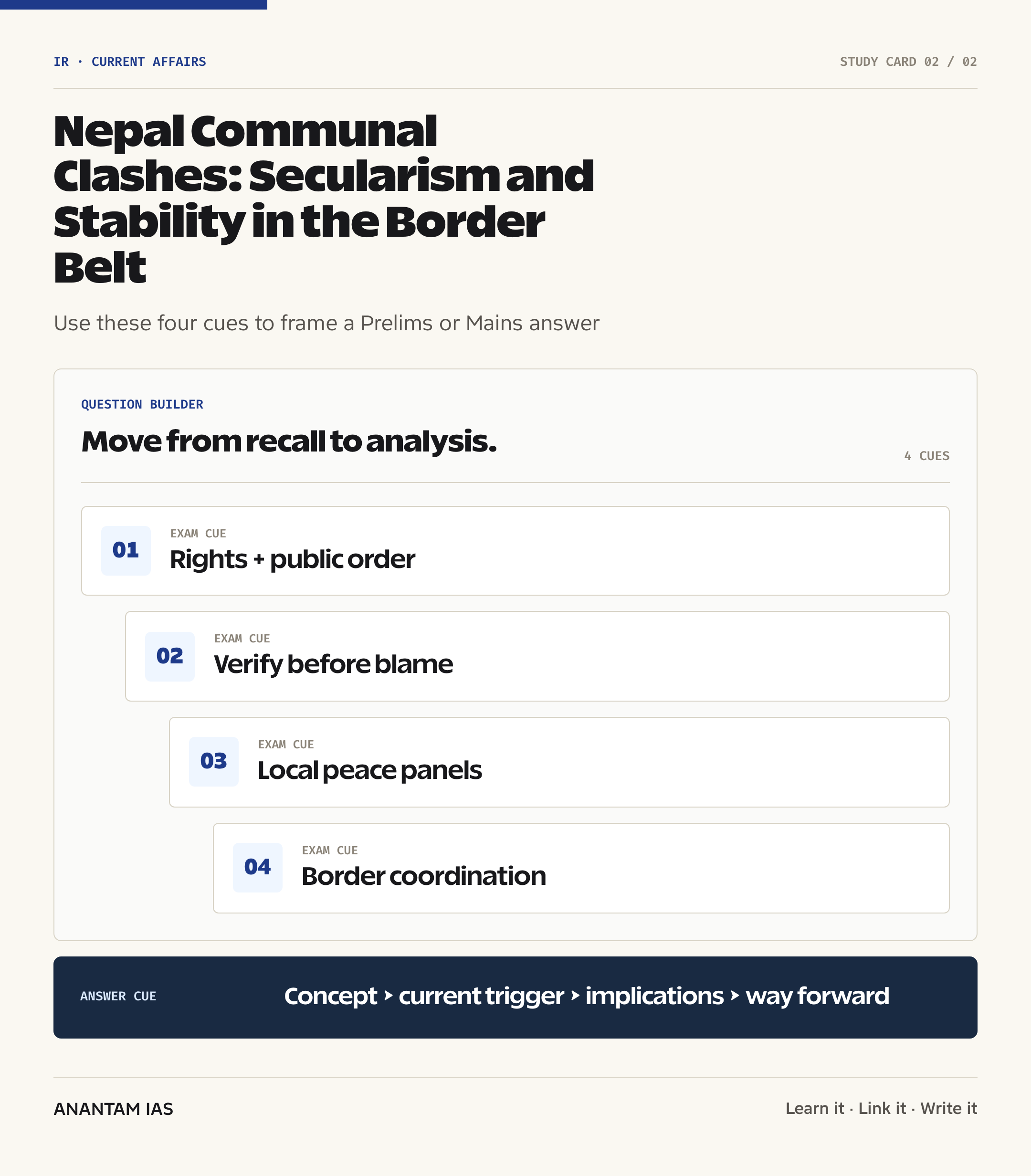
Background and Context
What Is Verified About the Sunsari Clash?
The incident record supports a limited factual account, while several broader claims circulating around it remain allegations or interpretation.
- The clash occurred at night in Kaptanganj, ward 3 of Dewanganj Rural Municipality, during the annual Bolbam pilgrimage in the Hindu month of Shrawan.
- Police said devotees returning from the Koshi Barrage were playing loud music when members of another community objected; a verbal dispute then escalated into physical violence.
- Nepali media reported one death and 22 injuries, including injuries to Nepal Police and Armed Police Force personnel.
- Police warning shots preceded live firing by Armed Police Force personnel, but authorities had not established why live rounds were used or how many were fired when the first detailed report was published.
- This distinction matters: the proximate trigger is documented, but claims about organised direction, cross-border instigation or the intent of whole communities require separate evidence.
Nepal's Constitutional Secularism
Nepal’s 2015 Constitution places secularism inside a wider commitment to inclusion, equality, religious freedom and social harmony.
- Article 4 calls Nepal secular and inclusive; its explanation gives secularism a Nepal-specific meaning that combines religious and cultural freedom with protection of inherited religion and culture.
- Article 18 requires equality before law and equal protection, and it recognises Muslims among groups for whom protective, empowering or developmental provisions may be made.
- Article 26(1) protects every person’s freedom to profess, practise and protect religion according to conviction.
- Article 26(2) protects religious denominations’ right to operate and protect religious sites and trusts, subject to lawful regulation.
- Article 26(3) withholds protection from conduct that breaches public peace, harms another’s religion or violates public health, decency and morality; religious freedom isn’t a defence for violence.
Secularism, Public Order and Equal Citizenship
A rights-based response must protect religious observance and public peace without assuming that the two are inherently opposed.
- Authorities may regulate procession routes, sound levels, timing and assembly through clear, neutral and previously announced rules.
- The same rules should apply across communities; selective permissions or selective enforcement can convert an administrative dispute into a claim of unequal citizenship.
- Public-order restrictions should be necessary, time-bound and proportionate, with access to essentials, medical care and legal review preserved during curfew.
- Police use of force needs a documented chain of command, graduated response, medical assistance and an independent review when live ammunition causes death or serious injury.
- Victim protection and prosecution should be based on individual conduct and evidence, not religious identity, neighbourhood or online accusation.
Why Local Disputes Become Communal
Communal escalation is best understood as a sequence of governance failures and social reactions, not as an automatic feature of religious diversity.
- A dispute over a loudspeaker, route, flag, social-media post or place of worship can become a symbolic contest when political entrepreneurs frame it as an attack on an entire faith.
- Rumours spread faster when police information is delayed, contradictory or inaccessible in the languages used by local communities.
- Retaliatory mobilisation expands the number of participants and makes it harder for community leaders to separate verified injury from accumulated grievance.
- Heavy-handed or visibly unequal enforcement can weaken trust in institutions, while impunity for vandalism or hate speech can encourage copycat action.
- This is an analytical risk chain, not a finding that every element caused the Sunsari incident; investigation must establish the facts in that case.
Way Forward
Establish the Incident Record
- Complete an independent, time-bound inquiry into the sequence of violence and police firing, preserve video and ballistic evidence, and publish findings that protect witnesses and due process.
- Prosecute assault, arson, vandalism, weapon possession and incitement on the basis of individual evidence, irrespective of religious affiliation.
- Use advance route coordination, sound limits, liaison officers and written conditions for major religious processions and gatherings.
- Train police in graduated crowd control, de-escalation, first aid and clear command responsibility for any use of firearms.
Conclusion
- The Sunsari clash is a test of whether Nepal can turn constitutional commitments into equal protection, disciplined policing and credible accountability.
- For India, the durable interest is a stable and inclusive Nepal and a trusted open border .
UPSC Practice Questions
Prelims MCQ 1
With reference to the Constitution of Nepal, consider the following statements:
- Article 4 describes Nepal as a secular and federal democratic republican State.
- Article 18 bars discrimination in the application of general laws on the ground of religion.
- Article 26 makes the freedom of religion absolute and removes all public-order limitations.
How many of the above statements are correct?
(a) Only one (b) Only two (c) All three (d) None
Answer: (b) Only two
Explanation:
Statements 1 and 2 are correct. Article 26 protects religious freedom but excludes conduct that breaches public peace or violates specified constitutional limits, so Statement 3 is incorrect.
Prelims MCQ 2
Article 7 of the 1950 India-Nepal Treaty of Peace and Friendship is chiefly associated with:
(a) Reciprocal privileges concerning residence, property, trade, commerce and movement (b) Creation of a common currency and central bank (c) Merger of the two countries’ armed forces (d) Delimitation of the India-Nepal-China tri-junction
Answer: (a) Reciprocal privileges concerning residence, property, trade, commerce and movement
Explanation:
Article 7 provides reciprocal privileges of a similar nature in residence, property ownership, participation in trade and commerce, movement and related matters. It creates neither a monetary union nor a common military.
UPSC Mains Questions
- Nepal’s recent communal clashes show that constitutional secularism depends on impartial local administration as much as formal rights. Examine how Nepal can reconcile religious freedom, equality and public order while preventing rumours and retaliatory mobilisation from converting local disputes into enduring communal conflict.
- Instability in Nepal’s southern plains has implications for India because of the open border and dense social ties, yet Nepal’s internal order remains a sovereign responsibility. Discuss the principles and practical mechanisms that should guide a cooperative, proportionate and non-intrusive Indian response.
Sources: Nepal Law Commission, Constitution of Nepal and The Hindu.
Frequently Asked Questions
What happened in Sunsari?
A dispute over loud music during a Bolbam religious procession in Kaptanganj escalated into violence on 26 July 2026. Nepali police accounts reported one death after Armed Police Force firing and 22 injuries, including 13 security personnel. An investigation was.
Is Nepal constitutionally secular?
Yes. Article 4 of the Constitution describes Nepal as a secular, inclusive and federal democratic republican State. Its explanation connects secularism with religious and cultural freedoms, including protection of inherited religion and culture. Articles 18 and 26 add equality guarantees.
What does Article 26 protect?
Article 26 protects every person’s freedom to profess, practise and protect religion according to conviction. It also protects religious denominations’ operation of religious sites and trusts, subject to lawful regulation. The right does not cover conduct that breaches public peace.
Why does the border belt matter?
The Tarai-Madhesh is linked with adjoining Indian districts through families, markets, transport, work and pilgrimage. Local unrest can interrupt movement and heighten anxiety on both sides. But lawful mobility is a core social and economic asset, so security measures should.
How should communal rumours be handled?
Authorities should publish frequent multilingual updates that distinguish confirmed facts from allegations, identify false claims and give practical safety directions. Police should preserve digital evidence and pursue unlawful incitement through due process. Targeted action is preferable to blanket communication shutdowns.