Nepal Social Media Ban Issue

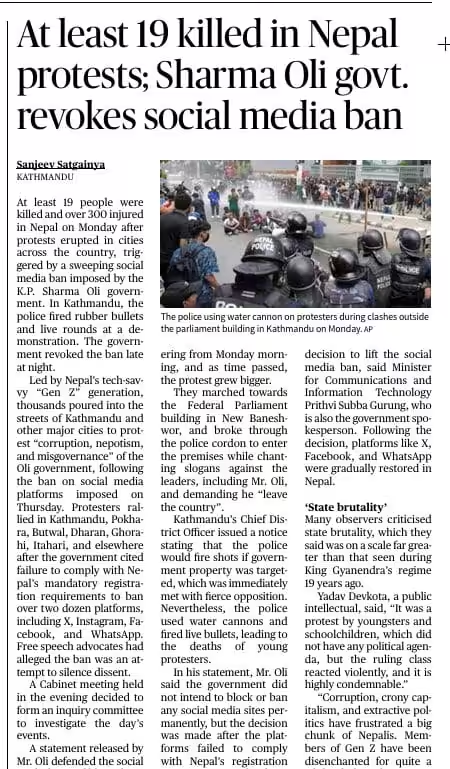
Why in news:
The K.P. Sharma Oli government in Nepal imposed a sweeping ban on social media platforms like X, Facebook, Instagram, and WhatsApp, citing non-compliance with mandatory registration rules. The move triggered massive protests led by Nepal’s Gen Z, spreading across major cities such as Kathmandu, Pokhara, and Butwal. At least 19 people were killed and over 300 injured after police used rubber bullets, water cannons, and even live ammunition.
UPSC Relevance:
Social media regulation
UPSC PYQ:
Q. Child cuddling is now being replaced by mobile phones. Discuss its impact on the socialization of children. (2023)
Why this matters:
- For Nepal’s Gen Z, social media isn’t just entertainment, it’s a political tool, a livelihood, and a space for free expression. The sweeping ban has therefore struck a nerve, sparking one of the largest youth-led movements the country has seen in years.
- Whether the protests force the government to reconsider, or whether the ban marks the beginning of tighter state control over digital spaces, remains to be seen.
Analysis of Social Media Ban:
Argument in favour:
- National Security & Regulation:
- The government justified the ban by saying platforms failed to follow mandatory registration rules. Unregulated platforms can be misused for fake news, hate speech, and anti-national propaganda.
- Maintaining Law & Order
- Authorities argued that unchecked social media could inflame protests and worsen violence. A temporary ban was intended to prevent escalation of unrest.
- Regulatory Sovereignty
- Just like India (with IT Rules 2021) and EU (with the Digital Services Act), Nepal has the right to enforce compliance with its domestic cyber laws.
Arguments Against the Ban:
- Violation of Free Speech
- Critics called it an attack on democratic rights and dissent. Social media is a key medium for citizens to hold governments accountable.
- Fuelled Protests Instead of Containing Them
- The ban angered youth further and became the trigger for massive demonstrations. Suppression of voices often leads to greater political instability.
- Damage to International Image
- The violent crackdown and deaths during protests tarnished Nepal’s human rights reputation globally.
- Digital Economy Impact
- Banning social media disrupts communication, businesses, and startups dependent on online platforms.
India:
- On July 23, 2025, the Ministry of Information and Broadcasting (MIB) issued a directive to Internet Service Providers (ISPs) across India, ordering them to block public access to 25 OTT platforms. Prominent platforms affected by this ban include Ullu, ALTT, and Desiflix.
under:
- The blocking directive drew authority from the Information Technology Act, 2000, particularly Section 67 (prohibiting obscene material in electronic form) and Section 67A (prohibiting sexually explicit content in electronic form).
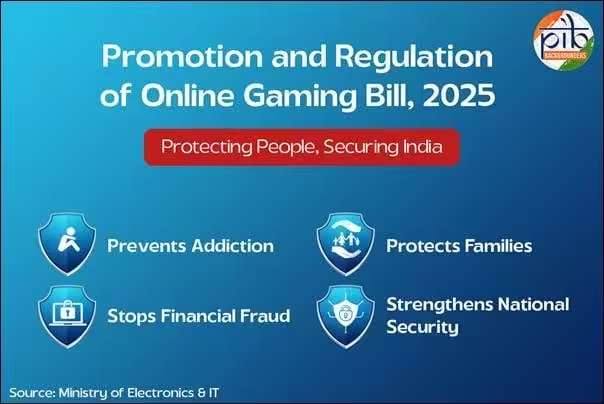
Recent: Promotion and Regulation of Online Gaming Bill, 2025
- Protecting middle class and youth; promoting e-sports, online social games
Why social media ban is not big issue in India:
- India has proper and systematic procedure, rules and regulation for operation and control of social media.
- India has never banned entire social media platforms. India has banned only which violate the rules operational under the broader constitutional and legal framework of India.
- In India the operation and regulation of social media is rooted in the constitutional morality and its principles.