Net FDI Quadruples to $6.6 Billion in April 2026: Reading the RBI’s Inflow Data
Why in News?
The Reserve Bank of India’s monthly data, captured in the RBI Bulletin’s “State of the Economy” article, showed net foreign direct investment (FDI) jumping more than fourfold to $6.58 billion in April 2026, against a far weaker year-ago figure. The surge was driven by a rebound in equity inflows and lower repatriation by foreign investors, even as the wider economy showed signs of an industrial slowdown.
The headline matters because net FDI had stayed unusually thin through much of 2025-26 despite record gross inflows. April’s reading offers an early, tentative counterweight, though the gap between gross and net FDI remains the central story for India’s capital account and balance of payments.
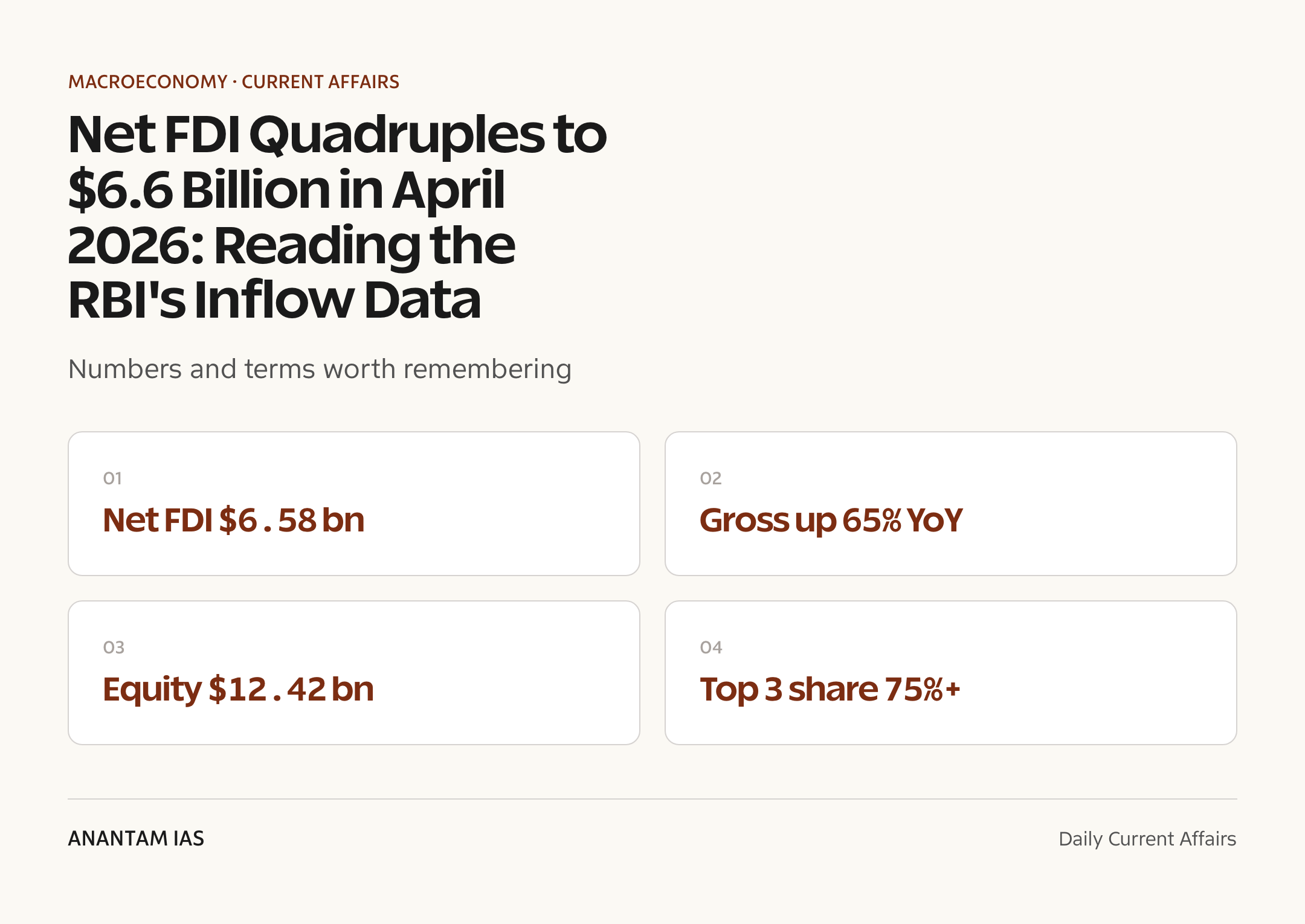
- Net FDI rose to $6.58 billion in April 2026, more than four times the year-earlier level.
- Gross FDI inflows grew 65% year-on-year to $15.29 billion.
- Equity inflows, the largest component, climbed to $12.42 billion from $6.82 billion a year earlier and $3.58 billion in March 2026.
- Japan, Singapore and Mauritius together supplied more than 75% of the inflows.
- The jump comes against an industrial slowdown, making robust capital inflows a useful cushion for the external account.
The development matters in the context of:
- Net FDI had been depressed for most of 2025-26: gross inflows touched a record near $94.5 billion, yet net FDI was only about $7.65 billion for the full year.
- The squeeze came from elevated repatriation and disinvestment (about $53.6 billion in FY26, a multi-year high) plus rising outward FDI by Indian firms.
- April 2026’s improvement was led by stronger equity inflows and softer repatriation, not a structural break.
UPSC Relevance
Prelims Relevance
- Net FDI = gross FDI inflows minus repatriation/disinvestment by foreign investors minus outward FDI by residents; it is the figure that enters the balance of payments.
- FDI is recorded in the capital account (financial account) of the balance of payments, not the current account.
- FDI vs FPI: FDI involves a lasting management interest (10%+ equity threshold) and is long-term; FPI (Foreign Portfolio Investment) is passive stock/bond exposure and far more volatile.
- Automatic route: no prior government approval needed up to sector caps; Government route: prior approval required, now routed through concerned ministries after FIPB’s abolition.
- FDI inflows are governed under the Foreign Exchange Management Act (FEMA), 1999 and the Non-Debt Instruments Rules.
- Top FDI source jurisdictions for India have historically included Mauritius, Singapore, the US, Netherlands and Japan.
- The RBI Bulletin publishes the monthly “State of the Economy” assessment; full-fiscal FDI is also tracked by DPIIT.
- Press Note 3 (2020) requires government approval for FDI from countries sharing a land border with India.
- Outward FDI flows in April 2026 went largely (about 80%) to the US and the Cayman Islands.
- Among equity inflows, financial services drew the largest share, then retail and wholesale trade, manufacturing and computer services.
Mains Relevance
GS Paper 3
- Explains the divergence between record gross FDI and weak net FDI, and what it signals about investor confidence versus profit-booking.
- Links FDI to balance of payments stability, rupee management and the financing of the current account deficit.
- Frames the policy debate on FDI routes, sector caps and ease of doing business needed to convert inflows into durable capital formation.
- Connects rising outward FDI to the growing global footprint of Indian firms and the maturing of India’s capital account.
Essay
- U
- s
- e
- f
- u
- l
- a
- s
- e
- v
- i
- d
- e
- n
- c
- e
- i
- n
- e
- s
- s
- a
- y
- s
- o
- n
- g
- l
- o
- b
- a
- l
- i
- s
- a
- t
- i
- o
- n
- ,
- s
- e
- l
- f
- –
- r
- e
- l
- i
- a
- n
- c
- e
- v
- e
- r
- s
- u
- s
- o
- p
- e
- n
- c
- a
- p
- i
- t
- a
- l
- f
- l
- o
- w
- s
- ,
- o
- r
- w
- h
- e
- t
- h
- e
- r
- f
- o
- r
- e
- i
- g
- n
- c
- a
- p
- i
- t
- a
- l
- s
- u
- b
- s
- t
- i
- t
- u
- t
- e
- s
- f
- o
- r
- o
- r
- c
- o
- m
- p
- l
- e
- m
- e
- n
- t
- s
- d
- o
- m
- e
- s
- t
- i
- c
- i
- n
- v
- e
- s
- t
- m
- e
- n
- t
- .
Background and Context
What net FDI actually measures
The headline number is a net figure, and the arithmetic explains why a record gross year can still produce thin net inflows.
- Net FDI = gross FDI inflows minus repatriation and disinvestment by foreign investors minus outward FDI by Indian residents.
- Gross inflows capture fresh equity, reinvested earnings and intra-company debt coming in; they say nothing about money leaving.
- Repatriation/disinvestment is foreign investors booking profits, selling stakes or exiting; high repatriation drags net FDI down even when gross stays strong.
- Outward FDI is Indian companies investing abroad, which also subtracts from the net figure.
- April 2026 improved on all three legs at once: higher gross equity, lower repatriation, and a more favourable balance against outflows.
The April 2026 numbers in detail
The RBI’s monthly data shows a broad-based rebound led by equity.
- Net FDI: $6.58 billion, more than four times the year-ago level.
- Gross FDI inflows: $15.29 billion, up about 65% year-on-year.
- Equity inflows: $12.42 billion versus $6.82 billion in April 2025 and $3.58 billion in March 2026 — the standout driver.
- Outward FDI: $4.82 billion, up from $2.56 billion the previous month and $3.39 billion a year earlier.
- The net jump reflects gross inflows outpacing the rise in outflows and softer repatriation.
Where the money came from and went
Source-country and sector concentration tells the qualitative story behind the totals.
- Japan, Singapore and Mauritius together accounted for more than 75% of inflows.
- Singapore and Mauritius dominate partly for treaty and routing reasons; Japan reflects genuine strategic capital.
- Financial services drew the largest equity share, followed by retail and wholesale trade, manufacturing and computer services — the top four together over 80% of inflows.
- On the outward side, roughly 80% of flows went to the US and Cayman Islands, with financial, insurance and business services plus manufacturing making up over 90%.
FDI versus FPI: a distinction that matters
Both are foreign capital, but they behave very differently and sit in different policy boxes.
- FDI implies a lasting interest and management influence; the international threshold is a 10% equity stake.
- FPI is passive exposure to listed stocks and bonds, easily reversible and far more volatile — often called “hot money”.
- FDI is generally seen as stickier and growth-enhancing because it brings technology, jobs and managerial capacity.
- Both flow through the capital account, but their stability profiles differ, which shapes how the RBI reads external-sector risk.
The routes and the legal framework
How FDI enters India is governed by a route system and FEMA.
- Automatic route: investment up to sector caps needs no prior government nod, only post-facto RBI reporting.
- Government route: prior approval required, now handled by the relevant administrative ministry after the FIPB was abolished in 2017.
- The overarching law is FEMA, 1999, with the Non-Debt Instruments Rules specifying caps and conditions.
- Press Note 3 (2020) mandates government approval for FDI from land-bordering countries, a key strategic safeguard.
Why net FDI stayed weak through 2025-26
The full-year picture frames why one strong month is encouraging but not conclusive.
- Gross FDI hit a record near $94.5 billion in 2025-26, yet net FDI was only about $7.65 billion.
- Repatriation and disinvestment of roughly $53.6 billion — a multi-year high — was the main drag.
- Rising outward FDI by Indian firms reflects their globalisation but also subtracts from net inflows.
- A single robust month like April does not reverse the structural trend; sustained equity inflows and steadier repatriation would be needed.
Way Forward
Read net FDI alongside gross inflows and repatriation, since the gap, not the headline, drives balance-of-payments stress.
Policy attention should focus on converting strong gross inflows into durable capital formation through stable rules, faster approvals and predictable taxation.
Deepening domestic markets and improving ease of doing business can reduce the incentive for early profit-booking and exits.
Monitoring source-country concentration matters, since heavy reliance on a few jurisdictions raises routing and resilience concerns.
Conclusion
April 2026’s fourfold jump in net FDI is a welcome signal, especially as a counterweight to a softening industrial cycle. The rebound in equity inflows and the cooling of repatriation suggest foreign investors are, at least for now, more willing to commit fresh capital and less eager to exit.
The deeper test is durability. With full-year net FDI thin despite record gross inflows, the real measure of health is whether India can keep the wide gross-net gap from reopening. For exam purposes, the durable lesson is the arithmetic itself: net FDI is what the balance of payments sees, and it lives or dies on repatriation and outward flows as much as on fresh money coming in.
UPSC Practice Questions
Prelims MCQ 1
With reference to net foreign direct investment (FDI) as reported by the RBI, consider the following statements:
- Net FDI is calculated as gross FDI inflows minus repatriation/disinvestment by foreign investors and outward FDI by residents.
- FDI transactions are recorded in the current account of India’s balance of payments.
- A record level of gross FDI inflows necessarily implies a record level of net FDI.
1 only 1 and 2 only 2 and 3 only 1, 2 and 3
Answer: 1 only
Explanation:
Statement 1 is the correct definition of net FDI. Statement 2 is wrong — FDI is recorded in the capital (financial) account, not the current account. Statement 3 is wrong — high repatriation and outward FDI can keep net FDI low even in a record gross year, as seen in 2025-26.
Prelims MCQ 2
In the RBI’s data for April 2026, which group of countries together accounted for more than 75% of FDI inflows into India?
United States, United Kingdom and Germany Japan, Singapore and Mauritius China, Russia and the UAE Netherlands, France and Switzerland
Answer: Japan, Singapore and Mauritius
Explanation:
Per RBI data for April 2026, Japan, Singapore and Mauritius together supplied over 75% of FDI inflows. Singapore and Mauritius feature heavily for treaty and routing reasons, while Japan reflects strategic investment.
UPSC Mains Questions
- Explain the difference between gross FDI and net FDI. Why did India record thin net FDI in 2025-26 despite near-record gross inflows? (10 marks, 150 words)
- Distinguish between Foreign Direct Investment and Foreign Portfolio Investment, and discuss why the stability of FDI matters for India’s balance of payments. (10 marks, 150 words)
- “Rising outward FDI by Indian firms is both a sign of economic maturity and a drag on net inflows.” Critically examine. (15 marks, 250 words)
Sources: RBI Bulletin (May 2026, State of the Economy) and Business Standard (reporting RBI data).
Frequently Asked Questions
What is net FDI and how is it different from gross FDI?
Gross FDI is the total fresh foreign direct investment coming into India. Net FDI subtracts repatriation/disinvestment by foreign investors and outward FDI by Indian residents from that gross figure. Net FDI is the number that enters the balance of payments, which is why a record gross year can still show weak net inflows.
How much did net FDI rise in April 2026?
Net FDI rose to about $6.58 billion in April 2026, more than four times the year-ago level, helped by gross inflows climbing 65% to $15.29 billion and lower repatriation by foreign investors.
What is the difference between FDI and FPI?
FDI involves a lasting interest and management influence (the 10% equity threshold) and is long-term and relatively stable. FPI is passive investment in listed stocks and bonds, is easily reversible, and is far more volatile — often called hot money. Both flow through the capital account.
What are the automatic and government routes for FDI?
Under the automatic route, foreign investment up to sector caps needs no prior government approval, only reporting to the RBI. Under the government route, prior approval is required, now handled by the relevant ministry after the abolition of the Foreign Investment Promotion Board in 2017. FDI is governed by FEMA, 1999.
Why was India’s net FDI so low in 2025-26 despite record gross inflows?
Gross FDI touched a record near $94.5 billion in 2025-26, but net FDI was only about $7.65 billion. The main reasons were very high repatriation and disinvestment (about $53.6 billion) by foreign investors booking profits and exiting, plus rising outward FDI by Indian companies.
Which sectors and countries dominated April 2026’s FDI?
Japan, Singapore and Mauritius together supplied over 75% of inflows. By sector, financial services drew the largest equity share, followed by retail and wholesale trade, manufacturing and computer services, with the top four accounting for over 80% of inflows.