India’s New CPI Series: Why the Base-Year Revision Matters
Why in News?
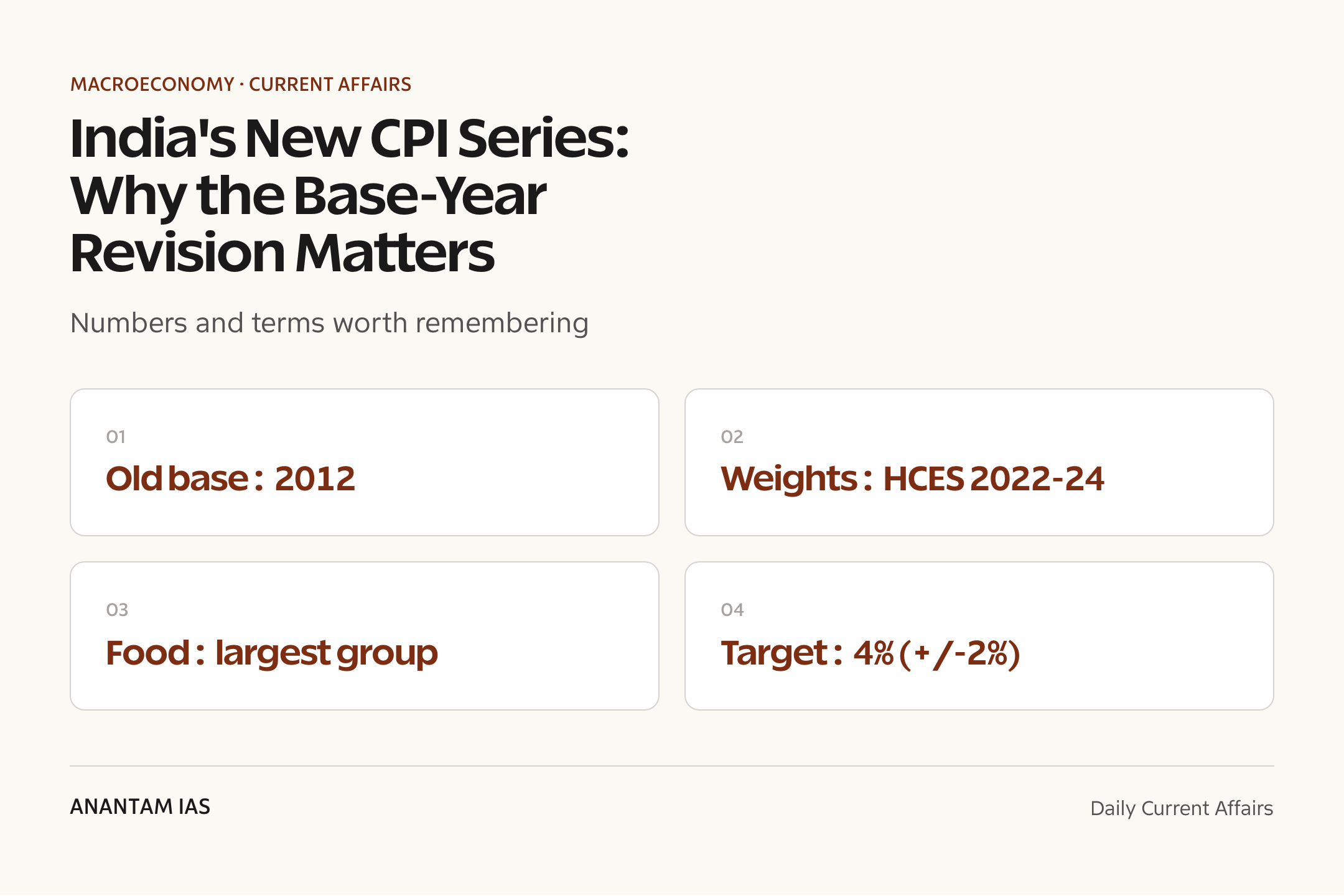
The Ministry of Statistics and Programme Implementation (MoSPI), through the National Statistical Office (NSO), has moved to roll out a revised Consumer Price Index (CPI) series, replacing the long-standing 2012 base year and re-weighting the consumption basket on fresher household-spending data.
The headline change is a lower weight for food in the basket, drawn from the Household Consumption Expenditure Survey (HCES) 2022-24, which alters how India’s official retail inflation, the RBI’s inflation-targeting anchor, is computed.
- NSO revises the CPI base year from 2012 to a recent year, the routine periodic exercise to keep the index representative.
- Basket weights are re-derived from the HCES 2022-24, the first large consumption survey released after a long gap.
- The food and beverages weight, near 46% in the 2012 series, is set lower as spending shifts toward services and discretionary items.
- Retail inflation is the flexible inflation-targeting anchor; the Monetary Policy Committee (MPC) reads CPI against the 4% (+/-2%) band.
The development matters in the context of:
- A rebasing matters because an outdated basket overstates the role of items families no longer spend on, distorting the measured cost of living.
- Because CPI drives monetary policy, dearness allowance and index-linked contracts, even a small re-weighting ripples across the economy.
UPSC Relevance
Prelims Relevance
- CPI compiled by NSO/MoSPI; WPI compiled by the Office of the Economic Adviser, DPIIT
- CPI base year being moved from 2012; weights from HCES
- CPI-Combined (rural+urban) is the headline inflation measure used by the RBI
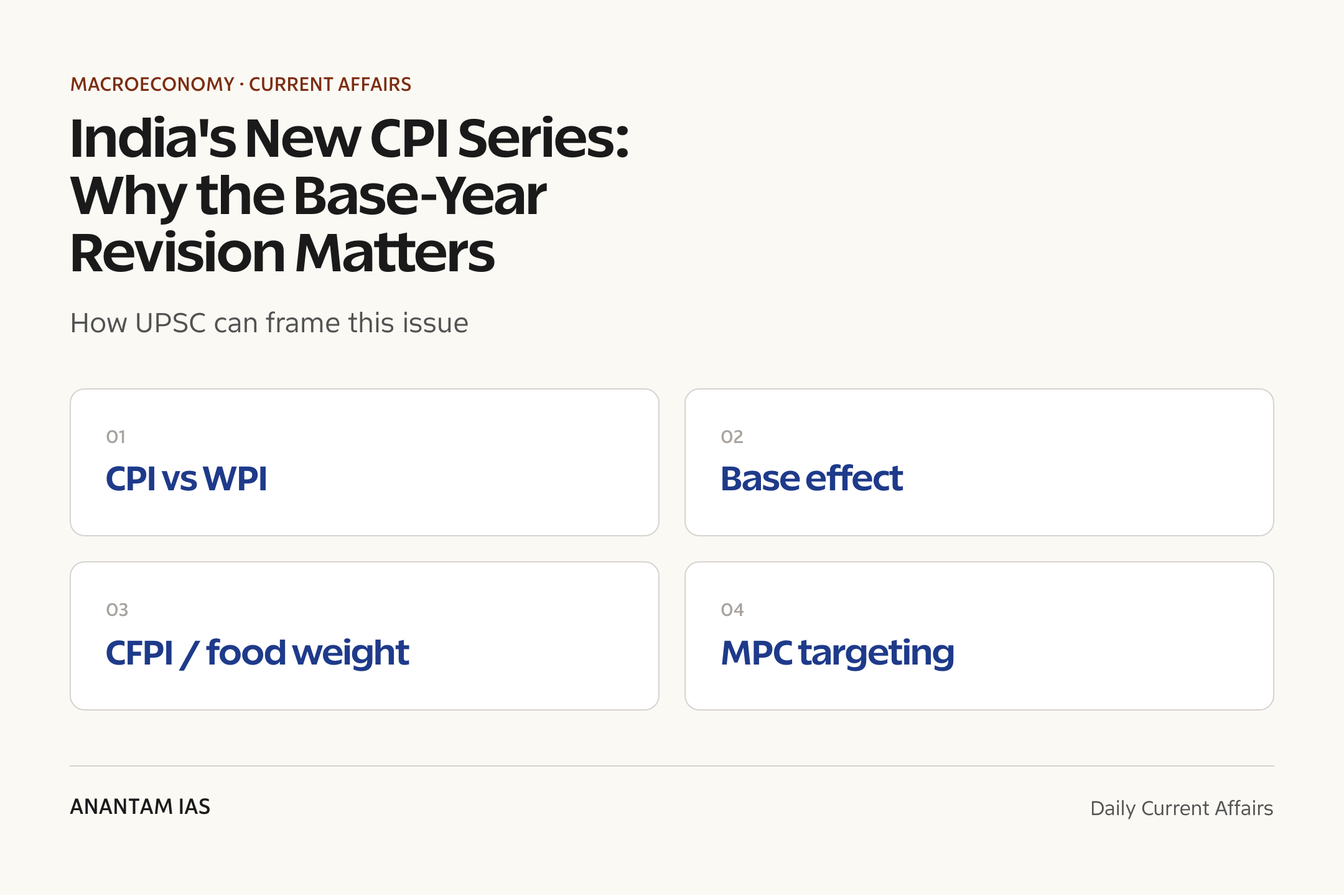
- CFPI = Consumer Food Price Index; food and beverages is the single largest CPI group
- Flexible Inflation Targeting adopted via the amended RBI Act, 1934; target 4% with a 2-6% band
- MPC is a six-member committee chaired by the RBI Governor
- Base effect: how a high or low year-ago index inflates or deflates current inflation
- WPI excludes services; CPI captures the retail consumption basket including services
Mains Relevance
GS Paper 3
- Why periodic rebasing of price indices is essential for credible inflation measurement and policy.
- How a lower food weight changes headline-inflation dynamics and the RBI’s monetary-policy reaction.
GS Paper 2
- Role of statistical institutions (MoSPI, NSO) and data quality in evidence-based governance.
Essay
- Numbers we live by: how the statistics a state measures shape the choices it makes.
Background and Context
What the CPI is and who builds it
The Consumer Price Index tracks the average change in retail prices of a fixed basket of goods and services bought by households.
- Compiled by the National Statistical Office (NSO) under MoSPI, released monthly; see our explainer on the Consumer Price Index in India.
- CPI-Combined blends rural and urban indices and is the headline retail inflation figure cited in policy.
- Distinct from the Wholesale Price Index (WPI), which tracks producer-level prices, excludes services and is maintained by the Office of the Economic Adviser.
- Inflation is the year-on-year percentage change in the index, not the index level itself.
Why a base year, and why revise it
Every index is anchored to a base year whose basket and weights represent typical household spending at that time.
- The current series uses 2012 as the base; consumption patterns have shifted markedly since.
- Over time families spend relatively less on food and more on transport, health, education and communication.
- A stale basket misweights items, so the index drifts from the real cost of living, the classic case for rebasing.
- Global statistical practice recommends rebasing roughly every five to ten years to keep an index representative.
The HCES 2022-24 reweighting
The new weights are derived from the Household Consumption Expenditure Survey, the survey that maps where the rupee actually goes.
- The HCES 2022-24 is the first comprehensive consumption survey released after a long hiatus, giving fresh expenditure shares.
- It records a falling share of spending on food, especially cereals, and a rising share on services and processed items.
- These shares become the new CPI weights, so the basket reflects 2020s consumption rather than 2012 habits.
- A lower food weight means food-price swings move headline inflation less than before.
Food weight, CFPI and the base effect
Food has long dominated India’s CPI, which is why a re-weighting here is consequential.
- The Consumer Food Price Index (CFPI) isolates food inflation; food and beverages was the largest single group in the 2012 basket.
- A reduced food weight dampens the sensitivity of headline CPI to volatile vegetable and pulse prices.
- The base effect can also shift on rebasing: comparing prices against a different base year changes the arithmetic of measured inflation.
- Lower food weight does not lower actual food prices; it changes how much those prices count in the aggregate.
Link to inflation targeting and the MPC
The CPI is not just a statistic; it is the legal anchor of India’s monetary policy.
- Under the amended RBI Act, 1934, the government sets a flexible inflation-targeting goal of 4% CPI inflation within a 2-6% band.
- The Monetary Policy Committee (MPC), chaired by the RBI Governor, sets the repo rate by reading CPI against that target.
- A re-weighted CPI can print a different headline number for the same underlying prices, nudging how the MPC judges whether inflation is on target.
- The RBI has flagged that it will study continuity between old and new series so policy signals stay comparable.
Wider stakes of the number
Because so much is indexed to CPI, the revision reaches well beyond the central bank.
- Dearness allowance for government employees and pensioners is linked to CPI movements.
- Wage settlements, rent escalations and many index-linked contracts reference retail inflation.
- Real interest rates, real wages and poverty-line calculations all depend on a credible price index.
- Better weights improve the accuracy of these downstream calculations across the economy.
Caveats and continuity concerns
A cleaner basket is welcome, but a series break creates analytical challenges.
- A new base year breaks the continuous time series, complicating long-run comparisons of inflation.
- Analysts watch for splicing and back-series so old and new numbers can be read together.
- Transparency on methodology and weights is essential for the index to retain market and public trust.
- Survey design and data quality from the HCES directly shape how representative the new basket is.
Way Forward
Methodological transparency
- Publish the full revised weighting diagram and a clear back-series so users can splice old and new data.
- Document the survey methodology behind the HCES shares to pre-empt credibility questions.
Policy continuity
- Let the MPC communicate how the rebased series maps to the 4% target so rate signals stay clear.
- Run old and new series in parallel for a transition window to ease interpretation.
Modernising the statistical machine
- Move toward more frequent consumption surveys and faster price collection, including scanner and digital-transaction data.
- Strengthen institutional independence and timeliness of the NSO to sustain data confidence.
Conclusion
Rebasing the CPI is routine statistical hygiene, but its timing and a lower food weight make this revision unusually consequential. The number that emerges feeds straight into the RBI’s inflation-targeting framework, so even small re-weightings shift how policy reads the economy.
The deeper lesson is that measurement is governance. A representative basket, built on a credible consumption survey and communicated transparently, lets the central bank, employers and households make sounder decisions about the real cost of living.
UPSC Practice Questions
Prelims MCQ 1
With reference to India’s Consumer Price Index (CPI), consider the following statements:
- The CPI is compiled by the National Statistical Office under MoSPI.
- The food and beverages group has been the largest single component of the CPI basket.
- CPI tracks only goods and excludes services from its basket.
How many of the above statements are correct?
(a) Only one (b) Only two (c) All three (d) None
Answer: (b) Only two
Explanation:
Statements 1 and 2 are correct: NSO/MoSPI compiles the CPI, and food and beverages is its largest group. Statement 3 is wrong, CPI covers services such as transport, health and education, unlike WPI which excludes services.
Prelims MCQ 2
The flexible inflation-targeting framework, under which the RBI aims for 4% CPI inflation within a band, derives its legal basis from which one of the following?
(a) The amended Reserve Bank of India Act, 1934 (b) The Banking Regulation Act, 1949 (c) The FRBM Act, 2003 (d) The Companies Act, 2013
Answer: (a) The amended Reserve Bank of India Act, 1934
Explanation:
The flexible inflation-targeting mandate and the 4% target with a 2-6% band were institutionalised through amendments to the RBI Act, 1934, which also created the Monetary Policy Committee.
UPSC Mains Questions
- Periodic rebasing of price indices is essential for credible inflation measurement. Examine how revising the CPI base year and re-weighting its basket on fresh consumption-survey data affects the accuracy of measured retail inflation in India.
- A lower food weight in the new CPI series changes the dynamics of headline inflation and the RBI’s monetary-policy response. Critically analyse the implications for India’s flexible inflation-targeting framework.
- Discuss the role of robust statistical institutions and timely consumption surveys in evidence-based economic governance, with reference to the CPI revision.
Sources: MoSPI, National Statistical Office (NSO) and Reserve Bank of India.
Frequently Asked Questions
What is the Consumer Price Index (CPI)?
The CPI measures the average change over time in the retail prices of a fixed basket of goods and services that households buy. Compiled monthly by the National Statistical Office under MoSPI, its year-on-year change is India’s headline retail inflation rate and the anchor for monetary policy.
Why is the CPI base year being revised?
Consumption patterns change over time, so a basket weighted to 2012 spending no longer reflects how households spend today. Rebasing refreshes the basket and weights using newer survey data, keeping the index representative of the actual cost of living and improving the accuracy of measured inflation.
What data is used to set the new CPI weights?
The new weights are derived from the Household Consumption Expenditure Survey (HCES) 2022-24, a large official survey of where households actually spend. It captures a falling share of spending on food and a rising share on services and discretionary items, which then become the index weights.
Why does a lower food weight matter?
Food was the largest group in the old CPI basket, so volatile vegetable and pulse prices moved headline inflation sharply. A lower food weight means food-price swings count for less in the aggregate, dampening their effect on headline CPI, though actual food prices themselves are unchanged.
How does the CPI affect RBI monetary policy?
Under the amended RBI Act, 1934, the RBI follows flexible inflation targeting, aiming for 4% CPI inflation within a 2-6% band. The Monetary Policy Committee reads the CPI against this target to set the repo rate, so a re-weighted index can shift how policy judges whether inflation is on track.
How is the CPI different from the WPI?
The CPI tracks retail prices paid by consumers and includes services such as transport, health and education. The Wholesale Price Index tracks producer or wholesale-level prices, excludes services, and is maintained by the Office of the Economic Adviser. The RBI targets CPI, not WPI.